Global ·
Maintenance Margin Explained: Tier Maths Worked Out (2026)
Maintenance margin explained: the minimum equity that keeps a position open. Tiered rates, the maintenance amount derived, and why big positions liquidate sooner.

The short answer
- Maintenance margin is the minimum equity that keeps a leveraged position open. On USDⓈ-margined perpetuals Binance and Bybit both calculate it as notional × maintenance margin rate − maintenance amount.
- The maintenance amount is not a discount: it equals the previous tier's amount plus the tier floor × the rate increase, so the requirement is continuous and each rate applies only to its slice of the position.
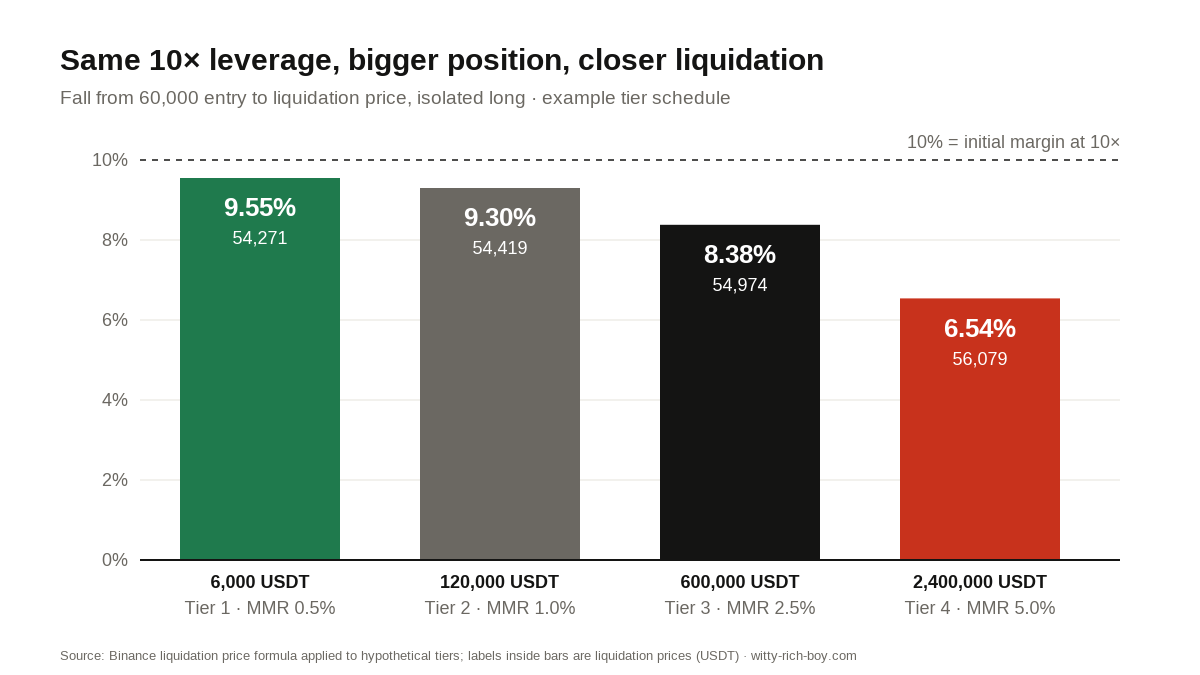
- Larger positions liquidate sooner at the same leverage. In our example schedule a 10× long liquidates after a 9.55% fall at 6,000 USDT but after only 6.54% at 2.4m USDT.
- Binance's margin ratio is maintenance margin ÷ margin balance; at 100% some or all positions may be liquidated, and a clearance fee from the liquidated amount goes to the insurance fund.
- US brokerage accounts follow FINRA Rule 4210: equity must stay at 25% of long margin securities' market value. Stock bought half on credit hits that floor after a 33.3% fall.
- CME futures work by margin call, not instant liquidation: below maintenance, the account must be topped back up to initial margin, which CME sets at 100% or 110% of maintenance.
In force: Formulas and thresholds as published in exchange, CME Group and FINRA documentation, checked 11 November 2026
Maintenance margin is the minimum equity an exchange or broker requires to keep a leveraged position open. On crypto perpetuals it is notional × maintenance margin rate − maintenance amount, and falling to it means liquidation: a 6,000 USDT position at 0.5% needs just 30 USDT. US stock accounts must keep 25% equity under FINRA Rule 4210.
Every leveraged position has two margin numbers. The first, initial margin, is the price of entry and the one everyone notices. The second is the floor beneath it, and it decides when the position stops being yours. That floor is not a fixed percentage: on crypto futures it rises in tiers as positions grow, with a deduction that looks arbitrary until you derive it. This guide does the derivation, works the tiers through four position sizes, and sets crypto against the rules for US stocks and CME futures.
What is maintenance margin? (maintenance margin meaning)
Maintenance margin is the minimum amount of equity that must remain behind an open leveraged position; if equity falls to it, the position is liquidated or a margin call is issued. It is a buffer that protects the lender, the clearing house or the exchange against the loss growing faster than it can be closed.
Binance defines it for USDⓈ-margined contracts in its Leverage and Margin of USDⓈ-M Futures FAQ:
Maintenance margin = position notional × maintenance margin rate − maintenance amount
Notional is position size in coins × mark price. Bybit’s maintenance margin page uses the same structure, calling the subtracted term the maintenance margin deduction. Three terms matter:
- Maintenance margin rate (MMR): the percentage of notional required, set by the tier the position falls into.
- Maintenance amount: a fixed deduction per tier, explained below.
- Margin balance (equity): your margin plus unrealised profit or loss. Liquidation compares this with maintenance margin.
Because notional is measured at the mark price, the requirement moves continuously with the market, and a position can drift into a different tier without a single new order.
Initial margin vs maintenance margin: what is the difference?
Initial margin is what you post to open a position; maintenance margin is the smaller amount you must keep to hold it. The distance between them is the loss you can take before the exchange acts.
On a crypto perpetual, initial margin is notional ÷ leverage: 10% at 10×, 2% at 50×. Maintenance margin is usually far lower. Binance stresses that maintenance margin “is always calculated in the same way, regardless of what leverage you select”. Leverage therefore does not change the floor; it changes how much cushion you start with above it.
| Initial margin | Maintenance margin | |
|---|---|---|
| Purpose | Collateral to open | Minimum equity to stay open |
| Crypto perpetuals | Notional ÷ leverage | Notional × MMR − maintenance amount |
| Depends on leverage? | Yes | No, only on notional tier |
| US stocks (margin account) | Up to 50% may be borrowed under Regulation T | 25% of market value under FINRA Rule 4210 |
| CME futures | 100% or 110% of maintenance | Set per product by CME Clearing |
| When breached | — | Liquidation (crypto) or margin call (stocks, CME) |
A 10× long with 0.5% maintenance margin has about 9.5% of headroom. Leverage of 50× leaves about 1.5%. The maintenance rate is the small number; leverage decides whether it matters.
How do maintenance margin tiers work?
Maintenance margin tiers raise the rate, and cut the maximum leverage, as a position’s notional grows. OKX’s tiered maintenance margin rules put it directly: larger positions fall into higher tiers, which require a higher maintenance margin and allow lower leverage.
The logic is about exit, not punishment. A small position can be closed in an instant near the liquidation price; a very large one has to walk down the order book, and the price it finally gets may be well below the trigger. A higher rate keeps more equity in reserve to cover that slippage.
Real tier tables vary by contract and are revised often, so the figures below are an example tier schedule, chosen to be easy to follow. The same schedule appears in our isolated vs cross margin guide.
| Tier | Notional (USDT) | Max leverage | MMR | Maintenance amount |
|---|---|---|---|---|
| 1 | 0 – 50,000 | 100× | 0.5% | 0 |
| 2 | 50,000 – 250,000 | 50× | 1.0% | 250 |
| 3 | 250,000 – 1,000,000 | 20× | 2.5% | 4,000 |
| 4 | 1,000,000 – 5,000,000 | 10× | 5.0% | 29,000 |
Why is there a maintenance amount? Deriving the deduction
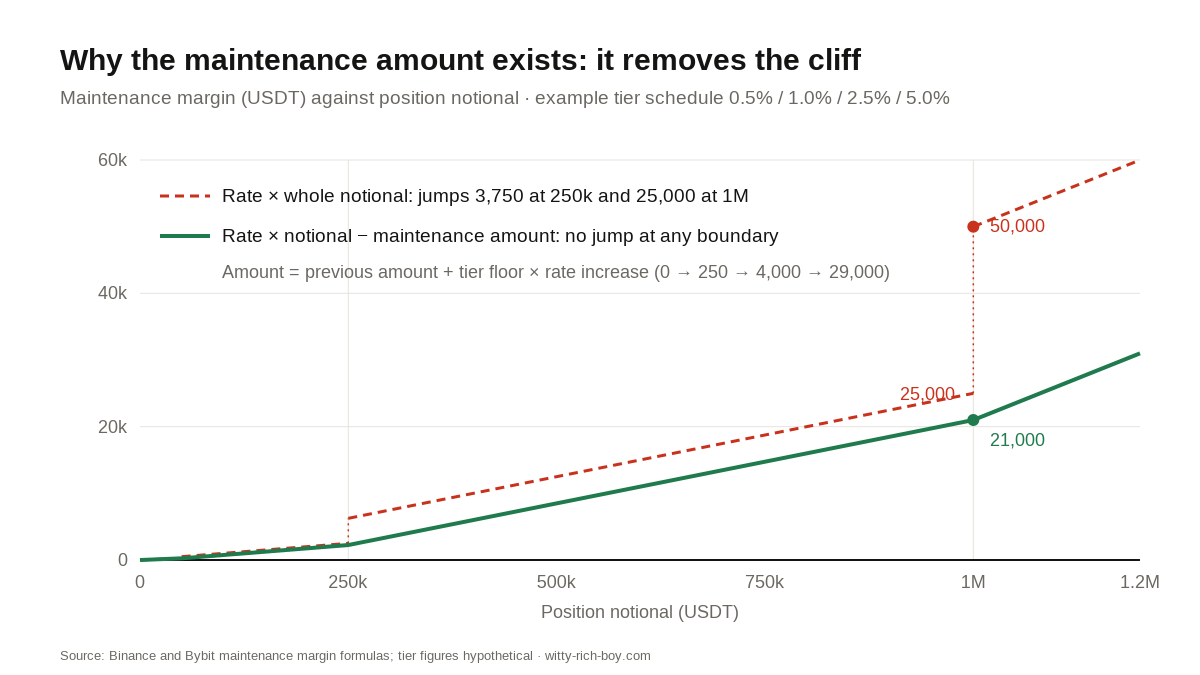
The maintenance amount exists so that the requirement does not jump when a position crosses a tier boundary; it makes each rate apply only to the slice of notional inside its tier. It is derived, not chosen.
Take a boundary b between tier k and tier k+1. Just below b, maintenance margin is b × rk − Ak. Just above it, b × rk+1 − Ak+1. For the two to match:
Ak+1 = Ak + b × (rk+1 − rk)
That is exactly Bybit’s published rule: each tier’s deduction is the previous tier’s risk limit × the rate difference, plus the previous deduction. Applied to the example schedule:
- Tier 2: 0 + 50,000 × (1.0% − 0.5%) = 250
- Tier 3: 250 + 250,000 × (2.5% − 1.0%) = 4,000
- Tier 4: 4,000 + 1,000,000 × (5.0% − 2.5%) = 29,000
Now imagine there were no deduction. A 250,000 USDT position at 1.0% needs 2,500 USDT. Add one dollar and it moves to 2.5% on the whole notional: 6,250 USDT. A position could be liquidated not because the market moved but because it grew by a hair. With the deduction, the requirement at the boundary is 2,250 on either side.
The result is the same as tax brackets. A 400,000 USDT position needs 400,000 × 2.5% − 4,000 = 6,000 USDT, which is 50,000 × 0.5% + 200,000 × 1.0% + 150,000 × 2.5% = 250 + 2,000 + 3,750.
How to calculate maintenance margin
To calculate maintenance margin, find the notional, look up its tier, multiply by the tier’s rate and subtract the tier’s maintenance amount. The full method, including the liquidation price:
- Compute notional. Position size × mark price. For 2 BTC at 60,000: 120,000 USDT.
- Find the tier. In the example schedule, 120,000 sits in tier 2: MMR 1.0%, amount 250.
- Apply the formula. 120,000 × 1.0% − 250 = 950 USDT of maintenance margin.
- Compare with your equity. Margin balance = margin + unrealised profit or loss. At 10× the margin is 12,000, so the cushion is 11,050.
- Solve for the liquidation price. For an isolated long, Binance’s liquidation price formula reduces to (WB + cum − Q × EP) ÷ (Q × MMR − Q), with WB the margin and cum the maintenance amount: (12,000 + 250 − 120,000) ÷ (0.02 − 2) = 54,419.19.
- Re-check the tier at that price. 2 × 54,419 = 108,838 USDT, still tier 2, so the answer stands. If it had crossed a boundary, repeat with the neighbouring tier.
Binance’s own worked example checks the formula: 10 BTC at a mark price of 26,000 is 260,000 USDT in its tier 3, at 1% with a 1,300 amount, giving 1,300 USDT.
Small, medium, large and very large positions
All four are hypothetical 10× isolated longs entered at 60,000 USDT, with margin equal to 10% of notional.
| Position | Notional (USDT) | Tier · MMR | Maintenance margin at entry | Effective rate | Liquidation price | Fall to liquidation |
|---|---|---|---|---|---|---|
| 0.1 BTC | 6,000 | 1 · 0.5% | 30 | 0.50% | 54,271.36 | 9.55% |
| 2 BTC | 120,000 | 2 · 1.0% | 950 | 0.79% | 54,419.19 | 9.30% |
| 10 BTC | 600,000 | 3 · 2.5% | 11,000 | 1.83% | 54,974.36 | 8.38% |
| 40 BTC | 2,400,000 | 4 · 5.0% | 91,000 | 3.79% | 56,078.95 | 6.54% |
The effective rate, maintenance margin ÷ notional, is always below the headline tier rate because of the deduction. Shorts mirror the result: the 10 BTC short liquidates at 64,780.49 and the 40 BTC short at 63,547.62, both still inside their tiers.
Using the calculator with tiered positions
Our liquidation price calculator uses the shortcut Entry × (1 − 1/Leverage + MMR) and takes a single rate. For a tiered position, enter the effective rate, not the headline one. For the 10 BTC long, 1.83% gives about 55,100, close to the exact 54,974; entering the headline 2.5% gives 55,500 and overstates how close liquidation is.
What is the margin ratio, and when does it trigger liquidation?
The margin ratio compares maintenance margin with your equity; on Binance it is maintenance margin ÷ margin balance, and at 100% some or all positions may be liquidated. Binance’s guidance on reducing the chance of liquidation suggests keeping it below 80%.
Venues write the ratio in opposite directions, which confuses comparisons. OKX’s maintenance margin ratio puts equity on top, so a high number is safe and forced liquidation starts at 100% or below. Both describe the same moment: equity equals maintenance margin.
Example (hypothetical): the 0.1 BTC long from the table, 600 USDT of margin, with BTC at 56,000.
- Unrealised loss: 0.1 × (60,000 − 56,000) = 400, so margin balance = 200 USDT.
- Maintenance margin: 0.1 × 56,000 × 0.5% = 28 USDT.
- Binance-style ratio: 28 ÷ 200 = 14%. OKX-style ratio: 200 ÷ 28 = 714%.
Funding payments and fees also reduce margin balance, so the ratio can creep up while the price stands still; see how funding rates work.
What happens when you hit maintenance margin?
When equity reaches maintenance margin, the exchange’s liquidation engine takes over the position, using the mark price as the trigger, and what is left of the margin is largely lost. The details explain where that money goes.
Liquidation price and bankruptcy price
Binance describes a liquidation order as having the liquidation price as its trigger and the bankruptcy price, where equity would be zero, as its limit. For a 10× isolated long entered at 60,000, the bankruptcy price is 54,000. At liquidation, the 10 BTC position still has 9,743.59 USDT of equity (its maintenance margin at 54,974.36); that cushion pays for closing a large position below the trigger.
Liquidation fees and the insurance fund
Binance’s liquidation protocols say a clearance fee is charged on the amount liquidated and added to the insurance fund, unless the position is already bankrupt. The fund covers losses when a position is closed beyond its bankruptcy price, so that winning traders are still paid. Where losses exceed what the fund can cover, Binance’s documentation provides for auto-deleveraging (ADL) as the final backstop. Fee rates differ by contract and have changed over time, so check the contract’s current rules.
Partial liquidation
Large positions are often cut back rather than closed whole. OKX’s rules state that for a position in tier 2 or above, the system calculates the amount to liquidate to lower the position’s tier, and stops once the ratio is healthy again; only a position that remains in breach at the lowest tier goes to the liquidation engine at the bankruptcy price.
Example (hypothetical, before fees): the 10 BTC long reaches 54,974.36 with 9,743.59 USDT of equity. Selling about 5.45 BTC drops notional to 250,000 USDT, inside tier 2, where maintenance margin is 250,000 × 1.0% − 250 = 2,250. Equity of about 9,744 is now well above it, so the remaining 4.55 BTC survives, with a new liquidation price of about 53,310. The tier system both pulls liquidation closer for large positions and lets them unwind in steps.
How does crypto maintenance margin compare with stocks and CME futures?
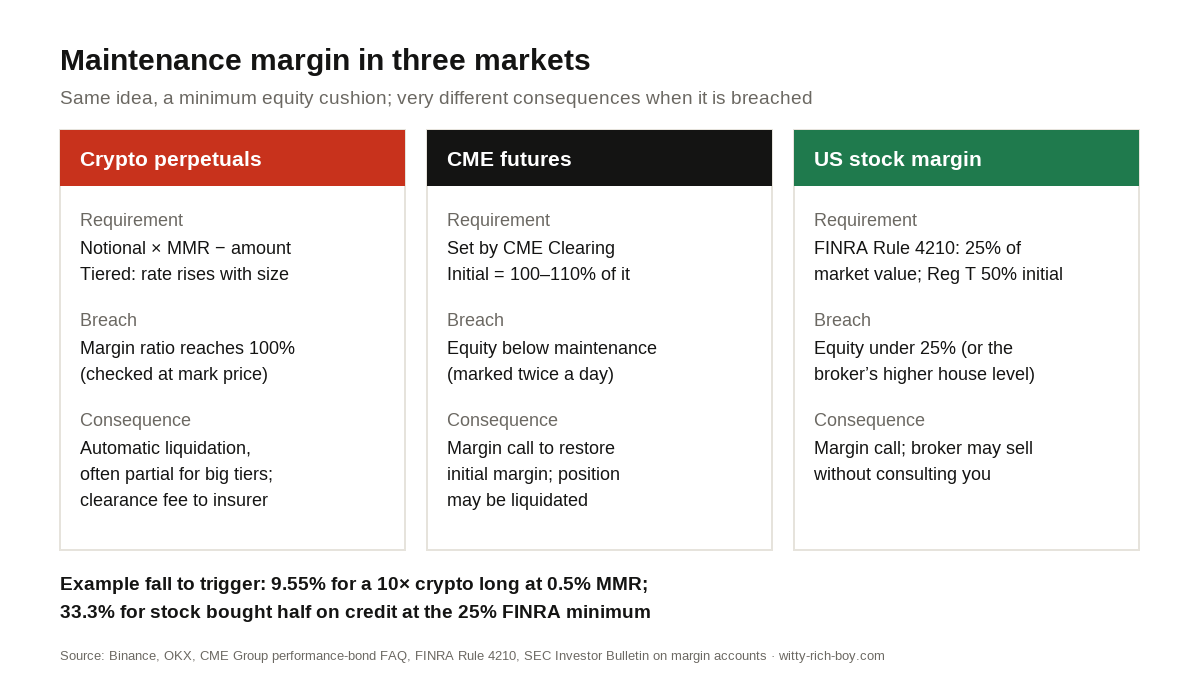
All three markets require a minimum equity cushion, but only crypto venues usually liquidate automatically the moment it is breached; stock brokers and futures clearing members issue a margin call.
US stocks: FINRA Rule 4210
FINRA Rule 4210 sets a maintenance requirement of 25% of the current market value of margin securities held long. Regulation T limits initial borrowing to 50% of the purchase price, as the SEC’s Investor Bulletin on margin accounts explains, and many brokers set stricter house requirements; the SEC’s investor tips on margin put them typically at 30% to 40%. Below the line, the firm issues a margin call and can sell securities without consulting you.
Example (hypothetical): you buy 20,000 USD of shares with 10,000 of your own and 10,000 borrowed. Equity ÷ value hits 25% when (V − 10,000) ÷ V = 0.25, so V = 13,333.33, a 33.3% fall. Under a 30% house requirement the trigger is 14,285.71, a 28.6% fall.
CME futures: performance bonds
CME Group calls margin a performance bond. Its performance bond FAQ explains that when equity falls below maintenance margin, a call must be issued to bring the account back up to initial margin, not just to maintenance. Initial margin is set at 100% of maintenance for non-heightened-risk accounts and 110% for heightened-risk ones, and requirements are designed to cover 99% of one-day price moves. CME’s introductory course adds that a position may be liquidated if the call is not met.
| Crypto perpetuals | CME futures | US stocks | |
|---|---|---|---|
| Minimum set by | Exchange tier table | CME Clearing, per product | FINRA Rule 4210 (25%) plus house rules |
| Scales with size? | Yes, tiered | Per contract | No, percentage of value |
| On breach | Automatic liquidation | Margin call to initial margin | Margin call; securities may be sold |
| Example fall to trigger | 9.55% (10× long, 0.5% MMR) | Depends on product margin | 33.3% (50% borrowed, 25% minimum) |
Does a bigger margin balance change your maintenance margin?
No: adding margin raises your equity, not the requirement, so it moves the liquidation price away while maintenance margin stays the same. The requirement depends only on notional. Adding 400 USDT to the 0.1 BTC isolated long, for instance, moves its liquidation price from 54,271 to about 50,251, as our isolated vs cross margin guide works through. In cross mode, the same logic applies to the whole wallet.
What does change the requirement is notional: a rising price lifts a long’s notional and its maintenance margin, and a large position adding size can climb a tier. For positions held in place of spot coins, the margin floor is one of the costs a perpetual futures vs spot comparison has to weigh.
The numbers above are worked examples on a hypothetical schedule, not forecasts or advice. The formula, though, is the venue’s own: read the live tier table for any contract, and the maths here tells you how close the floor really is.
Questions readers ask
What is maintenance margin in simple terms?
Maintenance margin is the smallest amount of your own money that must remain in a leveraged position for it to stay open. It is a cushion against further losses. On crypto perpetuals, falling to it triggers liquidation; on stock and futures accounts it usually triggers a margin call first. For a 6,000 USDT position at a 0.5% rate, it is 30 USDT.
What is the difference between initial margin and maintenance margin?
Initial margin is what you must put up to open a position; maintenance margin is the lower amount you must keep to hold it. At 10× leverage the initial margin is 10% of notional, while a small position's maintenance margin may be 0.5%. The gap between the two is the loss you can absorb before liquidation or a margin call.
How do you calculate maintenance margin?
Multiply the position's notional value by the maintenance margin rate of the tier the notional falls into, then subtract that tier's maintenance amount. Binance's own example: 10 BTC at a mark price of 26,000 is 260,000 USDT, tier 3, rate 1% and amount 1,300 USDT, so maintenance margin is 2,600 − 1,300 = 1,300 USDT.
Why do exchanges subtract a maintenance amount?
Without it, crossing a tier boundary would apply the higher rate to the whole position and the requirement would jump. In our example schedule, a position just over 250,000 USDT would need 6,250 USDT instead of about 2,250. The amount, equal to the previous amount plus the tier floor times the rate increase, removes that jump exactly.
What happens when you fall below maintenance margin?
On crypto derivatives venues the position is liquidated automatically, triggered by the mark price; Binance says some or all positions may be liquidated when the margin ratio reaches 100%. On US brokerage accounts the firm issues a margin call and may sell securities without consulting you. At CME the account must be brought back up to initial margin.
Does leverage change maintenance margin?
Not directly. Binance states that maintenance margin is calculated the same way whatever leverage you select, because it depends on position notional. Leverage changes the initial margin and so the size of the buffer above maintenance margin. That is why higher leverage moves the liquidation price closer even though the maintenance requirement itself is unchanged.
What is the maintenance margin for stocks?
In the United States, FINRA Rule 4210 sets a minimum maintenance requirement of 25% of the current market value of margin securities held long. Many brokers set higher house requirements; the SEC's investor guidance says these are typically 30% to 40%. Regulation T separately limits initial borrowing to 50% of the purchase price.
What is a margin ratio of 100%?
On Binance futures the margin ratio is maintenance margin divided by margin balance, so 100% means your equity has fallen to exactly the maintenance requirement and liquidation can begin; Binance suggests keeping it below 80%. OKX expresses the ratio the other way round, equity over maintenance margin, but also starts forced liquidation at 100% or below.
Was this guide useful?
Thanks — your answer helps us decide what to cover next.
Sources
- Binance — Leverage and Margin of USDⓈ-M Futures
- Binance — How to Calculate Liquidation Price of USDⓈ-M Futures Contracts
- Binance — How to Reduce Your Chances of Getting Liquidated (margin ratio)
- Binance — Binance Futures Liquidation Protocols
- Bybit Help Center — Maintenance Margin (USDT Perpetual and Expiry Contracts)
- OKX — Tiered maintenance margin ratio rules
- FINRA — Rule 4210. Margin Requirements
- SEC / Investor.gov — Investor Bulletin: Understanding Margin Accounts
- CME Group — Performance Bonds/Margins FAQ
- SEC — Investor Tips: Margin, Borrowing Money to Pay for Stocks
General information, not tax or legal advice. Rules change — check the official source or a licensed adviser before acting.