Global ·
Funding rate explained: what perpetual futures cost to hold
Funding rate explained: when it is positive, perpetual futures longs pay shorts. 0.01% every 8 hours costs about 11% a year of position value. Formula and examples.
The short answer
- A perpetual future never expires. Funding — a payment between longs and shorts, usually every 8 hours — keeps its price near the spot index.
- Positive funding means longs pay shorts; negative funding means shorts pay longs. The exchange is not the counterparty and, per BitMEX and OKX documentation, charges no fee on it.
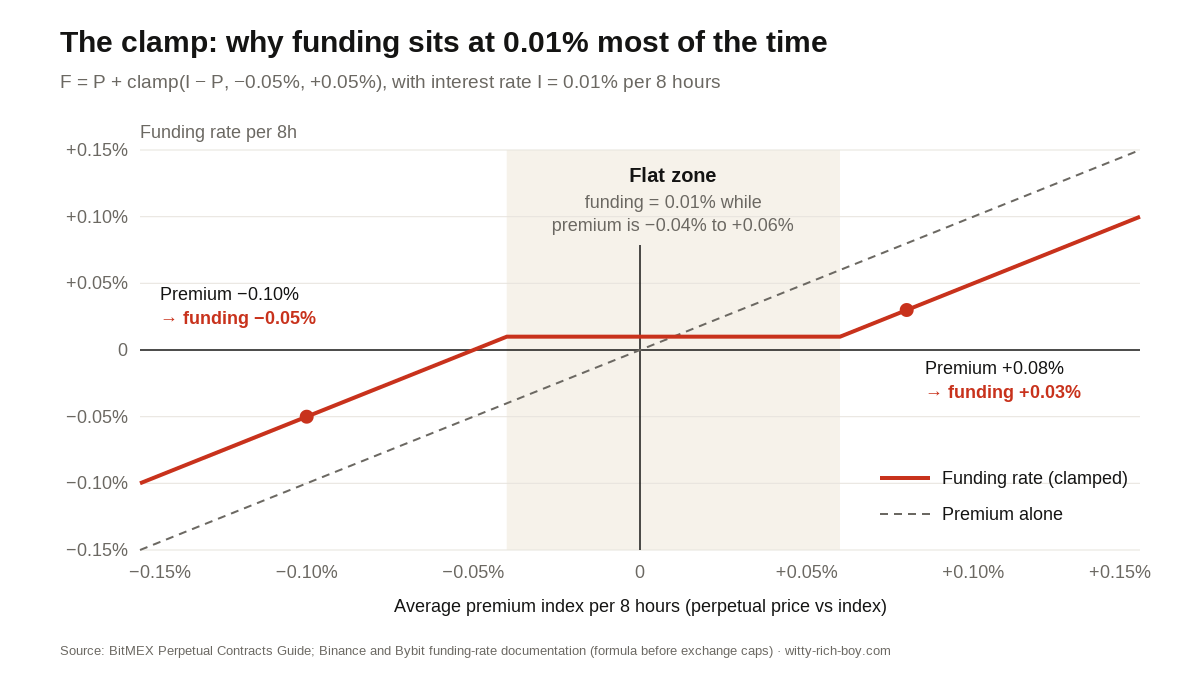
- The standard formula is F = P + clamp(I − P, −0.05%, +0.05%), with interest I = 0.01% per 8 hours. Any premium between −0.04% and +0.06% gives exactly 0.01%.
- Payment = position value × funding rate — on the full leveraged notional, not your margin. 10,000 USDT at +0.01% costs 1 USDT per interval, 90 USDT over 30 days.
- Annualised, 0.01% per 8 hours is 10.95% a year (simple) of position value — roughly 110% a year of margin at 10× leverage.
- Only positions open at the funding timestamp pay or receive. Close a moment earlier and nothing changes hands.
In force: Formulas as published in exchange documentation, re-checked 26 October 2026
A funding rate is a periodic payment between holders of a perpetual futures contract that keeps its price near the spot index. When it is positive, longs pay shorts; when negative, shorts pay longs. Payment = position value × rate. At the common 0.01% every 8 hours, a 10,000 USDT position pays 1 USDT per interval — about 10.95% of position value a year.
Holding a coin costs nothing beyond the purchase. Holding the same exposure through a perpetual futures contract does: every few hours, a payment called funding changes hands between the two sides of the market. In quiet markets it is a rounding error; in a crowded rally it can become the largest cost of a trade — larger than fees, and large enough to move a leveraged position’s liquidation price. Below is the formula as the exchanges document it, then the numbers over 8 hours, 24 hours, 30 days and a year.
What are perpetual futures? (perpetual futures meaning)
A perpetual future (or perpetual swap) is a derivative contract that tracks the price of an asset but never expires. You can go long or short with margin and leverage, and you can hold the position for as long as your margin lasts.
BitMEX, which describes the perpetual swap as “an innovative product invented by BitMEX”, lists the defining features in its Perpetual Contracts Guide: there is no expiry or settlement, the contract mimics a margin-based spot market and trades close to a reference index price, and “the Funding mechanism is used to tether contracts to their underlying spot price.” That last point is the whole story. A traditional future is pulled towards the spot price because it must settle against it on a fixed date. A perpetual has no such date, so something else must do the pulling. That something is funding.
Three prices matter on every perpetual contract page:
- Index price — a weighted average of spot prices from several venues. It is the anchor.
- Mark price — the exchange’s fair-value estimate, used for unrealised profit, liquidation and (on most venues) funding amounts.
- Last traded price — what the perpetual itself last traded at, which can drift above or below the index.
What is a funding rate, and why does it exist?
A funding rate is the percentage of position value that one side of a perpetual market pays the other at each funding timestamp. It exists to make holding the “expensive” side of the market costly enough that the perpetual’s price drifts back towards the index.
If the perpetual trades above the index — usually because more traders want to be long — funding turns positive and longs pay shorts. Staying long becomes more expensive, shorting becomes more attractive, and the premium tends to compress. The reverse happens when the perpetual trades below the index.
| Funding rate | Perpetual vs index | Who pays | What it describes |
|---|---|---|---|
| Positive (above 0.01%) | Trading at a premium | Longs pay shorts | Demand skewed to longs |
| 0.01% (default) | Close to index | Longs pay shorts, a small amount | Balanced market on most venues |
| Between 0 and 0.01% | Discount of more than 0.04% | Longs pay less | Short-leaning |
| Negative | Trading at a discount | Shorts pay longs | Demand skewed to shorts |
Two facts are often misunderstood. First, the exchange is not the counterparty. BitMEX states that it “does not charge any fees on funding; it is exchanged directly peer-to-peer”, and OKX’s documentation says the platform “only facilitates the exchange of funds between traders and doesn’t charge any service fees under this mechanism.” Second, timing is binary. Binance’s funding FAQ is explicit: “If you close your position prior to the funding time, you will not pay or receive any funding.” Whether you held for seven hours or seven seconds before the timestamp makes no difference.
How is the funding rate calculated?
The funding rate is calculated from two inputs — an interest rate (I) and an average premium index (P) — combined through a clamp. The formula in the BitMEX guide, which Binance, Bybit, OKX and Hyperliquid all reproduce in close variants, is:
Funding rate (F) = P + clamp(I − P, −0.05%, +0.05%)
The interest rate component
The interest rate is meant to reflect the cost of borrowing the quote currency versus the base currency. BitMEX defines it as (Funding Quote Rate − Funding Base Rate) / Funding Interval, with a funding interval of 3 because funding occurs every 8 hours. In practice, most venues fix it: Binance documents an interest rate “fixed at 0.03% daily by default (0.01% per funding interval since funding occurs every 8 hours)”, Bybit uses 0.03% / (24 / funding interval), and OKX states 0.01% “fixed across all settlement intervals”. Bybit notes exceptions — some pairs, such as USDCUSDT, use 0%.
The premium index
The premium index measures how far the perpetual trades from the index using order-book depth rather than a single last price. Bybit’s version is:
Premium index = [max(0, impact bid − index) − max(0, index − impact ask)] / index
The impact bid and impact ask are the average fill prices for a set notional order (the “impact margin notional”) on each side of the book. The exchange samples this every minute and averages it over the funding interval — BitMEX uses a time-weighted average; Bybit weights later minutes more heavily, so the premium near the settlement time counts most.
The clamp, and why 0.01% is so common
The clamp limits the difference between the interest rate and the premium to ±0.05%. If I − P falls inside that band, the formula collapses to F = P + (I − P) = I — funding equals the interest rate. As BitMEX puts it, “if (I − P) is within +/-0.05% then F = P + (I − P) = I.” With I = 0.01%, any average premium between −0.04% and +0.06% produces funding of exactly 0.01%.
| Average premium (P) | I − P | After clamp | Funding (F) |
|---|---|---|---|
| +0.03% | −0.02% | −0.02% | 0.01% |
| −0.02% | +0.03% | +0.03% | 0.01% |
| +0.08% | −0.07% | −0.05% | +0.03% |
| +0.20% | −0.19% | −0.05% | +0.15% (before caps) |
| −0.06% | +0.07% | +0.05% | −0.01% |
| −0.10% | +0.11% | +0.05% | −0.05% |
Caps and shorter intervals
Exchanges add outer limits. BitMEX caps the absolute funding rate at 75% of (initial margin − maintenance margin) — its worked example gives 75% × (1% − 0.5%) = 0.375% — and limits how far the rate can move between intervals. Bybit sets the cap at min((initial margin rate − maintenance margin rate) × 0.75, maintenance margin rate), may adjust the 0.75 coefficient between 0.5 and 1, and switches a contract to hourly settlement when funding hits its limit. Hyperliquid caps funding at 4% per hour.
For contracts that settle more often than every 8 hours, Binance and OKX divide the 8-hour result by (8 / N), where N is the interval in hours. A 4-hour contract pays half the 8-hour rate twice as often — the daily cost is unchanged; only the timing differs.
How much funding will I pay? A worked example over 8 hours, 24 hours and 30 days
You pay (or receive) the position value multiplied by the funding rate at each timestamp. Binance writes it as “Funding Amount = Nominal Value of Positions × Funding Rate”, where nominal value is mark price × size; OKX’s version is “Funding fee = Position value × Funding rate”.
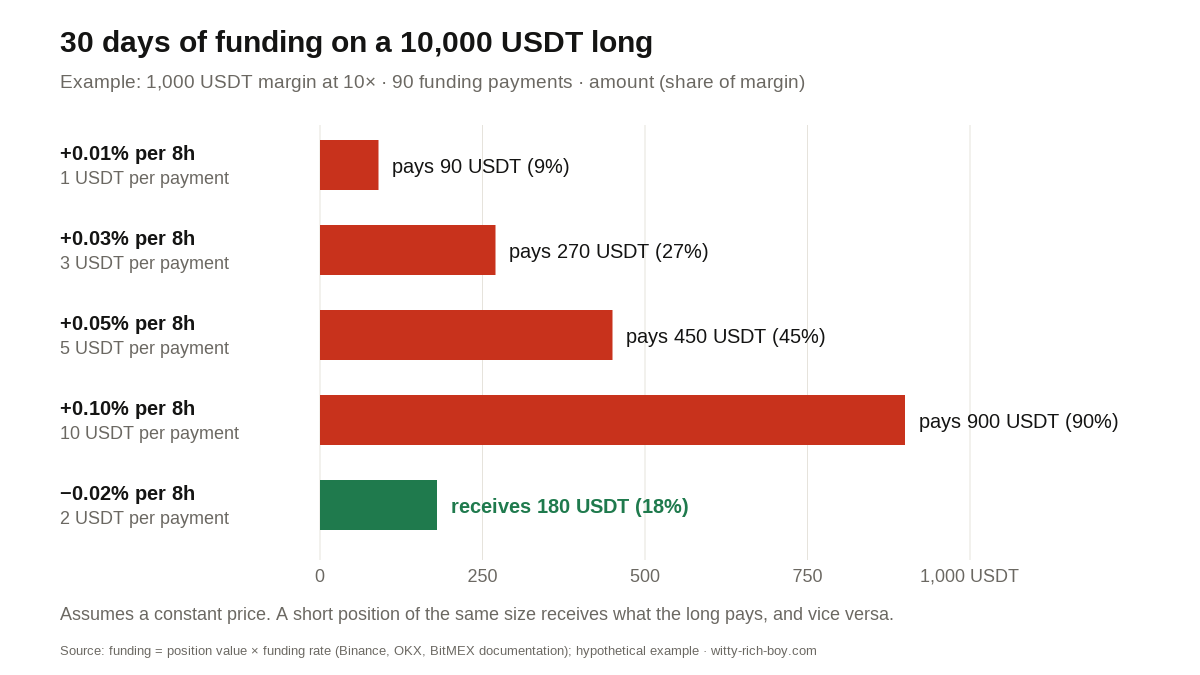
Example: Anna opens a long perpetual position worth 10,000 USDT, posting 1,000 USDT of margin (10× leverage). Assume the price stays flat, so her position value stays at 10,000 USDT, and funding is settled every 8 hours.
| Funding rate per 8h | One payment (8h) | 24 hours (3 payments) | 30 days (90 payments) | 30 days as % of margin |
|---|---|---|---|---|
| +0.01% | pays 1 USDT | pays 3 USDT | pays 90 USDT | 9% |
| +0.03% | pays 3 USDT | pays 9 USDT | pays 270 USDT | 27% |
| +0.05% | pays 5 USDT | pays 15 USDT | pays 450 USDT | 45% |
| +0.10% | pays 10 USDT | pays 30 USDT | pays 900 USDT | 90% |
| −0.02% | receives 2 USDT | receives 6 USDT | receives 180 USDT | +18% |
A short position of the same size sees the mirror image: at +0.05% it receives 450 USDT over 30 days. Two refinements matter in real life. Position value is recalculated at each timestamp, so if the price rises 20%, the same rate costs 20% more. And the rate itself is recalculated every interval, so a 30-day total is the sum of 90 different numbers, not one number times 90.
Funding rate annualised: what 0.01% per 8 hours costs per year
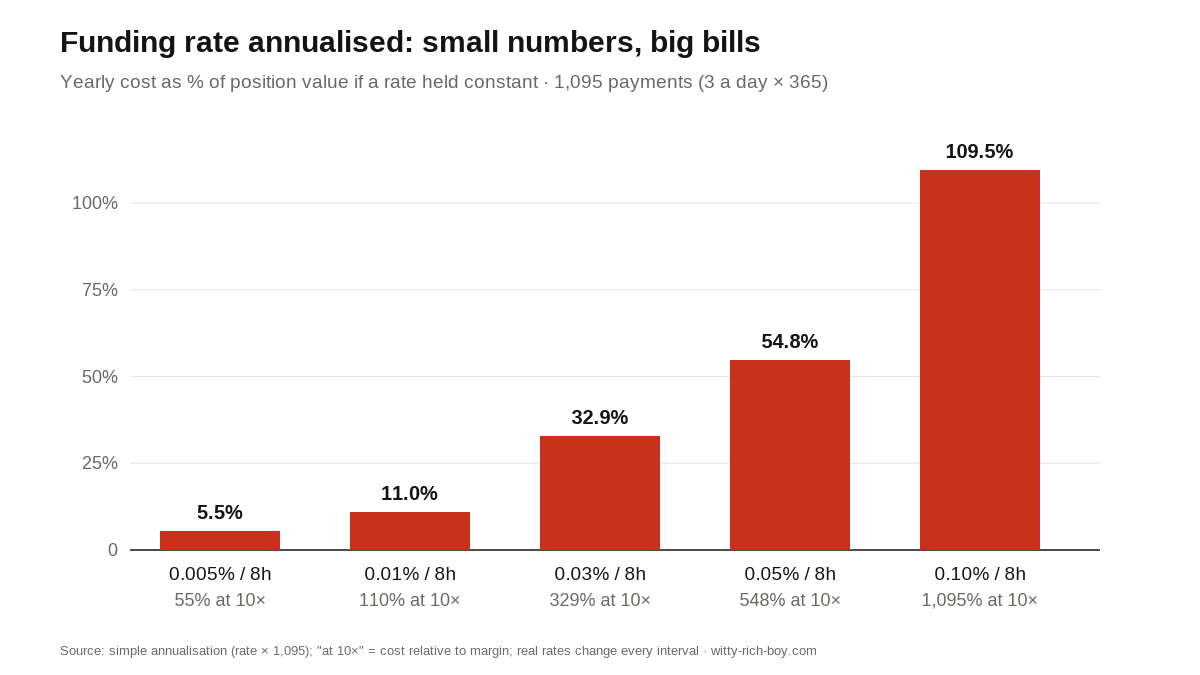
Annualising multiplies the rate per interval by the number of intervals in a year — 1,095 for 8-hour funding (3 × 365). It is the clearest way to compare funding with a loan rate or a deposit yield.
| Rate per 8h | Per day | Per 30 days | Per year (simple) | Per year on margin at 5× | Per year on margin at 10× |
|---|---|---|---|---|---|
| 0.005% | 0.015% | 0.45% | 5.48% | 27% | 55% |
| 0.01% | 0.03% | 0.9% | 10.95% | 55% | 110% |
| 0.03% | 0.09% | 2.7% | 32.85% | 164% | 329% |
| 0.05% | 0.15% | 4.5% | 54.75% | 274% | 548% |
| 0.10% | 0.30% | 9.0% | 109.5% | 548% | 1,095% |
Simple annualisation is standard, but you will see slightly higher figures elsewhere. Hyperliquid, which pays one-eighth of an 8-hour rate every hour, describes 0.01% per 8 hours as “11.6% APR paid to short” — the compounded figure: (1.0001)^1,095 − 1 ≈ 11.6%. Neither is wrong; just compare like with like.
The useful mental shortcut: at 0.01% per 8 hours, a perpetual long costs about the same per year as a high-interest loan on its full notional. Leverage does not make the loan smaller; it makes your margin a smaller cushion against it.
What does a negative funding rate mean?
A negative funding rate means the perpetual is trading below its index, so shorts pay longs at each timestamp. Under the clamp formula, funding only turns negative once the average premium falls below −0.05% (with I = 0.01%), so a negative print signals a meaningful discount, not just noise.
Negative funding is often read as a sign that the market is crowded on the short side. Three cautions apply:
- Receiving funding is not a return. A long collecting 0.02% per 8 hours earns 0.06% a day; a 1% price fall erases more than two weeks of it.
- It is descriptive, not predictive. Funding tells you where positioning is today. Crowded shorts can stay crowded, and the price can keep falling.
- Rates can flip fast. Funding is recalculated every interval, so the payment you expect at opening is not the one you are guaranteed at the next timestamp.
Perpetual futures vs quarterly futures: which costs more to hold?
Neither is cheaper by design; they charge for the same thing — the cost of leveraged exposure — in different ways. A perpetual charges a floating fee every few hours. A quarterly (dated) future builds the cost into its price as a basis, fixed when you open.
| Perpetual futures | Quarterly futures | |
|---|---|---|
| Expiry | None | Fixed date — on Binance, the last Friday of the quarter at 08:00 UTC |
| What anchors the price | Funding payments | Convergence to the index at settlement |
| Holding cost | Floating: sum of every funding payment while open | Basis (premium or discount to spot) locked in at entry |
| Cost known in advance? | No — rate resets each interval | Yes, if held to expiry |
| Settlement | None; close whenever you choose | Cash-settled; Binance uses the average index over the final 30 minutes (1,800 readings) |
| Rolling | Not needed | Must close and reopen to keep exposure |
Example: a quarterly contract trading 1.5% above spot with three months left implies roughly 6% a year in carry — a figure you can compare directly with the annualised funding table above. If perpetual funding averages above that implied rate over the same period, the perpetual turns out more expensive for a long; if below, cheaper. The difference is certainty: the quarterly’s carry is known on day one, the perpetual’s only in hindsight. For the same sums against simply owning the coins — including how a year of funding drags a long’s liquidation price closer — see perpetual futures vs spot.
How funding affects your margin and liquidation price
Funding is settled from your margin balance, so it changes your risk as well as your profit. Every payment you make reduces the equity supporting the position; every payment you receive adds to it.
On an isolated position, where only the margin assigned to that trade backs it, repeated payments shrink that margin and move the liquidation price closer to the market — in Anna’s example, 450 USDT of funding over 30 days at +0.05% would remove 45% of her cushion even if the price never moved. On cross margin the payments are drawn from your shared balance, so the effect is spread but not removed. The trade-offs between the two modes are covered in isolated vs cross margin, and you can see how a smaller margin shifts the trigger price with the liquidation price calculator.
Funding also matters after the trade: payments made and received form part of your trading record, and how they are taxed depends on where you live. For the general rules on crypto disposals, see our guides to UK crypto tax and whether crypto-to-crypto swaps are taxable. In the EU, exchanges’ reporting duties under DAC8 mean that history is increasingly visible to tax authorities.
How to check the funding cost before holding a perpetual position
You can estimate the cost of holding a perpetual in five steps, using only what the contract page shows.
- Find the current (predicted) funding rate and the countdown to the next timestamp. The displayed rate is an estimate that, per Bybit, is “updated every minute” until the interval ends.
- Check the interval. 8 hours is the default, but 4-, 2- and 1-hour contracts exist; count payments per day accordingly.
- Multiply by position value, not margin. Position value × rate gives the currency amount per payment.
- Scale to your holding period, then divide by your margin to see the cost as a share of the money you actually have at risk.
- Review the funding history for the contract. A rate that has sat at 0.01% for weeks behaves very differently from one that has swung between −0.05% and +0.10%.
For a position held across many intervals, recalculate as you go: the rate, the price and therefore the payment all change. For a position opened and closed between two timestamps, funding is zero regardless of the displayed rate.
Questions readers ask
What does a funding rate of 0.01% mean?
It means that at the next funding timestamp, every long position pays 0.01% of its position value to short positions. On a 10,000 USDT position that is 1 USDT. Paid three times a day, it adds up to 0.03% a day and about 10.95% a year of position value. On most major venues 0.01% per 8 hours is the default when the perpetual trades close to its index.
Do I pay funding if I close before the funding time?
No. Binance, OKX and BitMEX documentation all state that only positions open at the funding timestamp pay or receive funding. If you close before it, you neither pay nor receive. Opening a position just after the timestamp likewise avoids that payment, but the next one arrives one interval later.
Is funding paid on margin or on position size?
On position size. Exchanges apply the funding rate to the position's notional value — mark price times size on Binance and OKX, the oracle price on Hyperliquid. Leverage does not change the payment in currency terms, but it multiplies the cost relative to your margin: at 10× leverage, 0.01% of position value is 0.1% of margin per interval.
What does a negative funding rate mean?
A negative funding rate means the perpetual is trading below its index price, so short positions pay long positions. It usually reflects heavy demand to be short. Longs receive the payment, but that income can be wiped out by a small adverse price move; negative funding is a description of positioning, not a forecast that the price will rise.
How often is funding paid?
The common default is every 8 hours — 00:00, 08:00 and 16:00 UTC on Binance; 04:00, 12:00 and 20:00 UTC on BitMEX. Some contracts settle every 4, 2 or 1 hours, and Bybit says contracts that hit their funding limit switch to hourly settlement. Hyperliquid pays funding every hour at one-eighth of an 8-hour rate.
Who receives the funding fee — the exchange?
No. Funding moves between traders: longs pay shorts, or shorts pay longs. BitMEX states it 'does not charge any fees on funding; it is exchanged directly peer-to-peer', and OKX says it only facilitates the exchange and charges no service fee. Trading fees are separate and charged on top.
Do quarterly futures have funding rates?
No. Quarterly (dated) futures have an expiry date and converge to the index at settlement, so they need no funding mechanism. Their holding cost is instead built into the price as a basis — the premium or discount to spot — which is fixed when you open and realised at expiry or when you close.
How do I annualise a funding rate?
Multiply the rate per interval by the number of intervals in a year. For 8-hour funding that is 1,095 (3 × 365): 0.01% × 1,095 = 10.95%. Compounding the same rate gives about 11.6%, which is the figure Hyperliquid quotes. Annualised numbers assume the rate stays constant, which it rarely does.
Was this guide useful?
Thanks — your answer helps us decide what to cover next.
Sources
- BitMEX — Perpetual Contracts Guide (funding, interest rate, premium index, caps)
- Binance — Introduction to Binance Futures Funding Rates
- Bybit Help Center — Introduction to Funding Rate
- OKX Help — Introduction to perpetual swap funding fee
- Hyperliquid Docs — Funding
- Binance — Delivery and Settlement of Quarterly Futures
General information, not tax or legal advice. Rules change — check the official source or a licensed adviser before acting.