Global ·
Isolated vs Cross Margin: Liquidation Prices Worked Out (2026)
Isolated vs cross margin: isolated caps your loss at the margin you assign; cross shares your whole balance, so liquidation sits further away but can take it all.

The short answer
- Isolated margin ring-fences one position: with 600 USDT assigned to a 6,000 USDT long, the most that position can lose is about 600 USDT.
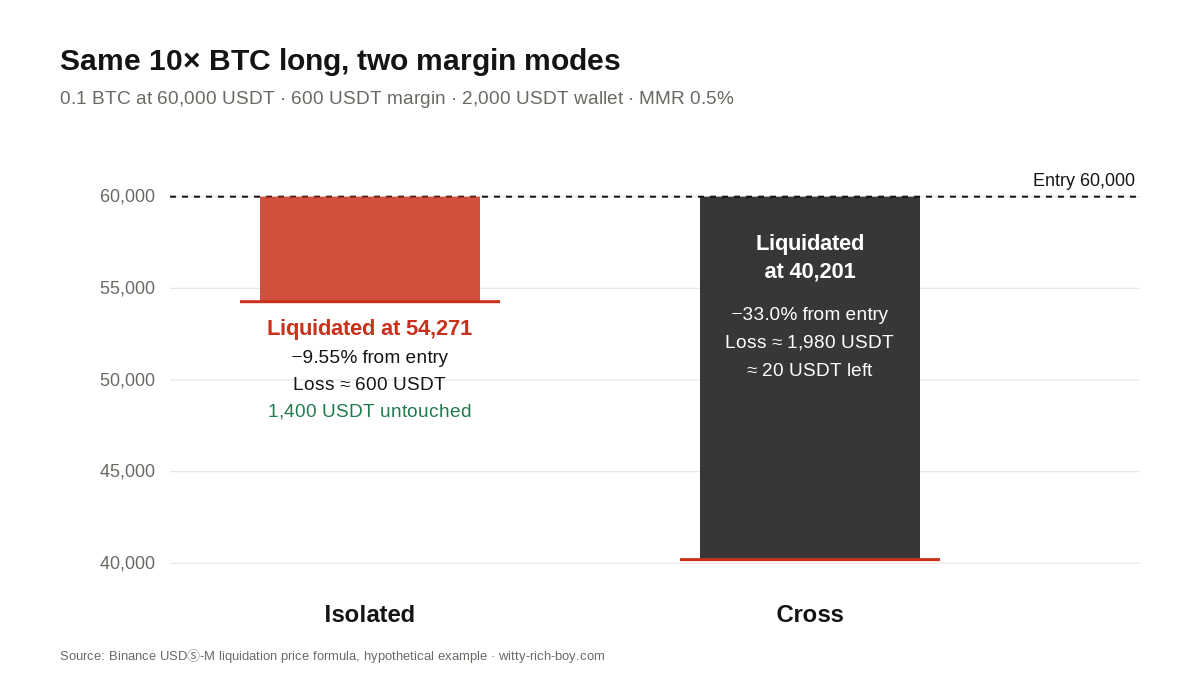
- Cross margin lets every position draw on the whole wallet: the same long backed by 2,000 USDT liquidates at about 40,201 instead of 54,271 — but the loss at that point is about 1,980 USDT.
- Liquidation happens when equity falls to the maintenance margin, which Binance defines as notional × maintenance margin rate − maintenance amount.
- Maintenance margin tiers raise the rate as a position grows: in our example a 600,000 USDT position at 10× liquidates 8.4% below entry, against 9.5% for a small one.
- In cross mode the liquidation price moves with your other positions: a 1,000 USDT loss on an ETH short pulls the BTC long's liquidation price from 40,201 up to 50,603.
- Portfolio margin goes further and sizes margin on the worst stress scenario for the whole book; Binance liquidates its portfolio-margin accounts at a uniMMR of 105% or below.
In force: Formulas and thresholds as published in exchange documentation, re-checked 2 November 2026
Isolated vs cross margin comes down to what backs a position. Isolated margin uses only the collateral you assign, so a 6,000 USDT long at 10× with 600 USDT liquidates about 9.5% below entry and loses roughly 600 USDT. Cross margin uses your whole balance: with 2,000 USDT, the same long liquidates about 33% lower, but loses nearly all 2,000.
Every leveraged futures position carries a setting most people leave on its default: the margin mode. It looks like an interface detail. It actually fixes two numbers before the market moves at all — the price at which the exchange closes you out, and how much money disappears when it does. Below, both modes are worked through the same position using the formula exchanges publish.
What is isolated margin? (isolated margin meaning)
Isolated margin is a margin mode in which a fixed amount of collateral is assigned to a single position, and only that amount can be lost if the position is liquidated. The rest of your wallet is untouched by that position’s losses.
Kraken’s derivatives rules put it in five words — “each position has dedicated collateral” — and trigger liquidation when that collateral is insufficient against the position’s maintenance margin. OKX starts forced liquidation when an isolated position’s maintenance margin ratio drops to 100% or lower.
Two consequences follow. The liquidation price is fixed at entry, moving only if you add or remove margin or fees and funding are charged to the position. And leverage sets the distance: at 10× you have put up 10% of the notional, so a fall of a little under 10% wipes out the margin.
What is cross margin? (cross margin meaning)
Cross margin is a margin mode in which all positions draw on one shared balance, so profits on one position and free funds in the wallet both support every other position. Kraken’s wording: “positions share collateral, enabling profit and loss (PnL) offset”.
At OKX, products settled in the same currency “can share the same total margin”; a liquidation alert goes out when the cross maintenance margin ratio falls below 300%, and liquidation starts at 100% or below.
The consequence mirrors isolated mode: the liquidation price is further away because more equity stands behind the position, it moves as your balance and other positions change, and the worst case is the whole cross balance rather than a slice of it.
Isolated vs cross margin: the comparison table
| Isolated margin | Cross margin | |
|---|---|---|
| Collateral behind a position | Only the margin you assign | Entire available cross balance |
| Liquidation price | Fixed at entry, closer | Further away, moves with other positions |
| Maximum loss on liquidation | Assigned margin | The whole cross balance |
| Profit on one position helps another | No | Yes |
| Effective leverage | As set (e.g. 10×) | Total notional ÷ total equity |
| Typical use | One directional position with a defined risk | Hedged or multi-leg books |
The effective-leverage row is the one people miss: a 10× position backed by a cross wallet three times its margin is economically about 3× — with three times the money at stake.
How is liquidation price calculated? The formula
A position is liquidated when its equity falls to the maintenance margin. Binance publishes the full formula for USDⓈ-M contracts. For a single position in one-way mode it reduces to:
Liquidation price = (WB − TMM₁ + UPNL₁ + cum − Side × Q × EP) ÷ (Q × MMR − Side × Q)
WB is the wallet balance (the isolated margin, or the cross wallet balance), TMM₁ and UPNL₁ are the maintenance margin and unrealised profit or loss of all other positions, cum is the maintenance amount, Side is 1 for a long and −1 for a short, Q the position size, EP the entry price and MMR the maintenance margin rate. Binance states that in isolated mode TMM = 0 and UPNL = 0 — the whole difference between the modes, written as algebra.
Checked against Binance’s own worked example, it returns 1,153.26 for the ETHUSDT position and 26,316.89 for BTCUSDT — matching the published figures to the cent.
Many calculators, including ours, use the shortcut Entry × (1 − 1/Leverage + MMR) for a long. It is a close approximation for isolated positions; the exact formula applies the maintenance rate at the liquidation price, so it lands slightly lower. Run your own numbers in the liquidation price calculator.
How to calculate your liquidation price in either mode
- Find the position’s tier. Look up the contract’s leverage and margin table and note the MMR and maintenance amount for your notional.
- Choose the wallet balance. Isolated: the margin you assigned. Cross: the cross wallet balance.
- Collect the other positions (cross only). Add up their maintenance margin (TMM₁) and unrealised profit or loss (UPNL₁).
- Apply the formula above. Side is 1 for a long, −1 for a short.
- Check the tier. Multiply the result by Q; if that notional sits in a different tier, repeat with that tier’s MMR and amount.
- Compare with the order screen. The venue’s own estimate includes fees and mark-price details; the liquidation price calculator gives a quick isolated-mode estimate.
Liquidation price isolated vs cross: one position, both modes
Example (hypothetical): Anna has 2,000 USDT in her futures wallet. She opens a long of 0.1 BTC at 60,000 USDT — a notional of 6,000 USDT — at 10× leverage, so the initial margin is 600 USDT. The maintenance margin rate for a position this size is 0.5% and the maintenance amount is 0.
Step by step: isolated mode
- Wallet balance for the formula = the isolated margin: WB = 600. TMM₁ = 0, UPNL₁ = 0, cum = 0, Side = 1.
- Numerator: 600 − 0.1 × 60,000 = 600 − 6,000 = −5,400.
- Denominator: 0.1 × 0.005 − 0.1 = −0.0995.
- Liquidation price: −5,400 ÷ −0.0995 = 54,271.36 USDT, 9.55% below entry.
- Loss at liquidation: 0.1 × (60,000 − 54,271.36) = 572.86 USDT, leaving 27.14 USDT — exactly the maintenance margin (54,271.36 × 0.1 × 0.5%), which the exchange’s liquidation process then absorbs. Practically, the 600 USDT is gone; the other 1,400 USDT is untouched.
The shortcut formula gives 60,000 × (1 − 0.1 + 0.005) = 54,300 — 29 USDT higher, because it uses the maintenance rate at entry.
Step by step: cross mode
- Wallet balance = the whole cross balance: WB = 2,000. No other positions, so TMM₁ = 0 and UPNL₁ = 0.
- Numerator: 2,000 − 6,000 = −4,000.
- Denominator is unchanged: −0.0995.
- Liquidation price: −4,000 ÷ −0.0995 = 40,201.01 USDT, 33.0% below entry.
- Loss at liquidation: 0.1 × (60,000 − 40,201.01) = 1,979.90 USDT. What remains, 20.10 USDT, is again the maintenance margin. Nearly the entire wallet is gone.
Cross mode with a single position gives exactly the same answer as isolated mode with all 2,000 USDT assigned. Cross margin is not a different kind of risk; it is a decision to put more collateral behind the trade.
What happens at different prices
| BTC price | Isolated (600 USDT assigned) | Cross (2,000 USDT wallet) |
|---|---|---|
| 56,000 | Open, −400 USDT unrealised | Open, −400 USDT unrealised |
| 54,000 | Liquidated, about −600 USDT | Open, −600 USDT unrealised |
| 48,000 | Already closed at about −600 | Open, −1,200 USDT unrealised |
| 40,000 | Already closed at about −600 | Liquidated, about −2,000 USDT |
| Recovery to 62,000 | Not in the position | +200 USDT if it survived the dip |
Cross margin buys survival through a deeper dip at the price of a larger possible loss.
The same position as a short
For a 0.1 BTC short at 60,000, Side = −1, so the formula becomes (WB + Q × EP) ÷ (Q × MMR + Q). Isolated with 600 USDT: 6,600 ÷ 0.1005 = 65,671.64. Cross with 2,000 USDT: 8,000 ÷ 0.1005 = 79,601.99.
Why does the cross liquidation price move?
In cross mode, other positions’ losses and maintenance margin are subtracted from the shared buffer, so one losing position drags every other position’s liquidation price closer.
Example (hypothetical): Anna keeps the BTC long in cross mode and adds a short of 2 ETH at 3,000 USDT (another 6,000 USDT of notional, maintenance rate 0.5%).
- With ETH flat at 3,000, TMM₁ = 6,000 × 0.5% = 30 and UPNL₁ = 0. BTC liquidation = (2,000 − 30 − 6,000) ÷ −0.0995 = 40,502.51.
- If ETH rises to 3,500, the short shows an unrealised loss of 1,000 USDT and its maintenance margin rises to 35. BTC liquidation = (2,000 − 35 − 1,000 − 6,000) ÷ −0.0995 = 50,603.02.
BTC has not moved, yet its liquidation price has climbed by more than 10,000 USDT: in cross mode the risk is shared. The same mechanism is what makes hedges work — if BTC and ETH fall together, the short’s gain offsets the long’s loss, whereas in isolated mode the long could be liquidated while the short sits on a profit it cannot lend.
Fees and funding payments work the same way: in isolated mode they erode one position’s buffer; in cross mode, the balance every position relies on. How far a year of funding can move an isolated long’s liquidation price is worked through in perpetual futures vs spot.
Maintenance margin explained: how the tiers work
Maintenance margin is the minimum equity an exchange requires to keep a leveraged position open; below it, the position is liquidated. Binance defines it as Maintenance Margin = Notional Position Value × Maintenance Margin Rate − Maintenance Amount, with the rate set by “notional value tiers”. OKX’s rules say the same thing plainly: “larger positions fall into higher tiers, which require a higher maintenance margin and allow for lower leverage.”
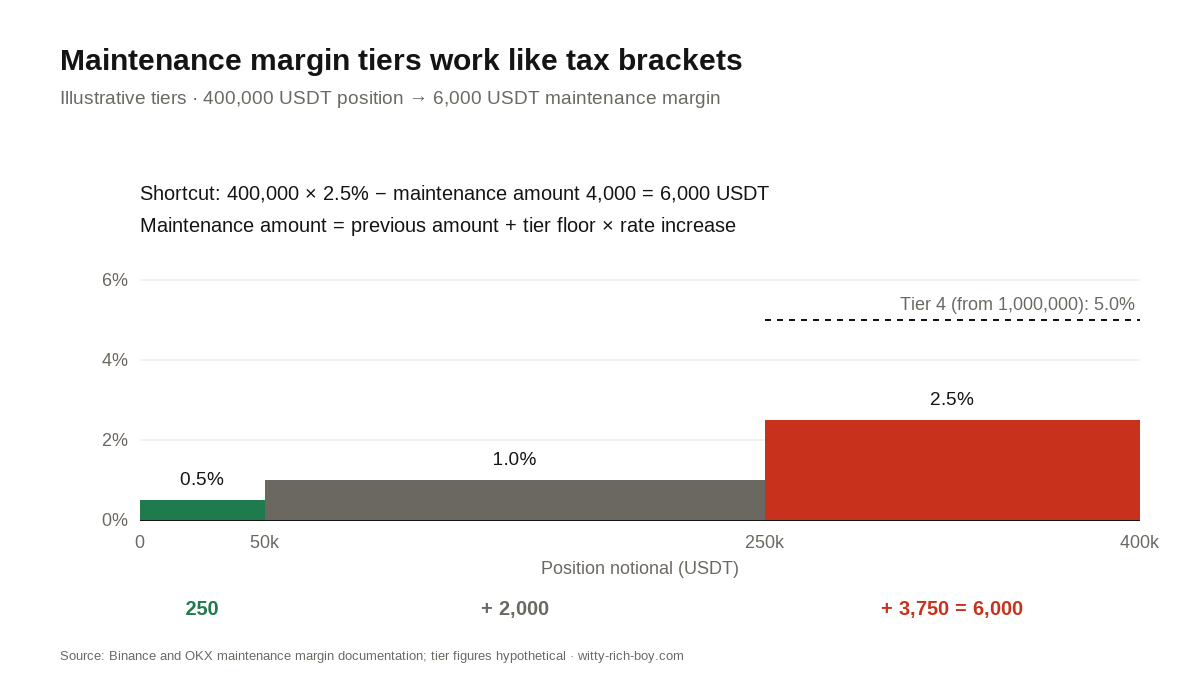
The maintenance amount stops a tier boundary from repricing the whole position at a stroke: each tier’s rate effectively applies only to the slice of notional inside it, like income tax brackets. Each tier’s amount equals the previous one plus the tier’s lower bound × the rate increase. Our maintenance margin explainer derives that rule and works the tiers through four position sizes.
Illustrative tier table (hypothetical figures; real tables differ by contract and change over time — always check the venue’s current table):
| Tier | Position notional (USDT) | Max leverage | MMR | Maintenance amount |
|---|---|---|---|---|
| 1 | 0 – 50,000 | 100× | 0.5% | 0 |
| 2 | 50,000 – 250,000 | 50× | 1.0% | 250 |
| 3 | 250,000 – 1,000,000 | 20× | 2.5% | 4,000 |
| 4 | 1,000,000 – 5,000,000 | 10× | 5.0% | 29,000 |
For a 400,000 USDT position: 400,000 × 2.5% − 4,000 = 6,000 USDT. Check by brackets: 50,000 × 0.5% + 200,000 × 1.0% + 150,000 × 2.5% = 250 + 2,000 + 3,750 = 6,000.
Why big positions liquidate sooner
Example (hypothetical): a 10 BTC long at 60,000 (600,000 USDT notional) at 10×, isolated, with 60,000 USDT of margin. It sits in tier 3, so MMR = 2.5% and cum = 4,000:
(60,000 + 4,000 − 600,000) ÷ (10 × 0.025 − 10) = −536,000 ÷ −9.75 = 54,974.36
That is 8.38% below entry, against 9.55% for the 0.1 BTC position at the same leverage. The notional at the liquidation price (549,744) is still inside tier 3, so the result stands; Binance notes that if it were not, you must recalculate with the neighbouring tier’s rate and amount.
Which is better, isolated or cross margin? A decision table
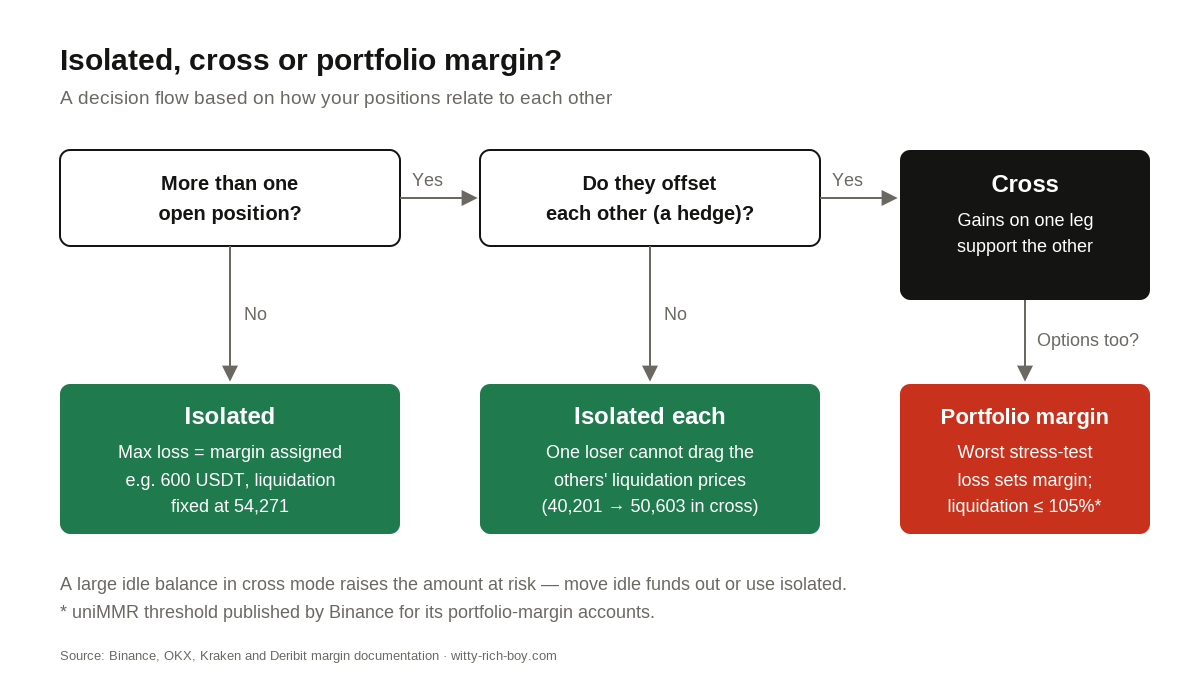
Neither mode is better in general; the right one depends on how many positions you hold and whether they offset each other.
| Your situation | Mode that fits | Why |
|---|---|---|
| One directional position, loss limit decided in advance | Isolated | Maximum loss equals the margin assigned |
| Several unrelated positions | Isolated | One bad position cannot drain the others |
| Long one contract, short a correlated one | Cross | Gains on one leg support the other |
| Large idle balance in the futures wallet | Isolated, or move the idle funds out | Cross puts the whole balance behind every position |
| Positions near the top of a margin tier | Either — check the tier first | Higher MMR pulls liquidation closer in both modes |
| Options plus futures on the same underlying | Portfolio margin, where offered | Margin reflects the net risk of the book |
What is portfolio margin?
Portfolio margin is a margin method that sets the requirement from the worst stress-test loss of the whole portfolio, rather than adding up a separate requirement for each position. Deribit’s documentation explains that the system “looks at how the entire portfolio of positions would perform together with changing market conditions” and uses the scenario that “would inflict the largest loss”. Under standard margin, a spread’s profit and loss offset but “the margin required would not be offset”.
Binance’s portfolio-margin accounts are monitored with a unified maintenance margin ratio, uniMMR = unified account adjusted equity ÷ unified maintenance margin. Its published thresholds: above 150% you “can trade freely”; at 120–150% you receive reminders; at 105–120% only reduce-only orders are accepted; at 105% or below, liquidation takes place.
Portfolio margin is cross margin taken to its logical end: more capital-efficient for genuinely hedged books, more exposed when a hedge stops behaving like one.
Can you switch margin mode on an open position?
Generally no: on major venues margin mode is set per contract and can only be changed when there is no open position (and usually no open order) on that contract. What you can do in isolated mode is add margin to a live position, which raises WB in the formula — in Anna’s case, adding 400 USDT moves liquidation from 54,271 to about 50,251.
A liquidation also realises the loss, and how derivatives gains and losses are taxed depends on where you live — see our guides to crypto tax in the UK and crypto tax in Germany.
The numbers here are examples, not forecasts. Both margin modes end in the same place if the price keeps moving against you; the mode only decides how far it has to travel, and how much it takes with it.
Questions readers ask
What is the difference between isolated and cross margin?
Isolated margin assigns a fixed amount of collateral to one position, so liquidation can only consume that amount. Cross margin lets all positions share the available balance of the account, so a losing position can draw on everything else. Cross pushes the liquidation price further away; isolated keeps the worst-case loss smaller and fixed in advance.
Which is better, isolated or cross margin?
Neither is better in general. Isolated suits a single directional position where you want the maximum loss fixed in advance. Cross suits a book of positions that offset each other, such as a long in one contract and a short in a related one, because profit on one leg supports the other. A large idle balance in cross mode simply raises the amount at risk.
Is cross margin riskier than isolated margin?
Cross margin is less likely to be liquidated for the same position, because more collateral stands behind it, but the loss when liquidation does arrive is larger. In our example the same 6,000 USDT long liquidates after a 9.5% fall in isolated mode, losing about 600 USDT, and after a 33% fall in cross mode, losing about 1,980 USDT.
Why does my liquidation price keep changing in cross margin?
In cross mode the liquidation price of each position depends on the wallet balance and on the unrealised profit or loss and maintenance margin of every other position, as Binance's published formula shows. When another position loses money, the shared buffer shrinks and the liquidation price moves closer. In isolated mode it only changes if you add or remove margin.
What is maintenance margin?
Maintenance margin is the minimum equity an exchange requires to keep a leveraged position open. Binance calculates it as position notional × maintenance margin rate − maintenance amount, with the rate rising in tiers as the position grows. When your margin balance falls to that level, the position is liquidated.
Can I switch from isolated to cross margin on an open position?
Generally not. On major venues the margin mode is set per contract and can only be changed when there is no open position, and usually no open orders, on that contract. Choose the mode before opening the position. In isolated mode you can still add margin to an open position, which moves its liquidation price further away.
What is portfolio margin?
Portfolio margin sizes the requirement on the whole book rather than position by position. Deribit's documentation describes stress-testing the entire portfolio against price and volatility moves and using the worst loss as the margin requirement. Binance's portfolio-margin accounts are liquidated when the unified maintenance margin ratio falls to 105% or below.
Was this guide useful?
Thanks — your answer helps us decide what to cover next.
Sources
- Binance — How to Calculate Liquidation Price of USDⓈ-M Futures Contracts
- Binance — Leverage and Margin of USDⓈ-M Futures
- Binance — What Is the Unified Account Maintenance Margin Ratio (uniMMR) and How Is It Calculated
- OKX — Tiered maintenance margin ratio rules
- OKX — Futures mode: cross margin trading
- OKX — Isolated margin mode
- Kraken — Trading Rules: Liquidation Process (Unified Wallet)
- Deribit Insights — Portfolio Margin
General information, not tax or legal advice. Rules change — check the official source or a licensed adviser before acting.