Global ·
Crypto Travel Rule Explained (2026): EU, UK and US Thresholds
Crypto travel rule explained: EU providers send your name with every crypto transfer, check self-hosted wallets above €1,000; the UK uses £800, the US $3,000.

The short answer
- The travel rule is FATF Recommendation 16 applied to crypto: providers must send sender and recipient details with a transfer. FATF lets countries skip full data below USD/EUR 1,000.
- The EU sets no minimum for crypto transfers between providers under Regulation (EU) 2023/1113, applied since 30 December 2024; above €1,000 a provider must assess whether a self-hosted wallet is yours.
- The UK replaced its €1,000 trigger with £800 from 30 June 2026 (SI 2026/621): below it, names and account numbers; at or above it, extra identifying data.
- The US rule starts at $3,000 (31 CFR 1010.410(f)), Singapore adds verified details above S$1,500 (MAS Notice PSN02), and Japan applies it to all amounts since 1 June 2023.
- FATF's July 2026 update found 83% of surveyed jurisdictions have passed travel rule legislation, up from 73% in 2025.
In force: Rules as in force on 9 November 2026 · FATF Recommendation 16 via INR.15 · EU Regulation (EU) 2023/1113, applied since 30 December 2024 · EBA/GL/2024/11 · UK MLR 2017 regs 64C and 64G, £800 threshold under SI 2026/621 from 30 June 2026 · US 31 CFR 1010.410(f) and FIN-2019-G001 · MAS Notice PSN02 (revised 30 June 2025) · FINMA Guidance 02/2019 · Japan APTCP notification obligation from 1 June 2023
The crypto travel rule is FATF Recommendation 16 applied to crypto: regulated providers must send the sender's and recipient's details with a transfer. The EU applies it to every provider-to-provider transfer with no minimum and checks self-hosted wallets above €1,000; the UK uses £800, Singapore S$1,500, the US $3,000, and Japan all amounts.
For years a crypto withdrawal asked one question: which address? Now it asks several. Who is the recipient? Is the wallet yours? Which platform runs it? The questions come from one global standard, written for bank wires and extended to crypto in 2019, and every country has turned it into law in its own way. Below: what the EU’s Transfer of Funds Regulation demands, what you type in on a withdrawal, how six jurisdictions compare, and a scenario table of which fields you face for which transfer.
What is the crypto travel rule?
The travel rule is the requirement that a regulated provider pass identifying information about the sender (the originator) and the recipient (the beneficiary) to the next provider in a transfer. The information “travels” with the payment, but not on the blockchain itself: providers exchange it separately, usually through dedicated messaging systems.
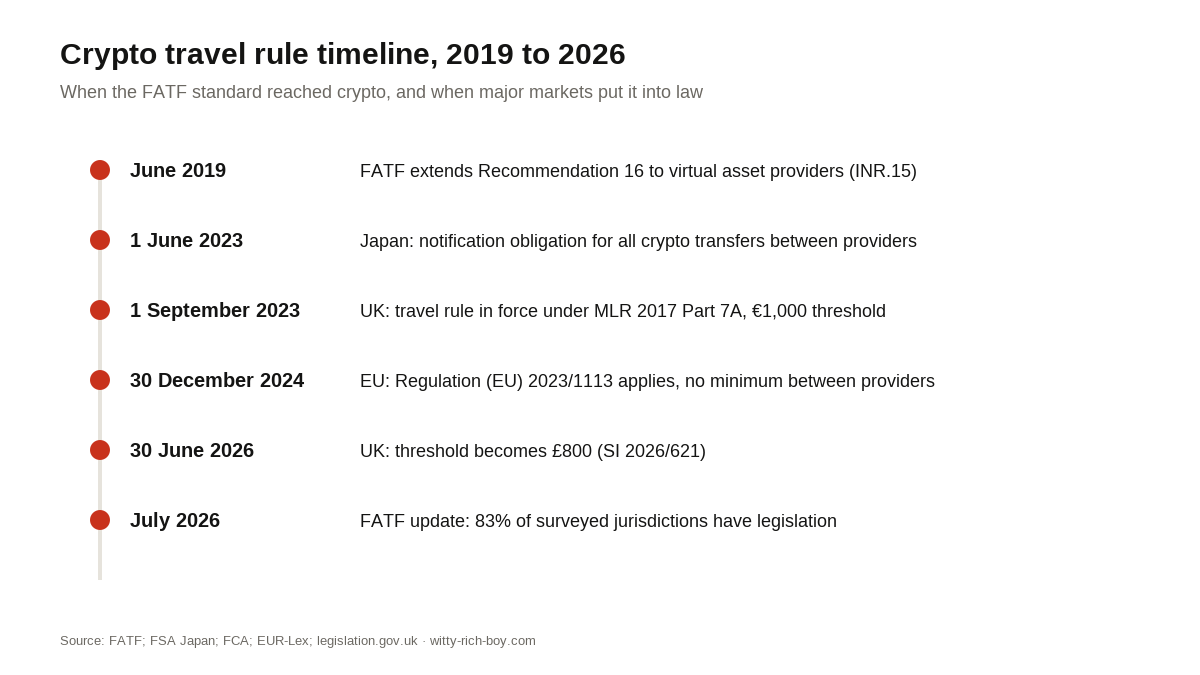
It is FATF Recommendation 16, the wire-transfer rule, applied to virtual asset service providers (VASPs) through the Interpretive Note to Recommendation 15 adopted in June 2019. The FATF’s updated guidance on virtual assets sets the baseline:
- Optional threshold. Countries may adopt a de minimis threshold of USD/EUR 1,000.
- Below the threshold, providers still collect the names of the originator and beneficiary and a wallet address or unique transaction reference for each.
- Above it, the originator’s provider adds further identifying data, such as an address, national identity number, customer number or date and place of birth, and verifies it.
- Unhosted wallets. The data-submission duty applies between regulated entities, so FATF does not require providers to send travel rule data to an unhosted wallet.
A VASP (called a CASP, crypto-asset service provider, in EU law) is a business that exchanges, transfers or holds crypto for customers. A self-hosted or unhosted wallet is one whose keys you hold yourself.
Adoption is now broad but uneven. The FATF’s July 2026 targeted update found that 83% of surveyed jurisdictions have passed travel rule legislation, up from 73% (85 of 117) in 2025. Enforcement still lags legislation in many of them.
What does the EU Transfer of Funds Regulation require?
Every crypto transfer between providers must carry originator and beneficiary information, regardless of amount, and transfers involving self-hosted wallets above €1,000 trigger an ownership check.
The law is Regulation (EU) 2023/1113, the recast Transfer of Funds Regulation (TFR), which has applied since 30 December 2024, the same day MiCA applied in full. Unlike the FATF standard, it sets no de minimis threshold for crypto transfers between providers. Article 14 lists what the originator’s provider must attach:
| Data item | Originator (you, when sending) | Beneficiary (the recipient) |
|---|---|---|
| Name | Required | Required |
| Distributed ledger address | Required where the transfer is on a DLT network | Required where the transfer is on a DLT network |
| Crypto-asset account number | Where an account exists and is used | Where an account exists and is used |
| Address including country | Required | Not listed |
| Official personal document number and customer identification number, or date and place of birth | Required | Not listed |
| LEI or equivalent identifier (businesses) | Where applicable | Where applicable and provided by the originator |
The originator’s provider must not initiate or execute the transfer before it has complied with Article 14, and it verifies your own details against its customer records. The EBA’s travel rule guidelines (EBA/GL/2024/11) add that where the name, account number, address and document number do not identify you unambiguously, the provider should add your date and place of birth.
The €1,000 self-hosted wallet rule
Transfers to or from a self-hosted address are treated differently. For an outgoing transfer, the provider must obtain and hold the originator and beneficiary information and make sure the transfer can be individually identified (Article 14(5)). For an amount exceeding €1,000, it must also take adequate measures to assess whether the address is owned or controlled by you (Article 14(5) for outgoing, Article 16(2) for incoming transfers). The EBA says the threshold is measured in euros at the time of transfer, regardless of fees. Recital 39 adds that a provider should in principle not be required to verify information on the user of a self-hosted address that is not its customer.
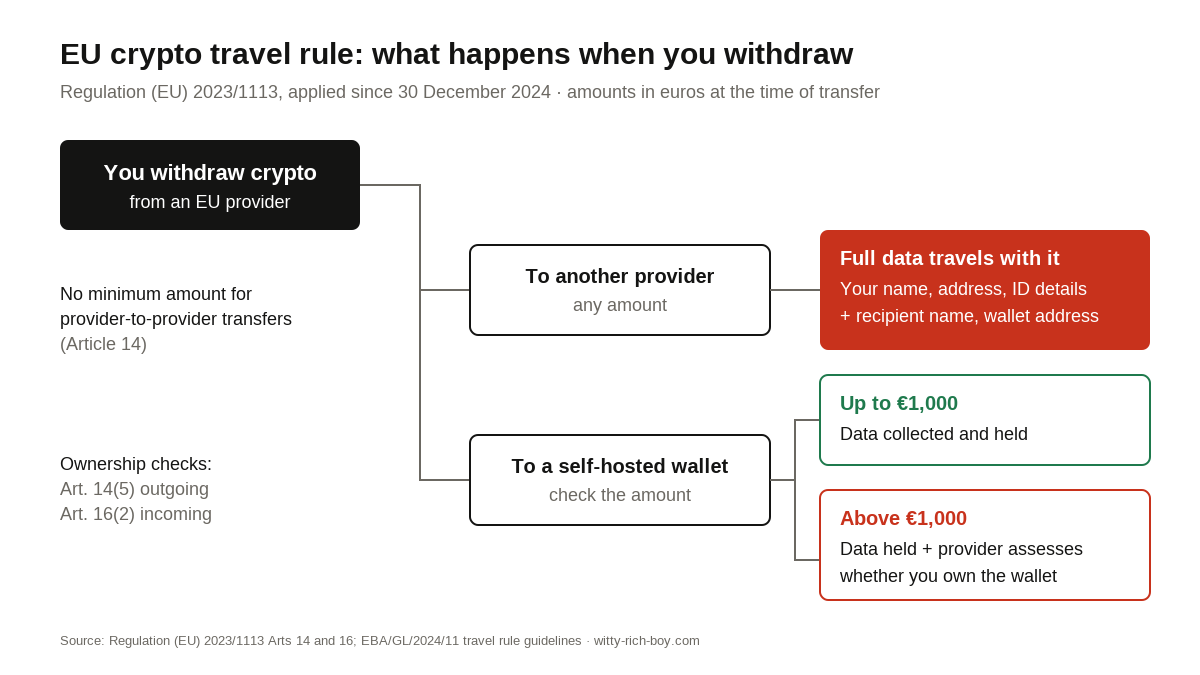
If data arrives incomplete, the receiving provider’s risk-based procedures decide what happens. Under the EBA guidelines, once a request for missing information goes unanswered by the deadline, the provider decides whether to reject, return or execute the transfer, and must tell the previous provider in the chain if it rejects or returns it.
What do you have to provide when you withdraw crypto?
Expect to give the recipient’s name, say whether the destination is your own self-hosted wallet or an account at another provider, name that provider, and, for a self-hosted wallet above the local threshold, prove you control it.
Your own details are already on file from onboarding, so the new fields are about the other end. Typical withdrawal screens, built to meet Article 14 in the EU or regulation 64C in the UK, ask for:
- Recipient type: yourself or someone else; a natural person or a business.
- Recipient name: the beneficiary’s full name, or the registered name for a business.
- Destination type: another provider (and which one) or a self-hosted wallet.
- Proof of control for a self-hosted wallet above the threshold.
- Sometimes the recipient’s country or address, where local rules or the receiving provider ask for it.
Deposits work in reverse. If funds arrive from another provider with missing originator data, your provider may ask you who sent them, or hold the deposit until the data is complete.
How to verify that you own a self-hosted wallet
The provider picks the method, but under the EBA’s guidelines it uses at least one recognised technique, combined where one alone is not reliable enough.
- Choose “my own wallet” as the destination type on the withdrawal screen and enter the address.
- Read which method is offered. The EBA names sending a predefined amount, preferably the smallest denomination of the crypto-asset, from the wallet to the provider, and digitally signing a specific message with the key for that address.
- For a small-amount test, send exactly the amount requested from the self-hosted address. Sending from a different address fails the test.
- For a signed message, copy the provider’s text exactly, sign it in your wallet software and paste the signature back. Your private key never leaves the wallet.
- Keep the wallet’s address book entry. Once ownership is documented, the EBA says the provider need not repeat the measures for later transfers from the same address.
- Expect extra questions if the wallet belongs to someone else: the EBA calls for additional mitigating measures where a third person owns or controls the address.
- Do not split transfers to dodge a threshold. UK law counts linked transfers together against the £800 trigger, and splitting changes nothing about how the coins are taxed.
How does the travel rule work in the UK?
The UK applies the rule to transfers between cryptoasset businesses under Part 7A of the Money Laundering Regulations 2017, in force since 1 September 2023, and since 30 June 2026 its threshold is £800, not €1,000.
Under regulation 64C, every inter-cryptoasset business transfer carries the names of the originator and beneficiary and their account numbers or, failing that, a unique transaction identifier. Where the transfer, together with any linked transfer, equals or exceeds the threshold, the originator’s business adds one item for an individual: a customer identification number, an address, an identity document number, or the date and place of birth. The information must be verified against a reliable, independent source.
The Money Laundering and Terrorist Financing (Amendment) Regulations 2026, SI 2026/621, replaced the “1,000 euros” figure with £800 in the Part 7A cryptoasset transfer rules, including the provision on transfers to and from unhosted wallets.
The FCA’s statement on travel rule expectations adds that when a UK business sends to a jurisdiction without the rule, it must still collect and verify the information and store it before making the transfer. For tax on the coins themselves, see our UK crypto tax guide.
How do the US, Switzerland, Singapore and Japan compare?
They range from Japan, which applies the rule to every amount, to the United States, whose rule starts at $3,000.
United States: $3,000
FinCEN’s Funds Travel Rule, 31 CFR 1010.410(f), applies to transmittals of $3,000 or more. FinCEN guidance FIN-2019-G001 (May 2019) states that transmittals involving convertible virtual currency qualify, so money transmitters handling crypto must pass on the information before or at the time of the transfer. According to FinCEN’s travel rule questions and answers, the sender’s institution includes the sender’s name, address and account number, the amount, the execution date and the recipient’s institution and details; records are kept for five years. We found no FinCEN rule requiring a self-hosted wallet ownership test like the EU’s.
Switzerland: no unhosted-wallet exception
FINMA applies Swiss payment-information rules to blockchain transfers under Guidance 02/2019. Its 2019 announcement said the practice applies without the FATF’s exception for unregulated wallets, making it one of the strictest in the world; supervised firms must verify, by appropriate technical means, the client’s power of disposal over an external wallet. Our Swiss crypto tax guide covers the separate tax side.
Singapore: S$1,500
Under MAS Notice PSN02, a digital payment token transfer of S$1,500 or less carries the originator’s and beneficiary’s names and account numbers or unique transaction references. Above S$1,500, the ordering institution must identify and verify the originator and add an address, a unique identification number, or the date and place of birth.
Japan: every amount
Japan’s amended Act on Prevention of Transfer of Criminal Proceeds has required crypto-asset exchange service providers to notify the beneficiary’s provider of originator and beneficiary information since 1 June 2023. The FSA’s explanation says it covers all transfers regardless of amount to domestic providers and to foreign providers in jurisdictions with equivalent rules, but not transfers to individuals or unregistered providers; for unhosted wallets, providers must collect and retain owner information.
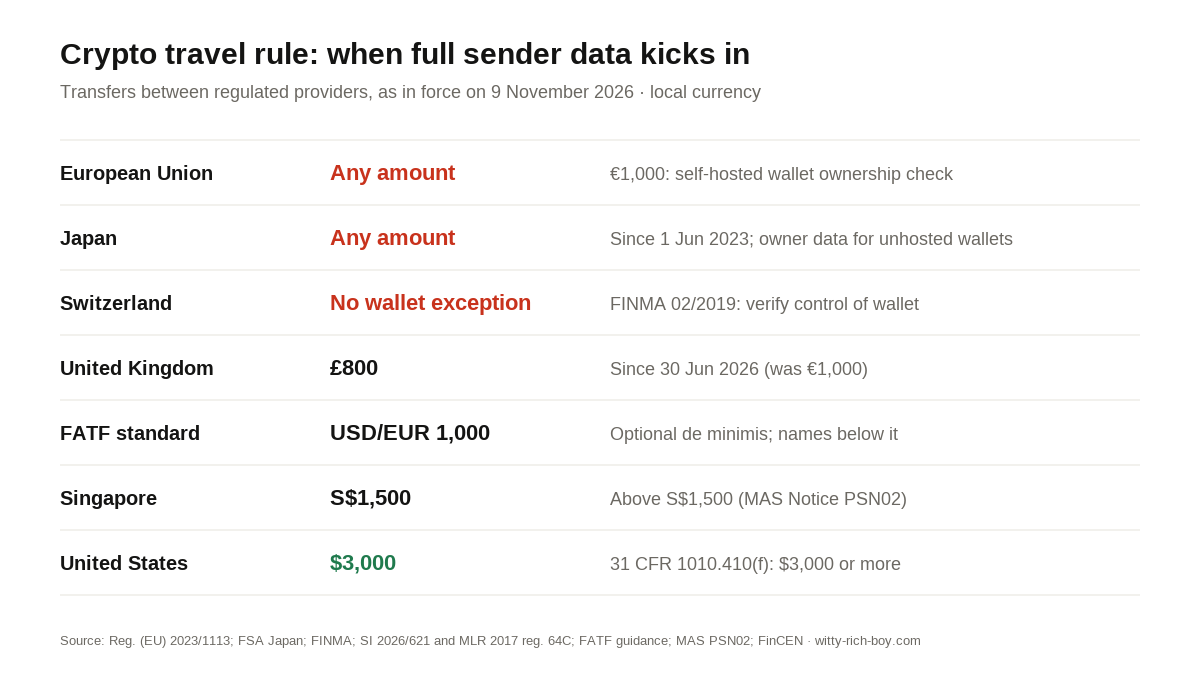
| Jurisdiction | Law | Full data from | Self-hosted wallets |
|---|---|---|---|
| FATF standard | R.16 via INR.15 | Above USD/EUR 1,000 if a threshold is used | No duty to send data to unhosted wallets |
| European Union | Reg. (EU) 2023/1113 | Any amount between providers | Collect and hold data; ownership check above €1,000 |
| United Kingdom | MLR 2017 regs 64C, 64G | £800 (since 30 Jun 2026) | Same £800 trigger in reg. 64G |
| Switzerland | FINMA Guidance 02/2019 | No FATF-style exception | Client’s power of disposal verified |
| United States | 31 CFR 1010.410(f) | $3,000 | No specific ownership test found |
| Singapore | MAS Notice PSN02 | Above S$1,500 | — |
| Japan | APTCP (from 1 Jun 2023) | Any amount | Owner information collected and retained |
Which details apply to your transfer? A scenario table
The answer depends on where you are, where the coins go, and the amount. These are hypothetical examples for a private customer of a regulated provider in each place.
| Scenario | Data sent between providers | Extra step for you |
|---|---|---|
| EU, €200 to a friend’s account at another provider | Full Article 14 data on you, plus your friend’s name, ledger address and account | Enter the friend’s name and provider |
| EU, €800 to your own self-hosted wallet | Data collected and held; nothing to send | Confirm the wallet is yours |
| EU, €1,500 to your own self-hosted wallet | Data collected and held | Ownership assessment, such as a signed message or small test transfer |
| UK, £500 to another provider | Names and account numbers or transaction identifier | Enter recipient name |
| UK, £900 to another provider | Names, accounts plus one identifier, such as your customer number or address | Usually none beyond recipient name; your data is on file |
| Singapore, S$2,000 to another provider | Names, accounts plus verified address, ID number or date and place of birth | Recipient name |
| US, $2,500 to another provider | Below the $3,000 Funds Travel Rule trigger | Provider’s own policy may still ask |
| Japan, ¥10,000 to a domestic provider | Originator and beneficiary information at any amount | Recipient name and provider |
Is the travel rule the same as DAC8 or MiCA?
No. The travel rule moves sender and recipient data between providers for anti-money-laundering and sanctions screening; it is not a tax report and does not authorise anyone.
MiCA, Regulation (EU) 2023/1114, licenses the provider; our MiCA explainer covers it. DAC8, Council Directive (EU) 2023/2226, makes providers report your annual totals to tax authorities from the 2026 tax year; see our guide to DAC8 crypto reporting. The three rest on the same identity checks, so a single onboarding feeds all of them. Stablecoins are crypto-assets for travel rule purposes, so a USDC withdrawal faces the same questions as any other; their tax treatment is in our stablecoin yield tax guide. For bank wires, the funds side of the same EU regulation applies, and the costs are compared in our guide to international money transfer costs.
Questions readers ask
What is the crypto travel rule in simple terms?
It is an anti-money-laundering rule that makes regulated crypto providers pass on who is sending and who is receiving a transfer, the same way banks do for wire transfers. It comes from FATF Recommendation 16, which the FATF applied to virtual asset service providers in 2019. The data travels between providers, not on the blockchain, and it is not a tax report.
Is there a minimum amount for the travel rule in the EU?
No, not for crypto. Under Regulation (EU) 2023/1113, a provider must attach originator and beneficiary information to every crypto transfer it makes to another provider, whatever the amount. The €1,000 figure only matters for self-hosted wallets: above it, the provider must assess whether the wallet you are sending to, or receiving from, is owned or controlled by you.
Why does my exchange ask for the recipient's name when I withdraw crypto?
Because the travel rule requires your provider to send the beneficiary's name with the transfer. In the EU, Article 14 of Regulation (EU) 2023/1113 lists the beneficiary's name, distributed ledger address and crypto-asset account number, where one is used. The provider may not execute the transfer before the information is complete, so a missing name usually means the withdrawal stops at that screen.
How do I prove I own a self-hosted wallet?
Your provider will choose the method. The EBA's travel rule guidelines name two common ones: sending a small predefined amount from the wallet to the provider, and digitally signing a specific message with the wallet's key. Other technical means are allowed if the provider is satisfied. Once ownership is established and documented, providers need not repeat the check for each later transfer from that address.
Does the travel rule apply to self-custody wallets?
It applies to the provider, never to you or your wallet software. FATF does not require providers to send travel rule data to unhosted wallets. But when your EU or Japanese provider sends to or receives from a self-hosted address, it still collects and keeps the sender and recipient details, and in the EU it must check ownership above €1,000. Wallet-to-wallet transfers between individuals are outside the rule.
What is the UK crypto travel rule threshold?
£800 since 30 June 2026, when SI 2026/621 replaced the original €1,000 figure in regulations 64C and 64G of the Money Laundering Regulations 2017. Below £800, an inter-provider transfer carries the names of both parties and their account numbers or a unique transaction identifier. At or above £800, linked transfers counted together, the sender's provider adds identifying data such as an address or date and place of birth.
Does the US have a crypto travel rule?
Yes. FinCEN's Funds Travel Rule, 31 CFR 1010.410(f), applies to transmittals of $3,000 or more, and FinCEN guidance FIN-2019-G001 says transmittals involving convertible virtual currency are covered. The sender's institution passes on the sender's name, address and account number, the amount, the execution date and recipient details. Records must be kept for five years.
Does the travel rule send my data to the tax office?
No. The travel rule moves data between providers so each can screen transfers for money laundering and sanctions. Tax reporting is a separate regime: in the EU, DAC8 has required providers to collect tax IDs and report annual transaction totals to tax authorities since 1 January 2026. Both draw on the same customer records, which is why platforms ask for so much information.
Was this guide useful?
Thanks — your answer helps us decide what to cover next.
Sources
- Regulation (EU) 2023/1113 on information accompanying transfers of funds and certain crypto-assets — EUR-Lex
- EBA Travel Rule Guidelines, EBA/GL/2024/11 — Final report (European Banking Authority, PDF)
- FATF — Updated Guidance for a Risk-Based Approach to Virtual Assets and VASPs (PDF)
- FATF — Virtual Assets: July 2026 Targeted Update on Implementation of the FATF Standards (PDF)
- Money Laundering, Terrorist Financing and Transfer of Funds (Information on the Payer) Regulations 2017, regulation 64C — legislation.gov.uk
- The Money Laundering and Terrorist Financing (Amendment) Regulations 2026, SI 2026/621 (legislation.gov.uk, PDF)
- FinCEN — Funds "Travel" Regulations: Questions & Answers
- MAS Notice PSN02 on AML/CFT for digital payment token services, last revised 30 June 2025 (Monetary Authority of Singapore, PDF)
- FINMA — Stringent approach to combating money laundering on the blockchain (26 August 2019)
- FSA Japan — Notification obligations regarding transfers of crypto-assets (Weekly Review No. 540, PDF)
General information, not tax or legal advice. Rules change — check the official source or a licensed adviser before acting.