Global ·
Perpetual Futures vs Spot: Holding Cost and Liquidation (2026)
Perpetual futures vs spot: spot costs nothing to hold, a perp long pays funding — about 1,095 USDT a year on 10,000 USDT at 0.01% per 8h — and can be liquidated.

The short answer
- Spot means owning the coins: no funding, no expiry, no liquidation price. A perpetual future is a contract with no expiry that charges or pays funding, usually every 8 hours.
- At the default 0.01% per 8 hours, a 10,000 USDT perpetual long pays 90 USDT over 30 days, 270 over 90 days and 1,095 over a year at a flat price; at 0.03% the year costs 3,285 USDT.
- Funding is charged on the full position, so the drag on margin scales with leverage: 0.01% per 8 hours is 10.95% a year of margin at 1× but 109.5% at 10×.
- In our example (0.4% maintenance margin), an isolated long is liquidated after a fall of 49.8% at 2×, 19.7% at 5× and 9.6% at 10×. Spot can fall 100% and you still hold the coins.
- Funding drag moves the liquidation price: after a year at 0.01%, the 5× long's buffer shrinks from 19.7% to 8.7%; the 10× long is liquidated by funding alone after about 320 days.
- Access differs by country: the FCA has banned crypto derivatives for UK retail clients since 6 January 2021; in the EU they fall under MiFID II rather than MiCA; the CFTC approved a US bitcoin perpetual on 29 May 2026.
In force: Funding and liquidation formulas as published in exchange documentation; UK, EU and US rules as of 11 November 2026
Perpetual futures vs spot comes down to cost and survival. Spot means you own the coins and pay nothing to keep them. A perpetual future never expires but charges funding — at the common 0.01% every 8 hours, about 1,095 USDT a year on a 10,000 USDT long — and can be liquidated: at 10×, a 9.6% fall closes it.
Two people can hold exactly the same view on bitcoin and end the year with very different results. One buys the coin and leaves it alone. The other expresses the same view through a perpetual futures contract — and discovers that a position which never expires still has a running bill, a trigger price and a counterparty. Most comparisons of perps and spot stop at “perps offer leverage, spot is simpler”. Below, the difference is priced: the holding cost over 30, 90 and 365 days, the liquidation distance at 2×, 5× and 10×, and the less obvious interaction between the two.
What is the difference between perpetual futures and spot?
Spot is the purchase of the asset itself for immediate delivery: you pay 10,000 USDT and receive coins worth 10,000 USDT. A perpetual future (or perpetual swap) is a derivative contract that tracks the asset’s price, has no expiry date and is kept close to the spot index by periodic payments between longs and shorts called funding.
The BitMEX Perpetual Contracts Guide, written by the venue that introduced the product, lists the defining features: no expiry or settlement, a margin-based structure that mimics a spot market, and a funding mechanism to tether the contract to its underlying spot price. Positions are marked to a fair price derived from the index rather than the last trade, and that mark price drives both unrealised profit and liquidation.
| Spot | Perpetual futures | |
|---|---|---|
| What you hold | The coins themselves | A contract plus margin (collateral) |
| Expiry | None | None |
| Cost of carry | Zero running cost; trading fees on entry and exit, plus any custody cost | Funding every 8 hours on most venues (some 4, 2 or 1 hour); paid by longs when positive |
| Funding drag | None | Charged on full position value, so drag on your margin scales with leverage |
| Liquidation risk | None if fully paid for | Liquidated when equity falls to maintenance margin — 9.6% below entry at 10× in our example |
| Ownership and custody | You own the asset; can withdraw to a wallet you control | No coins to withdraw; collateral sits with the venue |
| Going short | Not directly (you must borrow) | As easy as going long |
| Capital tied up | Full position value | Margin only (e.g. 20% at 5×) |
| UK retail access | Allowed | Banned for retail since 6 January 2021 (FCA) |
The table hides an asymmetry. Spot’s costs are paid once, at the door. A perpetual’s costs accrue for as long as the position is open, and they are taken from the same margin that keeps it alive.
What does it cost to hold a perpetual future compared with spot?
Holding spot costs nothing beyond trading fees; holding a perpetual long costs the sum of every funding payment made while it is open. That running charge is the perpetual’s cost of carry.
The mechanics are set out in Binance’s funding rate FAQ: the funding rate combines an interest-rate component, “fixed at 0.03% daily by default” (0.01% per 8-hour interval), with a premium index measuring how far the contract trades from the index, linked by a clamp of ±0.05%. When the premium is small, the formula returns exactly 0.01% — which is why that number shows up so often. The payment is position value × funding rate, and only positions open at the funding timestamp pay or receive. The full derivation is in our guide to funding rates explained.
Example: Ben wants 10,000 USDT of bitcoin exposure for a year. He compares buying spot with opening a 10,000 USDT perpetual long. Assume the price is flat, so position value stays at 10,000 USDT, and funding settles three times a day.
| Holding period | Payments | Spot: funding | Perp long at 0.01% per 8h | Perp long at 0.03% per 8h | Perp long at −0.01% per 8h |
|---|---|---|---|---|---|
| 1 day | 3 | 0 | pays 3 USDT | pays 9 USDT | receives 3 USDT |
| 30 days | 90 | 0 | pays 90 USDT | pays 270 USDT | receives 90 USDT |
| 90 days | 270 | 0 | pays 270 USDT | pays 810 USDT | receives 270 USDT |
| 365 days | 1,095 | 0 | pays 1,095 USDT | pays 3,285 USDT | receives 1,095 USDT |
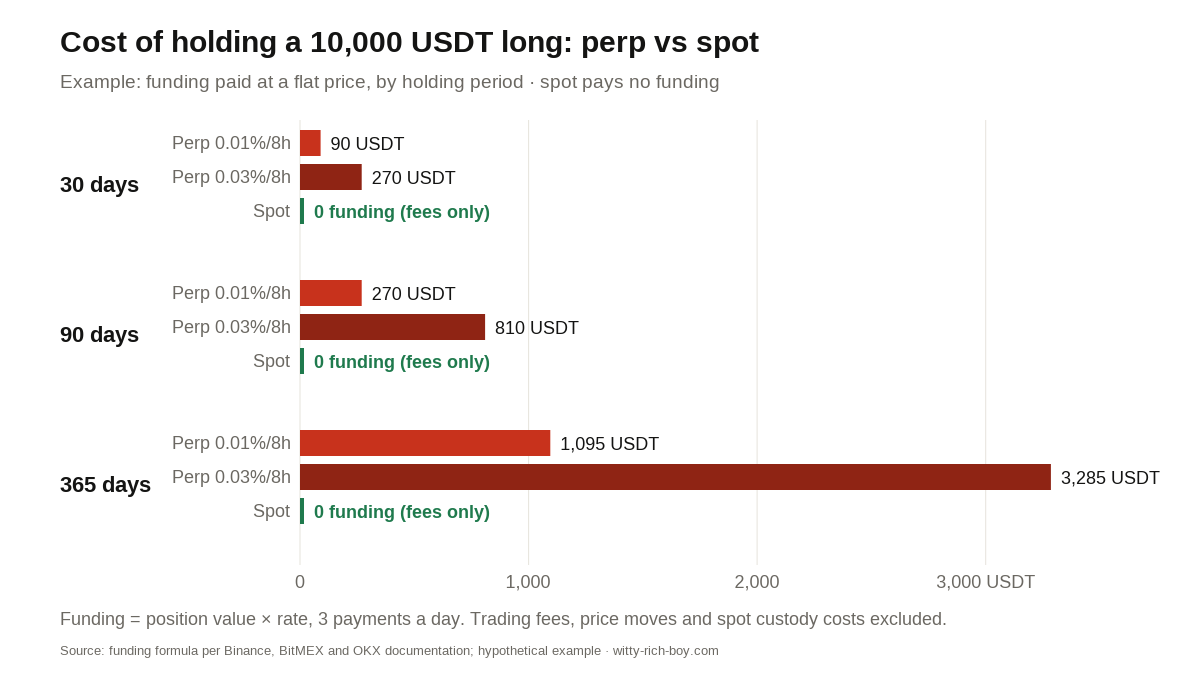
Real funding is not constant: it is recalculated every interval, so a year’s bill is the sum of 1,095 different rates, and payments rise with the price because they are charged on position value. A rally that lifts the position to 15,000 USDT makes each 0.01% payment 1.5 USDT. The direction of the error is uncomfortable — funding tends to be highest when markets are crowded long, which is exactly when long holders are most numerous.
The fair comparison: what the spare cash earns
A perpetual does tie up less money. At 5×, Ben posts 2,000 USDT of margin and keeps 8,000 USDT free. Example: if that 8,000 USDT earned an assumed 4% a year elsewhere, it would bring in 320 USDT. Set against 1,095 USDT of funding at 0.01%, the perpetual still costs about 775 USDT a year more than spot — and that is at the quiet-market rate, before any period of elevated funding. The capital saving offsets funding only when the rate on spare cash approaches the funding rate on the whole position.
Why does funding drag grow with leverage?
Funding drag grows with leverage because funding is charged on the full position value, not on the margin you post. The cash amount is the same at 1× and 10×; what changes is how large it is relative to the money actually at risk.
| Leverage | Margin on 10,000 USDT | Yearly funding at 0.01% per 8h | As % of margin | Yearly funding at 0.03% per 8h | As % of margin |
|---|---|---|---|---|---|
| 1× | 10,000 | 1,095 | 10.95% | 3,285 | 32.85% |
| 2× | 5,000 | 1,095 | 21.9% | 3,285 | 65.7% |
| 5× | 2,000 | 1,095 | 54.75% | 3,285 | 164.25% |
| 10× | 1,000 | 1,095 | 109.5% | 3,285 | 328.5% |
The last column is the one that matters for anyone tempted by high multiples. At 10× and a sustained 0.03% rate, a position that never moves loses more than three times its margin in a year — which in practice means it does not survive the year. The next two sections show where it stops.
How close is liquidation at 2×, 5× and 10× leverage?
A perpetual long is liquidated when its equity falls to the maintenance margin, the minimum the venue requires to keep it open. Spot bought outright has no such level: it can fall 100% and the coins remain yours.
Binance’s liquidation price FAQ defines maintenance margin as position notional × maintenance margin rate − maintenance amount, with the rate rising through tiers as the position grows. For a small isolated long with no maintenance amount, the formula reduces to:
Liquidation price = entry price × (1 − 1/leverage) ÷ (1 − maintenance margin rate)
Example: a 10,000 USDT isolated long opened at 100,000 USDT, using an assumed maintenance margin rate of 0.4% — the smallest BTCUSDT tier in Binance’s published bracket example. Real rates differ by contract and tier, and change; the maintenance margin explained guide covers the tier mechanics.
| Leverage | Margin | Liquidation price | Fall to liquidation | Loss at liquidation |
|---|---|---|---|---|
| Spot (fully paid) | 10,000 | none | — | none forced |
| 2× | 5,000 | 50,201 | 49.8% | about 5,000 USDT |
| 3× | 3,333 | 66,934 | 33.1% | about 3,333 USDT |
| 5× | 2,000 | 80,321 | 19.7% | about 2,000 USDT |
| 10× | 1,000 | 90,361 | 9.6% | about 1,000 USDT |
| 20× | 500 | 95,382 | 4.6% | about 500 USDT |
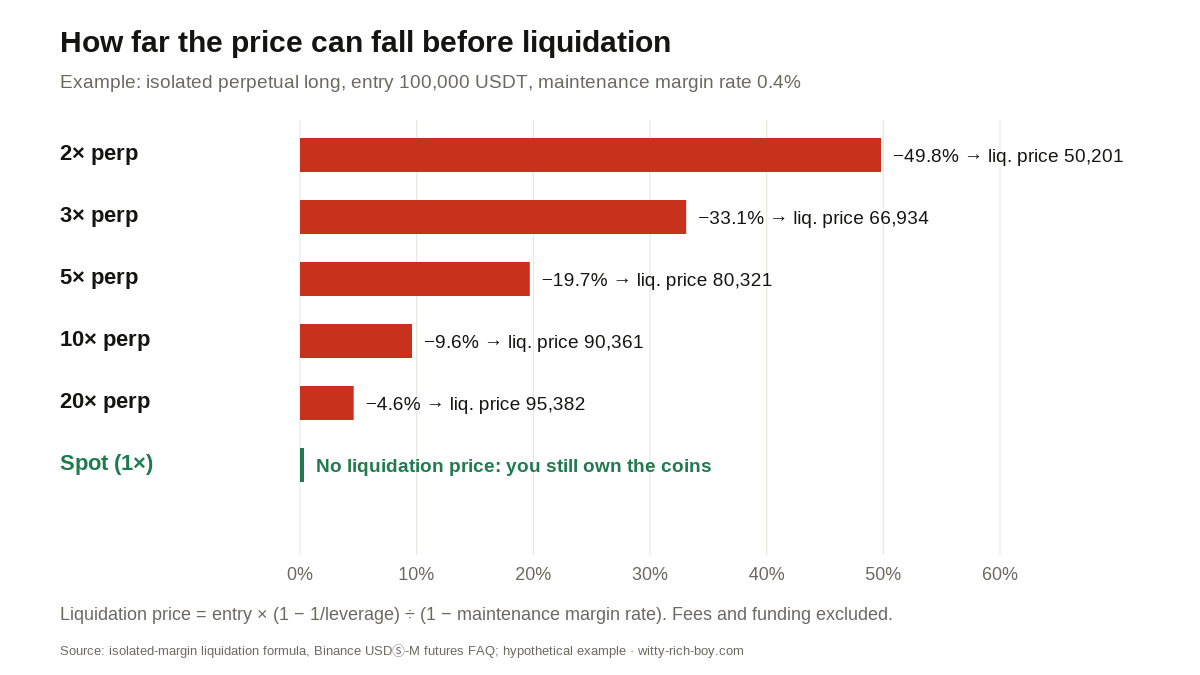
Liquidation is also costly in itself. Binance’s liquidation protocols describe cancelling open orders, reducing the position and charging a liquidation clearance fee on the amount liquidated, paid to the insurance fund. The spot holder who sits through a 20% drawdown keeps the coins and the chance of recovery; the 5× perpetual holder is closed out near the bottom and keeps neither. You can test other entry prices and multiples with our liquidation price calculator.
How does funding drag move your liquidation price?
Funding paid comes out of the position’s margin, so every payment moves a long’s liquidation price closer to the market — even if the price never moves. This is where cost of carry and liquidation risk, usually discussed separately, become one problem.
Example: keep Ben’s 10,000 USDT long, a flat price of 100,000 USDT, 0.4% maintenance margin and funding of 0.01% per 8 hours (3 USDT a day), all in isolated margin.
| Position | Margin left | Liquidation price | Fall to liquidation |
|---|---|---|---|
| 5× at opening | 2,000 | 80,321 | 19.7% |
| 5× after 90 days | 1,730 | 83,032 | 17.0% |
| 5× after 365 days | 905 | 91,315 | 8.7% |
| 10× at opening | 1,000 | 90,361 | 9.6% |
| 10× after 90 days | 730 | 93,072 | 6.9% |
| 10× after about 320 days | 40 | 100,000 | 0% — liquidated |
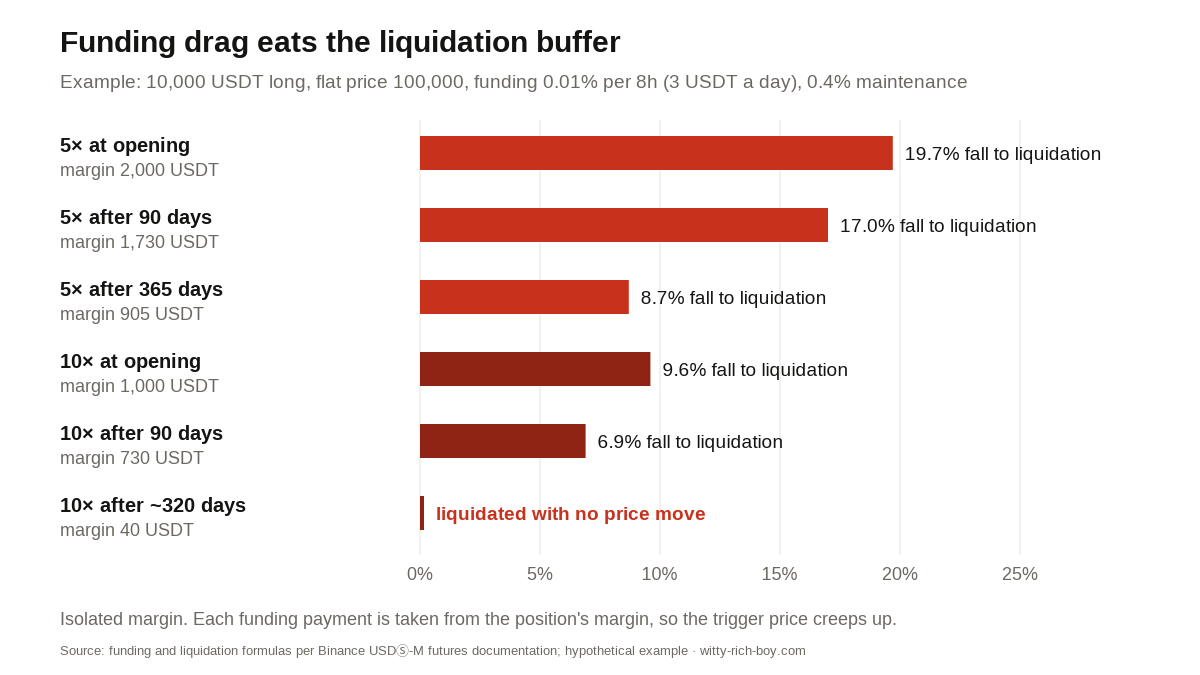
The 10× line is the striking one. At 320 days, Ben has paid 960 USDT of funding, his margin has fallen to the 40 USDT maintenance requirement, and the position is closed with the price exactly where he opened. Topping up margin postpones the date; it does not cancel the cost. In cross margin, payments are drawn from the shared balance, which spreads the effect across the account rather than removing it — see isolated vs cross margin.
Who owns the coins: custody in spot vs perpetual futures
With spot, you own the asset; with a perpetual, you own a claim on a venue that settles in cash. That distinction is invisible on a price chart and decisive if something goes wrong at the venue.
A spot holder can leave coins with an exchange or withdraw them to a wallet whose keys they control. A perpetual has nothing to withdraw: the position exists only on the venue’s books, the collateral sits there too, and gains are paid by the venue’s margin system out of other traders’ losses, with an insurance fund behind it. In the event of an exchange failure, a spot holder in self-custody is unaffected, whereas a perpetual holder is a creditor.
Ownership also shapes what you can do with the asset. Spot coins can be transferred, used as collateral elsewhere or staked where a protocol allows it. A perpetual offers none of this — but it can do one thing spot cannot easily do, which is go short with a single order.
Can perpetual futures ever be cheaper than spot?
Yes, in three situations: when funding is negative, when the aim is to be short, and when the perpetual is used alongside spot rather than instead of it.
- Negative funding. When the perpetual trades below its index, shorts pay longs. A long then receives funding — 1,095 USDT a year on 10,000 USDT at −0.01% per 8 hours. That income is real but fragile: rates reset every interval, and a 1% price fall erases more than a month of it.
- Short exposure. Shorting spot requires borrowing the coin and paying interest on the loan. A perpetual short simply receives funding when it is positive. For a bearish view or a hedge, the comparison flips.
- Cash and carry. Holding spot and shorting an equal amount of perpetual or dated futures neutralises price exposure and collects the premium of futures over spot. A BIS working paper, “Crypto carry” (No 1087, 2023), describes this as a simple cash-and-carry strategy and reports that the carry can become very large — up to 60% a year — and varies strongly over time, with interest-rate differentials explaining little of it.
That last point is the mirror image of Ben’s problem: the funding a perpetual long pays is income to whoever holds spot and shorts the perpetual. The cost does not vanish; it is a transfer from leveraged longs to the other side of the market.
Are perpetual futures available where you live?
Spot crypto is broadly available to retail buyers; crypto perpetuals are restricted in several large markets.
| Jurisdiction | Spot crypto | Crypto perpetuals and other derivatives | Rule |
|---|---|---|---|
| United Kingdom | Available | Cannot be sold, marketed or distributed to retail clients by firms in or from the UK | FCA ban, in force since 6 January 2021 |
| European Union | Regulated under MiCA | Treated as financial instruments under MiFID II, outside MiCA | MiCA Art. 2(4)(a) |
| United States | Available | CFTC approved a cash-settled bitcoin perpetual on a designated contract market | CFTC order of 29 May 2026 |
In the UK, the FCA’s press release announcing the ban covers derivatives — CFDs, options and futures — and exchange-traded notes that reference unregulated transferable cryptoassets. The FCA’s later move to allow retail access to crypto ETNs on recognised investment exchanges left the derivatives ban in place.
In the EU, the MiCA Regulation (Regulation (EU) 2023/1114) states in Article 2(4) that it does not apply to crypto-assets that qualify as financial instruments; ESMA, consulting on its qualification guidelines, said derivatives on crypto-assets should be treated as financial instruments under MiFID II. A perpetual sold in the EU is therefore an investment-services product, not a MiCA one — see MiCA explained for what MiCA does cover.
In the US, the CFTC announced its approval of KalshiEX’s BTCPERP, a cash-settled perpetual referencing a bitcoin real-time index in which longs and shorts exchange funding payments based on the gap between the mark price and the reference price. A companion policy statement said perpetuals on asset classes the order does not contemplate would go through case-by-case review under CFTC Regulation 40.3.
Tax can diverge as well. HMRC’s Cryptoassets Manual, at CRYPTO10150, says that where a derivative over cryptoassets has been entered into, its cryptoasset guidance “will not generally apply”; for companies such a contract will typically be a derivative contract under Part 7 CTA 2009. Spot disposals, by contrast, follow the capital gains rules summarised in our UK crypto tax guide.
How to compare the cost of perpetual futures vs spot before holding
Six checks, using only the contract page and a calculator, turn the comparison into numbers.
- Fix the holding period. Under a day, funding may be zero if you avoid a timestamp; over weeks it dominates. Count the payments: three a day on 8-hour contracts, more on 4- or 1-hour ones.
- Read the funding history, not just the current rate. Take an average over a period like the one you plan to hold, and note the highest readings.
- Multiply by position value. Funding per day = position value × rate × payments per day. Scale to the holding period and compare with spot’s round-trip trading fees.
- Divide by your margin. This shows the drag on the money actually at risk — 109.5% a year at 10× and 0.01% per 8 hours.
- Work out the liquidation price twice: at opening, and again after subtracting the expected funding from margin. If the second figure sits within a normal week’s price range, the plan depends on luck.
- Credit the spare capital fairly. Add what the cash not posted as margin would realistically earn, then compare the net figure with spot’s zero.
If the perpetual still looks cheaper after step six, the reason is usually negative funding or a short position — and both deserve a check at every funding interval, because the rate that justified the trade is not the rate you are guaranteed next time.
Questions readers ask
Is it cheaper to hold crypto spot or through perpetual futures?
For a long held more than a few days, spot is usually cheaper. Spot has no running charge beyond trading fees and any custody costs. A perpetual long pays funding whenever the rate is positive: at the default 0.01% every 8 hours that is 3 USDT a day on a 10,000 USDT position, or about 1,095 USDT a year. Only sustained negative funding makes the perpetual long cheaper to hold.
Can spot crypto be liquidated?
No. A spot purchase paid for in full has no margin and therefore no liquidation price. If the price falls 60%, you hold coins worth 60% less, but you still hold them and can wait. Liquidation only applies to positions that use borrowed funds or margin, such as perpetual futures or spot bought on margin.
Is a 1x perpetual long the same as owning spot?
Not quite. At 1× the price would have to fall to roughly zero before liquidation, so the price risk resembles spot. But you do not own the coins, you cannot withdraw them, and you still pay funding when it is positive. Over a year at 0.01% per 8 hours, a 1× perpetual long costs about 10.95% of its value, which spot does not.
Do perpetual futures expire?
No. A perpetual future has no expiry or settlement date, which is what distinguishes it from a dated future. BitMEX's guide describes this as its defining feature. Instead of converging to spot at expiry, a perpetual is held near the spot index by funding payments between longs and shorts, usually every 8 hours.
Do you own the coins when you buy a perpetual future?
No. A perpetual is a cash-settled contract that tracks the price; you hold margin, not coins. You cannot withdraw bitcoin from a perpetual long or move it to your own wallet. With spot you own the asset and can keep it with the exchange or move it to self-custody, which matters if a platform fails.
How does funding affect my liquidation price?
Funding you pay is taken from your margin, so each payment moves the liquidation price of a long closer to the market. In our example, a 5× isolated long on 10,000 USDT starts 19.7% from liquidation; after a year of paying 0.01% per 8 hours at a flat price, the distance is 8.7%. At 10× funding alone triggers liquidation after about 320 days.
Are perpetual futures legal in the UK?
UK firms may not sell them to retail clients. The FCA's ban on selling, marketing and distributing derivatives and exchange-traded notes that reference unregulated transferable cryptoassets to retail consumers has applied since 6 January 2021. Spot crypto is not covered by that ban. The FCA's later decision to allow retail access to crypto ETNs did not extend to derivatives.
Are perpetual futures taxed differently from spot crypto?
Often, yes. In the UK, HMRC's Cryptoassets Manual (CRYPTO10150) says its cryptoasset guidance will not generally apply where a derivative over cryptoassets has been entered into; derivatives follow their own rules, while spot disposals fall under capital gains tax. Rules differ by country, so check your tax authority's guidance.
Was this guide useful?
Thanks — your answer helps us decide what to cover next.
Sources
- BitMEX — Perpetual Contracts Guide (no expiry, funding, fair price marking)
- Binance — Introduction to Binance Futures Funding Rates
- Binance — How to Calculate Liquidation Price of USDⓈ-M Futures Contracts
- Binance — Binance Futures Liquidation Protocols
- FCA — FCA bans the sale of crypto-derivatives to retail consumers
- CFTC — CFTC Approves BTCPERP Contract Submitted by KalshiEX, LLC (release 9240-26)
- EUR-Lex — Regulation (EU) 2023/1114 on markets in crypto-assets (MiCA)
- HMRC Cryptoassets Manual — CRYPTO10150: derivatives over cryptoassets
- BIS Working Papers No 1087 — Crypto carry (Schmeling, Schrimpf, Todorov)
General information, not tax or legal advice. Rules change — check the official source or a licensed adviser before acting.