Global ·
Stablecoin Yield Tax (2026): Interest vs Disposal by Country
Stablecoin yield tax in 2026: lending and earn returns are generally income on receipt in the US, UK, Germany, Australia and Canada; swaps are separate disposals.

The short answer
- In the US, crypto received as a reward is gross income at fair market value once you can dispose of it (Rev. Rul. 2023-14); stablecoin yield follows that logic at 10% to 37% in 2026.
- HMRC CRYPTO61214 says a fixed, recurring DeFi lending return is revenue (miscellaneous income), a speculative one is capital, and that the return is not interest for tax purposes.
- UK draft legislation published on 13 July 2026 would, from 6 April 2027, exempt individuals' disposals of eligible stablecoins from CGT and treat time-value returns on them as interest.
- Germany taxes crypto lending fees under § 22 no. 3 EStG (BMF letter of 6 March 2025, para. 65) and only once the year's service income reaches €256; then the whole amount is taxed.
- The ATO says many DeFi lending arrangements are a CGT event when beneficial ownership passes, and rewards are income at market value when received.
- In our example, 500 of yield on 10,000 USDC costs $110 in the US (22%), £100 in the UK (20%, allowance used), €150 in Germany (30%) and A$160 in Australia.
In force: Rules as in force on 8 November 2026 · US Rev. Rul. 2023-14 and Rev. Proc. 2025-32 (2026 brackets) · HMRC CRYPTO61214 and UK 2026-27 rates; UK stablecoin draft legislation (13 July 2026) from 6 April 2027 · BMF letter of 6 March 2025 and § 22 no. 3 EStG · ATO DeFi guidance and 2026-27 rates · CRA 2026 brackets · MiCA Arts 40 and 50 · GENIUS Act (Public Law 119-27)
Stablecoin yield is taxed as income in almost every major system: the US, UK, Germany, Australia and Canada tax lending and savings returns at their value when received, at ordinary rates (US 10%–37% in 2026). Selling, swapping or redeeming the coin is a separate disposal. From 6 April 2027 UK draft rules would exempt eligible stablecoins from CGT.
A stablecoin earning 5% looks like a savings account, and many investors assume it is taxed like one. It is not, or not yet. Tax authorities see two different things: the yield, which is income the day it lands, and the coin itself, which is a crypto-asset whose every sale, swap or redemption can be a disposal. Below: the rule in six systems with its legal source, a worked example run through five of them, the depeg question, and the regulatory reason so few issuers pay interest at all. It covers private individuals, not traders or companies.
How is stablecoin yield taxed? The rule by country
In most countries the yield is ordinary income at market value on receipt, and the coin is a capital asset whose disposal is taxed separately. The table gives the short answer.
| Country | Yield (lending, earn, DeFi rewards) | Lending the coin out | Selling or swapping the coin | Legal source |
|---|---|---|---|---|
| United States | Gross income at fair market value when you can dispose of it | No lending-specific IRS ruling | Taxable disposal; capital gain or loss | Rev. Rul. 2023-14; IRC § 61 |
| United Kingdom | Miscellaneous income if revenue in nature; CGT if capital | Disposal if beneficial ownership passes | Taxable disposal today; eligible stablecoins exempt from 6 Apr 2027 (draft) | CRYPTO61214, CRYPTO61620; draft legislation |
| Germany | § 22 no. 3 EStG income, tax-free below €256 a year | Lent coins keep their one-year clock | § 23 EStG: taxable within one year, €1,000 Freigrenze | BMF letter 6 Mar 2025, para. 65 |
| Australia | Assessable income at market value when received | Often a CGT event when beneficial ownership ends | CGT event; 50% discount after 12 months | ATO DeFi guidance |
| Canada | Income when credited (staking analogy) | No lending-specific CRA page | Disposition; 50% of a capital gain taxed | CRA crypto-asset guide |
| Japan | Taxable on acquisition at market value | — | Generally miscellaneous income | NTA crypto FAQ |
What counts as stablecoin yield?
Stablecoin yield is any return paid to you for holding, lending or depositing a stablecoin, a crypto-asset designed to keep a stable value against a currency such as the dollar or euro. It arrives in four main forms.
- Centralised “earn” or savings products. You deposit coins with a platform, which lends or invests them and credits a fixed or variable rate, usually daily or monthly.
- DeFi lending. You supply coins to a lending protocol and receive a receipt token that accrues a return as borrowers pay.
- Reward programmes. A platform pays a percentage on balances held, often funded by its own revenue rather than lending.
- Yield-bearing or rebasing tokens. The token balance grows automatically, or its price rises against the underlying stablecoin.
The legal form matters more than the label. The ATO warns that in DeFi, words such as “lending” and “interest” do not always carry their ordinary tax meaning, and HMRC’s CRYPTO61214 says it does not consider a DeFi lending return to be interest for tax purposes. None of the authorities cited here has published a rule written specifically for rebasing tokens, so the general income-or-capital tests below decide.
Is stablecoin interest income or a capital gain in the US?
Income. In the US, stablecoins received as yield are ordinary income at their fair market value when you gain dominion and control, and that value becomes your basis.
The IRS has not issued a ruling specifically on crypto lending. The closest authority is Rev. Rul. 2023-14, which holds that a cash-method taxpayer who receives staking rewards includes their fair market value in gross income under IRC § 61 in the year they gain dominion and control, meaning the ability to sell, exchange or otherwise dispose of them. The ruling applies equally where rewards are earned through an exchange. A stablecoin worth $1 credited as yield is therefore $1 of income, taxed at ordinary rates: for 2026, Rev. Proc. 2025-32 keeps the seven rates from 10% to 37%, with the 22% band running from $50,400 to $105,700 for a single filer.
Two reporting points catch people out. Brokers report sales on Form 1099-DA, not income, and IRS Notice 2024-57 lets them skip transactions described as lending for now. Under the optional method, qualifying stablecoin sales up to $10,000 of yearly gross proceeds need not be reported either. None of that changes what is taxable.
How does HMRC tax stablecoin yield in the UK?
Today, a fixed or recurring return on lent stablecoins is miscellaneous income; a speculative return, or one realised by disposing of an asset, is capital and falls within Capital Gains Tax.
CRYPTO61214 sets out the test. A return agreed when the deal is made, such as a fixed annual rate, indicates a revenue receipt, and recurring payments are more likely to be income. A return that is unknown and speculative, or realised by disposing of a capital asset, indicates a capital receipt. Because HMRC does not treat the return as interest, the Personal Savings Allowance does not cover it; the £1,000 trading and miscellaneous income allowance can, as our UK crypto staking tax guide explains. Above that, it is taxed at 20%, 40% or 45% in 2026-27.
Lending can also be a disposal. Where beneficial ownership passes to a platform or borrower, the transfer is a disposal at that moment (CRYPTO61620). For a dollar stablecoin the sterling value moves with the exchange rate, so a real gain or loss can arise even when the coin holds its peg.
What changes on 6 April 2027?
HMRC published a policy paper on the tax treatment of stablecoins with draft legislation on 13 July 2026, for Finance Bill 2026-27. For individuals and trustees it would:
- Exempt disposals of eligible stablecoins from CGT, from 6 April 2027.
- Treat qualifying returns as interest. A return on a cryptoasset debt qualifies if it is reasonable to assume it reflects the time value of the coins and they are eligible stablecoins when it accrues; it then counts as savings income.
An eligible stablecoin is one where it is reasonable to assume enough currency or other assets are held to keep a stable value against sterling or another currency, that is designed for payments or settlement, and whose type is widely available. A dollar coin is therefore not excluded by its currency alone. Separately, qualifying crypto loans would move to a no gain, no loss basis from the same date. All of this is draft until enacted.
How is stablecoin yield taxed in Germany, Australia and Canada?
All three tax the yield as income on receipt; they differ on thresholds and on whether lending itself is a disposal.
Germany
The BMF letter of 6 March 2025 says income from lending is taxable under § 22 no. 3 EStG, because making coins available for a period is a service (para. 65). Tokens received are acquired at their market price on receipt. Depending on the contract, the letter says investment income under § 20 EStG or business income may apply instead. Under § 22 no. 3 sentence 2 EStG, the income is tax-free only if all service income, staking included, totals less than €256 in the year; at €256 the whole amount is taxed at your personal rate, as our German crypto staking tax guide shows. A Federal Finance Ministry draft bill dated 30 September 2026 would move certain private crypto income into § 20 EStG; it is a draft, not law.
Australia
The ATO’s page on decentralised finance and wrapping crypto says many DeFi lending and borrowing arrangements cause a CGT event because beneficial ownership of the token ends, and where a contract is unclear and the platform pools fungible tokens, the event happens at the initial loan. Rewards paid in crypto are assessable income at market value when received, and the securities lending rules do not apply to crypto lending. For 2026-27 the resident rates are nil to A$18,200, then 15%, 30%, 37% and 45%, plus the 2% Medicare levy; our ATO crypto tax guide covers the 50% discount on disposals.
Canada
The CRA has no lending-specific page. Its staking guidance says rewards from staking on a centralised platform are generally income when credited to your wallet, and its crypto guide says income from crypto transactions is business income or a capital gain depending on the circumstances. Record units, date and Canadian-dollar value for every credit.
Is swapping USD to USDC, or USDC to USDT, a taxable disposal?
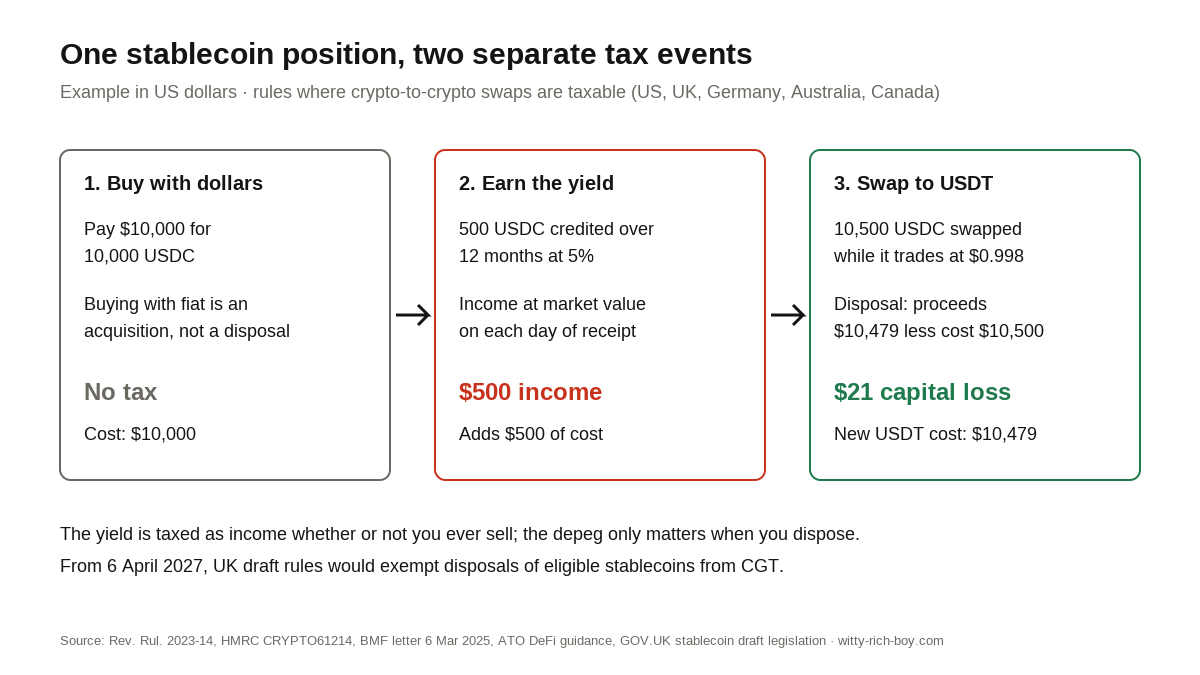
Buying a stablecoin with dollars is not a disposal; swapping one stablecoin for another, or redeeming it for cash, generally is.
A purchase with fiat simply gives you an asset with a cost. A swap of USDC for USDT disposes of the USDC in every system that taxes crypto-to-crypto swaps, as our explainer on whether crypto swaps are taxable sets out. Because both coins trade close to one dollar, the gain or loss is usually small.
Example: Sam holds 10,500 USDC with a cost of $10,500 and swaps it for USDT while USDC trades at $0.998. Proceeds are $10,479, so he has a $21 capital loss, and his USDT costs $10,479. In Germany, gains on coins held under a year count towards the separate €1,000 Freigrenze of § 23 EStG. In the UK, from 6 April 2027 a disposal of an eligible stablecoin would be exempt, so neither gain nor loss would count.
The trap is volume, not size. Hundreds of small swaps, deposits into lending pools and withdrawals each need a date, value and cost, even when the net result is a few dollars.
What does 10,000 USDC at 5% cost in tax? A worked example
Example: An individual holds 10,000 USDC in an earn product paying 5% for a year, credited monthly, for 500 of yield. To keep the comparison clean we treat the yield as 500 units of local currency in each country, assume a marginal rate and ignore other income in the category.
| Country | Treatment of the 500 | Assumed rate | Tax on the yield |
|---|---|---|---|
| United States | Ordinary income (Rev. Rul. 2023-14 logic) | 22% (single, $50,400–$105,700) | $110 |
| United Kingdom | Miscellaneous income (CRYPTO61214) | 20% basic rate; £1,000 allowance already used | £100 (£0 if allowance unused) |
| Germany | § 22 no. 3 EStG; €500 is over €256 | 30% personal rate (assumed) | €150 |
| Australia | Assessable income | 30% + 2% Medicare levy | A$160 |
| Canada | Income when credited | 20.5% federal bracket only | C$102.50 plus provincial tax |
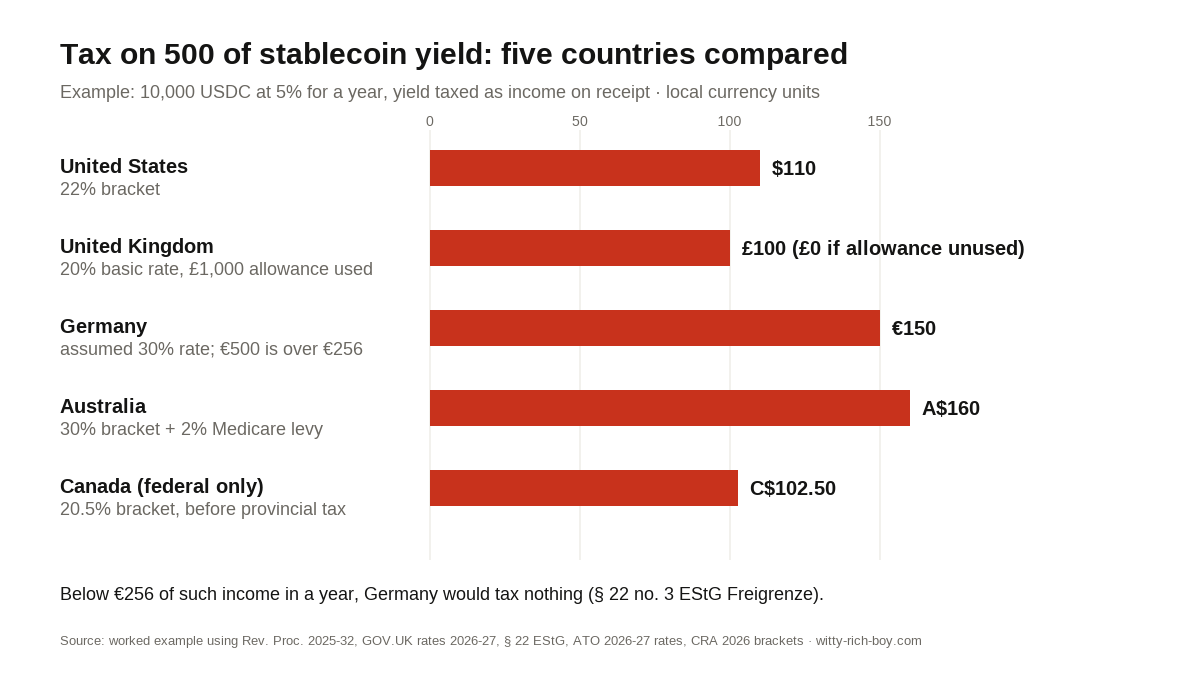
Thresholds swing the result more than rates. Cut the yield to €250 and the German bill falls to zero; push it to €256 and the whole amount is taxed. In the UK an unused £1,000 allowance wipes out the bill. From 2027-28 the UK answer would change again, because qualifying returns on eligible stablecoins would be savings income rather than miscellaneous income.
Why can’t stablecoin issuers pay interest? MiCA and the GENIUS Act
Because both the EU and the US prohibit it for most issuers, so any yield you see is paid by someone else, through lending or a reward arrangement, and taxed according to that structure.
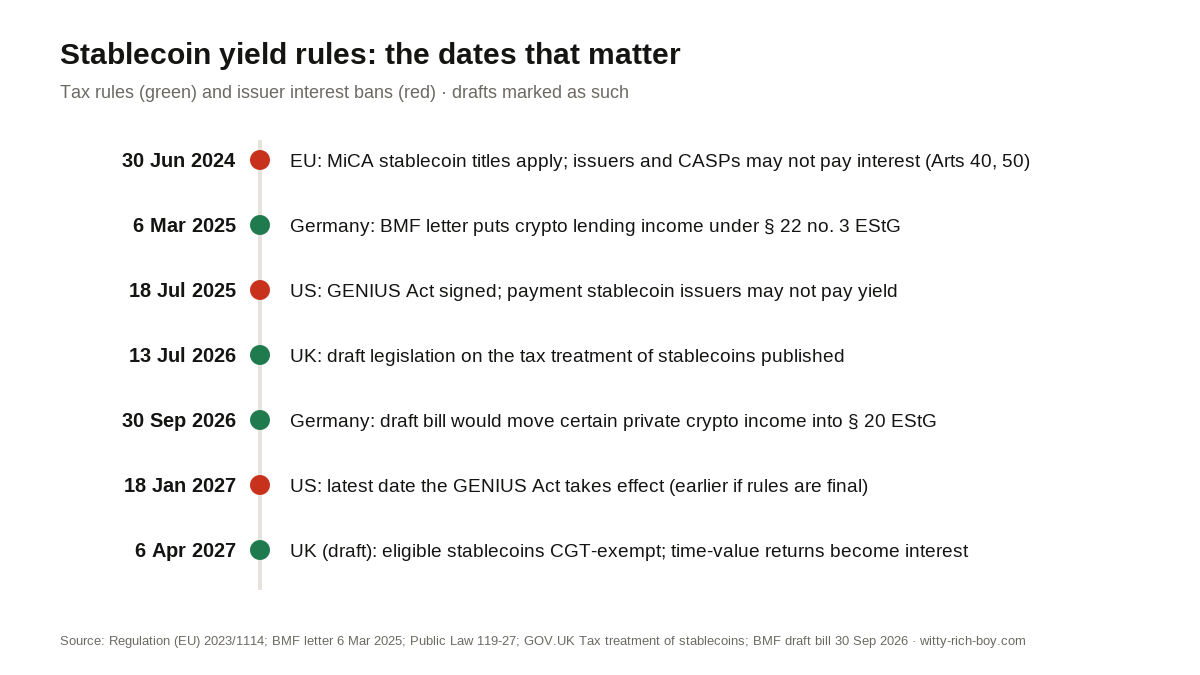
In the EU, MiCA Article 50 bars issuers of e-money tokens from granting interest, and extends the bar to crypto-asset service providers providing services related to them; Article 40 does the same for asset-referenced tokens (Regulation (EU) 2023/1114). Any remuneration or benefit related to how long a holder keeps the token counts as interest. Our MiCA explainer covers the rest of the regime.
In the US, the GENIUS Act (Public Law 119-27), signed on 18 July 2025, prohibits permitted and foreign payment stablecoin issuers from paying interest or yield to a holder solely in connection with holding, using or retaining the coin. The ban names issuers; whether it reaches platforms that pay rewards remains debated. The Act takes effect on the earlier of 18 months after enactment (18 January 2027) or 120 days after final regulations.
How to record and report stablecoin yield, step by step
- Identify the structure. Earn product, DeFi loan, reward programme or rebasing token? Keep the terms, especially whether the provider takes ownership of your coins.
- Log every credit. Date, quantity and value in your own currency on the day it became available to you; in the US that is the dominion-and-control date.
- Classify the yield. US, Australia and Canada: income on receipt. UK: revenue or capital under CRYPTO61214. Germany: § 22 no. 3 unless the contract points to § 20.
- Test the thresholds. Germany’s €256 Freigrenze across all service income; the UK’s £1,000 allowance across trading and miscellaneous income.
- Record the deposit itself. In the UK and Australia, handing coins to a platform that takes beneficial ownership can be a disposal; note the value at that moment.
- Track the cost of each lot. Yield coins carry their income value as cost; the coins you bought carry their purchase price.
- Treat swaps and redemptions as disposals. Calculate the small gain or loss, using sterling or euro values where your tax currency is not the dollar.
- Reconcile with platform statements. Forms such as the 1099-DA show disposals, not yield, so add income from your own log.
- Keep the file for as long as you hold the coins and for the years after sale your authority requires.
Questions readers ask
Is stablecoin yield taxable?
Yes, in every major system covered here. The US treats crypto received as a reward as income at fair market value once you can dispose of it. The UK taxes a fixed, recurring lending return as miscellaneous income, Germany as § 22 no. 3 income above €256 a year, and Australia as assessable income at market value. Selling or swapping the stablecoin later is a separate disposal.
Is stablecoin interest taxed as income or capital gains?
Usually income, at the value on the day you receive it. Capital treatment applies to disposals: selling, swapping or redeeming the coin. The UK is the clearest exception: under HMRC CRYPTO61214 a return that is speculative or realised by disposing of an asset is capital and falls within Capital Gains Tax, while a fixed, recurring return is revenue. Germany may treat some lending contracts as investment income under § 20 EStG.
Is swapping USDC for USDT a taxable event?
Where crypto-to-crypto swaps are taxable, yes: the US, UK, Germany, Australia and Canada all treat swapping one stablecoin for another as a disposal of the first. Because both trade near one dollar, the gain or loss is usually tiny, for example a $21 loss on 10,500 USDC swapped at $0.998. Buying USDC with dollars is an acquisition, not a disposal.
How is stablecoin yield taxed in the UK from April 2027?
Under draft legislation published on 13 July 2026, disposals of eligible stablecoins by individuals and trustees would be exempt from Capital Gains Tax from 6 April 2027, and a return on a cryptoasset debt that reflects the time value of eligible stablecoins would be treated as interest, so savings income. Eligibility requires sufficient backing, a payment purpose and wide availability. It is draft law until Finance Bill 2026-27 passes.
Do I pay tax on stablecoin yield in Germany?
Only above a threshold. The BMF letter of 6 March 2025 treats crypto lending income as other income under § 22 no. 3 EStG, valued in euros on receipt. It is tax-free if all such service income, staking included, stays below €256 in the calendar year; at €256 or more the whole amount is taxed at your personal rate. Some contracts may instead give investment income under § 20 EStG.
Why don't stablecoin issuers pay interest?
Because the law stops many of them. In the EU, MiCA Articles 40 and 50 bar issuers of asset-referenced and e-money tokens, and crypto-asset service providers, from granting interest on those tokens. In the US, the GENIUS Act bars payment stablecoin issuers from paying interest or yield solely for holding, using or retaining the coin. Yield offered elsewhere comes from lending or other arrangements, which are taxed as such.
Is stablecoin yield reported on Form 1099-DA?
Not as income. Form 1099-DA reports sales and exchanges by brokers, and IRS Notice 2024-57 lists transactions described as lending among those brokers need not report until further guidance. Brokers using the optional method also need not report qualifying stablecoin sales up to $10,000 of yearly gross proceeds. Yield remains taxable, so the amounts and dates must come from your own records.
Was this guide useful?
Thanks — your answer helps us decide what to cover next.
Sources
- Rev. Rul. 2023-14 — staking rewards are gross income on dominion and control (Internal Revenue Service, PDF)
- Rev. Proc. 2025-32 — 2026 inflation adjustments incl. income tax brackets (Internal Revenue Service, PDF)
- CRYPTO61214 — DeFi lending and staking: Income Tax: nature of the return (HMRC Cryptoassets Manual)
- Tax treatment of stablecoins — policy paper (HM Revenue & Customs, GOV.UK)
- Tax treatment of stablecoins — draft legislation, accessible version (GOV.UK)
- BMF letter of 6 March 2025 — Einzelfragen zur ertragsteuerrechtlichen Behandlung bestimmter Kryptowerte (PDF)
- Decentralised finance and wrapping crypto (Australian Taxation Office)
- Reporting income from crypto-asset mining and staking activities (Canada Revenue Agency)
- MiCA Article 50 — Prohibition of granting interest (ESMA Interactive Single Rulebook)
- Public Law 119-27 — GENIUS Act, 18 July 2025 (Congress.gov, PDF)
General information, not tax or legal advice. Rules change — check the official source or a licensed adviser before acting.