United Kingdom · Crypto
HMRC Crypto Nudge Letter (2026): What to Do and Penalty Risk
Got an HMRC crypto nudge letter? It is not an investigation, but don't ignore it. Response options, how to fix past years, 0–100% penalty ranges and 2026 interest.

The short answer
- An HMRC crypto nudge letter is a non-statutory “one to many” letter: it is not an enquiry, but HMRC can open one — or raise an assessment — if you ignore it.
- According to a Freedom of Information request reported by the FT, HMRC sent nearly 65,000 crypto letters in 2024-25, up from about 27,700 the year before; CARF data collection began on 1 January 2026.
- Errors in the current or previous tax year are fixed on your Self Assessment return (amendable for 12 months after the 31 January deadline); older years go through the cryptoasset disclosure service, with payment due within 30 days.
- HMRC can normally go back 4 years, 6 years for careless errors and 20 years for deliberate ones (TMA 1970 s34 and s36).
- Inaccuracy penalties under Schedule 24 FA 2007 run from 0–30% (careless, unprompted) to 50–100% (deliberate and concealed, prompted) of the extra tax.
- Late-payment interest is Bank Rate plus 4%: 7.75% from 9 January 2026 and 8.00% from 24 November 2026 after Bank Rate rose to 4%.
In force: 1 January 2026 (CARF data collection) · 9 January 2026 (7.75% late-payment interest) · 24 November 2026 (8.00% late-payment interest)
An HMRC crypto nudge letter is a non-statutory “one to many” letter telling you HMRC holds data suggesting you may owe tax on cryptoassets. It is not an investigation. Check every year: fix the last two on your Self Assessment return, older years through HMRC's cryptoasset disclosure service, or reply confirming your returns are correct. Ignoring it risks an enquiry.
HMRC has been writing to crypto investors for years, but the volume has changed. A Freedom of Information request by an accountancy firm, reported by the Financial Times, found HMRC sent nearly 65,000 letters about cryptoassets in 2024-25, more than double the roughly 27,700 of the year before. With platforms now collecting tax identifiers under the Cryptoasset Reporting Framework, the next rounds will be built on better data. Below: what the letter means, your options, the penalties and interest in numbers, and a step-by-step reply.
What is an HMRC crypto nudge letter?
A nudge letter — HMRC’s own term is a “one to many” letter — is a standard letter sent to a large group of taxpayers whom HMRC’s data flags as possibly having undeclared income or gains. It invites you to check your affairs and put things right yourself. It is not a statutory information notice and it does not open an enquiry.
The crypto version typically says HMRC has information that you hold or have disposed of cryptoassets, reminds you that disposals can create a Capital Gains Tax liability and that staking or mining can be income, and points you to the disclosure route. Some rounds have enclosed a certificate of tax position — a declaration that your returns are complete — and asked for a reply by a stated date. Treat the date printed on your letter as the deadline that matters; past campaigns have varied.
| Nudge (“one to many”) letter | Compliance check (enquiry) | |
|---|---|---|
| Legal status | Non-statutory, educational | Statutory enquiry or information notice |
| Who gets it | Thousands of people from one data set | You, about a specific return or year |
| Must you respond? | No legal duty, but strongly advisable | Yes — deadlines are enforceable |
| What happens if ignored | HMRC may open an enquiry or raise an assessment | Penalties for non-compliance with notices |
| Effect on penalties | Disclosure after it is often treated as prompted | Disclosure is prompted |
Why did HMRC send me a crypto letter?
Almost always because a platform’s records show you bought, sold or held tokens, and HMRC could not match that activity to the cryptoasset section of your return. HMRC has long been able to demand customer data from UK exchanges under its information powers; from 2026 it receives far more, automatically.
Under the Cryptoasset Reporting Framework (CARF), UK platforms have been collecting each user’s name, address, date of birth, country of residence and National Insurance number or UTR since 1 January 2026. The first annual report, covering calendar 2026, must reach HMRC by 31 May 2027, according to HMRC’s CARF guidance. Platforms in other CARF jurisdictions exchange equivalent data, and the EU’s parallel regime is explained in our guide to DAC8 crypto reporting.
A letter is therefore not proof that you owe anything. Data shows transactions, not profits. A person who bought £20,000 of Bitcoin and never sold it, or who sold at a loss, can receive exactly the same letter as someone with a £50,000 undeclared gain.
Do I have to respond to an HMRC nudge letter?
There is no legal obligation to respond, but you should. HMRC can still open a compliance check or raise an assessment where it believes tax is due, and silence leaves HMRC to draw its own conclusions from incomplete data.
Your answer falls into one of three outcomes:
- Everything was declared correctly. Reply in writing to say so. Keep your calculations — pools, sterling values, exchange exports — ready in case HMRC asks.
- No tax was due. You may have had gains within the £3,000 annual exempt amount, net losses, or only purchases. Say so, and consider whether you should have reported anyway: if you are in Self Assessment, disposals with total proceeds over £50,000 must be reported even when no tax is due.
- Something was missed. Correct it using the route that fits the year (next section), then reply.
On the certificate: signing is voluntary, and signing it knowing it to be wrong turns a careless error into something far worse. Disclose first, sign afterwards — or not at all.
How do I correct past crypto tax years?
Use your Self Assessment return for the current or previous tax year, and HMRC’s cryptoasset disclosure service for anything older. HMRC’s guidance on telling HMRC about unpaid tax on cryptoassets says income or gains from the current or previous year should go on a return rather than through the service.
Amending a Self Assessment return
You can change a filed return within 12 months of the 31 January filing deadline for that year, under GOV.UK’s corrections guidance. In practice, in November 2026:
- 2024-25 return (deadline 31 January 2026): amend online until 31 January 2027.
- 2025-26 return (deadline 31 January 2027): not yet due — include crypto when you file.
- 2023-24 and earlier: the amendment window has closed; use the disclosure service.
The cryptoasset disclosure service
The service covers exchange tokens, NFTs and utility tokens. You sign in, work out the Capital Gains Tax and Income Tax owed for each year, add interest and penalties, and make an offer. HMRC’s guidance says you must pay within 30 days of submitting the disclosure, and to call its helpline if you cannot. Never registered for Self Assessment? The same service applies; the penalty is then for failure to notify rather than an inaccurate return.
Before you calculate, rebuild each token’s cost properly. The UK uses same-day, 30-day and section 104 pooling rules rather than FIFO — see UK crypto tax rules and our explainer on crypto cost basis methods for why exchange-generated reports are often wrong for UK purposes.
How far back can HMRC go for crypto tax?
Four years after the end of the tax year as standard, six years if the under-declaration was careless and twenty years if it was deliberate. These limits come from sections 34 and 36 of the Taxes Management Act 1970 and are tabulated in HMRC CH56100; the deliberate limit is explained at CH53600.
| Your behaviour | Time limit (TMA 1970) | Earliest year open in Nov 2026 | That year closes on |
|---|---|---|---|
| Took reasonable care | 4 years — s34 | 2022-23 | 5 April 2027 |
| Careless | 6 years — s36(1) | 2020-21 | 5 April 2027 |
| Deliberate | 20 years — s36(1A) | 2006-07 | 5 April 2027 |
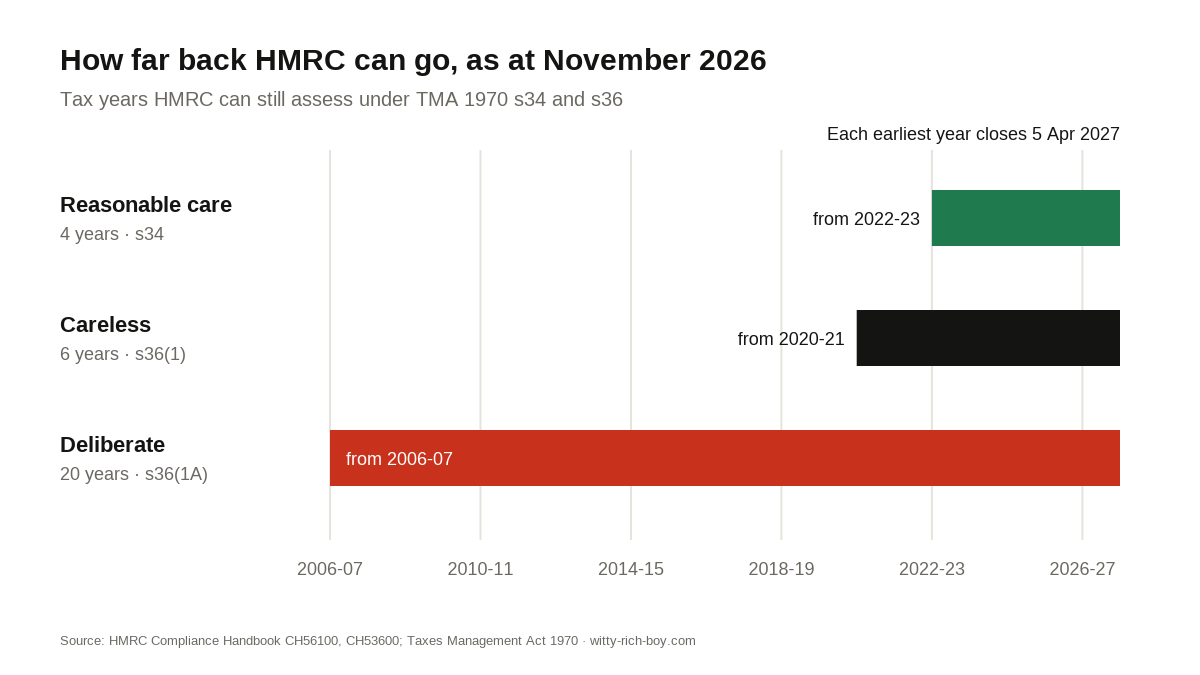
A disclosure should cover every year in which you think tax was underpaid within the limit that matches your behaviour. Under-disclosing — claiming carelessness for something HMRC sees as deliberate — is one of the quickest ways to lose penalty reductions.
What are the penalties for undeclared crypto gains?
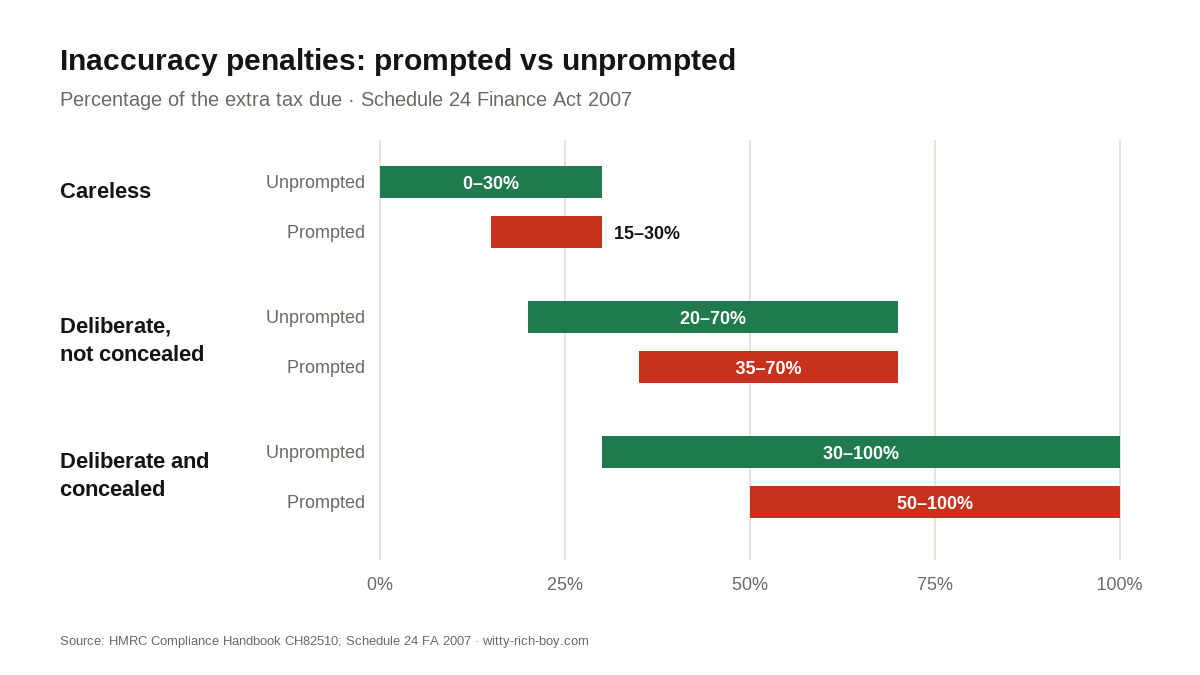
Penalties are a percentage of the extra tax, set by your behaviour and whether the disclosure was prompted. For an inaccurate return the ranges come from Schedule 24 of the Finance Act 2007, listed in HMRC CH82510:
| Behaviour | Unprompted disclosure | Prompted disclosure |
|---|---|---|
| Careless | 0% – 30% | 15% – 30% |
| Deliberate, not concealed | 20% – 70% | 35% – 70% |
| Deliberate and concealed | 30% – 100% | 50% – 100% |
Within each range HMRC reduces the penalty for the quality of disclosure: telling, helping and giving access to records. A full, early and well-documented disclosure lands near the bottom; a grudging one near the top.
If you were never registered for Self Assessment, Schedule 41 of the Finance Act 2008 applies instead. HMRC’s factsheet CC/FS11 sets a non-deliberate failure to notify at 0–30% if disclosed unprompted within 12 months of the tax being due, and 10–30% after that. No penalty is charged where you have a reasonable excuse and the failure was not deliberate.
Does a nudge letter make my disclosure prompted?
Usually, but not by definition. HMRC’s CH82421 says the test is objective — did you have reason to believe HMRC had found, or was about to find, the error? — and that a general campaign announcing an area of focus does not on its own stop a disclosure being unprompted. A letter that cites data about your accounts is harder to argue around. Either way, the lesson is simple: the earlier you correct, the lower the floor.
How much interest will HMRC charge?
Late-payment interest is Bank Rate plus 4 percentage points, the margin in force since 6 April 2025 under HMRC’s late-payment interest policy paper. It runs daily from the original due date — 31 January after the tax year — until you pay. It is not a penalty and cannot be negotiated away.
The rate was 7.75% from 9 January 2026, when Bank Rate stood at 3.75%. After Bank Rate rose to 4.00% on 5 November 2026, HMRC announced that the rate for non-quarterly payments moves to 8.00% from 24 November 2026.
Worked example: interest and penalty on an undeclared gain
Example: Priya is a higher-rate taxpayer. In February 2025 she sold Ether for a £15,000 gain after pooling, and filed her 2024-25 return in January 2026 without it. A nudge letter arrives in autumn 2026. She amends the 2024-25 return before the 31 January 2027 cut-off and pays that day.
| Step | Calculation | Amount |
|---|---|---|
| Taxable gain | £15,000 − £3,000 annual exempt amount | £12,000 |
| Capital Gains Tax | £12,000 × 24% | £2,880.00 |
| Interest, 31 Jan – 24 Nov 2026 | £2,880 × 7.75% × 297/365 | £181.62 |
| Interest, 24 Nov 2026 – 31 Jan 2027 | £2,880 × 8.00% × 68/365 | £42.92 |
| Penalty if careless and prompted | 15% – 30% of £2,880 | £432 – £864 |
| Total cost | Tax + interest + penalty | £3,536.54 – £3,968.54 |
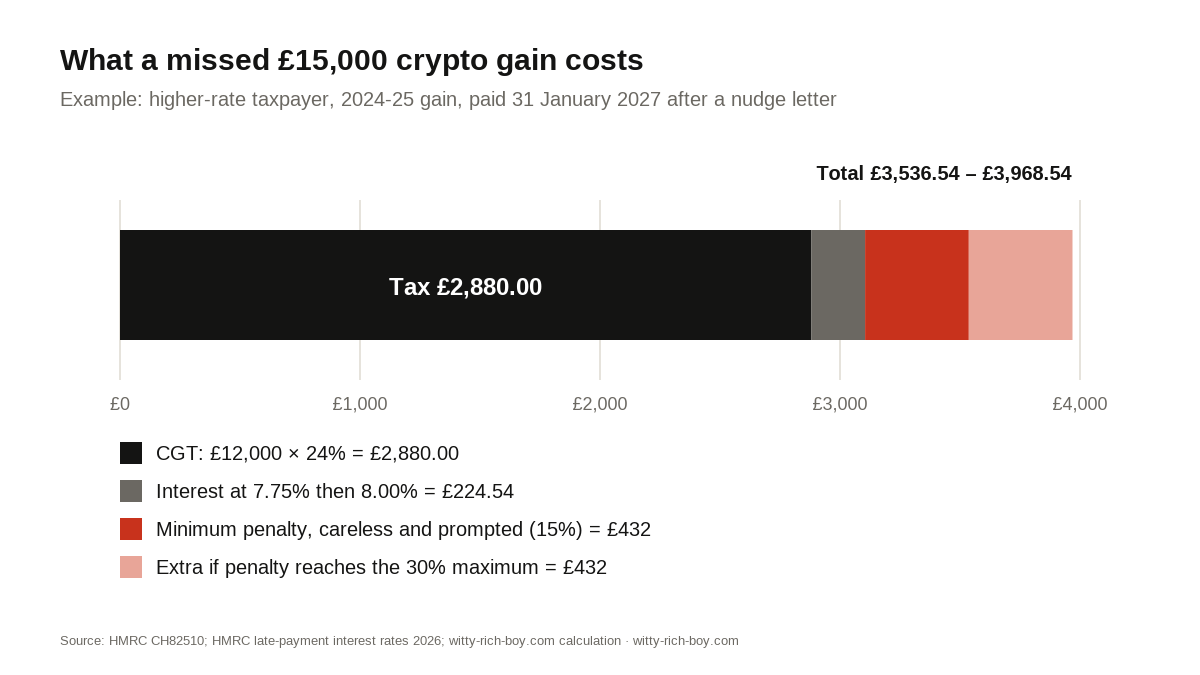
Had Priya corrected the return before any letter, and HMRC accepted the disclosure as unprompted, the careless range would start at 0% — a total of £3,104.54 at best. The example assumes the 8% rate holds to the end of January 2027 and that the error was careless; a deliberate omission would start at 35%. Our UK Capital Gains Tax calculator splits a gain between the 18% and 24% rates if you are a basic-rate taxpayer.
What should I do? A decision table for your situation
Match your position to the row and act on the right-hand column. The treatment of staking and other income is set out in our guide to crypto staking tax in the UK.
| Your situation | Most likely route | Penalty exposure |
|---|---|---|
| Only bought and held, never sold or swapped | Written reply: no disposals | None |
| Sold, but gains within £3,000 and proceeds under £50,000 | Written reply with calculation | None |
| Net losses in the years concerned | Reply; claim losses within 4 years | None; losses can shelter future gains |
| Missed gain in 2024-25, return already filed | Amend the return by 31 Jan 2027 | Careless: 0–30% or 15–30% |
| Missed gains in 2023-24 or earlier | Cryptoasset disclosure service; pay within 30 days | Schedule 24 ranges by behaviour |
| Never registered for Self Assessment | Register for Self Assessment now; disclosure service for earlier years | Schedule 41 failure to notify |
| Large sums, many years, or deliberate omission | Specialist adviser before any reply | Up to 100%; 20-year look-back |
Swaps between tokens count as disposals in the UK even when no pounds reach your bank — a frequent cause of letters to people who believe they “never cashed out”. Our Capital Gains Tax guide covers the annual exempt amount and the 18% / 24% band split in full.
How to respond to an HMRC crypto letter
- Note the date and the reference. Diarise the response date on the letter and keep the letter’s reference for every contact with HMRC.
- Do not sign anything yet. Leave any certificate of tax position until you have checked every year it covers.
- Export your full history. Download transaction records from every exchange, wallet and DeFi protocol you have used, including closed accounts.
- Rebuild each token’s cost. Apply the same-day rule, the 30-day rule and the section 104 pool in sterling, year by year.
- Separate income from gains. Staking, mining and some airdrops are income; disposals go to Capital Gains Tax.
- Classify your behaviour honestly. Reasonable care, careless or deliberate determines how far back you go and the penalty floor.
- Choose the route. Amend the return for 2024-25, include crypto in the 2025-26 return, and use the cryptoasset disclosure service for older years.
- Calculate tax, interest and penalty. Use the daily interest rates in force for each period and the Schedule 24 or Schedule 41 range that fits.
- Pay or arrange payment. Pay within 30 days of a disclosure, or contact HMRC to discuss a payment plan before that date.
- Reply in writing. Tell HMRC what you did — amended, disclosed or no tax due — and keep copies of everything for at least the open time limit.
Questions readers ask
Do I have to reply to an HMRC crypto nudge letter?
A nudge letter is not a statutory notice, so there is no legal duty to reply or to sign any declaration it encloses. But ignoring it is unwise: HMRC can still open a compliance check or raise an assessment for tax it believes is due. If your returns were right, a short written reply saying so, with your workings to hand, is usually the sensible course.
Does a nudge letter mean HMRC is investigating me?
No. A nudge or “one to many” letter goes to many people at once, typically chosen from third-party data such as exchange records. It signals that HMRC holds information suggesting you may owe tax, not that an enquiry has started. A formal compliance check arrives as a separate letter opening an enquiry into a specific return or tax year.
Should I sign the certificate of tax position?
Only once you have checked every tax year it covers. Some crypto letters have enclosed a certificate asking you to confirm your affairs are correct. Signing is voluntary, but signing a certificate you know to be false could expose you to far more serious consequences than the original error. If anything is missing, disclose it first and then decide whether to sign.
How far back can HMRC go for crypto tax?
Four years from the end of the tax year if you took reasonable care, six years if the error was careless and twenty years if it was deliberate, under sections 34 and 36 of the Taxes Management Act 1970. In November 2026 that means 2022-23 onwards in a simple error case, 2020-21 onwards for carelessness and 2006-07 onwards for deliberate under-declaration.
What is the penalty for not declaring crypto in the UK?
It depends on behaviour and timing. For an inaccurate return, Schedule 24 FA 2007 sets ranges of 0–30% of the extra tax for careless errors disclosed unprompted, 15–30% if prompted, and up to 100% for deliberate and concealed errors. If you never registered for Self Assessment, failure-to-notify penalties under Schedule 41 FA 2008 apply instead. A reasonable excuse can remove the penalty.
Is a disclosure after a nudge letter prompted or unprompted?
Often prompted, but not automatically. HMRC's Compliance Handbook (CH82421) says the test is objective: whether you had reason to believe HMRC had discovered or was about to discover the error. A general campaign does not by itself make a disclosure prompted, whereas a letter citing data about you usually will. The difference moves the careless minimum from 0% to 15%.
How much interest does HMRC charge on unpaid crypto tax?
Late-payment interest is Bank Rate plus 4 percentage points, charged daily from the original due date until you pay. It was 7.75% from 9 January 2026 and rises to 8.00% from 24 November 2026, after Bank Rate went to 4.00% on 5 November. On £2,880 of tax paid a year late, that is roughly £225.
What if I made losses, not gains?
Then you may owe nothing, but you should still reply and keep the evidence. HMRC's data shows disposals, not your profit, so a letter can reach someone with net losses. Losses can be claimed up to four years after the end of the tax year of the disposal, so a reply that also claims unreported losses can reduce tax on future gains.
Was this guide useful?
Thanks — your answer helps us decide what to cover next.
Sources
- Tell HMRC about unpaid tax on cryptoassets (HMRC guidance)
- Self Assessment tax returns: if you need to change your return (GOV.UK)
- CH82510 — Penalties for inaccuracies: standard penalty ranges (HMRC Compliance Handbook)
- CH82421 — Penalties for inaccuracies: prompted and unprompted disclosure (HMRC Compliance Handbook)
- Compliance checks: penalties for failure to notify — CC/FS11 (HMRC)
- CH56100 — Assessing time limits: Income Tax and Capital Gains Tax (HMRC Compliance Handbook)
- CH53600 — Extended time limits: 20-year time limit (HMRC Compliance Handbook)
- Changing late payment interest rates on unpaid tax liabilities (HMRC policy paper)
- HMRC interest rates update, November 2026 (GOV.UK news)
- Reporting cryptoasset user and transaction data — CARF (HMRC)
General information, not tax or legal advice. Rules change — check the official source or a licensed adviser before acting.