United Kingdom · Crypto
HMRC Crypto Tax UK (2026): £3,000 Allowance, 18% & 24% Rates
HMRC crypto tax in 2026: gains above the £3,000 allowance are taxed at 18% or 24%. How pooling, the 30-day rule, staking income and CARF reporting work.

The short answer
- HMRC treats crypto held as an investment as a chargeable asset: selling, swapping, spending or gifting it is a disposal for Capital Gains Tax.
- The annual exempt amount is £3,000 in 2025-26 and 2026-27, shared across every asset you sell — not £3,000 per coin.
- Gains above it are taxed at 18% within the basic-rate band and 24% above it, the rates in force since 30 October 2024.
- Cost is matched by the same-day rule, then the 30-day rule, then the section 104 pool at average cost — never FIFO.
- Staking and mining rewards are usually miscellaneous income at their sterling value when received (HMRC CRYPTO21150, CRYPTO21200).
- Since 1 January 2026, UK crypto platforms collect your name, address, date of birth and NI number or UTR under CARF; first reports reach HMRC by 31 May 2027.
In force: 30 October 2024 (18% / 24% rates) · 6 April 2026 (2026-27 tax year, £3,000 allowance) · 1 January 2026 (CARF data collection)
In the UK, HMRC taxes crypto under Capital Gains Tax. Selling, swapping, spending or gifting tokens is a disposal. In 2026-27 the first £3,000 of total gains is tax-free; above that, gains are taxed at 18% within the basic-rate band and 24% beyond it. Staking and mining rewards are usually taxed as income.
There is no special crypto tax in Britain. HMRC simply applies the ordinary rules for Capital Gains Tax (CGT) — rules written for shares — to Bitcoin, Ether and every other token. That sounds reassuring until you meet the share-identification rules, which decide which coins you sold and at what cost, and which overturn most investors’ assumptions about losses. Below: the 2026-27 rates, the matching rules with worked numbers, staking income and the new CARF reporting.
Do I pay tax on crypto in the UK?
You pay tax on crypto in the UK when you dispose of it at a gain above your annual allowance, or when you receive it as income. Buying and holding is not taxable.
HMRC’s Cryptoassets Manual says tokens are chargeable assets for CGT if they are “capable of being owned” and “have a value that can be realised” (CRYPTO22050). HMRC does not treat exchange tokens as money or currency. For most individuals buying and selling is regarded as investment, so profits fall under CGT rather than Income Tax.
Two separate taxes therefore matter:
| You… | Tax | Rate in 2026-27 |
|---|---|---|
| Sell, swap, spend or gift tokens at a profit | Capital Gains Tax | 18% / 24% above £3,000 of total gains |
| Receive tokens as staking or mining rewards | Income Tax (miscellaneous income) | 20% / 40% / 45% at your marginal rate |
| Receive tokens from an employer | Income Tax and National Insurance | Via PAYE where tokens are readily convertible |
| Buy tokens with pounds, or hold them | None | — |
What counts as a disposal for HMRC crypto tax?
A disposal is any event in which you stop owning a token. HMRC CRYPTO22100 lists four:
- Selling tokens for pounds or another fiat currency.
- Exchanging tokens for a different type of token — including stablecoins.
- Using tokens to pay for goods or services.
- Giving tokens away to another person, other than a spouse or civil partner.
The second item catches people out most. Swapping ETH for USDC “to lock in profits” is a taxable disposal of the ETH at its sterling market value, even though no pounds reached your bank. Not every country agrees — see which countries tax crypto-to-crypto swaps — but the UK firmly does. HMRC’s own worked example (CRYPTO22257) turns a short run of token-for-token trades into five separate gain and loss calculations.
What is not a disposal: moving tokens between wallets or exchanges you control, because you keep beneficial ownership; buying crypto with pounds; and — perhaps surprisingly — losing your private keys. HMRC CRYPTO22400 says misplacing a key “does not count as a disposal”, because the tokens still exist on the ledger. If you can show they are irrecoverable, a negligible value claim can crystallise the loss.
Gifts to a spouse or civil partner are excluded from the disposal list. Every other gift is valued in pounds at market value, so you can owe tax on a gift even though you received nothing. Our crypto gift tax guide works through the spouse rule and the Inheritance Tax side with numbers.
UK crypto tax rates and the £3,000 allowance in 2026-27
The CGT annual exempt amount is £3,000 for 2024-25, 2025-26 and 2026-27, according to HMRC’s published table of rates and allowances. It is a single allowance per person per tax year (6 April to 5 April), shared across crypto, shares, funds and second homes.
Rates changed mid-way through 2024-25. For disposals before 30 October 2024 the rates on crypto were 10% and 20%; from 30 October 2024 they are:
| Tax year | Annual exempt amount | CGT rate in basic-rate band | CGT rate above it |
|---|---|---|---|
| 2024-25 (before 30 Oct 2024) | £3,000 | 10% | 20% |
| 2024-25 (from 30 Oct 2024) | £3,000 | 18% | 24% |
| 2025-26 | £3,000 | 18% | 24% |
| 2026-27 | £3,000 | 18% | 24% |
How the 18% / 24% split is worked out
Your taxable gain is added on top of your taxable income. Whatever is left of the basic-rate band — taxable income up to £50,270 in England, Wales and Northern Ireland, after the £12,570 personal allowance — is taxed at 18%. Everything above is taxed at 24%. The split, not the headline rate, is where real bills are decided.
Example: Anna earns a salary of £40,000. Her taxable income is £27,430, leaving £10,270 of the £37,700 basic-rate band unused. In 2026-27 she makes a £25,000 gain on Bitcoin:
| Step | Amount | Tax |
|---|---|---|
| Total gain | £25,000 | — |
| Less annual exempt amount | −£3,000 | £0 |
| Taxable gain in basic-rate band | £10,270 × 18% | £1,848.60 |
| Taxable gain above it | £11,730 × 24% | £2,815.20 |
| Total CGT | £22,000 taxable | £4,663.80 |
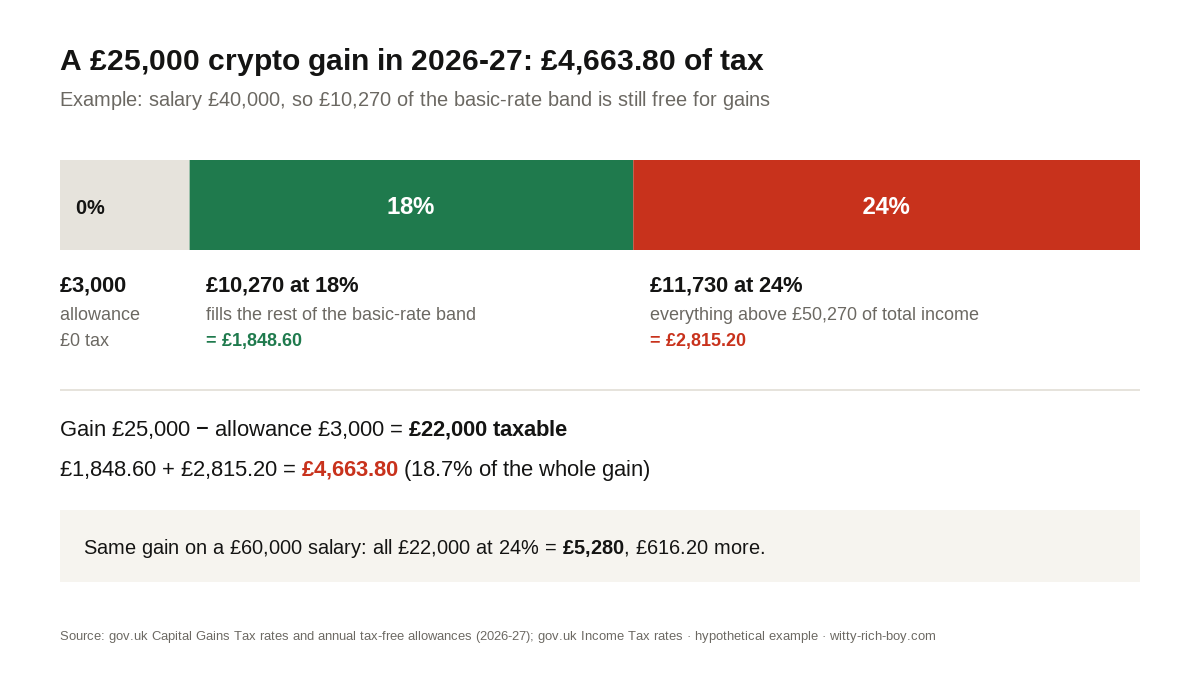
On a £60,000 salary the basic-rate band is already used, so all £22,000 is taxed at 24%: £5,280. Timing matters too. Spreading disposals across two tax years uses two £3,000 allowances, and a year with lower income leaves more of the gain at 18%. To run your own numbers, the UK Capital Gains Tax calculator splits a gain between the 18% and 24% rates from your taxable income.
Crypto held directly cannot go inside an ISA, but shares and funds can — see how the £20,000 UK ISA allowance works in 2026-27 if you want gains elsewhere in your portfolio sheltered from CGT.
How does the section 104 pool work for crypto?
A section 104 pool is a running total of how many units of one token you hold and what they cost you in sterling. Each token type has its own pool, and when you sell from it your cost is the pool’s average cost. HMRC CRYPTO22200 applies this to any fungible token, under section 104 of the Taxation of Chargeable Gains Act 1992.
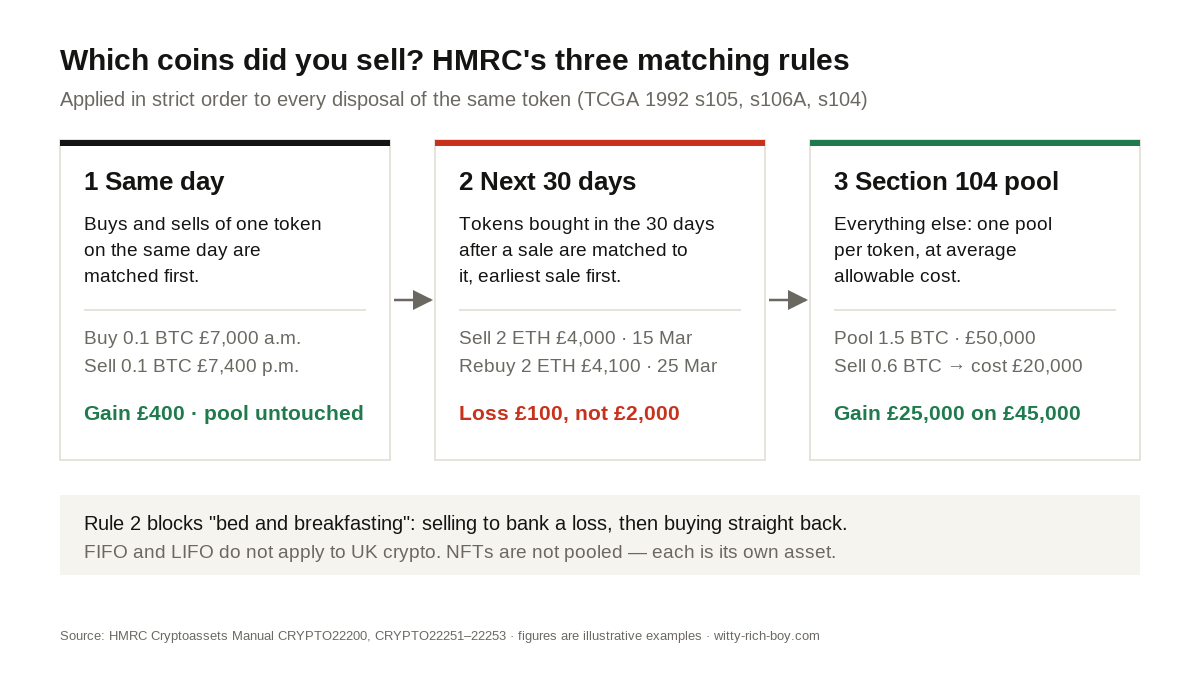
This means FIFO and LIFO do not apply in the UK. You cannot choose to sell your most expensive coins first, and it does not matter which exchange or wallet the coins sit on — all your BTC is one pool. NFTs are different: each is separately identifiable, so it is not pooled and the matching rules do not apply.
Example (continued): Anna’s gain comes from her pool.
| Date | Event | Units | Pool cost |
|---|---|---|---|
| March 2024 | Buys 1 BTC | 1.0 | £20,000 |
| February 2025 | Buys 0.5 BTC for £30,000 | 1.5 | £50,000 |
| 10 June 2026 | Sells 0.6 BTC for £45,000 | −0.6 | −£20,000 (£50,000 × 0.6 ÷ 1.5) |
| After sale | — | 0.9 | £30,000 |
Her gain is £45,000 − £20,000 = £25,000. The remaining 0.9 BTC carry a cost of £30,000 into the next sale. This mirrors HMRC’s own example at CRYPTO22251, in which 50 of 150 pooled tokens are sold and exactly one third of the pool cost is deducted.
Which costs can you add?
HMRC CRYPTO22150 allows the purchase price plus exchange trading fees, blockchain transaction fees for the buy or sell, professional fees for contracts, and reasonable valuation costs. It does not allow mining equipment or electricity, withdrawal fees for moving coins, or any cost already deducted for Income Tax.
The 30-day rule and the same-day rule: why selling for a loss can backfire
Before the pool is touched, HMRC applies two matching rules in strict order. Under CRYPTO22200 every disposal is matched first with acquisitions of the same token on the same day (TCGA 1992 s105), then with acquisitions in the next 30 days (s106A), and only then with the section 104 pool.
The same-day rule
All buys of a token on one day are treated as one acquisition and all sells as one disposal; they are matched against each other first. Example: you buy 0.1 BTC for £7,000 in the morning and sell 0.1 BTC for £7,400 that evening. The gain is £400, measured against the morning purchase, and your pool is left untouched.
The 30-day rule
The 30-day rule (often called the “bed and breakfast” rule) matches a disposal with tokens of the same type bought in the 30 days after it, earliest disposal first. Its purpose is to stop investors banking a paper loss while keeping their position.
Example: Ben holds 2 ETH in his pool at a cost of £6,000. ETH has fallen, and on 15 March 2027 — three weeks before the tax year ends — he sells both for £4,000, expecting a £2,000 loss to offset other gains. On 25 March he buys 2 ETH back for £4,100.
| Ben rebuys on 25 March | Ben rebuys on 15 April | |
|---|---|---|
| Disposal matched with | 25 March purchase (£4,100) | Section 104 pool (£6,000) |
| Allowable loss in 2026-27 | £100 | £2,000 |
| Cost of ETH he now holds | £6,000 (original pool unchanged) | £4,100 (new pool) |
Buying back within 30 days leaves Ben exactly where he started for tax purposes, with a £100 loss instead of £2,000. Day 30 after 15 March is 14 April, so a purchase on 15 April falls outside the rule. The rule bites only on the same token; HMRC CRYPTO22253 works through a case where three later purchases are split between two earlier sales.
Is staking, mining or an airdrop taxed as income?
Usually yes for staking and mining, and sometimes for airdrops. In each case the sterling value on receipt then becomes your CGT cost — our guide to crypto staking tax in the UK works through the pool arithmetic, the £1,000 allowance and DeFi staking.
- Staking: unless the activity is a trade, “the pound sterling value (at the time of receipt) of any tokens awarded will be taxable as income (miscellaneous income)” (HMRC CRYPTO21200).
- Mining: the same treatment applies, with appropriate expenses reducing the amount chargeable (CRYPTO21150). Whether it is a trade depends on the degree of activity, organisation, risk and commerciality.
- Airdrops: Income Tax may not apply if you received tokens “without doing anything in return”. Airdrops given in return for, or in expectation of, a service are taxable as miscellaneous income (CRYPTO21250). Either way, selling the tokens later can produce a capital gain. Our airdrop tax by country comparison works through the base cost of an untaxed airdrop and how the US, Germany, Australia and Japan differ.
- Employment: tokens received from an employer are employment income; where they count as readily convertible assets, the employer must operate PAYE.
Example: you receive 0.5 SOL in staking rewards worth £60 on the day it lands. £60 is miscellaneous income. If you sell that SOL a year later for £90, £30 is a capital gain, and the £60 cost goes into your SOL pool. HMRC’s guidance on receiving cryptoassets notes a £1,000 annual allowance can cover small amounts of such income.
How do crypto losses work, and can you claim for lost or stolen coins?
Capital losses reduce your gains, but only once reported. Under gov.uk guidance you can claim a loss up to 4 years after the end of the tax year in which you made the disposal. Same-year losses are set against same-year gains before the £3,000 allowance; unused losses carry forward indefinitely and are used only to bring later gains down to the allowance, so the allowance is not wasted.
Losses on disposals to a spouse, civil partner or other connected person can only be used against gains from that same person. Lost private keys are not a loss by themselves (CRYPTO22400); you need an accepted negligible value claim. A 2026-27 loss not claimed by 5 April 2031 is gone.
How to report crypto on your Self Assessment
You must report crypto gains if your total gains exceed the £3,000 allowance. Separately, if you are registered for Self Assessment, you must report disposals when total sale proceeds exceed £50,000 — even if the gain is under £3,000 (the limit for 2023-24 onwards). Swaps count towards proceeds at market value, so active traders reach £50,000 faster than they expect.
Since the 2024-25 return, the Capital Gains summary (SA108) has a dedicated cryptoasset section, separate from “other property, assets and gains”. To complete it:
- Export every transaction from every exchange, wallet and DeFi protocol for the tax year, including swaps and fees.
- Convert each transaction to sterling at the time it happened, using a consistent and reasonable pricing source.
- Apply the matching rules in order — same day, next 30 days, section 104 pool — separately for each token.
- Separate income from gains: staking, mining and airdrop income go in the income pages; disposals go on SA108.
- Total the proceeds, allowable costs, gains and losses and enter them in the cryptoasset section.
- Claim losses from this year and earlier years within the 4-year limit.
- Keep records for each pool: token type, dates, quantities, sterling values, bank statements and pool costs before and after each disposal, as HMRC’s guidance requires.
- File and pay by 31 January following the end of the tax year.
| Deadline (2026-27 disposals) | What happens |
|---|---|
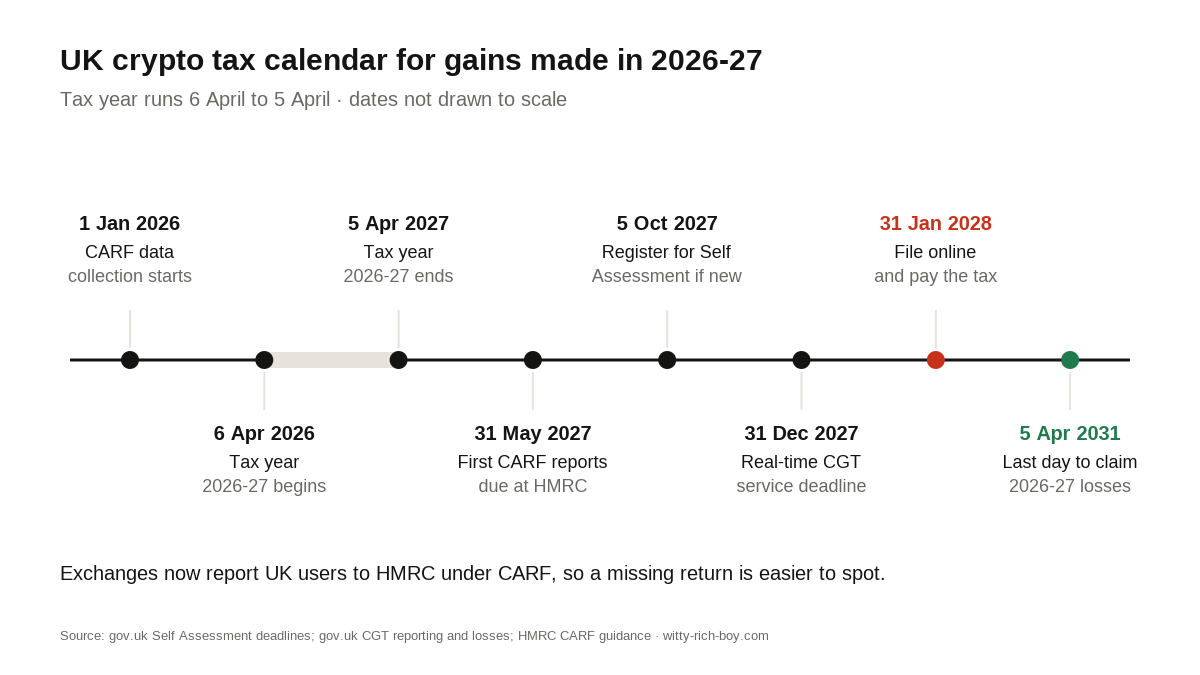
| 5 October 2027 | Register for Self Assessment if you have not filed before |
| 31 October 2027 | Paper return deadline |
| 31 December 2027 | Real-time CGT service deadline, if you are not in Self Assessment |
| 31 January 2028 | Online return and payment due |
| 5 April 2031 | Last date to claim 2026-27 capital losses |
If you have not filed and should have done for earlier years, HMRC points individuals to its Cryptoasset Disclosure Service to bring their affairs up to date — our guide to what to do about an HMRC crypto nudge letter sets out the penalty ranges, interest and time limits.
What will HMRC see from 2026? CARF explained
The Cryptoasset Reporting Framework (CARF) is an OECD standard requiring crypto platforms to collect identity and transaction data on their users and report it to tax authorities. In the UK it took effect on 1 January 2026, and it covers users resident in the UK as well as those in other CARF countries.
Under HMRC’s guidance, a UK platform must collect your full name, date of birth, address and country of residence, and your tax identification number — for UK residents, your National Insurance number or UTR. If you give inaccurate details, or none, you could face a penalty of up to £300. Platforms report a summary of each user’s transactions for each calendar year; the first report, covering 1 January to 31 December 2026, must reach HMRC between 1 January and 31 May 2027.
The EU runs a parallel regime for its own platforms — see how DAC8 crypto reporting works. The practical consequence is simple: HMRC will be able to match exchange records against Self Assessment returns, and a missing crypto section is easier to spot than before.
How does the UK compare?
The UK sits in the middle. Germany exempts gains on crypto held for more than a year — see the German one-year rule — while Japan taxes most crypto profits as miscellaneous income at progressive rates (Japan’s crypto tax rules). Britain offers neither a holding-period exemption nor a punitive income rate: a small allowance, two flat CGT rates and matching rules that reward careful record-keeping.
Questions readers ask
Do I pay tax on crypto in the UK if I don't cash out?
Not while you simply hold it. Buying crypto with pounds and moving it between your own wallets are not disposals. But you do not need to cash out to pounds to owe tax: swapping one token for another, paying for goods with crypto or giving it away (other than to a spouse or civil partner) are all disposals for Capital Gains Tax under HMRC CRYPTO22100.
How much crypto can I sell tax-free in the UK?
There is no tax-free amount of crypto as such; there is a tax-free amount of gain. In 2026-27 the first £3,000 of your net gains across all assets is covered by the annual exempt amount. You could sell £40,000 of Bitcoin with no tax if your profit on it is £3,000 or less, though proceeds above £50,000 must still be reported if you file Self Assessment.
What is the UK crypto tax rate for 2026?
For 2026-27, gains above the £3,000 allowance are taxed at 18% to the extent they fit inside your unused basic-rate band (taxable income up to £50,270 in England, Wales and Northern Ireland) and 24% on the rest. Crypto received as staking or mining income is instead taxed at your Income Tax rate of 20%, 40% or 45%.
Does HMRC know about my crypto?
Increasingly, yes. Under the Cryptoasset Reporting Framework, UK crypto platforms have collected users' names, dates of birth, addresses and National Insurance numbers or UTRs since 1 January 2026, and must send their first annual report on 2026 activity to HMRC by 31 May 2027. Platforms in other CARF countries exchange data with HMRC too.
What is the 30-day rule for crypto in the UK?
If you sell a token and buy the same token back within the next 30 days, HMRC matches the sale with the repurchase rather than with your average pool cost (TCGA 1992 s106A, HMRC CRYPTO22200). It stops investors selling at a loss for tax purposes and immediately buying back. Waiting until day 31, or buying a different token, avoids it.
Do I need to report crypto if I made a loss?
You are not obliged to, but you should. A capital loss can only be used once it has been reported to HMRC, and you have up to four years after the end of the tax year of the disposal to claim it. Reported losses reduce same-year gains first and can be carried forward indefinitely against future gains.
Is crypto staking taxed in the UK?
Usually, yes. Unless your activity amounts to a trade, HMRC treats staking rewards as miscellaneous income at their sterling value when you receive them (CRYPTO21200). That value then becomes your cost for Capital Gains Tax, so when you later sell the rewarded tokens only the further rise in value is a capital gain.
When do I have to pay crypto tax in the UK?
For disposals made between 6 April 2026 and 5 April 2027, the online Self Assessment return and the tax are both due by 31 January 2028. If you are new to Self Assessment you must register by 5 October 2027. People outside Self Assessment may be able to use HMRC's real-time CGT service instead, reporting by 31 December 2027.
Was this guide useful?
Thanks — your answer helps us decide what to cover next.
Sources
- Capital Gains Tax rates and annual tax-free allowances (gov.uk)
- Capital Gains Tax: work out if you need to pay — £50,000 reporting rule (gov.uk)
- Capital Gains Tax: losses (gov.uk)
- Check if you need to pay tax when you sell cryptoassets (HMRC guidance)
- Check if you need to pay tax when you receive cryptoassets (HMRC guidance)
- CRYPTO22100 — Capital Gains Tax: what is a disposal (HMRC Cryptoassets Manual)
- CRYPTO22200 — Capital Gains Tax: pooling (HMRC Cryptoassets Manual)
- CRYPTO21250 — Income Tax: airdrops (HMRC Cryptoassets Manual)
- Information you'll need to give to UK cryptoasset service providers (HMRC)
- Reporting cryptoasset user and transaction data — CARF (HMRC)
General information, not tax or legal advice. Rules change — check the official source or a licensed adviser before acting.