United Kingdom · Crypto
Crypto Staking Tax UK (2026): Income on Receipt, CGT on Sale
Crypto staking tax UK: HMRC taxes rewards as income at their sterling value on receipt (20/40/45%), then charges 18% or 24% CGT on any later rise when you sell.

The short answer
- Unless your activity is a trade, HMRC taxes staking rewards as miscellaneous income at their pound sterling value at the time of receipt (CRYPTO21200) — at 20%, 40% or 45% in 2026-27.
- The same sterling value becomes the reward's acquisition cost in your section 104 pool, so on sale only the later rise is taxed at 18% or 24% CGT above the £3,000 allowance.
- The £1,000 trading and miscellaneous income allowance can cover small rewards; between £1,000 and £2,500 you contact HMRC, and above £2,500 you register for Self Assessment.
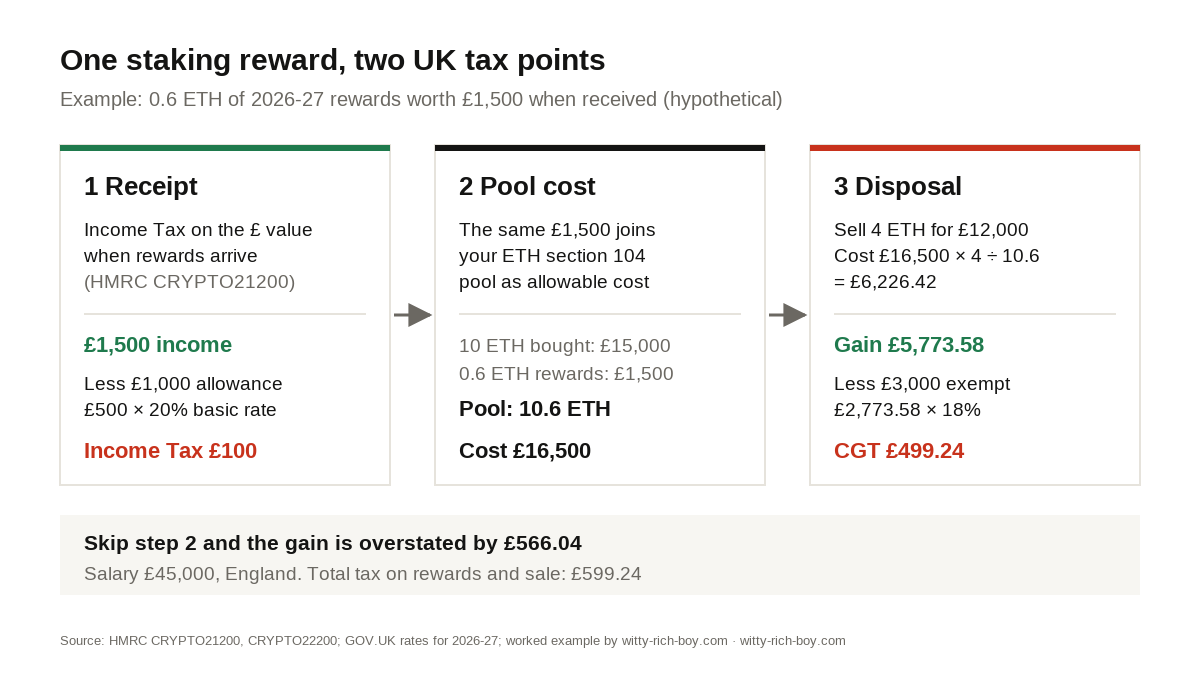
- In our worked example, £1,500 of rewards and a later 4 ETH sale cost a basic-rate taxpayer £599.24; costing the rewards at zero would overstate the gain by £566.04.
- HMRC's DeFi manual uses "staking" for liquidity provision, where passing beneficial ownership is a disposal; proposed no gain, no loss rules for crypto loans and liquidity pools would start on 6 April 2027.
In force: 6 April 2026 (2026-27 tax year: £12,570 personal allowance, £3,000 CGT allowance, 18% / 24% CGT) · 6 April 2027 (proposed no gain, no loss rules for crypto loans and liquidity pools)
In the UK, staking rewards are usually taxed twice at different moments. HMRC charges Income Tax on the sterling value of each reward when you receive it — 20%, 40% or 45% in 2026-27. That value becomes the tokens' cost in your section 104 pool, and any later rise is taxed at 18% or 24% CGT when you sell.
Staking looks like interest, behaves like a dividend and is taxed like neither. HMRC has no bespoke staking regime; it combines two existing ones. The reward is income when it lands, and the token is a capital asset from that moment on. Most errors — paying tax twice, missing the 30-day rule, or treating every DeFi deposit the same way — come from mixing up those two tax points. This guide covers staking specifically, with 2026-27 numbers; for the wider rules on selling, swapping and reporting, see our UK crypto tax guide.
How is crypto staking taxed in the UK?
Staking is taxed in two stages: Income Tax on each reward at receipt, then Capital Gains Tax on the reward tokens when you dispose of them.
Staking, in the sense used here, is locking tokens on a proof-of-stake network — directly, through a validator or through a custodial account — in return for newly issued tokens or fees. HMRC’s manual page CRYPTO21200 sets out the rule: unless the activity is a trade, “the pound sterling value (at the time of receipt) of any tokens awarded will be taxable as income (miscellaneous income)”, with appropriate expenses reducing the amount chargeable. The same page adds that if you keep the tokens, you may have to pay Capital Gains Tax when you later dispose of them.
HMRC’s consumer guidance, check if you need to pay tax when you receive cryptoassets, confirms that tokens received from mining, staking or lending count as income, including income earned from decentralised finance. The mining equivalent is CRYPTO21150, which applies the same receipt-value rule.
| Stage | Tax | 2026-27 rate | HMRC source |
|---|---|---|---|
| Reward received | Income Tax (miscellaneous income) | 20% / 40% / 45% (Scotland: 19%–48%) | CRYPTO21200 |
| Reward held | None | — | — |
| Reward sold, swapped or spent | Capital Gains Tax on rise since receipt | 18% / 24% above £3,000 of total gains | CRYPTO22100, CRYPTO22200 |
| Staking is a trade (rare) | Income Tax on trading profits | Marginal rate | CRYPTO21200, CRYPTO20250 |
Is staking a trade or miscellaneous income?
For almost every individual, staking income is miscellaneous income, not trading income. HMRC says whether staking is a trade “will depend on the particular facts”, weighing the degree of activity, organisation, risk and commerciality (CRYPTO21200).
HMRC sets a high bar. Its general guidance on whether crypto activity is trading (CRYPTO20250) says HMRC would expect individuals’ buying and selling of tokens to amount to a trade “only in exceptional circumstances”. Its DeFi call for evidence went further, saying an individual holding cryptoassets and engaging in DeFi transactions is unlikely to be trading.
The distinction matters in two ways:
- Character of the tokens. A trader’s rewards are trading receipts and the tokens are trading stock; there is no separate CGT layer while they remain stock. A non-trader has income first, then a capital asset.
- Expenses. A trade deducts expenses under trading rules. A non-trader deducts only “appropriate expenses” against the miscellaneous income — or claims the £1,000 allowance instead.
Running validators at scale on commercial terms may warrant advice; staking from a personal wallet or account means miscellaneous income.
What rate of Income Tax do you pay on staking rewards in 2026-27?
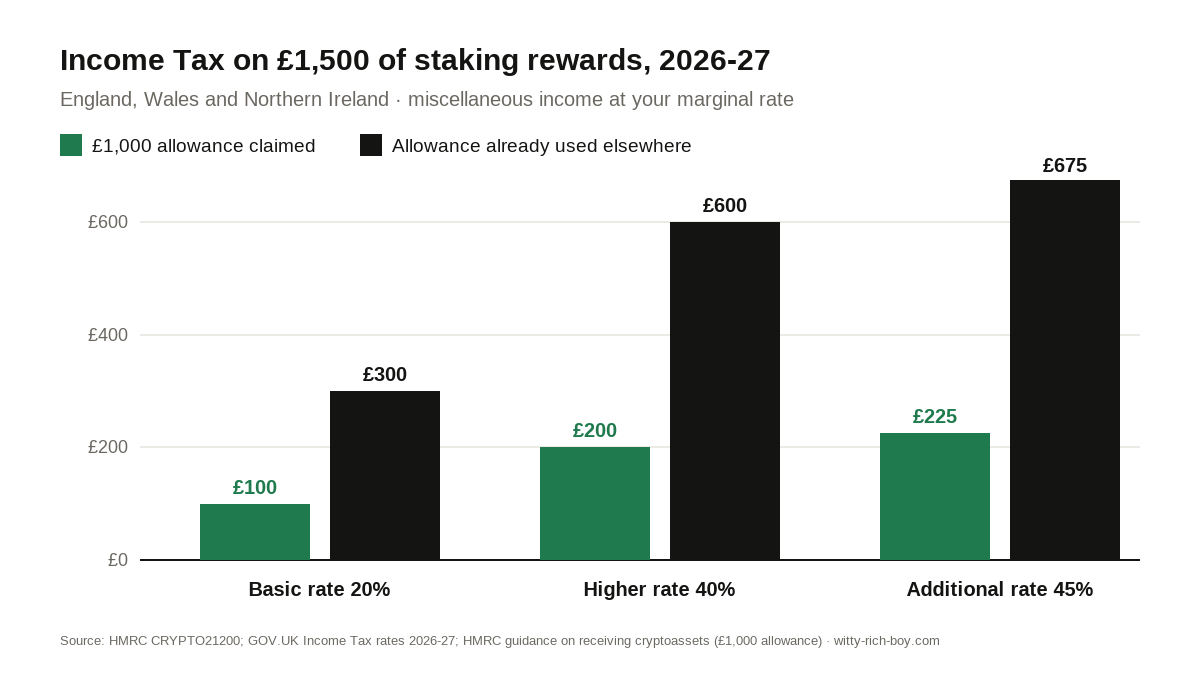
Staking rewards are added to your other income and taxed at your marginal rate. For 2026-27 in England, Wales and Northern Ireland, GOV.UK’s Income Tax rates give a £12,570 personal allowance, 20% up to £50,270, 40% up to £125,140 and 45% above. The personal allowance is withdrawn by £1 for every £2 of income above £100,000.
Scottish taxpayers pay Scottish rates on staking income, as it is non-savings income: 19%, 20%, 21%, 42%, 45% and 48% across six bands. The personal allowance and basic rate limit are fixed at £12,570 and £37,700 for 2026-27 and 2027-28.
| Your 2026-27 position (England, Wales, NI) | Marginal rate on rewards | Tax on £1,500 of rewards, £1,000 allowance claimed | Tax on £1,500, allowance already used |
|---|---|---|---|
| Income below £12,570 (allowance unused) | 0% | £0 | £0 up to the unused allowance |
| Basic rate (up to £50,270) | 20% | £100 | £300 |
| Higher rate (£50,271–£125,140) | 40% | £200 | £600 |
| Additional rate (above £125,140) | 45% | £225 | £675 |
| Income £100,000–£125,140 | Effectively 60% (allowance taper) | £300 | £900 |
The bottom row is worth noticing. Between £100,000 and £125,140 every extra £1 of rewards costs 40p in tax and also removes 50p of personal allowance, which is itself taxed at 40% — an effective 60%.
How does the £1,000 allowance work for staking income?
The trading and miscellaneous income allowance exempts up to £1,000 a year of combined trading and miscellaneous income. HMRC’s guidance on receiving cryptoassets confirms that crypto income counts towards it.
Three practical rules follow from HMRC’s guidance and the SA150 return notes:
- It is shared. Side-hustle or freelance trading income uses the same £1,000.
- It replaces expenses. If you claim the allowance against miscellaneous income, you cannot also deduct expenses incurred to earn it. Choose whichever is larger.
- It sets reporting thresholds. If your total miscellaneous income from all sources is between £1,000 and £2,500, HMRC asks you to contact it; if it is over £2,500, you must register for Self Assessment.
Example: Priya receives £800 of staking rewards in 2026-27 and has no other trading or miscellaneous income. The allowance covers it and there is nothing to pay. She still records each reward’s sterling value, because that value is her CGT cost when she sells.
How do staking rewards enter the section 104 pool?
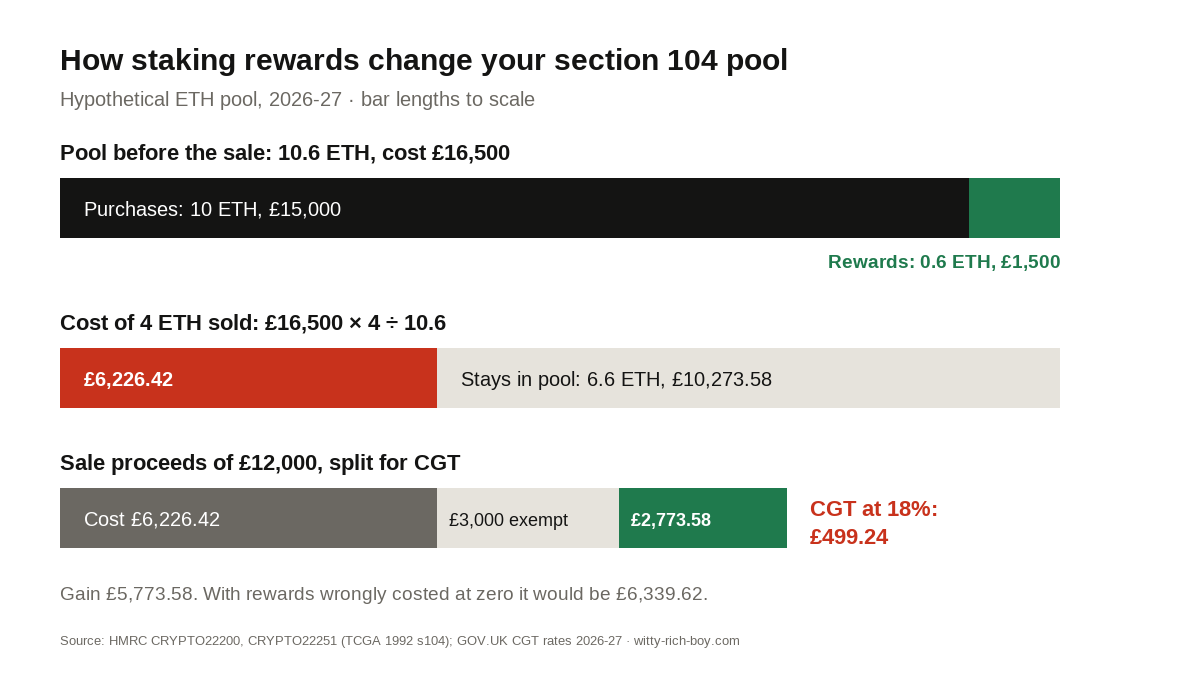
Each reward is an acquisition of that token at its sterling value on the day received, and it joins your existing section 104 pool for that token. A section 104 pool is the running total of units held and their combined allowable cost, under section 104 of the Taxation of Chargeable Gains Act 1992; CRYPTO22200 applies it to fungible tokens, one pool per token type.
The value taxed as income is used as cost. That is consistent with the general rule that an asset acquired otherwise than by an arm’s-length bargain is acquired at market value (TCGA 1992 s17), and it prevents the same value being taxed twice. HMRC’s own example 1 at CRYPTO22251 shows the pooling arithmetic: 50 of 150 pooled tokens are sold, so one third of the £126,000 pool cost (£42,000) is deducted.
Worked example: Tom’s ETH pool in 2026-27
Example (hypothetical): Tom earns a £45,000 salary in England. He holds 10 ETH bought over several years for £15,000. During 2026-27 he receives 0.6 ETH of staking rewards worth a combined £1,500 at the moments they arrived. In February 2027 he sells 4 ETH for £12,000.
| Step | Calculation | Result |
|---|---|---|
| Staking income | Sum of sterling values at receipt | £1,500 |
| Less £1,000 allowance | £1,500 − £1,000 | £500 taxable |
| Income Tax | £500 × 20% | £100 |
| Pool after rewards | 10 + 0.6 ETH; £15,000 + £1,500 | 10.6 ETH, £16,500 |
| Cost of 4 ETH sold | £16,500 × 4 ÷ 10.6 | £6,226.42 |
| Gain | £12,000 − £6,226.42 | £5,773.58 |
| Less annual exempt amount | £5,773.58 − £3,000 | £2,773.58 taxable |
| Unused basic-rate band | £37,700 − (£32,430 salary + £500 rewards) | £4,770 |
| CGT | £2,773.58 × 18% | £499.24 |
| Total tax | Income Tax + CGT | £599.24 |
Had Tom recorded the rewards at nil cost, the 4 ETH would carry only £5,660.38 of cost and the gain would be £6,339.62 — £566.04 too high, on value he had already paid Income Tax on. As a higher-rate taxpayer, his CGT would instead be £2,773.58 × 24% = £665.66, and his Income Tax £200. To test other incomes, the UK Capital Gains Tax calculator splits a gain between 18% and 24%.
Do the same-day and 30-day rules apply to staking rewards?
Yes — rewards are acquisitions, so they are matched like any other purchase of the same token. Under CRYPTO22200, a disposal is matched first with acquisitions on the same day (TCGA 1992 s105), then with acquisitions in the following 30 days (s106A), and only then with the section 104 pool. The pool rules in full are covered in our UK Capital Gains Tax guide.
This catches people who keep staking while they sell. Rewards that compound daily mean you acquire the token on almost every day of the year. If you sell part of a holding, rewards credited the same day are matched with that sale first, and rewards in the next 30 days are matched with it next, at their own receipt values, instead of the pool’s average cost.
The effect is usually small, but it complicates loss-harvesting: sell a staked token at a loss while rewards keep arriving, and part of the sale is matched with fresh rewards rather than your higher pool cost. Every reward needs a timestamp.
Is liquid staking or DeFi staking a disposal?
It can be. The test is whether you give up beneficial ownership of your tokens, and the label “staking” does not decide it.
HMRC uses the word differently in its DeFi chapter. CRYPTO61120 says there is no statutory meaning of “lending” or “staking”, and describes DeFi “staking” as a liquidity provider sending tokens to a platform and receiving different tokens back. The government’s summary of consultation responses now calls this work “cryptoasset loans and liquidity pools”, and says staking as a mechanism of blockchain validation is not within its scope.
Under current guidance:
- Native or custodial staking where you keep beneficial ownership: the reward is income. CRYPTO21200 charges the reward and says CGT may arise when you later dispose of the tokens; it does not describe the act of staking itself as a disposal.
- DeFi lending or liquidity provision: where beneficial ownership passes to the platform or borrower, the transfer is a disposal at that moment (CRYPTO61620), and withdrawal is another disposal (CRYPTO61650). Whether ownership passes depends on the contract terms; freedom to deal with the tokens is a strong indicator that it has.
- Liquid staking: exchanging a token for a different receipt token is, on HMRC’s general rule, a disposal of the original (CRYPTO22100). HMRC has not published a liquid-staking example in the pages cited here, so read the protocol’s terms against the beneficial-ownership test.
The 2027 change
A tax information and impact note published with draft legislation proposes treating qualifying crypto loans and liquidity pool disposals as no gain, no loss from 6 April 2027, deferring CGT until an economic disposal. It covers single-asset lending, borrowing and automated market-making pools, and estimates about 700,000 individuals are affected. The government says it is not exploring changes to how the rewards are taxed, so income treatment on receipt stays. Our explainer on why crypto-to-crypto swaps are taxable compares the swap rule across countries.
| Arrangement | Disposal on entry? (now) | From 6 April 2027 (proposed) | Rewards |
|---|---|---|---|
| Proof-of-stake staking, ownership kept | No | Unchanged | Income at receipt |
| DeFi loan, ownership passes | Yes (CRYPTO61620) | No gain, no loss if qualifying | Income at receipt |
| Liquidity pool deposit | Yes, where ownership passes | No gain, no loss if qualifying | Income at receipt |
| Swap into liquid staking token | Likely, as a token exchange | Only if within the new rules | Income at receipt |
Which staking expenses can you deduct?
Against non-trading staking income you may deduct “appropriate expenses” (CRYPTO21200) — costs incurred to earn the rewards, such as validator or service fees charged in cash. The SA150 notes add that expenses must be solely for earning the income, not for private use, and not capital items such as a computer.
Two traps. First, you cannot deduct expenses if you claim the £1,000 allowance. Second, a cost deducted against income cannot also be deducted from a capital gain.
How to report staking income on your Self Assessment
Staking income and staking-token disposals go in different parts of the return. For 2026-27, the online return and payment are due by 31 January 2028, and new filers must register by 5 October 2027.
- Export every reward from each wallet, validator and account for 6 April 2026 to 5 April 2027, with timestamps and token amounts.
- Value each reward in pounds at the time of receipt, using one consistent and reasonable price source.
- Total the miscellaneous income and decide between the £1,000 allowance and actual expenses.
- Enter the income under “Other UK income”: the 2026 SA150 notes put it in box 17, expenses in box 18 and a description (and any allowance claimed) in box 21. Check the box numbers on the 2027 form.
- Add each reward to the pool for its token, at its receipt value, and update units and cost.
- Match disposals — same day, then 30 days, then the pool — and complete the SA108 cryptoasset section (boxes 13.1 to 13.8 on the 2025-26 form) if your gains exceed £3,000 or your disposals exceed £50,000.
- Keep records: HMRC lists token type, date received, number received, total held, sterling value and bank statements.
What will HMRC see about your staking from 2026?
More than before. Under the Cryptoasset Reporting Framework (CARF), UK crypto service providers have collected user identity and transaction data since 1 January 2026, with the first reports on the 2026 calendar year due to HMRC by 31 May 2027. HMRC’s guidance lists transaction value, type of cryptoasset, type of transaction and number of units among the data collected.
CARF is an information tool, not a new tax. Platforms in other CARF jurisdictions, and EU platforms under the parallel DAC8 crypto reporting regime, share data too, so a return that omits staking income is easier to spot — and more likely to prompt one of HMRC’s crypto nudge letters. By contrast, Germany taxes staking rewards only once a year’s total reaches €256 and lets each reward be sold tax-free after one year, as our guide to crypto staking tax in Germany shows.
Questions readers ask
Are staking rewards taxable in the UK?
Yes. Unless your staking amounts to a trade, HMRC treats the pound sterling value of the tokens you are awarded, measured when you receive them, as miscellaneous income (CRYPTO21200). That income is taxed at your marginal rate — 20%, 40% or 45% in England, Wales and Northern Ireland for 2026-27. If you later sell or swap the tokens, any further rise in value is a capital gain.
Do I pay tax on staking rewards if I don't sell them?
Yes, Income Tax is due on receipt, whether or not you sell. HMRC values the reward in pounds at the time it reaches you, so a reward that later falls in price is still taxed on its original value. The fall may then produce a capital loss when you dispose of the tokens, which can be set against other gains once reported.
How much staking income can I earn tax-free in the UK?
The £1,000 trading and miscellaneous income allowance can cover up to £1,000 a year of staking rewards, shared with any trading income. Any unused personal allowance (£12,570 in 2026-27) also applies. If total miscellaneous income is between £1,000 and £2,500 you should contact HMRC; above £2,500 you must register for Self Assessment.
What is the cost basis of staking rewards in the UK?
The sterling value used for Income Tax at receipt becomes the reward's acquisition cost. It is added to the section 104 pool for that token alongside your purchases (CRYPTO22200), so later disposals use the pool's average cost. Recording rewards at zero cost double-counts tax: you would pay Income Tax on the value and then CGT on it again.
Is unstaking crypto a taxable event in the UK?
HMRC's staking page (CRYPTO21200) charges the reward; it does not describe locking or unlocking your own tokens as a disposal, and where you keep beneficial ownership throughout nothing has changed hands. DeFi arrangements differ: where you pass beneficial ownership to a platform or pool and receive different tokens back, HMRC treats the transfer, and the later withdrawal, as disposals (CRYPTO61620, CRYPTO61650).
Is liquid staking taxable in the UK?
Swapping a token for a different token is a disposal for Capital Gains Tax (CRYPTO22100), so exchanging ETH for a liquid staking receipt token can trigger a gain at the ETH's market value. Whether beneficial ownership actually passes depends on the protocol's terms. The proposed no gain, no loss rules from 6 April 2027 cover qualifying loans and liquidity pools; check whether your arrangement qualifies.
Where do I put staking income on my Self Assessment return?
Staking income is not entered on the Capital Gains pages. HMRC's SA150 notes direct miscellaneous income to 'Other UK income', box 17, with allowable expenses in box 18 and a description in box 21. If you claim the £1,000 allowance instead of expenses, note the amount claimed in box 21. Disposals of the tokens go on the SA108 cryptoasset section.
Can staking count as a trade?
It can, but HMRC sets a high bar: its trading guidance (CRYPTO20250) expects crypto activity by individuals to be a trade only in exceptional circumstances. CRYPTO21200 says the answer depends on the facts, including the degree of activity, organisation, risk and commerciality. If staking is a trade, rewards are trading receipts and the tokens are trading stock, rather than miscellaneous income followed by Capital Gains Tax. Most individuals staking from a personal wallet or account are not trading.
Was this guide useful?
Thanks — your answer helps us decide what to cover next.
Sources
- CRYPTO21200 — Cryptoassets for individuals: Income Tax: staking (HMRC Cryptoassets Manual)
- Check if you need to pay tax when you receive cryptoassets (HMRC guidance)
- CRYPTO22200 — Cryptoassets for individuals: Capital Gains Tax: pooling (HMRC Cryptoassets Manual)
- CRYPTO22251 — Pooling examples: example 1, basic section 104 pool disposal (HMRC Cryptoassets Manual)
- CRYPTO61120 — Decentralised Finance: Lending and staking: meaning of 'loan' and 'staking' (HMRC Cryptoassets Manual)
- Tax treatment of cryptoasset loans and liquidity pools — tax information and impact note (GOV.UK)
- The taxation of DeFi involving the lending and staking of cryptoassets — summary of responses (GOV.UK)
- Income Tax rates and Personal Allowances: current rates (GOV.UK)
- Capital Gains Tax: rates and allowances (GOV.UK)
- SA150 Tax Return notes 2026 (HMRC)
General information, not tax or legal advice. Rules change — check the official source or a licensed adviser before acting.