United Kingdom · Tax
UK Dividend Allowance 2026: £500, 10.75% Rate & Director Maths
UK dividend allowance 2026: £500 tax-free, then 10.75%, 35.75% or 39.35% from 6 April 2026. Rates by band, when to tell HMRC, and a salary-vs-dividend example.

The short answer
- The dividend allowance is £500 for 2026-27, charged at a 0% "dividend nil rate" under section 13A of the Income Tax Act 2007.
- From 6 April 2026 the dividend ordinary and upper rates rose by 2 points to 10.75% and 35.75%; the additional rate stays at 39.35%.
- Dividends are taxed as the top slice of income, and the £500 allowance still uses up band space: on £45,000 salary plus £10,000 dividends, that costs £125 extra in 2026-27.
- A single-director company with £60,000 of profit leaves its owner £46,091 via a £12,570 salary plus dividends, against £41,197 taken all as salary.
- Dividends over £10,000 require a Self Assessment return; tax on 2025-26 dividends is due by 31 January 2027.
In force: 6 April 2026
The UK dividend allowance for 2026-27 is £500: the first £500 of dividends is taxed at 0%. Above that, dividends are taxed at 10.75% in the basic-rate band, 35.75% in the higher-rate band and 39.35% in the additional-rate band — up from 8.75% and 33.75% in 2025-26. The allowance still uses up band space.
A dividend is a payment a company makes to its shareholders out of profits that have already borne Corporation Tax. That is why it is taxed differently from wages: lower rates, no National Insurance, and a small tax-free slice. The tax-free slice has shrunk from £5,000 a decade ago to £500, and from 6 April 2026 the rates above it rose by two percentage points. Below: the rates for both the current year and the one now being filed, the order-of-taxation rule that decides which rate you pay, and the salary-versus-dividend arithmetic for company directors, recalculated for 2026-27.
What is the UK dividend allowance for 2026-27?
The dividend allowance is £500 for 2026-27, the tax year running from 6 April 2026 to 5 April 2027. GOV.UK’s Tax on dividends guidance states that you pay tax only on dividend income above the allowance. In law it is not an exemption but a dividend nil rate: section 13A of the Income Tax Act 2007 charges the first slice of dividend income at 0%.
Two features define it:
- It is per person. Spouses and civil partners have £500 each.
- It applies at every income level. Basic-, higher- and additional-rate taxpayers all get the same £500.
The allowance has been cut three times since it was introduced by Finance Act 2016 at £5,000. HMRC’s table of current and past rates shows £1,000 in 2023-24 and £500 from 2024-25 onwards; the 2026 rate rise left it unchanged at £500.
| Tax year | Dividend allowance |
|---|---|
| 2016-17 | £5,000 |
| 2018-19 | £2,000 |
| 2023-24 | £1,000 |
| 2024-25, 2025-26, 2026-27 | £500 |
What are the dividend tax rates for 2025-26 and 2026-27?
For 2026-27 the dividend rates are 10.75% (ordinary), 35.75% (upper) and 39.35% (additional). HMRC’s technical note Change to tax rates for property, savings and dividend income confirms the ordinary and upper rates rose by 2 percentage points from 6 April 2026, announced at Budget 2025 in November 2025 and legislated in Finance Act 2026 by amending section 8 of the Income Tax Act 2007. The additional rate did not move.
| Income Tax band (2026-27) | Taxable income | Dividend rate 2025-26 | Dividend rate 2026-27 |
|---|---|---|---|
| Personal allowance | Up to £12,570 | 0% | 0% |
| Dividend allowance | First £500 of dividends | 0% | 0% |
| Basic rate | £12,571 to £50,270 | 8.75% | 10.75% |
| Higher rate | £50,271 to £125,140 | 33.75% | 35.75% |
| Additional rate | Over £125,140 | 39.35% | 39.35% |
Two details are easy to miss. First, the bands are UK-wide for dividends: Scotland sets its own rates and bands for earnings, but the basic rate limit that governs dividend income is the UK one. Second, the thresholds are frozen. The personal allowance stays at £12,570 and the basic rate limit at £37,700 — so the higher-rate threshold stays at £50,270 — until 5 April 2031, a freeze extended at Budget 2025.
What the rise costs on a typical dividend
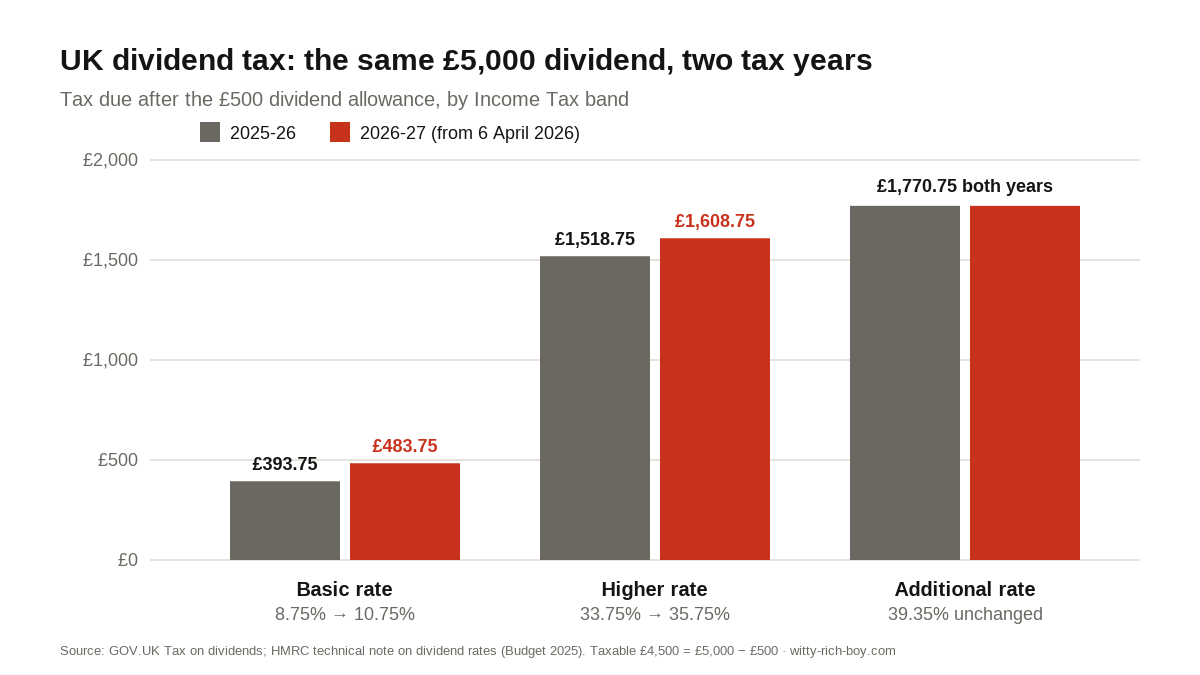
The table below applies both years’ rates to the same dividend, assuming it sits wholly within one band.
| Dividend received | Band | Tax 2025-26 | Tax 2026-27 | Change |
|---|---|---|---|---|
| £5,000 | Basic | £393.75 | £483.75 | +£90.00 |
| £5,000 | Higher | £1,518.75 | £1,608.75 | +£90.00 |
| £5,000 | Additional | £1,770.75 | £1,770.75 | £0 |
| £20,000 | Basic | £1,706.25 | £2,096.25 | +£390.00 |
| £20,000 | Higher | £6,581.25 | £6,971.25 | +£390.00 |
| £20,000 | Additional | £7,673.25 | £7,673.25 | £0 |
The rule of thumb: 2% of every pound above the £500 allowance, for basic- and higher-rate taxpayers alike. On £5,000 that is 2% × £4,500 = £90. Additional-rate taxpayers are untouched.
How are dividends taxed on top of a salary?
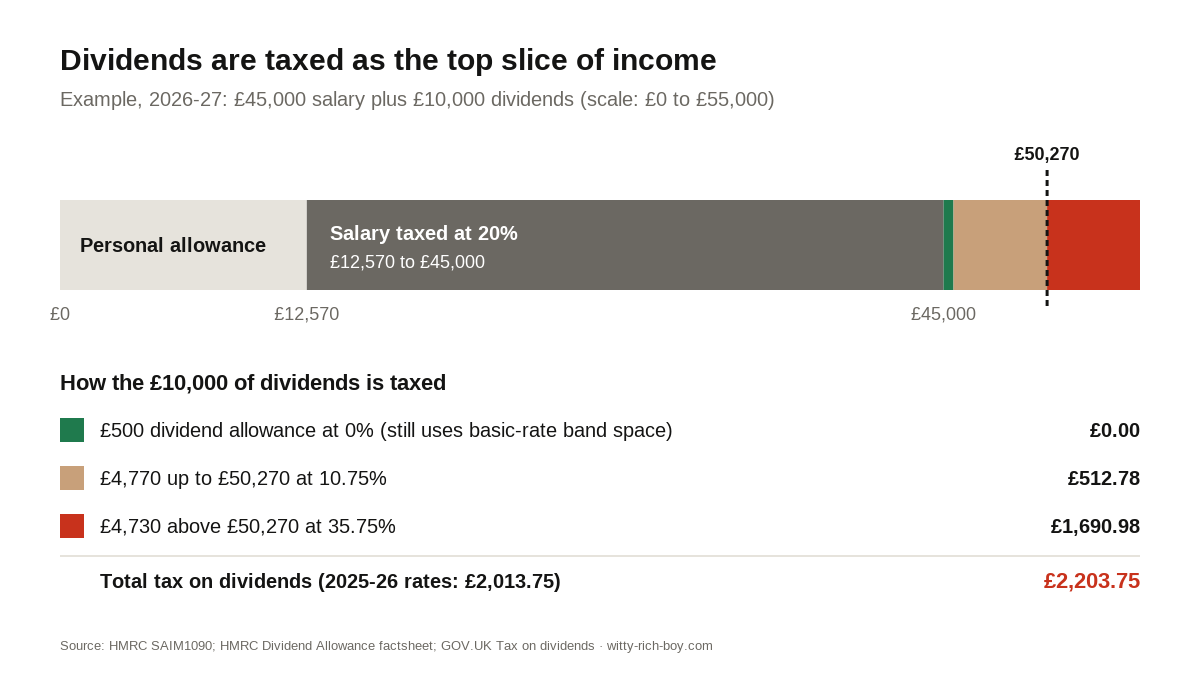
Dividends are taxed last, as the top slice of your income. HMRC’s Savings and Investment Manual (SAIM1090) sets out the order: earnings, pensions, trading and property profits first; then savings interest; then dividends. Whatever band space your other income leaves determines the rate on your dividends.
Example 1 — Priya, salary £60,000, dividends £5,000 (2026-27).
- Salary uses the £12,570 personal allowance and the whole £37,700 basic-rate band, reaching £50,270, and a further £9,730 falls in the higher-rate band.
- Her dividends therefore start at £60,000 and sit entirely in the higher-rate band.
- First £500: 0%.
- Remaining £4,500 × 35.75% = £1,608.75.
In 2025-26 the same dividends cost £4,500 × 33.75% = £1,518.75. Priya pays £90 more.
The ordering matters most for people with modest salaries. Someone earning £25,000 has £25,270 of basic-rate band left for dividends; someone earning £50,000 has £270.
Why does the £500 allowance still use up your tax band?
Because it is a 0% rate, not an exclusion from income. HMRC’s Dividend Allowance factsheet says dividends within the allowance still count towards your basic or higher rate band, and so can affect the rate you pay on the rest. In practice the £500 occupies £500 of band space — which can push other dividends over the £50,270 line.
Example 2 — Tom, salary £45,000, dividends £10,000 (2026-27).
| Slice of income | Amount | Rate | Tax |
|---|---|---|---|
| Salary up to £12,570 | £12,570 | 0% (personal allowance) | — |
| Salary £12,570–£45,000 | £32,430 | 20% (earnings) | £6,486.00 |
| Dividends: allowance, £45,000–£45,500 | £500 | 0% | £0 |
| Dividends: rest of basic band, to £50,270 | £4,770 | 10.75% | £512.78 |
| Dividends above £50,270 | £4,730 | 35.75% | £1,690.98 |
| Tax on dividends | £10,000 | £2,203.75 |
If the £500 allowance did not use band space, £5,270 of dividends would fit into the basic band and only £4,230 would be taxed at 35.75%, for £2,078.75 in total. The difference — £125, or £500 × (35.75% − 10.75%) — is the hidden cost of the allowance sitting inside the band. In 2025-26 Tom’s dividend bill was £2,013.75, so the rate rise added £190.
The £100,000 personal allowance taper
Dividends count towards the income that triggers the taper. Above £100,000, the personal allowance falls by £1 for every £2 of income and is gone by £125,140, the point at which the additional rate begins. A director whose salary and dividends total £110,000 keeps a personal allowance of only £7,570. Splitting dividends across tax years, where the company’s profits allow, can keep income below the taper.
Salary or dividends: how much do company directors keep in 2026-27?
For a single-director company, a salary at the £12,570 personal allowance with the remaining profit paid as dividends still leaves more in the director’s pocket than taking everything as salary — about £4,900 more on £60,000 of profit in 2026-27. The reason is National Insurance: dividends attract none, while salary attracts employer NICs at 15% above £5,000 and employee NICs at 8% then 2%.
The rates used, all for 2026-27 and confirmed in HMRC’s Rates and thresholds for employers 2026 to 2027 and Corporation Tax rates tables:
- Employer (secondary) Class 1 NICs: 15% above the secondary threshold of £5,000 a year (both since 6 April 2025).
- Employee Class 1 NICs: 8% between £12,570 and £50,270, 2% above.
- Corporation Tax: 19% small profits rate for profits up to £50,000, 25% main rate above £250,000, with marginal relief between.
- Employment Allowance (£10,500) is not available: HMRC’s National Insurance Manual (NIM06545) bars limited companies whose only employee paid above the secondary threshold is a director.
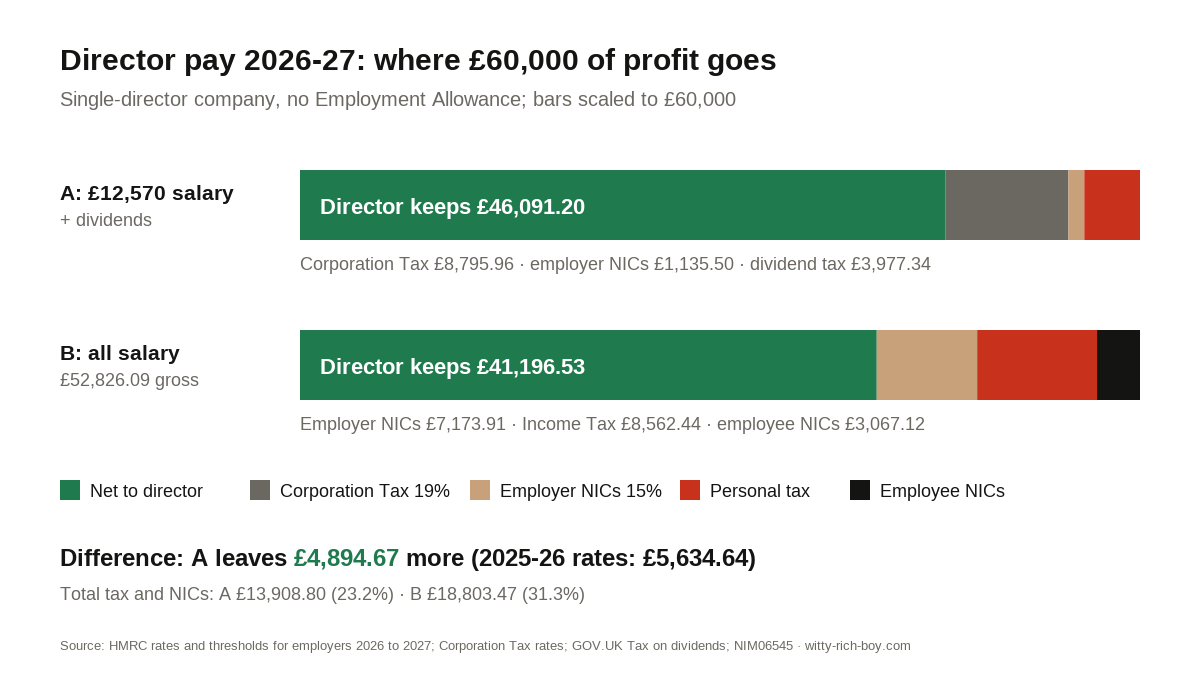
Example 3 — Alex, sole director-shareholder, £60,000 company profit before paying Alex (2026-27).
| A: £12,570 salary + dividends | B: all salary | |
|---|---|---|
| Gross salary | £12,570.00 | £52,826.09 |
| Employer NICs (15% above £5,000) | £1,135.50 | £7,173.91 |
| Taxable company profit | £46,294.50 | £0 |
| Corporation Tax at 19% | £8,795.96 | £0 |
| Dividend paid | £37,498.54 | £0 |
| Income Tax on salary | £0 | £8,562.44 |
| Employee NICs | £0 | £3,067.12 |
| Dividend tax (£36,998.54 × 10.75%) | £3,977.34 | £0 |
| Alex keeps | £46,091.20 | £41,196.53 |
| Total tax and NICs | £13,908.80 (23.2%) | £18,803.47 (31.3%) |
How the numbers work. In option A, salary plus dividends total £50,068.54, just under the £50,270 higher-rate threshold, so every taxable pound of dividend is at 10.75%. In option B the company spends the whole £60,000 on pay and employer NICs: £60,000 = salary + 15% × (salary − £5,000), so salary is £60,750 ÷ 1.15 = £52,826.09. Income Tax is £37,700 × 20% plus £2,556.09 × 40%; employee NICs are £37,700 × 8% plus £2,556.09 × 2%.
Under 2025-26 rates, option A left £46,831.17 — the dividend rate rise costs Alex £739.97 a year, and narrows the advantage over salary from £5,634.64 to £4,894.67.
Caveats the arithmetic hides
- Profits above £50,000 after salary fall into marginal relief, so Corporation Tax rises above 19% and the gap narrows. The £50,000 and £250,000 limits are divided among associated companies and cut for short accounting periods.
- Directors’ loans are taxed on the company at a rate tied to the dividend upper rate, which HMRC’s technical note says also rises to 35.75%.
- Retaining profit in the company defers dividend tax entirely; the example assumes everything is paid out.
When do you have to tell HMRC about dividends?
You need to tell HMRC only when your dividends exceed what your allowances cover. GOV.UK’s How to report tax on dividends sets three tiers.
| Dividends in the tax year | What you do |
|---|---|
| Within your £500 allowance (and any unused personal allowance) | Nothing |
| Over the allowance, up to £10,000 | If you already file Self Assessment, report them on the return. Otherwise ask HMRC to change your tax code, or contact HMRC |
| Over £10,000 | Complete a Self Assessment return; if you do not normally file, register by 5 October after the tax year |
Company directors usually file a return anyway. For 2025-26 dividends — taxed at 8.75%, 33.75% and 39.35% — both the online return and the payment are due by 31 January 2027.
How to work out and pay tax on your dividends
The calculation follows the order-of-taxation rule. Using the 2026-27 figures:
- Add up dividends received between 6 April and 5 April, excluding anything inside an ISA or pension.
- Total your other income — salary, pension, self-employed and rental profits, then savings interest — and deduct the personal allowance from that first. Any unused personal allowance can then cover dividends.
- Find the band space left: the higher-rate threshold is £50,270 of gross income, the additional rate starts above £125,140, and above £100,000 the personal allowance tapers.
- Apply the £500 dividend allowance to the bottom of your dividend slice — it occupies band space.
- Tax the rest at 10.75% in the basic band, 35.75% in the higher band and 39.35% above £125,140.
- Report and pay: by tax code change for dividends up to £10,000 if you do not file, or through Self Assessment, paying the balancing payment by 31 January after the tax year ends. Payments on account for the following year may be due on 31 January and 31 July.
Which dividends are tax-free?
Dividends are free of UK tax in four situations:
- Inside an ISA. GOV.UK confirms you pay no tax on dividends from shares held in an ISA, and they do not use the £500 allowance. Moving shares into an ISA via the £20,000 annual ISA allowance is the simplest way to shelter future dividends. To see how much of this year’s allowance you have left, use our ISA allowance calculator.
- Inside a registered pension. Section 186 of the Finance Act 2004 exempts income from investments held for a registered pension scheme; tax is paid later on withdrawals.
- Within your personal allowance. Someone with no other income can receive £13,070 of dividends tax-free in 2026-27: £12,570 personal allowance plus £500 dividend allowance.
- Within the £500 dividend allowance, at any income level.
Capital gains on the same shares are a separate tax with its own £3,000 Capital Gains Tax allowance; our UK Capital Gains Tax calculator works through the 18% and 24% rates. Distributions from crypto staking or tokens are not dividends at all — HMRC treats them as income or gains under its own UK crypto tax rules.
What else changes for dividend investors and directors?
The 2026 rise is the first stage of a broader shift in how unearned income is taxed. HMRC’s technical note sets out the sequence:
| Date | Change |
|---|---|
| 6 April 2024 | Dividend allowance cut from £1,000 to £500 |
| 6 April 2025 | Employer NICs rise to 15%; secondary threshold falls to £5,000 |
| 6 April 2026 | Dividend ordinary rate 10.75%, upper rate 35.75%; additional unchanged at 39.35% |
| April 2027 | Savings income rates rise by 2 points in every band |
| 5 April 2031 | End of the current freeze on the £12,570 personal allowance and £37,700 basic rate limit |
The freeze is the quieter squeeze. With thresholds fixed while salaries and dividends rise, more dividend income crosses the £50,270 line each year and becomes taxable at 35.75% rather than 10.75%. For directors, the case for a low salary plus dividends survives the 2026 rise, but by a narrower margin than at any point since dividend taxation was overhauled in 2016.
Questions readers ask
What is the dividend allowance for 2026/27?
The dividend allowance for the 2026-27 tax year, running from 6 April 2026 to 5 April 2027, is £500. It applies to every individual, whatever their tax band, and covers dividends from shares and funds held outside an ISA or pension. Dividends above £500 are taxed at 10.75%, 35.75% or 39.35% depending on which band they fall into.
Did dividend tax go up in April 2026?
Yes. Budget 2025 raised the dividend ordinary rate from 8.75% to 10.75% and the dividend upper rate from 33.75% to 35.75% from 6 April 2026, legislated in Finance Act 2026. The dividend additional rate stayed at 39.35% and the £500 allowance did not change. Basic- and higher-rate taxpayers therefore pay £20 more for every £1,000 of taxable dividends.
Do I pay tax on dividends if I earn under £12,570?
Often not. Dividends can use any personal allowance left over after your other income, then the £500 dividend allowance. Example: with no other income, £13,070 of dividends in 2026-27 is tax-free — £12,570 covered by the personal allowance and £500 by the dividend allowance. Above that, the basic-rate dividend rate of 10.75% applies.
Do I need to tell HMRC about dividends under £10,000?
Only if they exceed your allowances. If your dividends are between £500 and £10,000 and you do not already file a Self Assessment return, GOV.UK says you can ask HMRC to change your tax code or contact its helpline. If you already file a return, put them on it. Above £10,000, you must complete a Self Assessment return.
Are dividends in an ISA taxed?
No. Dividends from shares and funds held inside an ISA are free of Income Tax, do not use your £500 dividend allowance and do not need reporting to HMRC. Income from investments held in a registered pension scheme is also exempt from Income Tax under section 186 of the Finance Act 2004, although pension withdrawals are taxed later as income.
Is it better to take salary or dividends from a limited company?
For many owner-directors, a salary around the personal allowance plus dividends costs less tax in total, because dividends avoid National Insurance. In our 2026-27 example, a single-director company with £60,000 of profit leaves £46,091.20 after a £12,570 salary and dividends, against £41,196.53 taken all as salary. The 2026 rate rise narrowed, but did not close, that gap.
Does the dividend allowance count towards my tax band?
Yes. HMRC's dividend allowance factsheet says dividends within the allowance still count towards your basic or higher rate band. The £500 is taxed at 0% but occupies £500 of band space, which can push other dividends into the 35.75% upper rate. For someone straddling the £50,270 threshold, that can add up to £125 of tax in 2026-27.
When do I have to pay tax on my dividends?
Through Self Assessment, the balancing payment for a tax year is due by 31 January after it ends. Tax on dividends received in 2025-26, at 8.75% and 33.75%, is therefore due by 31 January 2027; tax on 2026-27 dividends, at 10.75% and 35.75%, is due by 31 January 2028. Payments on account may also be due on 31 January and 31 July.
Was this guide useful?
Thanks — your answer helps us decide what to cover next.
Sources
- Tax on dividends: check if you have to pay tax on dividends (GOV.UK)
- Tax on dividends: how to report tax on dividends (GOV.UK)
- Change to tax rates for property, savings and dividend income — technical note (HMRC)
- Income Tax rates and allowances for current and previous tax years (HMRC)
- Dividend Allowance factsheet (HMRC)
- SAIM1090 — Savings and dividend income is the highest part of total income (HMRC internal manual)
- Rates and thresholds for employers 2026 to 2027 (HMRC)
- Corporation Tax rates and allowances (HMRC)
- NIM06545 — Employment Allowance: single director limited companies (HMRC internal manual)
- Pay your Self Assessment tax bill (GOV.UK)
General information, not tax or legal advice. Rules change — check the official source or a licensed adviser before acting.