United Kingdom · Tax
UK Capital Gains Tax Allowance 2026: £3,000, 18% & 24% Rates
UK capital gains tax allowance 2026: £3,000 tax-free, then 18% or 24% on shares and property. Band-splitting maths, spouse transfers, bed and ISA, deadlines.
The short answer
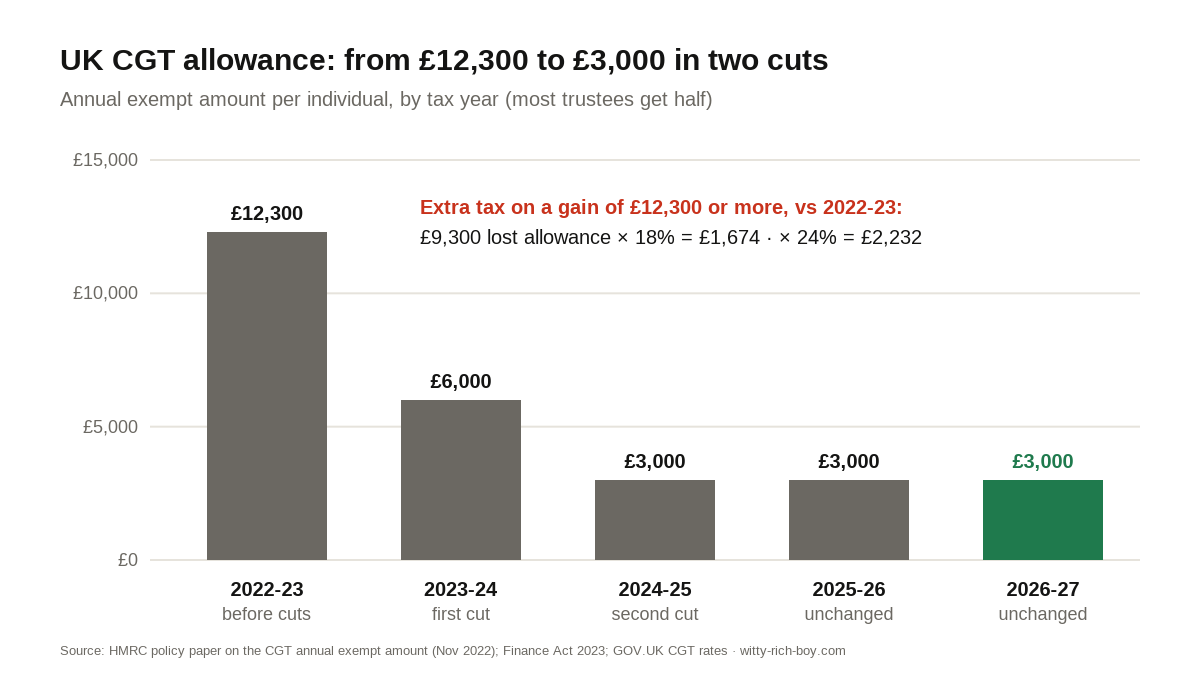
- The Capital Gains Tax annual exempt amount is £3,000 per person in 2026-27 (£1,500 for most trustees) — down from £12,300 in 2022-23 and £6,000 in 2023-24.
- Gains above it are taxed at 18% inside your unused £37,700 basic rate band and 24% above it — the same for shares and residential property.
- Business Asset Disposal Relief rose to 18% for disposals from 6 April 2026, up from 14% in 2025-26, on up to £1 million of lifetime gains.
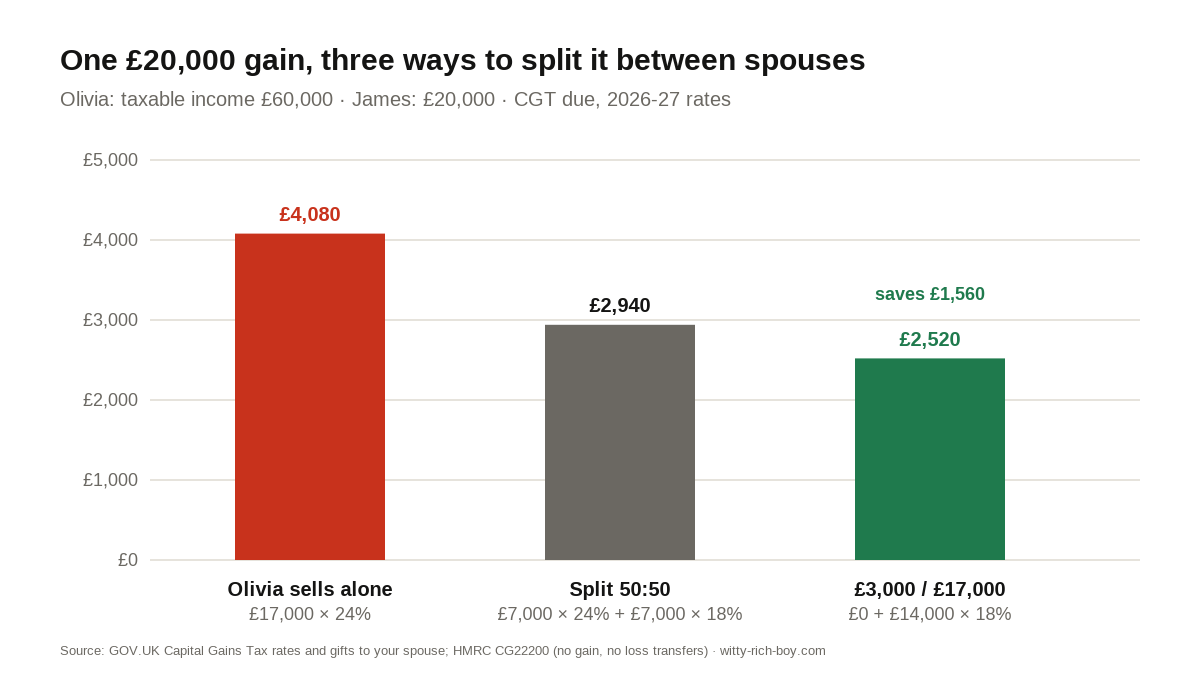
- Transfers between spouses or civil partners living together are no gain, no loss: in our example, moving most of a £20,000 gain to a basic-rate partner cuts the bill from £4,080 to £2,520.
- If you file Self Assessment, disposals with total proceeds over £50,000 must be reported even when no tax is due; tax on residential property gains is due within 60 days of completion.
In force: 6 April 2026 (2026-27 tax year: £3,000 allowance, 18% / 24% rates, BADR 18%)
The UK Capital Gains Tax allowance for 2026-27 is £3,000 per person: the first £3,000 of net gains in the tax year is tax-free. Above that, gains on shares, funds, crypto and residential property are taxed at 18% within your unused £37,700 basic rate band and 24% above it. Spouses each have their own £3,000.
A capital gain is the profit you make when you sell or give away an asset that has risen in value — the sale price minus what you paid and allowable costs. Capital Gains Tax (CGT) is charged on that profit, not on the sale proceeds. The tax-free slice has fallen by three-quarters in three years. Below: the 2026-27 rates, the band-splitting arithmetic, the spouse transfer and bed and ISA, and the deadlines that catch people out.
What is the UK capital gains tax allowance for 2026-27?
The allowance — formally the annual exempt amount — is £3,000 for 2026-27, the tax year running from 6 April 2026 to 5 April 2027. GOV.UK’s Capital Gains Tax rates page confirms the figure for individuals and personal representatives; most trustees get £1,500, half the individual amount. It is set by section 1K of the Taxation of Chargeable Gains Act 1992 (TCGA).
Three features define it:
- It covers net gains, not sales. You add up every gain in the year, deduct same-year losses, then apply the £3,000 once.
- It is per person. Spouses and civil partners have £3,000 each, £6,000 between them, but cannot transfer it.
- It cannot be carried forward. Anything unused on 5 April is lost.
The allowance was cut twice. HMRC’s tax information and impact note, published on 21 November 2022 and enacted in Finance Act 2023, reduced it from £12,300 to £6,000 for 2023-24 and to £3,000 for 2024-25 and later years, and removed the automatic inflation uprating. Budget 2025 left it unchanged.
| Tax year | Annual exempt amount (individuals) | Most trustees |
|---|---|---|
| 2022-23 | £12,300 | £6,150 |
| 2023-24 | £6,000 | £3,000 |
| 2024-25 | £3,000 | £1,500 |
| 2025-26 | £3,000 | £1,500 |
| 2026-27 | £3,000 | £1,500 |
What the cuts cost is easy to quantify. A higher-rate taxpayer with gains of £12,300 or more loses £9,300 of tax-free room, which at 24% is £2,232 a year; at 18% it is £1,674.
What are the capital gains tax rates for 2026-27?
For individuals, CGT is charged at 18% on gains that fall within the unused basic rate band and 24% on gains above it. Since 30 October 2024 those rates apply to almost every asset: HMRC’s Autumn Budget 2024 note Capital Gains Tax — rates of tax raised the main rates from 10% and 20% to match the 18% and 24% already charged on residential property, whose higher rate had been cut from 28% to 24% on 6 April 2024.
| Gain on… (2026-27) | Within basic rate band | Above basic rate band |
|---|---|---|
| Shares, funds, crypto, other assets | 18% | 24% |
| Residential property not covered by Private Residence Relief (second home, buy-to-let) | 18% | 24% |
| Business Asset Disposal Relief / Investors’ Relief | 18% | 18% |
| Trustees and personal representatives | 24% | 24% |
What changed on 6 April 2026
- Business Asset Disposal Relief (BADR) — the relief for people selling all or part of a qualifying business — now charges 18%, up from 14% in 2025-26 and 10% before that. HMRC helpsheet HS275 (2026) confirms the rate for disposals on or after 6 April 2026 and the £1 million lifetime limit. Investors’ Relief follows the same path.
- Carried interest for fund managers left CGT entirely: from 6 April 2026 it is taxed as trading profits under Income Tax, after a one-year 32% CGT rate in 2025-26.
- Main rates and the allowance did not move. Budget 2025 left 18%, 24% and the £3,000 allowance unchanged for 2026-27.
One persistent myth is worth dispelling: there is no separate Scottish rate. HMRC’s Capital Gains Manual (CG21204) works out the band for gains as if the taxpayer were not a Scottish or Welsh taxpayer, so the UK £37,700 band applies everywhere.
How is capital gains tax worked out on top of your income?
Your gains are added on top of your taxable income — income after the £12,570 personal allowance — and the part that fits inside the £37,700 basic rate band is taxed at 18%, the rest at 24%. GOV.UK sets out the same order: work out taxable income, deduct the £3,000 allowance from your gains, add what is left to your income, and split it at the band limit.
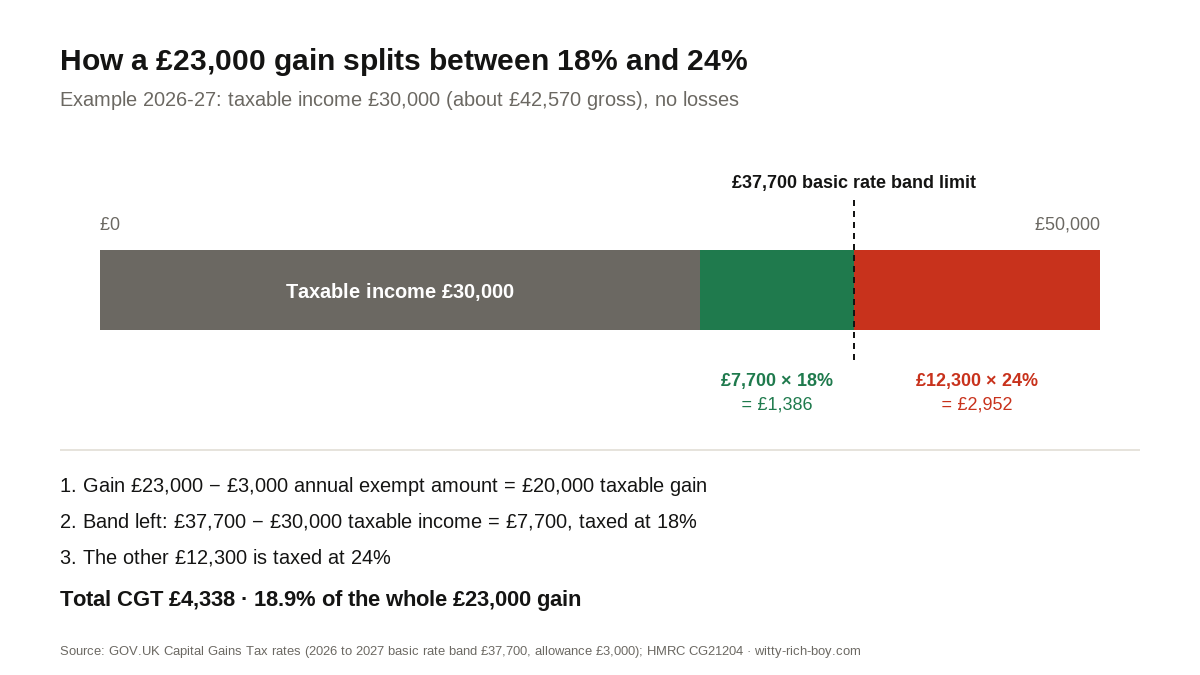
Example 1 — Sam, taxable income £30,000 (about £42,570 gross), sells shares at a £23,000 gain in 2026-27.
- Gain £23,000 − £3,000 annual exempt amount = £20,000 taxable gain.
- Basic rate band left: £37,700 − £30,000 = £7,700.
- £7,700 × 18% = £1,386.
- £12,300 × 24% = £2,952.
- Total CGT: £4,338, an effective 18.9% of the whole gain.
CGT is therefore not a flat rate: a basic-rate taxpayer can still pay 24% on most of a large gain. Someone with little or no taxable income, by contrast, has the whole £37,700 band available for gains at 18%. To run your own figures, use our UK Capital Gains Tax calculator, which performs exactly this split.
How do losses interact with the £3,000 allowance?
Losses from the same tax year are deducted from gains first, in full — even if that wastes part of the allowance. Losses carried forward from earlier years work differently: they are used only to bring net gains down to £3,000, and the rest stays available.
Example 2 — an £8,000 gain with £10,000 of losses brought forward. Only £5,000 of the old losses is used, leaving exactly £3,000 for the allowance and no tax. The other £5,000 carries forward. Had the £10,000 loss arisen in the same year, all of it would have been set against the gain, wiping it out and wasting the allowance.
So crystallising a loss in the same year as a small gain can squander part of your £3,000. A loss can only be used once it is reported to HMRC, and you have four years from the end of the tax year in which it arose to claim it — a 2026-27 loss must be claimed by 5 April 2031.
How can a spouse or civil partner transfer cut the bill?
Gifts between spouses or civil partners who live together are treated as no gain, no loss: no tax arises on the transfer, and the recipient takes over the giver’s original cost (GOV.UK Gifts to your spouse or charity; HMRC CG22200). If the recipient later sells, the gain is theirs — taxed with their own £3,000 allowance and their own band.
Example 3 — Olivia (taxable income £60,000) holds shares with a £20,000 gain. Her husband James has taxable income of £20,000, so £17,700 of his basic rate band is unused.
| Option | Who sells what | Tax on Olivia’s part | Tax on James’s part | Total CGT 2026-27 |
|---|---|---|---|---|
| A. Olivia sells everything | Olivia: £20,000 gain | (£20,000 − £3,000) × 24% = £4,080 | — | £4,080 |
| B. Split 50:50 | £10,000 gain each | £7,000 × 24% = £1,680 | £7,000 × 18% = £1,260 | £2,940 |
| C. Olivia keeps £3,000 of gain, gives the rest | Olivia £3,000 / James £17,000 | £0 | £14,000 × 18% = £2,520 | £2,520 |
Option C saves £1,560 against option A. James can absorb £17,700 of taxable gain at 18%, and Olivia’s allowance covers the slice she keeps. Giving James everything would cost £3,060, because Olivia’s £3,000 would go unused.
Conditions to respect:
- The gift must be outright. The shares become James’s; an arrangement to hand the proceeds back invites challenge.
- You must be living together, as CG22200 defines it. Since 6 April 2023, separating couples can still transfer at no gain, no loss until the end of the third tax year after they stop living together, or without limit under a formal divorce agreement or court order.
- The base cost travels with the asset. James’s gain is measured from Olivia’s original purchase price, not the value on the day of the gift.
What is bed and ISA, and does the 30-day rule apply?
A bed and ISA is the sale of an investment held outside an ISA followed by its repurchase inside a stocks and shares ISA. The sale is a normal disposal for CGT; the repurchase uses part of your £20,000 ISA allowance, and every future gain and dividend on that holding is then tax-free.
The 30-day rule — the “bed and breakfast” rule in section 106A TCGA — matches a sale with shares of the same class bought in the following 30 days, rather than with your existing holding. HMRC’s CG51560 says it applies only where the shares are acquired by the same person in the same capacity. Regulation 34 of the Individual Savings Account Regulations 1998 treats investments held in an ISA as held in a separate capacity, so a repurchase inside the ISA is generally not matched with the sale. The gain or loss is crystallised at the sale price.
Example 4 — Priya holds a global index fund outside an ISA worth £20,000, bought for £17,000. She sells it in May 2026, realising a £3,000 gain, which her 2026-27 allowance covers in full, and buys the same fund inside her ISA with the £20,000. Tax today: nil. Her new base cost is £20,000 — but inside the ISA it no longer matters, because gains there are exempt. Repeating this each year moves up to £20,000 a year out of reach of CGT and of dividend tax above the £500 allowance.
One caution: selling and buying back the same shares outside the ISA within 30 days does not reset the base cost — the 30-day rule matches them.
Do you have to report gains below £3,000, and when is CGT due?
You do not need to report gains covered by the £3,000 allowance — unless you are in Self Assessment and your total sale proceeds in the tax year exceeded £50,000. GOV.UK’s Work out if you need to pay confirms that threshold for 2023-24 onwards; it applies to what you sold assets for, not the gain, so selling a £60,000 portfolio at a £2,000 profit still goes on the return.
When tax is due, there are three routes, each with its own deadline:
| Situation | How to report | Deadline for a 2026-27 disposal |
|---|---|---|
| UK residential property, tax to pay (UK resident) | Capital Gains Tax on UK property service | Report and pay within 60 days of completion |
| Non-resident selling UK property or land | Same service | Within 60 days, even with no tax or a loss |
| Other gains, not in Self Assessment | Real-time Capital Gains Tax service | Report by 31 December 2027, pay by 31 January 2028 |
| Any gains, in Self Assessment | Capital gains pages of the return | Online return and payment by 31 January 2028 |
| New to Self Assessment | Register first | By 5 October 2027 |
| Loss to carry forward | Claim on return or in writing | By 5 April 2031 |
The 60-day rule applies to completions on or after 27 October 2021; earlier sales from 6 April 2020 had 30 days. Interest and penalties can apply if you miss it, and the sale must also go on your Self Assessment return if you file one. A main home fully covered by Private Residence Relief has no gain to report.
How to use your £3,000 allowance before 5 April 2027
The allowance resets each April, so run this routine before 5 April:
- List unrealised gains and losses on every holding outside ISAs and pensions — shares, funds, crypto, second property. Our guide to UK crypto tax covers how token pools are costed; remember that crypto-to-crypto swaps are disposals too.
- Total this year’s realised gains and losses so far, since 6 April 2026.
- Work out your band space: £37,700 minus your expected taxable income. Anything inside it is taxed at 18%; pension contributions can extend it.
- Realise gains up to £3,000 where you would sell anyway, or bed and ISA them to reset the cost inside the wrapper.
- Consider a spouse transfer before selling if your partner has an unused allowance or a lower band.
- Avoid crystallising same-year losses that only waste the allowance; carry them into a year with larger gains instead.
- Keep records and diarise deadlines: 60 days for property, 31 December or 31 January for everything else, and the £50,000 proceeds test if you file a return.
Which strategy fits your situation?
The right tactic depends on where your gains sit relative to the allowance and your band. For 2026-27:
| Your situation | Most useful step | Why |
|---|---|---|
| Unrealised gain under £3,000, ISA allowance unused | Bed and ISA | Gain covered by allowance; future growth sheltered |
| Gain over £3,000, partner on basic rate or lower | Spouse transfer before sale | Second £3,000 plus partner’s 18% band |
| Large gain, both partners higher-rate | Sell across two tax years | Two allowances each; e.g. part before and part after 5 April |
| Gain straddling the £50,270 line | Pension contribution in the same year | Extends basic rate band, moving gain from 24% to 18% |
| Loss on another holding, small gain this year | Delay the loss sale | Same-year losses can waste the £3,000 |
| Selling a business that qualifies | Claim Business Asset Disposal Relief | 18% flat on up to £1 million lifetime gains |
With an allowance of £3,000, anyone selling a meaningful portfolio outside an ISA will pay something. What remains in your hands is the timing, the owner and the wrapper.
Questions readers ask
What is the capital gains tax allowance for 2026/27?
The Capital Gains Tax annual exempt amount for 2026-27, the tax year from 6 April 2026 to 5 April 2027, is £3,000 for individuals and personal representatives, and £1,500 for most trustees. It applies to your total net gains for the year across all assets, not to each sale, and it has been fixed at £3,000 since 2024-25.
What are the capital gains tax rates for 2026/27?
Individuals pay 18% on the part of a taxable gain that fits inside their unused £37,700 basic rate band and 24% on the rest. The same two rates apply to shares, funds, crypto and residential property such as a second home or buy-to-let. Business Asset Disposal Relief and Investors' Relief gains are taxed at 18% from 6 April 2026, and trustees pay 24%.
Can I transfer my capital gains allowance to my spouse?
No. Each person has their own £3,000 allowance and it cannot be transferred. What you can do is give assets to a spouse or civil partner you live with: under HMRC CG22200 the gift is at no gain, no loss, so the receiving partner takes over your original cost. If they then sell, they use their own allowance and, possibly, their unused 18% band.
Can I carry forward my unused capital gains tax allowance?
No. An unused annual exempt amount is lost at the end of the tax year on 5 April. Capital losses, by contrast, can be carried forward indefinitely once reported to HMRC, within four years of the end of the tax year in which they arose. Brought-forward losses are only used to bring the year's net gains down to £3,000, so they never waste the allowance.
Does the 30-day rule apply to bed and ISA?
Generally not. HMRC's CG51560 says the 30-day rule matches a sale only with shares acquired by the same person in the same capacity, and regulation 34 of the ISA Regulations 1998 treats investments held in an ISA as held in a separate capacity. Selling outside an ISA and rebuying inside one therefore crystallises the gain or loss at the sale price.
Do I have to report capital gains under £3,000?
Usually not, if your total gains are within the £3,000 allowance. The exception is Self Assessment: if you are registered and the total you sold assets for in the tax year exceeded £50,000, you must report the disposals on your return even though no tax is due. Non-residents selling UK property must also report within 60 days.
When do I pay capital gains tax on a property sale?
For UK residential property completed on or after 27 October 2021, a UK resident who owes tax must report and pay within 60 days of completion, using HMRC's online Capital Gains Tax on UK property service. Missing the deadline can bring interest and penalties. If you file Self Assessment, you also include the sale on your return for that year.
Is capital gains tax higher in Scotland?
No. Scottish Income Tax rates and bands apply to earnings, not gains. HMRC's Capital Gains Manual (CG21204) says the available basic rate band for gains is worked out as if the person were not a Scottish or Welsh taxpayer, so everyone in the UK uses the same £37,700 band and the same 18% and 24% rates.
Was this guide useful?
Thanks — your answer helps us decide what to cover next.
Sources
- Capital Gains Tax: rates and allowances (GOV.UK)
- Capital Gains Tax: annual exempt amount — tax information and impact note (HMRC)
- Capital Gains Tax — rates of tax, Autumn Budget 2024 (HMRC)
- HS275 Business Asset Disposal Relief (2026) (HMRC helpsheet)
- Capital Gains Tax: gifts to your spouse or charity (GOV.UK)
- CG22200 — Transfer of assets between spouses or civil partners living together (HMRC Capital Gains Manual)
- CG51560 — Share identification: the same day and bed and breakfast rules (HMRC Capital Gains Manual)
- Capital Gains Tax: work out if you need to pay — £50,000 reporting rule (GOV.UK)
- Report and pay your Capital Gains Tax: if you sold a property in the UK (GOV.UK)
- Report and pay your Capital Gains Tax: if you have other capital gains to report (GOV.UK)
General information, not tax or legal advice. Rules change — check the official source or a licensed adviser before acting.