European Union · Policy changes
DAC8 crypto reporting (2026): what exchanges tell tax offices
DAC8 crypto rules: since 1 January 2026, platforms serving EU residents collect your tax ID and report buys, sells, swaps and transfers, shared by 30 Sept 2027.

The short answer
- DAC8 (Council Directive (EU) 2023/2226) applies from 1 January 2026: platforms collect data on 2026 activity and report it in 2027.
- Tax offices must exchange the 2026 data with your country of residence within nine months of year-end — by 30 September 2027.
- Platforms report annual totals per coin: fiat purchases and sales, crypto-to-crypto swaps, transfers in and out, and retail payments above USD 50,000.
- You must give a self-certification with your TIN. Ignore two reminders and, after at least 60 days, the platform must block reportable transactions.
- Penalties are national. In Germany a user who fails to provide the self-certification risks a fine of up to €50,000 (§ 18 KStTG); in the UK, up to £300.
- DAC8 is the EU version of the OECD's CARF, which 77 jurisdictions have committed to, with first exchanges in 2027, 2028 or 2029.
In force: 1 January 2026 (data collection) · 1 January 2027 (self-certification deadline for existing users) · 30 September 2027 (first EU exchange)
DAC8 crypto reporting is the EU rule that makes crypto platforms report their customers to tax authorities. Since 1 January 2026, providers serving EU residents collect your name, address, tax residence and tax ID, and report annual totals of your purchases, sales, swaps and transfers. The 2026 data must reach your home tax office by 30 September 2027.
For a decade, crypto sat in a blind spot of Europe’s tax-information system. Banks reported accounts under the Common Reporting Standard; brokers reported dividends; exchanges reported nothing unless a tax office went looking. DAC8 closes that gap. It does not change a single tax rate. It changes who supplies the evidence — and it means that from the 2026 tax year, the figures on your return can be checked against figures your platform has already filed.
What is DAC8 crypto reporting?
DAC8 is Council Directive (EU) 2023/2226, adopted on 17 October 2023 and published in the Official Journal on 24 October 2023. It is the eighth amendment to the Directive on Administrative Cooperation (2011/16/EU), the EU law under which tax authorities automatically swap information. Member states had to transpose it by 31 December 2025 and apply it from 1 January 2026 (Article 2 of the directive).
Three terms do most of the work:
- Reporting Crypto-Asset Service Provider (RCASP) is any business that carries out exchange transactions or transfers of crypto-assets for customers — exchanges, brokers, custodial wallets, crypto-asset ATM operators and similar intermediaries.
- Reportable Crypto-Asset is any crypto-asset as defined in MiCA, other than central bank digital currencies, e-money, and tokens the provider has adequately determined cannot be used for payment or investment (Annex VI, Section IV(A)).
- CARF, the Crypto-Asset Reporting Framework, is the OECD standard on which DAC8 is built. The European Commission states that the OECD’s CARF commentary can serve as interpretative material for DAC8 where the texts align.
DAC8 is a reporting rule, not a tax. How your gains are taxed still depends entirely on where you live — tax-free after a year in Germany’s crypto tax regime, a deemed return on your 1 January holdings under the Dutch Box 3 system, savings-base rates of 19% to 30% plus a separate Modelo 721 declaration for coins held abroad under Spain’s crypto tax rules, capital gains tax in the UK, and so on.
When does DAC8 start? The 2026–2027 timeline
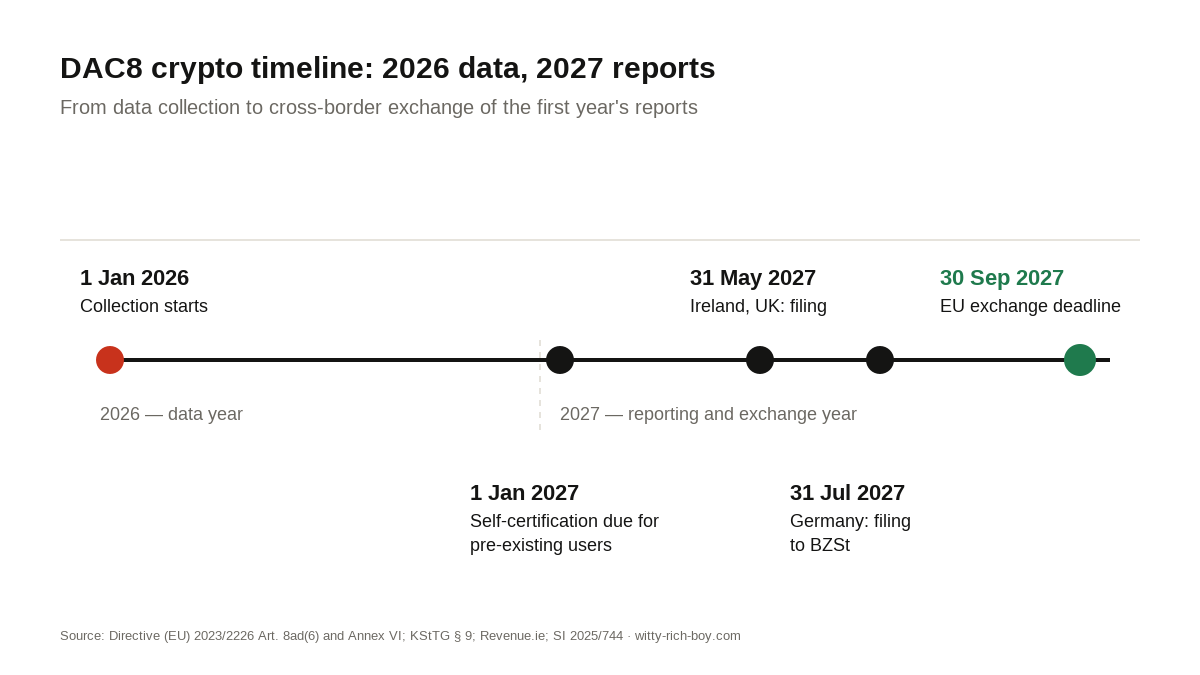
DAC8 data collection started on 1 January 2026, and the first reports cover the 2026 calendar year. Platforms file with their national tax authority in 2027, and authorities must forward the data to other member states “within nine months following the end of the calendar year” — that is, by 30 September 2027 (Article 8ad(6)).
The filing date for platforms is set nationally, which is why guides that quote a single EU-wide filing deadline are wrong:
| Date | What happens | Legal basis |
|---|---|---|
| 31 Dec 2025 | Cut-off: customers onboarded by this date are “pre-existing users” | Annex VI, Section IV(D) |
| 1 Jan 2026 | Data collection on 2026 activity begins; new customers must self-certify before transacting | Article 2; Annex VI, Section III |
| 1 Jan 2027 | Deadline for platforms to obtain self-certifications from pre-existing users | Annex VI, Section III(A)(1) |
| 31 May 2027 | Platforms file 2026 data in Ireland and send each user a copy; same filing date in the UK under CARF | s. 891HA TCA 1997; SI 2025/744 |
| 31 Jul 2027 | Platforms file 2026 data with Germany’s Federal Central Tax Office (BZSt) | § 9 KStTG |
| 30 Sep 2027 | EU tax authorities must have exchanged the 2026 data | Article 8ad(6) |
Who has to report under DAC8?
Any crypto-asset service provider with EU-resident customers has to report, whether or not it is based in the EU. The directive covers two groups. Crypto-asset service providers authorised under MiCA (Regulation (EU) 2023/1114; see MiCA regulation explained) report to the member state that authorised them. Crypto-asset operators — providers not authorised under MiCA, including those based outside the EU — must register with the tax authority of a single member state and report there (Article 8ad(7)).
A non-EU operator that ignores two reminders to report must have its registration revoked no earlier than 30 days and no later than 90 days after the second reminder (Annex VI, Section V(F)).
| Provider | Reports under DAC8? |
|---|---|
| MiCA-licensed exchange or broker in the EU | Yes, to its home member state, for all EU-resident customers — including residents of that same state |
| Non-EU platform with EU-resident customers | Yes, after registering in one member state |
| Custodial wallet provider that executes transfers | Yes |
| Self-custody wallet software | No — there is no intermediary |
| Fully decentralised protocol with no operator | Not directly; the on-ramp and off-ramp platforms still report |
What are the DAC8 reporting requirements for your personal data?
Every platform must obtain a self-certification from each customer: a signed or “positively affirmed” declaration of who you are and where you are tax resident. Under Annex VI, Section III(C), a self-certification from an individual is valid only if it contains:
- first and last name;
- residence address;
- member state(s) of residence for tax purposes;
- the TIN (taxpayer identification number) for each member state of residence;
- date of birth.
A TIN is “any number or code that a competent authority uses to identify a taxpayer” — your Steuer-ID in Germany, PPSN in Ireland, numéro fiscal in France. The platform must check the self-certification for plausibility against the anti-money-laundering data it already holds. If you are tax resident in two countries, you give a TIN for each; if you move often, work out first where you are actually resident — our guide to digital nomad tax residency walks through the day counts and treaty tie-breaker.
New customers have to self-certify before their first reportable transaction. Customers who opened accounts on or before 31 December 2025 have until 1 January 2027. Companies must also identify their controlling persons, who are reported in their own right.
Place of birth appears in the directive’s reporting list, but it only has to be reported where domestic law requires the platform to collect it (Annex VI, Section II(C)).
What crypto transactions does DAC8 report?
DAC8 reports almost everything a platform does for you — but as annual totals per crypto-asset, not as a trade-by-trade ledger. For each coin or token, Annex VI, Section II(B)(3) requires:
| Category | What is reported |
|---|---|
| Acquisitions against fiat | Gross amount paid, units, number of transactions |
| Disposals against fiat | Gross amount received, units, number of transactions |
| Acquisitions against other crypto | Fair market value, units, number of transactions |
| Disposals against other crypto | Fair market value, units, number of transactions |
| Reportable retail payments | Fair market value, units, number — only payments for goods or services above USD 50,000 |
| Transfers to you | Value, units, number, split by transfer type where the platform knows it |
| Transfers by you | Value, units, number, split by transfer type where the platform knows it |
| Transfers to external wallets | Value and units sent to addresses not known to belong to a provider or financial institution |
There is no minimum threshold for trades or transfers; the USD 50,000 figure applies only to retail payments. Crypto-to-crypto swaps are reported on both sides — useful to know because a swap is a taxable disposal in most countries (how crypto swaps are taxed). The questions your platform asks about the recipient and wallet ownership when you send coins come from a separate anti-money-laundering rule, explained in our guide to the crypto travel rule.
A worked example
Example: Anna, tax resident in Germany, uses a MiCA-licensed exchange in another member state. In 2026 she buys 0.5 BTC for €30,000 in three purchases, sells 0.2 BTC for €14,000, swaps 0.05 BTC (worth €3,500) into ether, and sends 0.1 BTC (worth €6,500) to her own hardware wallet.
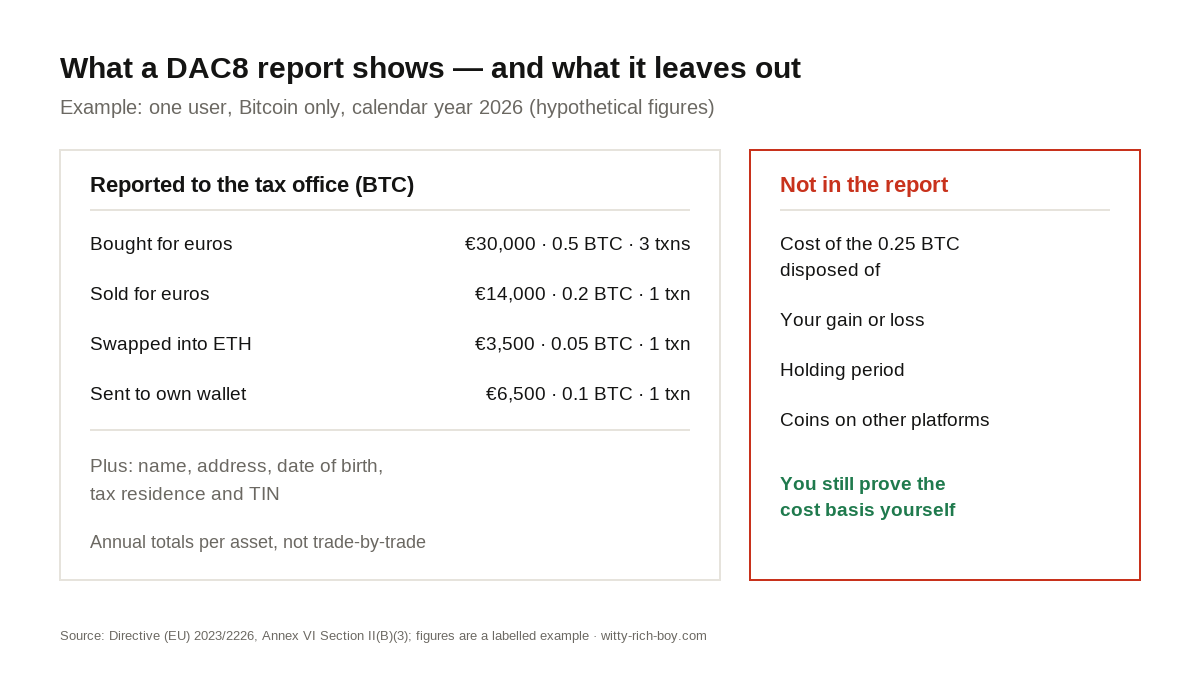
The German tax office receives those four BTC lines, an acquisition line for ETH, and Anna’s identity data. What it does not receive is her gain. She disposed of 0.25 BTC for €17,500; at her average cost of €60,000 per BTC, those coins cost €15,000, so her gain is €2,500. Because she held them for less than a year and the total exceeds Germany’s €1,000 exemption limit, the whole €2,500 is taxable. The report would look the same if she had made a loss — which is why your own cost records matter more after DAC8, not less.
Will my exchange report me to the tax office?
Yes — if you are tax resident in the EU and use a centralised platform, assume it reports you. The table below covers the common situations:
| Your situation | Reported under DAC8? | Where the data goes |
|---|---|---|
| EU resident, EU-licensed exchange in your own country | Yes | Your own tax office (domestic) |
| EU resident, EU-licensed exchange in another member state | Yes | Exchanged to your country by 30 Sep 2027 |
| EU resident, non-EU exchange serving EU customers | Yes, once the operator registers in a member state | Via that member state |
| EU resident, exchange in a CARF country (e.g. UK) | Under CARF, from that country’s first exchange year | Via CARF exchange agreements |
| Self-custody wallet and DeFi only | No direct report | Only on-ramp and off-ramp activity appears |
| Non-EU resident using an EU platform | Not under DAC8; possibly under CARF | Your residence country, if it exchanges under CARF |
One nuance: a platform that reports the same user’s data in a non-EU country with a qualifying agreement with the user’s EU home state can be exempt from reporting it again in the EU (Annex VI, Section II(E)). The data still arrives — just through a different channel.
What happens if you don’t give your exchange your tax ID?
You lose the ability to trade. Annex VI, Section V(A)(2) requires that where a user does not provide the information after two reminders following the initial request — “but not prior to the expiration of 60 days” — the platform “shall prevent the Crypto-Asset User from performing Reportable Transactions”. That means no buying, selling, swapping or sending out until you comply.
Fines are left to each member state. Article 25a requires penalties that are “effective, proportionate and dissuasive”, but the final directive sets no EU-wide amounts. Officially published examples:
| Jurisdiction | Law | Penalty |
|---|---|---|
| Germany | § 18 KStTG | Fine up to €50,000 for a user who, intentionally or recklessly, fails to provide a correct self-certification; up to €50,000 for a platform failing to collect it or report |
| Germany | § 8(3) KStTG | Pre-existing users: blocked no earlier than 60 and no later than 90 days after the original request |
| United Kingdom (CARF) | Reg. 13, SI 2025/744 | Up to £300 for a user who fails to provide a valid self-certification |
| United Kingdom (CARF) | Reg. 11, SI 2025/744 | Up to £300 per user for a platform that fails to obtain a self-certification |
Germany’s €50,000 is a maximum for an administrative offence, not a fixed charge. But it shows that refusing to provide a tax ID is not a neutral choice.
DAC8 vs CARF: what’s the difference?
CARF is the global standard; DAC8 is its binding EU implementation. The OECD completed and published CARF in June 2023 as part of its International Standards for Automatic Exchange of Information in Tax Matters, with the same reporting fields. DAC8 adds EU-specific machinery:
| Feature | OECD CARF | EU DAC8 |
|---|---|---|
| Legal form | International standard, adopted through domestic law and agreements | Directive binding all 27 member states |
| Start of data collection | Set by each jurisdiction (2026 for 2027 exchangers) | 1 January 2026 everywhere |
| Non-compliant users | Enforcement left to each jurisdiction | Must be blocked after two reminders, no earlier than 60 days |
| Non-resident operators | Nexus rules (residence, incorporation, management, branch) | Must register in one member state |
| Identity check | Self-certification | Self-certification, or a state Identification Service |
| Exchange deadline | Set in agreements between jurisdictions | Nine months after year-end (30 September) |
The geography matters. According to the OECD Global Forum’s list updated on 14 September 2026, 77 jurisdictions have committed to CARF: 46 will exchange from 2027 (including 26 EU member states, the UK, Japan, Korea, the Cayman Islands and Brazil), 27 from 2028 (including Switzerland, Singapore, the UAE, Hong Kong and Cyprus), and 4 from 2029 (including the United States and Mexico). Four relevant jurisdictions — El Salvador, Georgia, India and Viet Nam — have not yet committed. Domestically, the United States already runs its own regime: brokers report crypto sales to the IRS on Form 1099-DA from the 2025 tax year. Americans living in the EU face a separate duty on top: the FBAR filing requirement for foreign accounts worth more than $10,000 in aggregate.
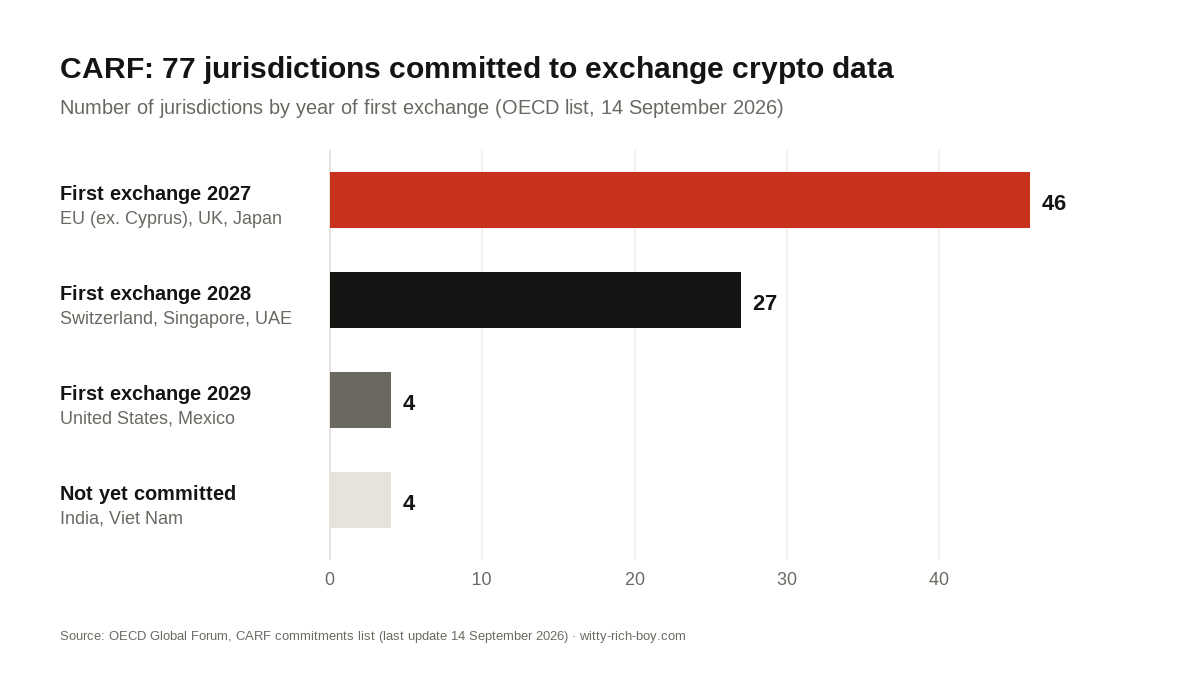
Cyprus’s 2028 CARF date concerns exchanges with non-EU countries; DAC8 itself applies in Cyprus, as in every member state, from 1 January 2026. The UK runs CARF for its own residents too, with 2026 data due to HM Revenue & Customs by 31 May 2027 (UK crypto tax rules). Japan is also in the 2027 group (Japan’s crypto tax).
How to prepare for DAC8 crypto reporting
The reports cover what platforms see, so the work for individuals is making sure your own records are better than theirs. Six steps:
- List every platform you used in 2026, including dormant accounts with a balance — each one files its own report.
- Check the self-certification on each account: correct name, address, tax residence and TIN. A wrong TIN can send your data to the wrong place or trigger a query.
- Download full 2026 transaction histories now, in CSV, while the platforms still hold them.
- Rebuild your cost basis, including coins bought before 2026 and moved between platforms, because the report shows proceeds but not what you paid.
- Label transfers between your own wallets so they are not mistaken for disposals or income.
- Reconcile your 2026 return with the platform totals before filing: same coins, same gross proceeds, same number of disposals.
If you have undeclared gains from earlier years, the arrival of DAC8 data is a reason to speak to a tax adviser about your country’s correction or voluntary-disclosure rules before the authority contacts you.
Questions readers ask
Does DAC8 create a new crypto tax?
No. DAC8 changes who tells the tax office about your crypto, not how much tax you owe. Gains, income and losses are still taxed under your own country's rules. What changes is that the tax authority now receives annual totals of your purchases, sales, swaps and transfers directly from the platform, and can compare them with your tax return.
Will my crypto exchange report to the tax office?
Yes, if it is a crypto-asset service provider with EU-resident customers. MiCA-authorised platforms report to the member state that authorised them; non-EU operators must register in one member state and report there. The data then goes to your country of residence. From 2026 activity onwards, an exchange that serves EU residents without reporting is in breach of the DAC8 rules.
What happens if I don't give my exchange my tax ID?
Under DAC8, the platform must request the self-certification, send two reminders and, no earlier than 60 days after the request, stop you making reportable transactions such as buying, selling, swapping or transferring. National fines can apply on top: Germany's KStTG allows fines of up to €50,000 for failing to provide it.
Does DAC8 apply to self-custody wallets?
DAC8 obliges service providers, not wallet software or individuals. Activity entirely inside a self-custody wallet is not reported. But when a platform sends crypto to an external wallet address, it reports the aggregate value and units of those transfers, flagging addresses not known to belong to another provider. The gains remain taxable either way.
What is the difference between DAC8 and CARF?
CARF is the OECD's global standard for crypto tax reporting, published in June 2023. DAC8 is the EU directive that writes CARF into binding law for all 27 member states, with extra EU features: mandatory blocking of non-compliant users after two reminders and 60 days, registration of non-EU operators in one member state, and a nine-month deadline for exchanges between EU tax authorities.
Are stablecoins and NFTs covered by DAC8?
Stablecoins are covered as crypto-assets, except those that qualify as electronic money, which are dealt with under the parallel CRS rules for financial accounts. Central bank digital currencies are excluded. NFTs and other tokens are reportable unless the platform has adequately determined they cannot be used for payment or investment purposes.
When will my tax office first see my crypto data?
Platforms file 2026 data in 2027 under national deadlines, such as 31 May in Ireland and 31 July in Germany. Data on users resident in another EU country must then be exchanged by 30 September 2027. Expect your tax office to be able to match the data against your 2026 return from late 2027 onwards.
Does DAC8 cover crypto bought before 2026?
DAC8 reports transactions from 1 January 2026 onwards, not historical trades. But a sale in 2026 of coins bought in 2020 is a 2026 disposal and will be reported as gross proceeds, without the original purchase price. You need your own records of the old cost to calculate the gain correctly.
Was this guide useful?
Thanks — your answer helps us decide what to cover next.
Sources
- Council Directive (EU) 2023/2226 of 17 October 2023 (DAC8), Official Journal L 2023/2226 — EUR-Lex
- European Commission, DG TAXUD — DAC8: Directive on Administrative Cooperation (tax transparency for crypto-assets)
- OECD Global Forum — Jurisdictions committed to implement the CARF (last update 14 September 2026)
- OECD — Delivering Tax Transparency to Crypto-Assets: A Step-by-Step Guide to the CARF (2024)
- Kryptowerte-Steuertransparenzgesetz (KStTG) — gesetze-im-internet.de
- Revenue (Ireland) — Crypto-Asset Reporting Framework (CARF)/DAC8: overview
- Revenue (Ireland) — CARF/DAC8: reporting obligations
- The Reporting Cryptoasset Service Providers (Due Diligence and Reporting Requirements) Regulations 2025 (SI 2025/744) — legislation.gov.uk
General information, not tax or legal advice. Rules change — check the official source or a licensed adviser before acting.