Australia · Crypto
ATO Crypto Tax (2026): 50% CGT Discount, Swaps and Staking
ATO crypto tax in 2026: swaps and wrapping are CGT events, staking is income, and the 50% discount after 12 months gives way to indexation from 1 July 2027.

The short answer
- Swapping one token for another is a CGT event for the token you give up, valued at the Australian-dollar market value of what you receive, according to the ATO.
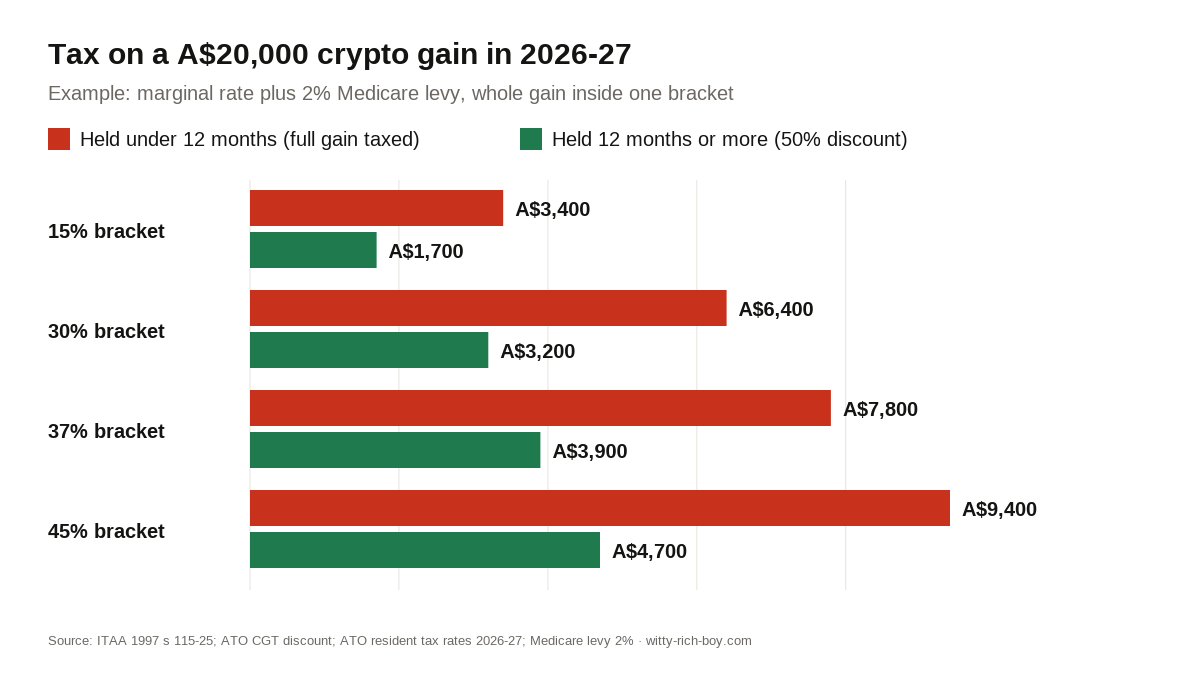
- Resident individuals who owned crypto for at least 12 months can cut the gain by 50% (ITAA 1997 s 115-25); on a A$20,000 gain in the 30% bracket that saves A$3,200 including Medicare levy.
- Staking rewards are ordinary income at their A$ value when received; that value becomes the tokens' cost base.
- The personal use asset exemption covers gains only on crypto acquired for A$10,000 or less and used for personal purchases — the ATO says crypto kept as an investment never qualifies.
- For 2026-27 the lowest resident rate fell from 16% to 15%; the tax-free threshold stays A$18,200, plus a 2% Medicare levy.
- From 1 July 2027 the 50% discount is replaced by cost base indexation and a 30% minimum tax for gains accruing after that date.
In force: 1 July 2026 (2026-27 resident rates: 16% bracket cut to 15%; tax-free threshold A$18,200) · 1 July 2027 (50% CGT discount replaced by cost base indexation and a 30% minimum tax for gains accruing from this date)
The ATO taxes crypto under ordinary capital gains tax rules. Selling, swapping, spending or wrapping a token is a CGT event; the gain is added to your income and taxed at 0–45% plus the 2% Medicare levy. Held 12 months or more, only half the gain is taxed. Staking rewards are ordinary income when received.
Australia never wrote a crypto tax. The Australian Taxation Office (ATO) applies the Income Tax Assessment Act 1997 (ITAA 1997) to tokens as to shares, so three questions decide almost every bill: did a CGT event happen, how long did you own the asset, and is the receipt capital or income? Below, each is answered with 2026-27 rates and worked numbers — plus the change to the 50% discount from 1 July 2027.
How does the ATO tax crypto?
The ATO treats crypto held as an investment as a CGT asset: you pay capital gains tax when a CGT event happens to it, not while you simply hold it. A CGT event is a transaction, such as a disposal, that crystallises a capital gain or loss for tax purposes.
The ATO’s crypto pages identify several events that count, even when no Australian dollars reach your bank account:
- Selling crypto for Australian dollars or another fiat currency.
- Swapping one crypto asset for another, including into a stablecoin.
- Using crypto to pay for goods or services.
- Depositing tokens into a DeFi liquidity pool, and many DeFi lending arrangements.
- Wrapping or unwrapping a token, in the ATO’s current (draft) view.
Moving tokens between wallets you own is not a disposal, the ATO says, as long as you keep ownership. Buying crypto with dollars is not taxable either; it simply sets your cost base — what you paid, plus incidental costs such as fees.
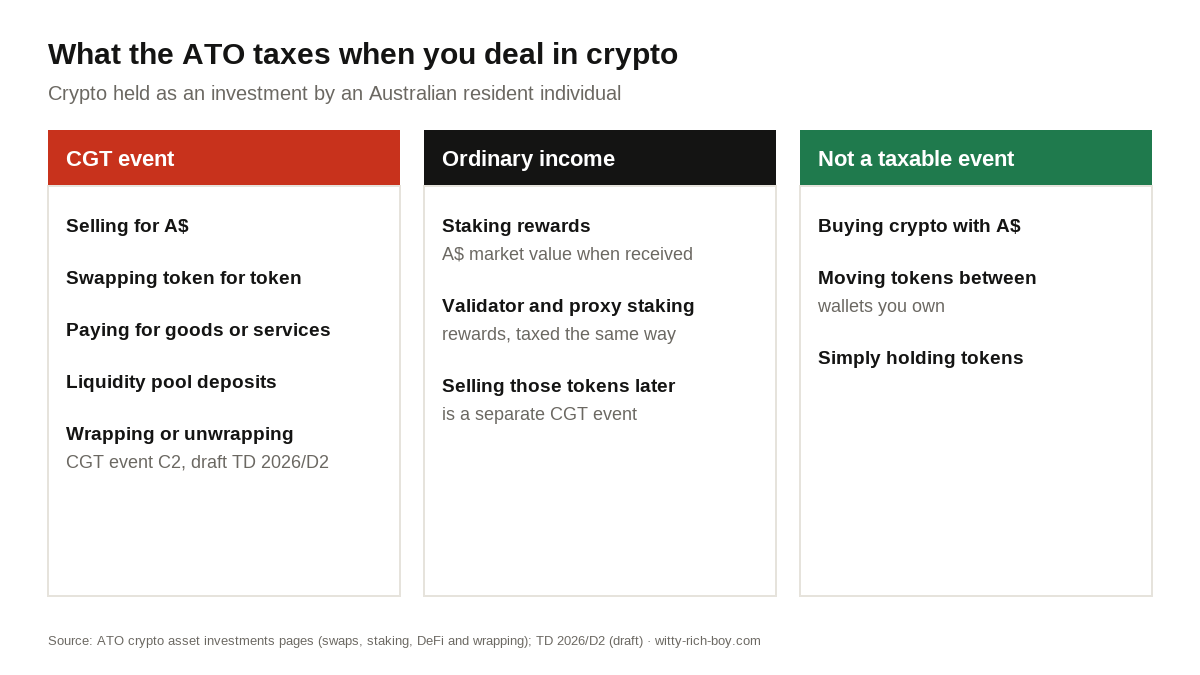
| What you do | Tax result | Amount measured in A$ |
|---|---|---|
| Buy crypto with dollars and hold | Nothing to report | Purchase price becomes cost base |
| Sell crypto for dollars | CGT event | Proceeds minus cost base |
| Swap token A for token B | CGT event on token A | Market value of token B received |
| Pay for goods with crypto | CGT event | Market value at the time |
| Receive staking rewards | Ordinary income | Market value when received |
| Wrap a token (e.g. ETH to WETH) | CGT event C2 (draft view) | Market value of wrapped token |
| Move tokens between your own wallets | Not a disposal | — |
There is no special crypto tax rate. Your net capital gain for the year — total gains, minus capital losses, minus any discount — is added to your taxable income and taxed at your marginal rate.
What are the Australian tax rates for crypto gains in 2025-26 and 2026-27?
Crypto gains are taxed at the ordinary resident rates, which for 2026-27 run from nil on the first A$18,200 to 45% above A$190,000, plus the 2% Medicare levy. The ATO’s table of resident rates notes that the rates exclude the Medicare levy, which is charged at 2% of taxable income unless you qualify for a reduction or exemption.
The lowest bracket changed on 1 July 2026. The ATO’s new-legislation page confirms that the 16% rate fell to 15% from 1 July 2026, and is legislated to fall again to 14% from 1 July 2027. The thresholds did not move.
| Taxable income | 2025-26 tax | 2026-27 tax |
|---|---|---|
| A$0 – A$18,200 | Nil | Nil |
| A$18,201 – A$45,000 | 16c for each $1 over A$18,200 | 15c for each $1 over A$18,200 |
| A$45,001 – A$135,000 | A$4,288 + 30c for each $1 over A$45,000 | A$4,020 + 30c for each $1 over A$45,000 |
| A$135,001 – A$190,000 | A$31,288 + 37c for each $1 over A$135,000 | A$31,020 + 37c for each $1 over A$135,000 |
| A$190,001 and over | A$51,638 + 45c for each $1 over A$190,000 | A$51,370 + 45c for each $1 over A$190,000 |
The gain is taxed in the year of the CGT event: a sale on or before 30 June 2026 belongs to 2025-26, one from 1 July 2026 to 2026-27.
How does the 50% CGT discount work for crypto?
If you are an Australian resident individual and owned the crypto for at least 12 months, you can reduce the capital gain by 50% before it is added to your income. Section 115-25 of ITAA 1997 requires the asset to have been acquired at least 12 months before the CGT event, and the ATO tells you to exclude both the day of acquisition and the day of the CGT event when counting.
Two details catch people:
- Losses come first. Current-year capital losses, then carried-forward net capital losses, are deducted from gains before the 50% discount is applied. A loss therefore saves less than its face value against a discountable gain.
- Every new token restarts the clock. A coin received in a swap, through wrapping or as a staking reward is a new CGT asset with its own acquisition date. Rotating between tokens can mean you never reach 12 months.
Example: Mia earns a A$85,000 salary. She bought 0.5 BTC for A$50,000 on 10 August 2025 and sells it for A$70,000 on 12 August 2026, a A$20,000 gain in 2026-27. She has owned it for more than 12 months, so only A$10,000 is added to her income, taking it to A$95,000. Her tax becomes A$4,020 + 30% × A$50,000 = A$19,020, plus a A$1,900 Medicare levy. The crypto adds A$3,200 to her bill. Had she sold on 1 August 2026, the full A$20,000 would be taxed: A$6,400.
Low incomes benefit most from the tax-free threshold. Example: Josh, a student with A$12,000 of part-time income in 2026-27, sells tokens held for 18 months at a A$14,000 gain. Half (A$7,000) is taxable, taking him to A$19,000 — just A$800 over the threshold, so his income tax is A$120 (15% × A$800). The Medicare levy may be reduced or nil at that income under the low-income thresholds.
Is swapping one crypto for another a CGT event?
Yes. The ATO states that when you exchange or swap one crypto asset for another, “you dispose of one CGT asset and acquire another”, so a CGT event happens to your original token. Because you receive property rather than money, your capital proceeds are the Australian-dollar market value of the token you receive at the time of the swap. If you cannot determine that value, you use the market value of the token you gave up.
That market value also becomes the cost base of the new token, and its 12-month discount clock starts that day.
Example: Priya swaps 2 ETH with a cost base of A$6,000, held for two years, for a different token worth A$9,000. She has a A$3,000 capital gain; after the 50% discount, A$1,500 is added to her income. Her new token has a cost base of A$9,000. A swap into a stablecoin is treated the same way — it is still crypto for crypto.
Most large tax systems do the same — see which countries tax crypto-to-crypto swaps, how Canada’s CRA treats swaps as barter and the UK crypto tax rules.
How are crypto staking rewards taxed?
Staking rewards are ordinary income, not capital gains. The ATO says the Australian-dollar market value of additional tokens received from staking is assessable income at the time you receive them, reported as other income. The same treatment applies to rewards earned through validator roles and proxy staking in other consensus mechanisms.
The amount you include in income becomes the cost base of those tokens. When you later sell or swap them, only the change in value since receipt is a capital gain or loss — and the 12-month discount runs from the date you received each reward.
Example: in 2026-27 Tom receives staking rewards worth A$1,500 when credited. With a salary in the 30% bracket, he pays A$1,500 × 32% = A$480 including Medicare levy. If he sells the tokens 14 months later for A$2,100, his capital gain is A$600, of which A$300 is taxable after the discount.
People who carry on a crypto business are taxed differently: the ATO says their tokens may be trading stock, with profits on revenue account rather than as capital gains, and no CGT discount.
Is wrapping or using DeFi a CGT event in Australia?
In the ATO’s view, usually yes. Its guidance on decentralised finance says many DeFi lending and borrowing arrangements result in a CGT event because beneficial ownership of the token ends, and that depositing into a liquidity pool is a CGT event, with proceeds equal to the market value of what you receive in return.
Wrapping is the sharpest point. The ATO treats sending a token to a wrapping smart contract as CGT event C2, because you lose control of the original token; the proceeds are the market value of the wrapped token you receive. Unwrapping — burning the wrapped token to get the original back — is a second C2 event. The ATO’s worked example: Finella wraps 5 ETH with a cost base of A$10,000 when the WETH received is worth A$30,000, making a A$20,000 capital gain; when she later unwraps at a value of A$28,000, she makes a A$2,000 capital loss.
This view is set out in draft Taxation Determination TD 2026/D2, which also records competing views — including that a different CGT event, or none at all, applies. A draft is not yet a final determination, but it shows how the ATO intends to assess. Bridging a token to another chain raises similar questions; the safest working assumption under the ATO’s reasoning is that receiving a different token is a new acquisition.
When is crypto a personal use asset?
Rarely, and only for small amounts used to buy things. Under section 118-10 of ITAA 1997, a capital gain from a personal use asset is disregarded if its first element of cost base is A$10,000 or less. A personal use asset is one kept mainly for personal use or enjoyment. Section 108-20 adds the sting: losses on personal use assets are always disregarded.
The ATO reads the exemption narrowly for crypto:
- The test is the main use at the time you dispose of the token; evidence of your original intention is relevant but not decisive.
- Crypto kept or used as an investment, in a profit-making scheme or in a business is not a personal use asset.
- Crypto acquired and used within a short period for personal purchases is more likely to qualify; the longer you hold it, the less likely.
The ATO’s own example is Michael, who pays A$270 for crypto and spends it on concert tickets the same day. That is the archetype. Note one drafting wrinkle: the ATO’s crypto page says “less than $10,000”, while the Act says “$10,000 or less”. The statute governs, but the gap only matters at exactly A$10,000.
Example: Sarah buys A$3,000 of a token, watches it rise for eight months, then spends it on a holiday booking. Because she held it as it appreciated rather than acquiring it to spend, the ATO is unlikely to accept that it was a personal use asset, and the gain is taxable.
How to work out and report crypto tax for 2026-27
Report crypto gains in the capital gains section of your return (myTax for most individuals) and staking income as other income. To get there:
- Export every transaction from each exchange and wallet for the year, including swaps, fees, staking credits, wrapping and DeFi deposits.
- Treat each token as a separate CGT asset, as the ATO requires, and record its acquisition date and cost base in Australian dollars.
- Value each event in A$ at the time it happened: proceeds for disposals, market value for swaps and rewards.
- Separate income from capital: staking rewards go in as income; their A$ value becomes the new tokens’ cost base.
- Calculate each gain or loss — capital proceeds minus cost base.
- Apply losses first: current-year capital losses, then carried-forward net capital losses, oldest first.
- Apply the 50% discount to remaining gains on tokens owned for at least 12 months.
- Check the personal use exemption only for small amounts genuinely acquired to spend.
- Lodge and keep the workings with your records, ready for an ATO query.
Capital losses cannot reduce salary or other income. An unused net capital loss is carried forward with no time limit and set against future capital gains. Gains inside super are taxed differently; see the super contribution caps for 2026-27 if you are weighing that route.
What crypto records does the ATO expect, and does it see your trades?
The ATO expects you to keep records for five years from the latest of when you prepared or obtained them, when the transactions were completed, or the year the CGT event happened. If you carry forward a capital loss, keep the records of the event that created it for longer. Exchange statements alone are not enough. The ATO’s list includes:
- the date of each transaction and receipts for buying, transferring or disposing of crypto;
- the value in Australian dollars at the time of each transaction;
- what the transaction was for and who the other party was — a wallet address is enough;
- exchange records, digital wallet records and keys;
- costs for agents, accountants, legal advice and tax software.
The ATO also sees much of this independently. Its crypto assets data-matching program collects client identification and transaction details — wallet addresses, dates and times, transaction types, deposits, withdrawals, quantities and coin type — from crypto service providers. The protocol covers financial years up to 2025-26, expects records on roughly 700,000 to 1.2 million individuals and entities each year, and keeps each year’s data for seven years. Similar reporting is spreading internationally; Europe’s version is explained in our guide to DAC8 crypto reporting.
What changes for crypto CGT from 1 July 2027?
The 50% discount is being replaced. The ATO says the Treasury Laws Amendment (Tax Reform No. 1) Act 2026 replaces the 50% CGT discount for individuals, trusts and partnerships with cost base indexation and a 30% minimum tax on capital gains, for gains that accrue on or after 1 July 2027.
Gains are split at that date. The 50% discount still applies to the difference between an asset’s cost base and its value immediately before 1 July 2027; that value then serves as the cost base for the post-2027 portion, which is indexed and subject to the new rules. The ATO says the 2027-28 return is the first that could be affected.
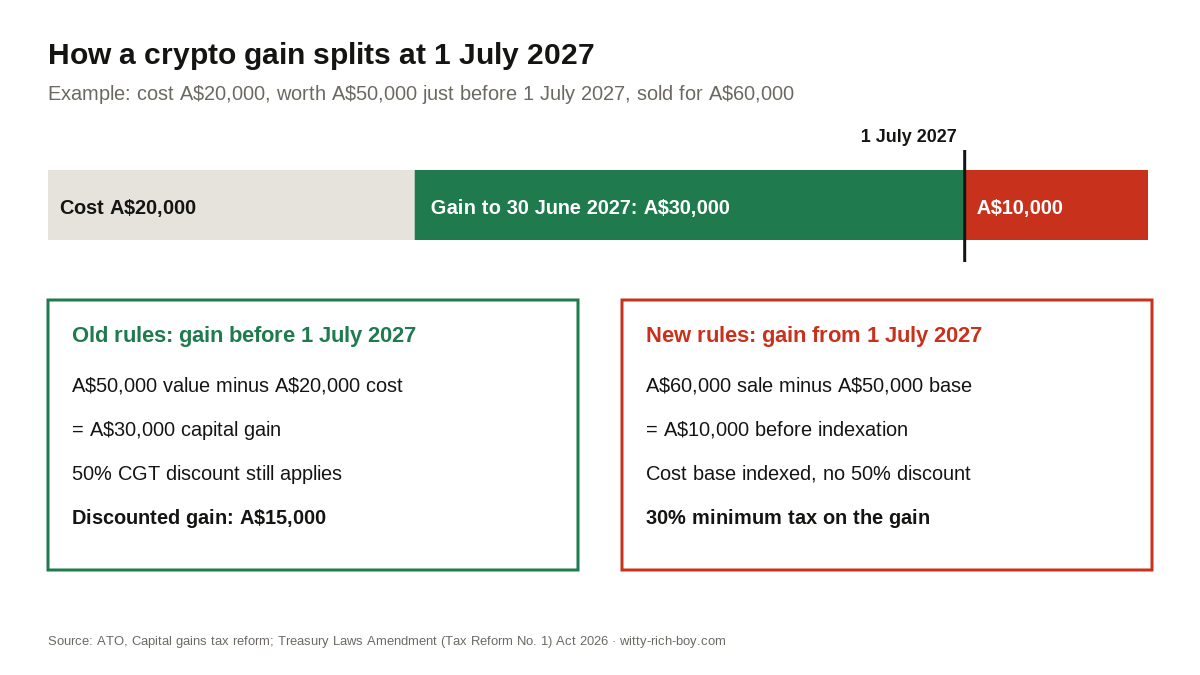
For crypto holders the practical message is record-keeping: note the market value of every token you hold on 30 June 2027, because it splits each future gain in two. The ATO had not, as at October 2026, published crypto-specific guidance on how that value should be evidenced.
Questions readers ask
How much tax do you pay on crypto in Australia?
There is no separate crypto rate. A net capital gain is added to your taxable income and taxed at your marginal rate plus the 2% Medicare levy. For 2026-27 the resident rates are nil up to A$18,200, then 15%, 30%, 37% and 45%. If you held the crypto for at least 12 months, only half the gain is taxed, so a A$20,000 gain in the 30% bracket costs A$3,200.
Is swapping one crypto for another taxable in Australia?
Yes. The ATO says that when you exchange or swap one crypto asset for another you dispose of one CGT asset and acquire another, so a CGT event happens to the original token. Your capital proceeds are the Australian-dollar market value of the token you receive; if that cannot be worked out, you use the market value of the token you gave up.
How does the ATO count the 12 months for the CGT discount?
You must have owned the crypto for at least 12 months before the CGT event, and the ATO tells you to exclude both the day you acquired it and the day of the CGT event when counting. A token you received in a swap, by wrapping or as a staking reward is a new asset, so its own 12-month count starts on the day you acquired it.
Are staking rewards taxable in Australia?
Yes. The ATO treats the Australian-dollar market value of extra tokens received from staking as ordinary income at the time you receive them, reported as other income. That value becomes the cost base of the new tokens, so when you later sell or swap them you only pay CGT on the change in value after receipt.
Is crypto a personal use asset in Australia?
Rarely. A capital gain is disregarded only if the crypto is a personal use asset and you acquired it for A$10,000 or less under ITAA 1997 s 118-10. The ATO looks at the main use when you dispose of it and says crypto kept or used as an investment is not a personal use asset. Its example is crypto bought and spent on concert tickets the same day.
Is wrapping crypto a taxable event in Australia?
In the ATO's view, yes. Its decentralised finance guidance and draft Taxation Determination TD 2026/D2 treat sending a token to a wrapping contract as CGT event C2, with proceeds equal to the market value of the wrapped token received. Unwrapping is a second C2 event. The determination is still a draft, and the ATO acknowledges other views exist.
Can I offset crypto losses against my salary?
No. A capital loss on crypto can only reduce capital gains. If your losses exceed your gains, the net capital loss is carried forward with no time limit and used against future capital gains. Losses must be applied before the 50% CGT discount, and losses on crypto that qualifies as a personal use asset are disregarded entirely.
Does the ATO know about my crypto?
Very likely. Under its crypto assets data-matching program the ATO obtains client identification and transaction details, including wallet addresses, dates, transaction types and coin quantities, from crypto service providers. It expects records on roughly 700,000 to 1.2 million individuals and entities each financial year and keeps each year's data for seven years.
Was this guide useful?
Thanks — your answer helps us decide what to cover next.
Sources
- Crypto to crypto exchange or swap (Australian Taxation Office)
- Crypto asset as a personal use asset (Australian Taxation Office)
- Staking rewards and airdrops (Australian Taxation Office)
- Decentralised finance and wrapping crypto (Australian Taxation Office)
- Keeping crypto records (Australian Taxation Office)
- CGT discount (Australian Taxation Office)
- Tax rates — Australian residents (Australian Taxation Office)
- Capital gains tax reform (Australian Taxation Office)
- Crypto assets data-matching program protocol — Crypto data (Australian Taxation Office)
- Income Tax Assessment Act 1997, s 118-10 — Collectables and personal use assets (AustLII)
General information, not tax or legal advice. Rules change — check the official source or a licensed adviser before acting.