United States · Tax
Form 1099-DA explained (2026): proceeds now, basis from 2026
Form 1099-DA explained: brokers report gross proceeds on 2025 crypto sales and cost basis only for coins bought from 2026. How to reconcile it on Form 8949.

The short answer
- Form 1099-DA is the information return US brokers file for digital asset sales and exchanges on or after 1 January 2025, under the final broker regulations in T.D. 10000.
- For 2025 sales, brokers must report gross proceeds (box 1f) but not basis; from 2026, basis (box 1g) is mandatory only for covered securities — coins bought on or after 1 January 2026 and kept in the same custodial account.
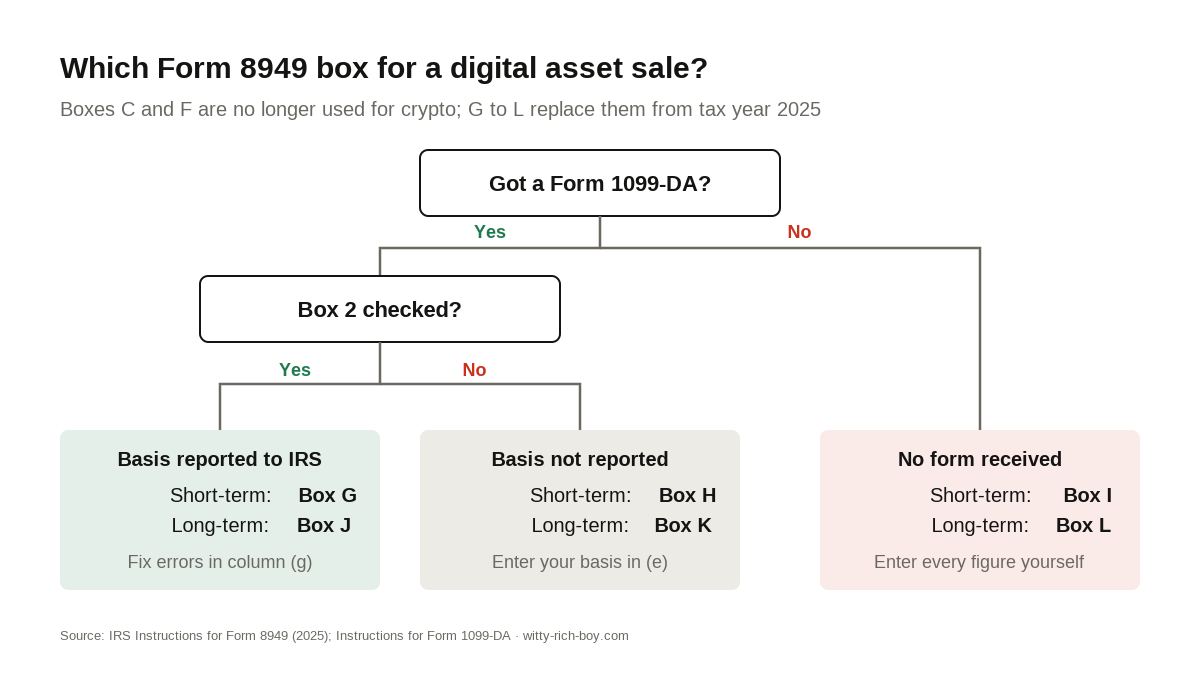
- On Form 8949, crypto now uses boxes G, H and I (short-term) and J, K and L (long-term); boxes C and F are no longer used for digital assets.
- If box 2 is checked, copy the broker's basis into column (e) and fix errors with code B in column (g); if it is not, enter your own basis in column (e).
- Brokers using the optional methods need not report qualifying stablecoins up to $10,000 or specified NFTs up to $600 of yearly gross proceeds — but the sales remain taxable.
- Backup withholding at 24% does not apply to 2025 or 2026 sales (Notice 2025-33); Notice 2026-20 lets you choose lots in your own records until 31 December 2026.
In force: 1 January 2025 (gross proceeds reporting under T.D. 10000) · 1 January 2026 (basis reporting for covered digital assets) · 1 January 2027 (backup withholding begins, with Notice 2025-33 relief)
Form 1099-DA is the IRS form US crypto brokers use to report your digital asset sales. For 2025 sales it shows gross proceeds but usually no cost basis; from 1 January 2026, basis is reported for coins bought and held in the same broker account. You reconcile it on Form 8949 using boxes G–L, adding any missing basis yourself.
For a decade the IRS asked crypto holders a yes-or-no question on the front of Form 1040 and largely took their word for the answer. Form 1099-DA ends that arrangement. From the 2025 tax year, every US custodial platform that meets the broker definition must tell the IRS what you sold and for how much. The catch is that, in its first years, the form often tells half the story — proceeds without cost. Below: what each box means, how the rules change from 2025 to 2027, and a line-by-line Form 8949 reconciliation, including the common case of no basis at all.
What is Form 1099-DA?
Form 1099-DA, Digital Asset Proceeds From Broker Transactions, is an information return that brokers file with the IRS and furnish to customers for sales and exchanges of digital assets effected on or after 1 January 2025. It was created by the final broker regulations, T.D. 10000, filed on 28 June 2024 and published at 89 FR 56480.
A digital asset broker is, in the regulations’ terms, any person that regularly effects sales of digital assets for customers: trading platforms, certain hosted wallet providers, digital asset payment processors and digital asset kiosks. A sale is broader than cashing out. Exchanging one token for another and spending crypto on goods or services both count — the same principle that makes crypto-to-crypto swaps taxable under IRS Notice 2014-21.
The form does not change the tax itself — digital assets are still property taxed under capital gains rules. What changes is that the IRS now has an independent record to match against your return.
What does each box on Form 1099-DA mean?
Box 1f, gross proceeds, is the number that matters most: it is what the IRS will compare with your Form 8949. According to the IRS Instructions for Form 1099-DA, proceeds are reduced by digital asset transaction costs — transaction fees, commissions and transfer taxes related to the sale — so the figure is already net of the platform’s fee.
| Box | What it shows | What to check |
|---|---|---|
| 1a / 1b | Digital Token Identifier code and asset name | That the token matches your records |
| 1c | Units sold | Units, not dollars — agree it to your ledger |
| 1d | Date acquired | May be blank if lots were bought on various dates or box 9 is checked |
| 1e | Date sold or disposed | Drives the short-term vs long-term split |
| 1f | Gross proceeds, net of transaction costs | Must match column (d) of Form 8949 |
| 1g | Cost or other basis | Blank if not reported; “0” should mean a genuine zero basis |
| 1i | Wash sale loss disallowed | Only for digital assets that are also stock or securities, such as tokenised shares |
| 2 | Basis reported to the IRS | Decides box G/J versus H/K on Form 8949 |
| 4 | Federal income tax withheld | Claim it on Form 1040 |
| 6 | Short-term, long-term or ordinary gain or loss | A single form cannot mix short- and long-term |
| 7 | Only cash proceeds received | Unchecked usually means a crypto-for-crypto exchange |
| 8 | You supplied acquisition information | The broker relied on your data to pick lots |
| 9 | Noncovered security | Boxes 1d, 1g, 1h, 1i, 2 and 6 may be blank |
| 11a–11c | Optional aggregate reporting for stablecoins or NFTs | Proceeds are a yearly total, without basis |
The instructions tell brokers to enter “-0-” in box 1g only if the asset genuinely had a basis of zero; an unreported basis should be left blank. A zero next to a checked box 2 deserves scrutiny: on the IRS’s records it turns an ordinary sale into a full-value gain. Box 1i, by contrast, should stay empty for ordinary coins, because § 1091 reaches only digital assets that are also stock or securities — our guide to the crypto wash sale rule in 2026 covers why, and the bill that would change it.
Why does Form 1099-DA show gross proceeds for 2025 but basis only from 2026?
The phase-in is deliberate: T.D. 10000 made gross proceeds reporting mandatory for sales from 1 January 2025, but basis reporting mandatory only from 1 January 2026, and then only for covered securities. According to the Instructions for Form 1099-DA, a digital asset is a covered security only if it was acquired after 2025 in an account for which the broker provided custodial services and was held in that account until the broker sold it.
That definition excludes three large groups of coins, even on forms for 2026 and later:
- Anything bought before 1 January 2026, however long it has sat at the same platform.
- Anything transferred in from a self-custody wallet or another broker, because it was not acquired in that account.
- Qualifying stablecoins and specified NFTs reported under the optional aggregate methods, for which basis is not required even if they are covered.
For noncovered assets brokers may report basis voluntarily, protected from penalties under §§ 6721 and 6722 if they check box 9 — which is why some 2025 forms carry a basis figure and others do not.
How does 1099-DA reporting change in 2025, 2026 and 2027?
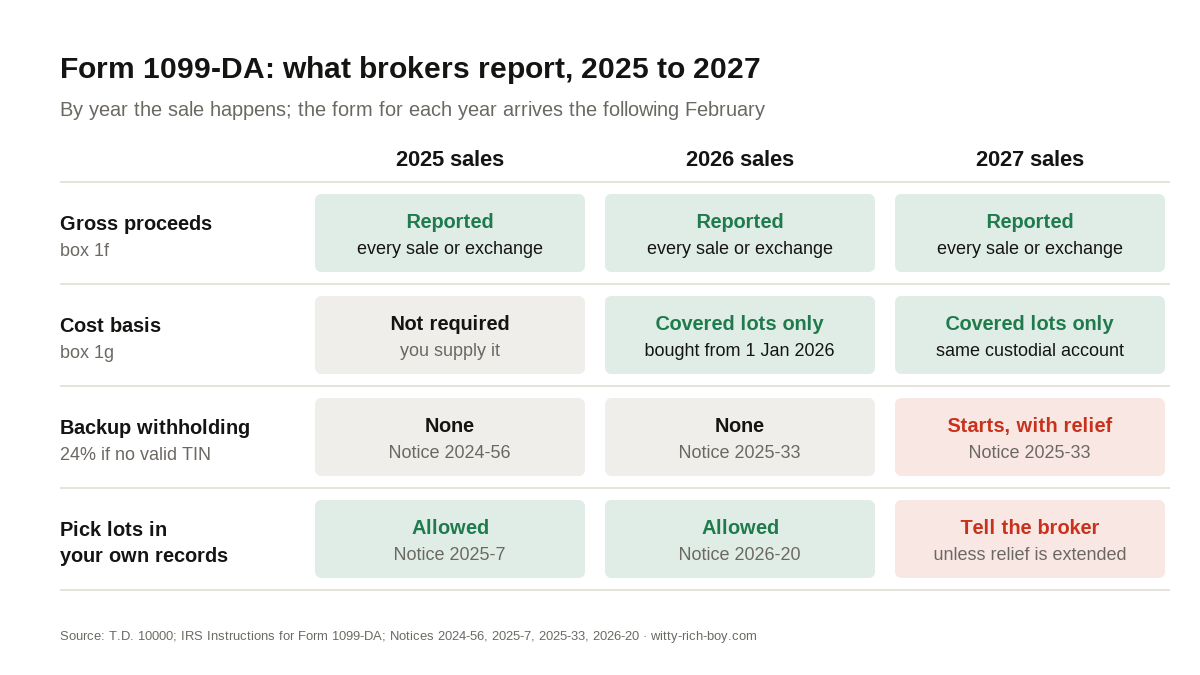
Each year adds a layer: proceeds in 2025, basis in 2026, backup withholding in 2027. The table combines the regulations with the four IRS notices that adjusted them.
| Rule | 2025 sales (forms in early 2026) | 2026 sales (forms in early 2027) | 2027 sales (forms in early 2028) |
|---|---|---|---|
| Gross proceeds (box 1f) | Mandatory | Mandatory | Mandatory |
| Cost basis (box 1g) | Not required | Required for covered securities | Required for covered securities |
| Broker penalties | Waived for good-faith filers — Notice 2024-56 | Standard penalty rules, with limited Notice 2025-33 relief | Standard penalty rules |
| Backup withholding (24%) | None — Notice 2024-56 | None — Notice 2025-33 | Applies, with relief for pre-2026 customers and crypto-for-crypto trades |
| Choosing lots in your own records | Allowed — Notice 2025-7 | Allowed — Notice 2026-20 | Must be communicated to the broker, unless relief is extended |
| Electronic statements | Standard consent rules | Proposed simpler consent for statements furnished from 1 January 2027 | Same, if finalised |
Backup withholding is the 24% a payer must hold back when it lacks a valid taxpayer identification number. Notice 2025-33 extends the relief so that none is required on any digital asset sale in 2025 or 2026; for 2027, brokers can rely on uncertified TINs for customers whose accounts predate 2026 if the IRS TIN Matching Program confirms them, and may cap the withholding on crypto-for-crypto trades at the value of 24% of the tokens received.
Lot selection matters because brokers default to first-in, first-out (FIFO) within each account. Notice 2026-20, published in Internal Revenue Bulletin 2026-15, continues for the whole of 2026 the relief that Notice 2025-7 gave for 2025: you may identify the units you sell — or record a standing order such as “highest cost first” — in your own books and records before the sale, without telling the broker. The notice states that the units sold are the ones in your records “regardless of whether the information reported by the broker” matches. That is the source of many deliberate mismatches on 2026 forms. How FIFO, LIFO and HIFO change the gain on the same sale — and why other countries do not allow the choice — is set out in our guide to how to calculate crypto cost basis.
What is not reported on Form 1099-DA?
Form 1099-DA does not cover everything taxable, and a missing form is not a missing tax bill. Notice 2024-57 lists six transaction types brokers need not report until further guidance: wrapping and unwrapping, liquidity provider transactions, staking, transactions described as lending, transactions described as short sales, and notional principal contracts. The relief does not extend to rewards or other income earned from them.
As of late November 2026, the IRS has published the 2026 Instructions for Form 1099-DA (the ones that govern forms furnished in early 2027) and has posted a draft of the form for tax year 2027 marked “do not file”. No new notice has extended the Notice 2026-20 lot-selection relief beyond 31 December 2026, so plan to give standing orders to your broker before the first sale in 2027 unless the IRS announces otherwise.
Two thresholds also keep small sales off the form. Under the optional method for qualifying stablecoins, a broker need not report designated sales for a customer whose aggregate gross proceeds do not exceed $10,000 for the year. Under the optional method for specified NFTs, the threshold is $600. Above those amounts, brokers may report a yearly aggregate in boxes 11a–11c without basis or acquisition dates.
Finally, decentralised platforms are outside the system. A rule published on 30 December 2024 would have made certain DeFi operators report from 2027, but Congress overturned it: H.J.Res.25 passed the House 292–132 and the Senate 70–28 and became Public Law 119-5 on 10 April 2025. Under the Congressional Review Act, a substantially similar rule cannot be reissued without new legislation. Cross-border data exchange runs on a separate track; for Europe’s version, see DAC8 crypto reporting. Accounts at platforms abroad raise a different question again — whether they count towards the FBAR filing requirement.
How do you reconcile Form 1099-DA with Form 8949?
Form 8949 exists, in the IRS’s words, to reconcile the amounts reported on Forms 1099-B, 1099-DA and 1099-S with the amounts on your return. From the 2025 tax year it has six new checkboxes for digital assets, and the Instructions for Form 8949 say plainly that boxes C and F must not be used for them.
Step by step
- Gather every Form 1099-DA and your own records: purchase confirmations, transfer histories and any standing orders recorded under Notice 2025-7 or 2026-20.
- Fix your opening basis. For coins held on 1 January 2025, basis is now tracked wallet by wallet and account by account under Treas. Reg. § 1.1012-1(j). Rev. Proc. 2024-28 allowed a one-off safe-harbour allocation of unused basis to each wallet as of that date; it cannot be applied to assets acquired on or after 1 January 2025.
- Split each form by holding period. More than one year is long-term; the broker may not combine short- and long-term sales on one form, so use box 6 and the dates in boxes 1d and 1e.
- Pick the Form 8949 box. Box 2 checked: box G (short-term) or J (long-term). Box 2 unchecked or box 9 checked: H or K. No form at all, including self-custody trades: I or L.
- Copy proceeds into column (d) exactly as shown in box 1f. Do not add the sale fee back; it has already been deducted.
- Enter basis in column (e). For boxes G and J, enter the basis shown in box 1g, even if it is wrong. For boxes H and K, enter your correct basis — cost plus acquisition fees — and put zero in column (g).
- Correct reported basis in columns (f) and (g). If a G or J basis is wrong, enter code B in column (f) and the adjustment in column (g): a negative figure when your true basis is higher. The instructions provide a worksheet for basis adjustments in column (g).
- Add unreported disposals — DeFi swaps, wallet-to-wallet trades and sub-threshold stablecoin or NFT sales — in boxes I and L.
- Total each box and carry it to Schedule D, then answer the digital asset question on Form 1040. Where basis was reported and no adjustment is needed, the 2025 Schedule D instructions allow summary totals on line 1a or 8a instead of itemised Form 8949 rows.
What if Form 1099-DA shows $0 or blank cost basis?
A blank or zero basis leaves your full proceeds unexplained until your return supplies the cost. The fix depends on box 2, not on whether the figure is blank or zero.
Example: Dana bought 0.2 of a coin on a platform in March 2024 for $9,400 plus a $100 fee, giving a basis of $9,500. She moved it to a second platform later that year and sold it there in August 2025 for $12,150, paying a $150 fee. Her 2025 Form 1099-DA shows box 1f $12,000, box 1g blank, box 9 checked, box 2 unchecked — the coin was bought before 2026 and transferred in, so it is noncovered twice over.
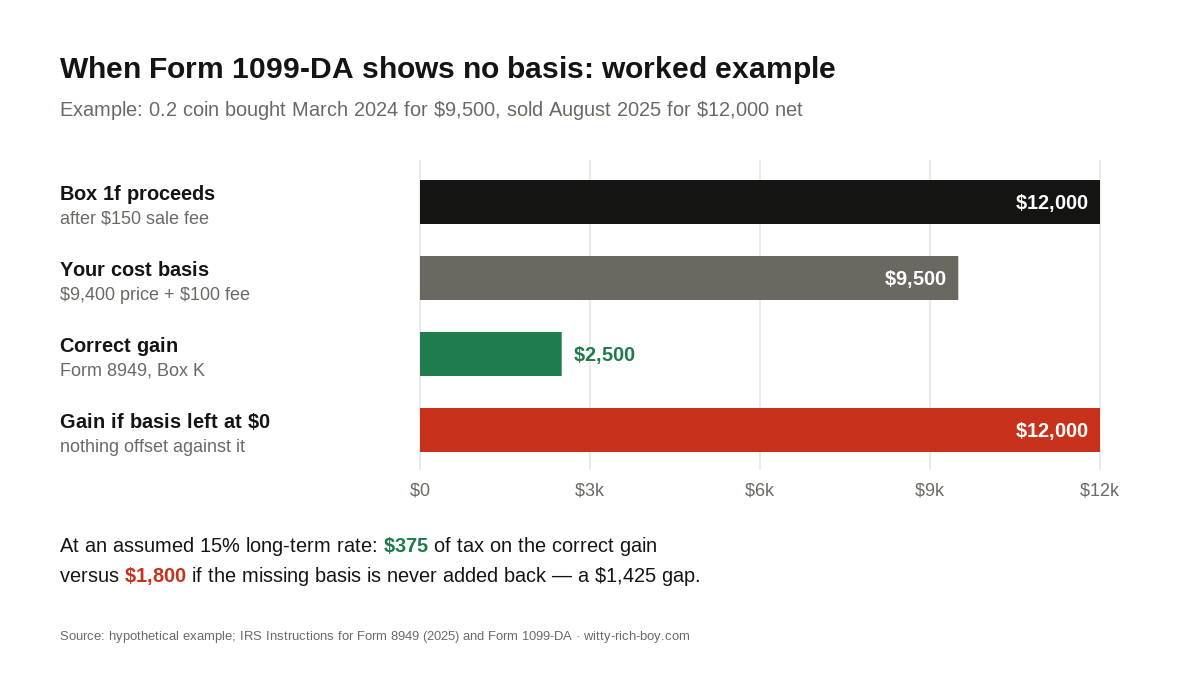
Held for more than a year, the sale goes on Form 8949 Part II with box K checked: column (d) $12,000, column (e) $9,500, column (g) zero, column (h) $2,500. At an assumed 15% long-term rate that is $375 of tax; leaving the basis out would produce a $12,000 gain and $1,800.
| What the 1099-DA shows | Form 8949 box | Column (e) | Columns (f) and (g) |
|---|---|---|---|
| Box 1g blank, box 2 unchecked (Dana) | K (or H if short-term) | Your basis: $9,500 | Blank / 0 |
| Box 1g “0”, box 2 unchecked | K or H | Your basis: $9,500 | Blank / 0 |
| Box 1g “0”, box 2 checked, basis wrong | J or G | $0, as reported | Code B, −$9,500 |
| No form at all (self-custody sale) | L or I | Your basis | As needed |
Example: in 2026 Lee buys one unit of a token in the same exchange account on 10 February for $3,000 and another on 15 May for $4,200, then sells one unit on 1 September for $3,800 net. The broker applies FIFO and reports basis of $3,000 with box 2 checked — a short-term gain of $800. But Lee had recorded a “highest cost first” standing order in her own books before the sale, which Notice 2026-20 permits for 2026. On Form 8949 with box G checked she enters $3,800 in column (d), $3,000 in column (e), code B in column (f) and −$1,200 in column (g): a $400 loss in column (h).
How is Form 1099-DA different elsewhere — and what comes next?
The US is unusual in sending crypto investors a transaction-level tax form at all; the UK, by comparison, relies on self-assessment (see our guide to UK crypto tax). Brokers must furnish Form 1099-DA by 15 February of the following year and file with the IRS by 28 February on paper or 31 March electronically.
Three dates are worth diarising. Forms for 2026 sales — the first with mandatory basis for covered lots — arrive in February 2027, and on 5 March 2026 Treasury proposed rules letting brokers deliver those statements electronically under a simpler consent process from 1 January 2027. The Notice 2026-20 relief on lot selection expires on 31 December 2026, after which your choice must reach the broker before a sale unless the IRS extends it again. And from 2027 backup withholding can bite on accounts without a valid TIN.
Gains inside a tax-advantaged account are not taxed as they happen, though contributions are capped — see the Roth IRA income limits for 2026. For ordinary accounts the rule is simple: keep your own basis records, because for coins bought before 2026 the broker never will.
Questions readers ask
What is Form 1099-DA used for?
Form 1099-DA, Digital Asset Proceeds From Broker Transactions, is the information return a US broker files with the IRS, and sends to you, for each sale or exchange of digital assets it handles from 1 January 2025. It shows gross proceeds and, for coins bought from 2026 in the same account, cost basis. You use it to fill in Form 8949 and Schedule D.
Why does my 1099-DA show no cost basis?
For sales in 2025, brokers were not required to report basis at all, so most 2025 forms show proceeds only. From 2026, basis is required only for covered securities: coins bought on or after 1 January 2026 and held in the same custodial account until sale. Coins bought earlier, or transferred in from a wallet or another platform, are noncovered, so box 1g can be blank.
How do I report a 1099-DA with no basis on Form 8949?
Use box H for short-term sales or box K for long-term sales. Enter the proceeds from box 1f in column (d), your own cost basis — purchase price plus acquisition fees — in column (e), and zero in column (g) unless another adjustment applies. Keep records that prove the basis, such as purchase confirmations and wallet histories, in case the IRS asks.
Do I have to report crypto if I did not receive a 1099-DA?
Yes. Every taxable sale, exchange or spending of digital assets must be reported whether or not a broker issued a form. Self-custody wallet trades, decentralised exchange swaps and small stablecoin or NFT sales below the optional reporting thresholds all still count. On Form 8949 they go in box I if short-term or box L if long-term.
When should I receive Form 1099-DA?
Brokers must furnish Form 1099-DA by 15 February of the year after the sale, moved to the next business day when that date falls on a weekend or legal holiday. They file their copy with the IRS by 28 February on paper or 31 March electronically. Forms for 2026 sales therefore arrive in February 2027.
Are stablecoin sales reported on Form 1099-DA?
Often, but not always. A broker using the optional reporting method for qualifying stablecoins need not report them for a customer whose gross proceeds from such sales do not exceed $10,000 for the year, and above that it may report them in aggregate without basis. Specified NFTs have a parallel $600 threshold. The sales remain taxable either way.
Does the 1099-DA cover DeFi and self-custody wallets?
No. A separate rule that would have treated certain decentralised finance platforms as brokers from 2027 was nullified by Congress under the Congressional Review Act; H.J.Res.25 became Public Law 119-5 on 10 April 2025. Form 1099-DA therefore comes from custodial platforms, hosted wallet providers, payment processors and kiosks that meet the broker definition, not from self-custody software.
What is the difference between Form 1099-DA and Form 1099-B?
Form 1099-B covers stocks, bonds and other traditional securities; Form 1099-DA covers digital assets from 2025. They feed different Form 8949 boxes: A to F for 1099-B, G to L for digital assets. Form 1099-DA also adds crypto-specific fields, including the token name and code, units sold, and a box showing whether you received only cash.
Was this guide useful?
Thanks — your answer helps us decide what to cover next.
Sources
- Instructions for Form 1099-DA, Digital Asset Proceeds From Broker Transactions (IRS)
- Instructions for Form 8949 (2025), Sales and Other Dispositions of Capital Assets (IRS)
- Final regulations and related IRS guidance for reporting by brokers on sales and exchanges of digital assets (IRS)
- Notice 2024-56: transitional relief for digital asset brokers (IRS)
- Notice 2024-57: digital asset transactions not yet required to be reported (IRS)
- Notice 2025-33: extended backup withholding and penalty relief for digital asset sales (IRS)
- Notice 2026-20: temporary relief for identifying digital asset units held by a broker (IRS)
- Rev. Proc. 2024-28: safe harbor for allocating unused basis of digital assets (IRS)
- Frequently asked questions about broker reporting (IRS)
- H.J.Res.25, 119th Congress — disapproval of the DeFi broker reporting rule (Congress.gov)
- 2026 Instructions for Form 1099-DA (IRS, PDF)
- Draft Form 1099-DA for tax year 2027 (IRS)
General information, not tax or legal advice. Rules change — check the official source or a licensed adviser before acting.