Global ·
Are Crypto Swaps Taxable? 9-Country Rules Compared (2026)
Are crypto swaps taxable? In the UK, US, Germany, Japan, Australia and Canada a crypto-to-crypto swap is a disposal. France and Portugal defer the tax.
The short answer
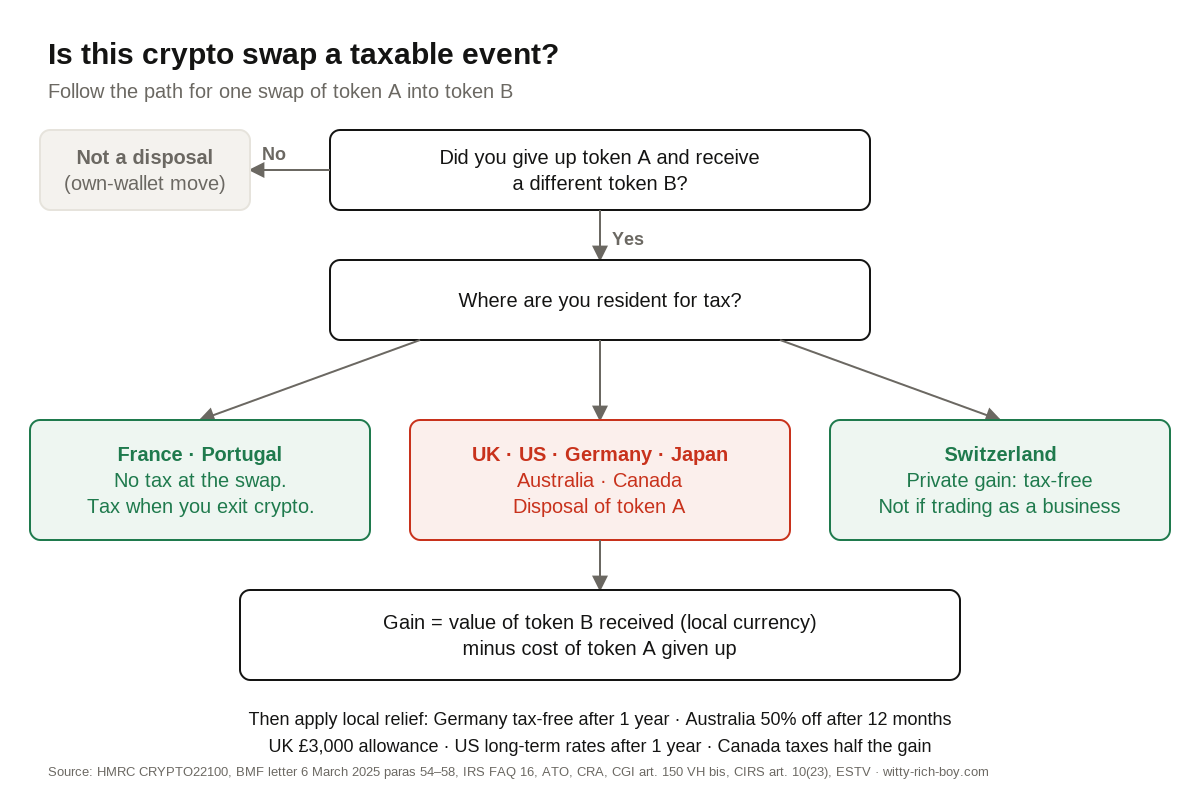
- In the UK, US, Germany, Japan, Australia and Canada, swapping one crypto-asset for another is a disposal of the coin you give up, taxed on its gain in local currency.
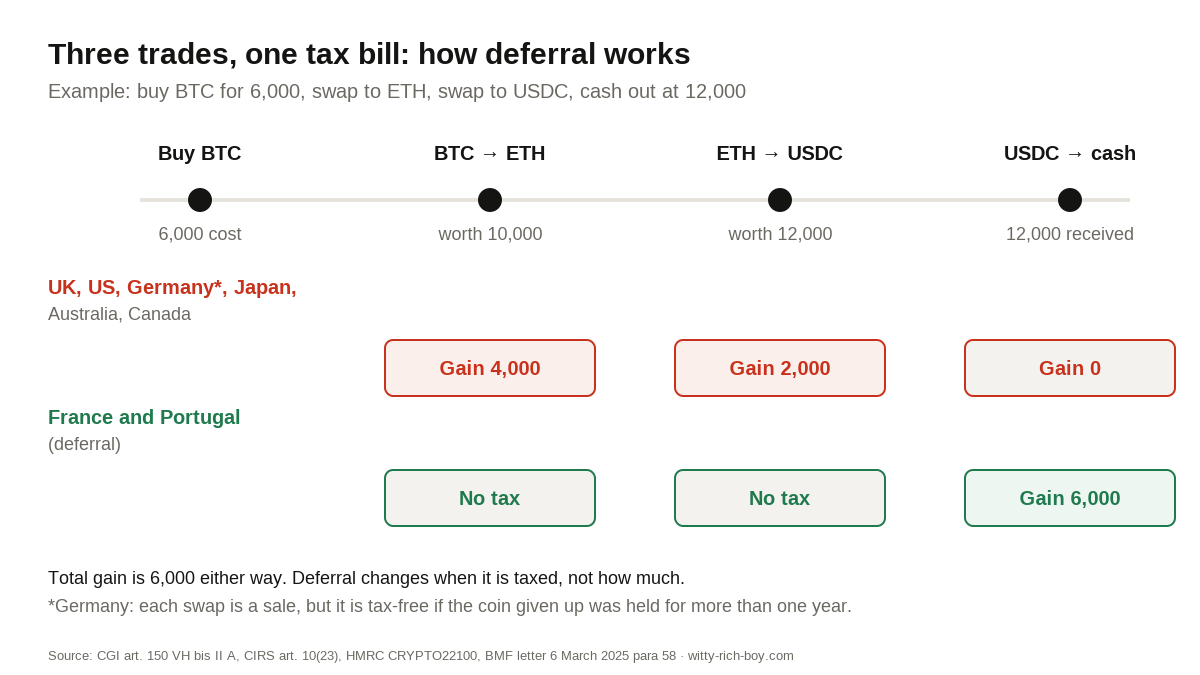
- France (art. 150 VH bis CGI) and Portugal (art. 10(23) CIRS) defer tax on crypto-to-crypto swaps until you exit to money, goods or services.
- Switzerland taxes nothing on the swap itself: private capital gains are tax-free under Art. 16 Abs. 3 DBG, unless you trade as a business.
- In Germany every swap restarts the one-year clock (BMF letter of 6 March 2025, para. 55), so rotating coins can turn a tax-free gain into a taxable one.
- A swap into USDT or USDC is a crypto-to-crypto swap, not a cash-out: taxable where swaps are taxable, deferred in France and Portugal.
- The gain is measured at the market value of the coin you receive; Germany, Australia and Japan all spell this out, with the old coin's value as a fallback.
In force: Rules as in force on 26 October 2026 · France: art. 150 VH bis CGI, version of 1 July 2026 · Germany: BMF letter of 6 March 2025
Yes, in most countries. The UK, US, Germany, Japan, Australia and Canada treat a crypto-to-crypto swap as selling the coin you give up, so any gain since purchase is taxed even though no cash changes hands. France and Portugal defer the tax until you exit to fiat; Switzerland leaves private gains untaxed.
Swapping Bitcoin for Ether feels like rearranging a portfolio. Most tax offices see two transactions: you sold Bitcoin, then used the proceeds to buy Ether. If the Bitcoin had risen since you bought it, that rise is a gain, realised at the moment of the swap, and the absence of any euros, pounds or dollars in your bank account does not change that. This guide sets out the exact rule in nine jurisdictions, the primary source for each, and what the same swap costs in each of them.
Are crypto swaps taxable? The rule in nine countries
A crypto swap is taxable at the moment it happens in six of the nine countries below; France and Portugal defer the tax, and Switzerland does not tax private gains.
A crypto-to-crypto swap is any transaction in which you give up one crypto-asset and receive a different one, whether on a centralised exchange, through a decentralised protocol or peer to peer. A disposal is the tax event that ends your ownership of an asset and crystallises its gain or loss.
| Country | Swap taxed at the time? | The rule | Primary source |
|---|---|---|---|
| United Kingdom | Yes | Exchanging tokens for a different token is a CGT disposal | HMRC CRYPTO22100 |
| Germany | Yes, unless held over 1 year | An exchange for other crypto-assets is a sale; holding period restarts | § 23 EStG; BMF letter 6 March 2025, paras 54–58 |
| United States | Yes | Exchanging virtual currency for another virtual currency recognises gain or loss | IRS Notice 2014-21; IRS FAQ 16 |
| Japan | Yes | Swapping coin A for coin B is treated as buying B with A | NTA FAQ 1-3 (December 2025) |
| Australia | Yes | A CGT event happens to the original crypto asset | ATO, “Crypto to crypto exchange or swap” |
| Canada | Yes | Trading for another crypto-asset is a disposition (barter) | CRA crypto-asset guide |
| France | No — deferred | Exchanges sans soulte between crypto-assets are outside the charge | Art. 150 VH bis II A CGI |
| Portugal | No — deferred | Crypto received as consideration takes over the old cost | Art. 10(23) CIRS |
| Switzerland | No (private investors) | Private capital gains are tax-free; professional traders are taxed | Art. 16 Abs. 3 DBG; ESTV working paper |
The detail matters as much as the headline. Two of the “yes” countries soften the blow sharply for patient holders, and one of the “no” countries still taxes you in full the moment you leave crypto.
Why is a crypto-to-crypto swap a taxable event?
A swap is taxable because most tax codes treat crypto as property, and exchanging one piece of property for another is a disposal of the first, whatever form the payment takes.
The US position, set in IRS Notice 2014-21, is the template: “virtual currency is treated as property”, and general property rules apply. The IRS FAQ then states that exchanging virtual currency “for another virtual currency” produces a capital gain or loss. Canada reaches the same result through its barter rules: the CRA lists trading “for government-issued currency or another type of crypto-asset” as a disposition, valued in Canadian dollars.
The UK does not need an analogy. HMRC’s Cryptoassets Manual lists “exchanging tokens for a different type of token” as a disposal in its own right, alongside selling for money and spending tokens on goods. Germany’s Federal Ministry of Finance is equally direct: an exchange of crypto-assets for euros, for goods or services “or for other crypto-assets is therefore a sale” (BMF letter of 6 March 2025, para. 54).
One historic escape route is closed in the US. Since the Tax Cuts and Jobs Act, like-kind exchange relief under IRC § 1031 applies only to real property, for exchanges completed after 31 December 2017. Token-for-token swaps cannot be rolled over that way.
How to calculate the gain on a crypto swap
The gain is the local-currency market value of the coin you receive, minus the cost of the coin you give up, minus allowable fees.
- Fix the moment. Record the date and time of the swap. In Germany, the timestamp on a centralised exchange decides the holding period (BMF para. 55).
- Value what you received. Take the market value of the new coin in your local currency at that moment. Germany (BMF para. 58) and Australia (ATO) both specify this, with the value of the coin given up as the fallback when the new coin has no market price.
- Find the cost of what you gave up. Apply your country’s matching rule: the section 104 pool with same-day and 30-day rules in the UK (CRYPTO22200), FIFO or average cost per wallet in Germany (BMF paras 61–62), the total-average method by default for individuals in Japan (NTA FAQ 1-3).
- Deduct fees correctly. HMRC treats a swap fee as relating to both the disposal and the acquisition, and accepts a 50/50 split as “just and reasonable” (CRYPTO22150).
- Set the new coin’s cost. The value used in step 2 becomes the acquisition cost of the coin you received (BMF para. 59), and its holding period starts that day.
- Apply local reliefs. Annual allowances, holding-period exemptions or discounts come last.
Japan’s tax agency publishes the cleanest worked example. Buy 4 BTC for ¥4,000,000, then pay 1 BTC for 40 XRP when 1 XRP is worth ¥30,000. Proceeds are ¥1,200,000 (40 × ¥30,000); the cost of one Bitcoin is ¥1,000,000; the taxable income is ¥200,000 (NTA FAQ 1-3).
Crypto swap tax by country: the precise rule
Each country below taxes the same economic event differently; what follows is the operative rule and where it is written.
United Kingdom
A swap is a disposal for Capital Gains Tax under CRYPTO22100. Gains above the £3,000 annual exempt amount are taxed at 18% within the basic-rate band and 24% above it — the 2026/27 rates; the Autumn Budget on 28 October 2026 is the next point at which they could change, and any change normally applies only to later disposals. Moving tokens between your own wallets is not a disposal. For pooling, allowances and reporting, see our UK crypto tax guide.
Germany
Under § 23 EStG crypto is an “other asset”; a swap is a sale, and the gain is taxable only if the coin was held one year or less. Short-term gains are tax-free if total private-sale gains for the year are under €1,000, a cliff rather than an allowance. The BMF letter adds the trap: the holding period restarts on each exchange (para. 55). The full mechanics are in our Germany crypto tax guide.
United States
Every swap is a sale or exchange reported on Form 8949, and the Form 1040 digital-asset question must be answered “Yes”. Coins held one year or less produce short-term gains taxed as ordinary income; longer holdings get long-term rates of 0%, 15% or 20% (IRS Topic 409). Brokers report gross proceeds on Form 1099-DA for transactions from 1 January 2025, and basis for certain transactions from 1 January 2026 — our Form 1099-DA guide shows how to reconcile it on Form 8949. A swap made at a loss still produces a deductible loss even if you buy the same coin back soon after, because the US wash sale rule does not yet cover crypto held directly; see the crypto wash sale rule in 2026 for the bill that would change that. Gains realised inside a Roth IRA, by contrast, are not taxed as they happen — but direct contributions are capped by income; see the Roth IRA income limits for 2026.
Japan
The NTA treats a swap as buying coin B with coin A. Gains are, as a rule, miscellaneous income taxed at progressive national rates of 5% to 45% (NTA Tax Answer No. 2260), plus local inhabitant tax. Losses in this category cannot be set against salary. A separate flat 20.315% regime is already law, but it starts only on 1 January of the year after the amended FIEA (enacted 15 July 2026) takes effect — expected 1 January 2028 — so swaps in 2026 and 2027 stay at progressive rates. More in our Japan crypto tax guide.
Australia
The ATO says a CGT event “happens to your original crypto asset” on a swap, with proceeds equal to the Australian-dollar market value of the coin received. Residents who owned the coin for at least 12 months can reduce the gain by 50%. Staking, wrapping and the narrow personal-use exemption are covered in our ATO crypto tax guide.
Canada
A swap is a barter disposition valued in Canadian dollars. For investors, half of a capital gain is included in income; a person carrying on a crypto business reports the whole profit as business income instead.
France and Portugal: how swap deferral actually works
France and Portugal do not exempt swap gains; they postpone them until you leave crypto-assets, then tax the accumulated gain in one go.
France — sursis d’imposition
Article 150 VH bis II A CGI states that the regime does not apply, for the year of the exchange, to “opérations d’échange sans soulte entre crypto-actifs”. A soulte is a cash balancing payment; an exchange with no cash leg is fully deferred. Tax arises on a disposal for money, goods or services, at the flat rate of 31.4% (12.8% income tax plus 18.6% social charges) according to impots.gouv.fr, updated 17 July 2026. Taxpayers whose total disposal proceeds in the year do not exceed €305 are exempt; note that the threshold is measured on proceeds, not on gains.
France also uses a portfolio formula rather than coin-by-coin costs: the gain equals the sale price minus total portfolio acquisition cost multiplied by the ratio of sale price to the portfolio’s global value (art. 150 VH bis III). In its version in force from 1 July 2026, the article defines its scope by reference to crypto-assets covered by the EU Markets in Crypto-Assets Regulation (EU) 2023/1114. Our France crypto tax guide works through the portfolio formula with real numbers, the €305 test and form 2086.
Portugal — carry-over of cost
Portugal taxes onerous disposals of crypto-assets that are not securities (art. 10(1)(k) CIRS), but with two carve-outs. Gains on crypto held 365 days or more are excluded (art. 10(22)). Where that exclusion does not apply and the consideration takes the form of crypto-assets, “não há lugar a tributação”: the crypto received inherits the acquisition value of the crypto given up (art. 10(23)). Our Portugal crypto tax guide works through the 28% rate, the 365-day exclusion and the return boxes.
Switzerland — no capital gains tax for private investors
The Swiss Federal Tax Administration treats buying and selling payment tokens like transactions in ordinary currencies: for individuals’ private wealth, gains are “steuerfreie Kapitalgewinne” and losses are not deductible (ESTV working paper, 14 December 2021, citing Art. 16 Abs. 3 DBG). Depending on volume, frequency and financing, activity can instead be classed as self-employed trading, taxed as income. Holdings remain subject to cantonal wealth tax.
Is swapping into a stablecoin taxable?
Yes, wherever swaps are taxable: a stablecoin is a crypto-asset, so moving from Bitcoin into USDT or USDC disposes of the Bitcoin.
HMRC is explicit that “stablecoins are another prominent type of cryptoasset” (CRYPTO10100), so CRYPTO22100 applies in full. The German, US, Australian and Canadian rules draw no line between volatile coins and stablecoins either. The common habit of “parking profits in USDC” therefore crystallises exactly the gain the investor hoped to postpone.
The mirror image holds in France and Portugal. Because USDC is itself a crypto-asset, a swap into it is an exchange between crypto-assets and remains deferred. The French tax is triggered only when the stablecoin is converted into euros or spent on goods or services.
One practical point applies everywhere: a later swap out of the stablecoin is usually close to break-even, because its price barely moves. The tax was already paid, or deferred, on the way in. Interest earned on the stablecoin while you hold it is a different matter, taxed as income in most countries, as our guide to stablecoin yield tax explains.
Are DeFi swaps, wrapping and liquidity pools taxable?
A swap through a decentralised exchange is taxed exactly like one on a centralised platform; the harder questions concern wrapping, bridging and liquidity pools.
Nothing in HMRC’s disposal list, the IRS FAQ or the BMF letter turns on whether the counterparty is a company or a smart contract. What differs is paperwork: no broker issues a statement, so you reconstruct values from wallet history.
Australia gives the most detailed official guidance. The ATO says a CGT event happens when you deposit crypto into a liquidity pool and again when you withdraw; that wrapping ETH into WETH through a smart contract triggers CGT event C2, with proceeds equal to the wrapped token’s market value; and that unwrapping is a second event. The ATO’s guidance points to Draft Taxation Determination TD 2026/D2.
The UK is more cautious. On moving tokens between distributed ledgers, HMRC says “the answer will depend on the facts” (CRYPTO22110). Perpetual futures are not swaps at all; their payments follow different rules, explained in our guide to funding rates.
Same swap, nine tax bills: a worked comparison
The same 4,000 gain produces nine different outcomes, from full taxation to none.
Example: Anna buys a coin for 6,000 and later swaps all of it for another coin worth 10,000. The figures are in local currency units, she has no other gains that year, and she is a private investor.
| Country | Held 8 months | Held 14 months |
|---|---|---|
| UK | 1,000 taxable after the £3,000 allowance, at 18% or 24% | Same |
| Germany | 4,000 at personal income tax rate | 0 — tax-free after one year |
| US | 4,000 short-term, ordinary rates | 4,000 long-term, at 0%, 15% or 20% |
| Japan | 4,000 miscellaneous income | Same |
| Australia | 4,000 in assessable income | 2,000 after the 50% discount |
| Canada | 2,000 taxable capital gain | Same |
| France | 0 now; taxed at 31.4% on exit | Same |
| Portugal | 0 now; cost carried over | 0 — excluded after 365 days |
| Switzerland | 0 | 0 |
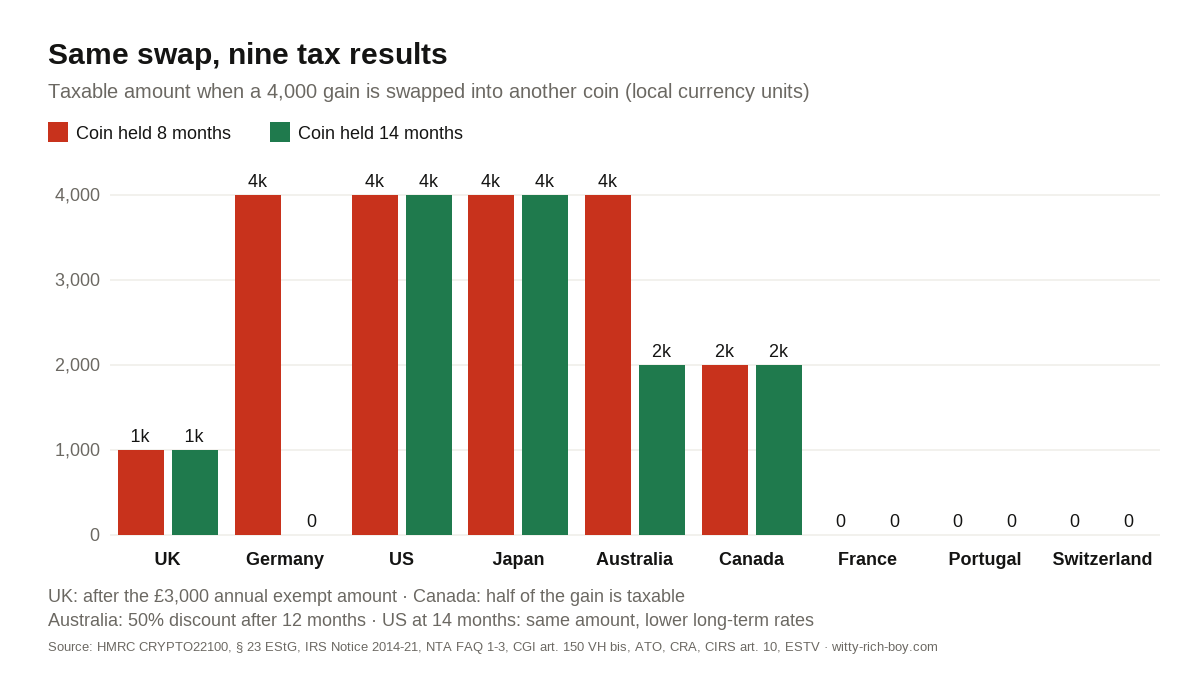
The table shows why “crypto to crypto tax” questions rarely have a one-line answer. A German investor who swaps after 14 months owes nothing; one who swaps after 8 months owes tax on the full 4,000, because the €1,000 limit is a cliff and the gain sits above it.
Swap losses, fees and records: what to keep
A swap at a loss is still a disposal, so it usually creates a reportable capital loss.
How far that loss helps depends on the country. The US lets net capital losses offset up to $3,000 of ordinary income a year, with the rest carried forward (IRS Topic 409). German losses from private sale transactions can be offset only against gains in the same category (§ 23 EStG). Japanese miscellaneous-income losses cannot reduce salary.
For every swap, keep:
- date, time and transaction hash or exchange order ID;
- quantities of both tokens;
- local-currency market value at that moment, and the price source used;
- fees, in the token paid and in local currency;
- the running cost basis of every token, by wallet where your country requires it.
Reporting is tightening. Under DAC8, EU platforms collect and report customer transactions from 1 January 2026, and US brokers now file Form 1099-DA. Assume that what an exchange sees, the tax office sees too.
Questions readers ask
Is swapping crypto a taxable event?
In most large tax systems, yes. The UK, US, Germany, Japan, Australia and Canada all treat a crypto-to-crypto swap as disposing of the coin you give up, valued at the market price of what you receive. France and Portugal defer the tax until you leave crypto, and Switzerland does not tax private capital gains at all.
Do I pay tax if I swap crypto but never cash out?
Usually, yes. Cashing out is not the trigger in the UK, US, Germany, Japan, Australia or Canada: the swap itself is the disposal. Only a few systems, notably France under art. 150 VH bis CGI and Portugal under art. 10(23) CIRS, wait until you convert to money, goods or services before taxing the gain.
Is converting crypto to USDT or USDC taxable?
Where swaps are taxable, yes. A stablecoin is another crypto-asset, so moving from Bitcoin into USDC is a disposal of the Bitcoin; HMRC lists stablecoins as cryptoassets in CRYPTO10100. In France and Portugal the same move is a crypto-to-crypto exchange and the tax is deferred until you exit to fiat or spend it.
Are DeFi swaps on Uniswap taxable?
The venue does not change the answer. A swap through a smart contract is still an exchange of one token for another, so it is a disposal wherever centralised-exchange swaps are. Australia goes further: the ATO treats depositing into a liquidity pool and wrapping a token as CGT events too. Keep wallet histories, because no broker statement covers them.
How do I value a crypto-to-crypto swap for tax?
Use the market value, in your local currency, of the coin you receive at the moment of the swap; that is your proceeds for the coin you gave up and the cost of the new one. Germany (BMF para. 58) and Australia (ATO) both allow the value of the coin given up if the new coin has no market price.
Does swapping crypto reset the holding period?
Yes, because you own a new asset. In Germany the one-year clock under § 23 EStG restarts with every exchange (BMF letter, para. 55). In the US the new coin starts its own short-term period, and in Australia a new 12-month count begins for the 50% CGT discount. Rotation can cost you long-term treatment.
Is a crypto swap at a loss deductible?
A swap at a loss is still a disposal, so it generally produces a capital loss you can report. The US lets net capital losses offset up to $3,000 of ordinary income a year. Germany only allows offset against other private sale gains, and Japan does not let miscellaneous-income losses reduce salary income.
Is moving crypto between my own wallets a swap?
No. Moving the same token between wallets you control is not a disposal; HMRC says so explicitly in CRYPTO22100. It becomes a swap only when you end up holding a different token, for example by bridging or wrapping. Australia treats wrapping as a CGT event; the UK says the answer on bridging depends on the facts.
Was this guide useful?
Thanks — your answer helps us decide what to cover next.
Sources
- HMRC Cryptoassets Manual — CRYPTO22100: what is a disposal
- § 23 EStG — Private Veräußerungsgeschäfte (gesetze-im-internet.de)
- BMF letter of 6 March 2025 on the income tax treatment of crypto-assets (English courtesy translation)
- IRS — Frequently asked questions on virtual currency transactions
- National Tax Agency (Japan) — 暗号資産等に関する税務上の取扱いについて (FAQ, December 2025)
- Article 150 VH bis, Code général des impôts — Légifrance
- Código do IRS, artigo 10.º — Portal das Finanças (Portugal)
- ATO — Crypto to crypto exchange or swap
- CRA — Reporting income from crypto-asset transactions
- ESTV — Arbeitspapier Kryptowährungen (14 December 2021)
General information, not tax or legal advice. Rules change — check the official source or a licensed adviser before acting.