Australia · Tax
Super Contribution Caps 2026: $32,500 and $130,000 Explained
Super contribution caps 2026-27: $32,500 concessional, $130,000 non-concessional, up to $390,000 via bring-forward. Carry-forward, Division 293 and excess rules.

The short answer
- The concessional contributions cap rose from $30,000 in 2025-26 to $32,500 from 1 July 2026; employer contributions, salary sacrifice and deductible personal contributions all count towards it.
- The non-concessional cap is $130,000 for 2026-27 (four times the concessional cap), and nil if your total super balance was $2.1 million or more on 30 June 2026.
- Under the bring-forward rule, people under 75 with a total super balance below $1.84 million on 30 June 2026 can contribute up to $390,000 after tax.
- Carry-forward lets anyone with a total super balance under $500,000 use unused concessional cap from the previous five years; 2021-22 amounts expire if not used by 30 June 2027.
- Division 293 tax adds 15% on concessional contributions above a combined income-and-contributions threshold of $250,000: $265,000 combined means $2,250 extra.
In force: 1 July 2026 (2026-27 caps: $32,500 concessional, $130,000 non-concessional; general transfer balance cap $2.1 million) · 30 June 2026 (total super balance tested for 2026-27 carry-forward and bring-forward)
For 2026-27 the super contribution caps are $32,500 concessional (before-tax) and $130,000 non-concessional (after-tax), up from $30,000 and $120,000 in 2025-26. People under 75 with a total super balance below $1.84 million can bring forward up to $390,000, and balances under $500,000 can carry forward unused concessional cap from five years.
Australian superannuation is one of the most generous retirement tax shelters in the world, and the contribution caps are the price of that generosity: they ration how much money can enter the 15%-taxed environment each year. Both caps moved on 1 July 2026, the first rise in the non-concessional cap since 2024-25. Below: what changed, the five-year carry-forward in dollars, bring-forward tables for both years, Division 293 at two income levels and what an excess costs.
What are the super contribution caps for 2026-27?
The concessional contributions cap for 2026-27 is $32,500 and the non-concessional contributions cap is $130,000, according to the Australian Taxation Office’s table of contributions caps. Both apply to everyone regardless of age, per person, per financial year (1 July 2026 to 30 June 2027).
A concessional contribution is money paid into super before income tax — the fund taxes it at 15% on the way in. A non-concessional contribution is money paid from after-tax income or savings and not claimed as a deduction; the fund does not tax it again.
The two caps are linked by statute. Section 291-20 of the Income Tax Assessment Act 1997 (ITAA 1997) sets the concessional cap and indexes it to average weekly ordinary time earnings (AWOTE) in increments of $2,500. Section 292-85 sets the general non-concessional cap at four times the concessional cap — hence $32,500 × 4 = $130,000.
| Cap | 2026-27 amount | What counts | Tax inside the fund |
|---|---|---|---|
| Concessional | $32,500 | Employer contributions (incl. super guarantee), salary sacrifice, personal contributions claimed as a deduction | 15% contributions tax (more under Division 293) |
| Non-concessional | $130,000 | Personal after-tax contributions not claimed as a deduction, spouse contributions, unreleased excess concessional contributions | None on entry |
| Non-concessional with bring-forward | Up to $390,000 | Same, if under 75 and total super balance below $1.84 million | None on entry |
Did the super caps change on 1 July 2026?
Yes. On 1 July 2026 the concessional cap rose by $2,500 and the non-concessional cap by $10,000, after AWOTE indexation pushed the concessional figure past its next $2,500 step. The general transfer balance cap — the lifetime limit on moving super into a tax-free retirement-phase pension — also rose by $100,000, from $2 million to $2.1 million, and the bring-forward thresholds moved with it.
| Limit | 2025-26 | 2026-27 | Change |
|---|---|---|---|
| Concessional cap | $30,000 | $32,500 | +$2,500 |
| Non-concessional cap | $120,000 | $130,000 | +$10,000 |
| Maximum with bring-forward | $360,000 | $390,000 | +$30,000 |
| General transfer balance cap | $2,000,000 | $2,100,000 | +$100,000 |
| Non-concessional cap is nil at a balance of | $2,000,000 | $2,100,000 | +$100,000 |
| Carry-forward balance test | Under $500,000 | Under $500,000 | Unchanged |
| Division 293 threshold | $250,000 | $250,000 | Unchanged |
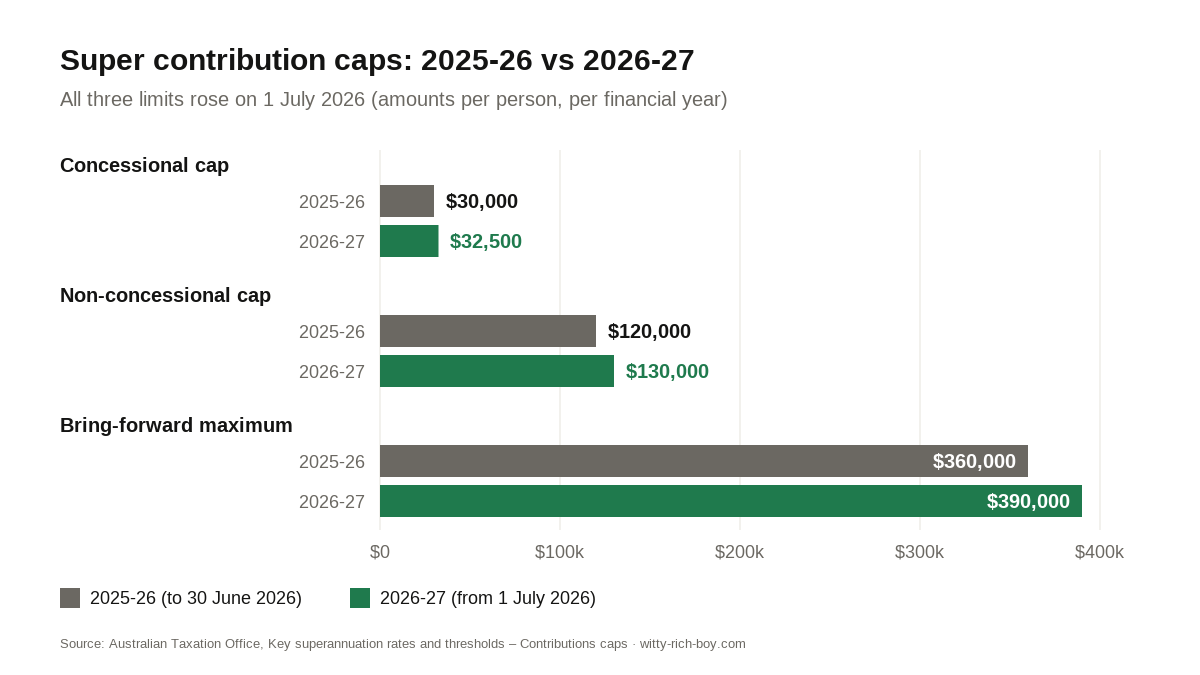
For context, the concessional cap was $25,000 from 2017-18 to 2020-21, $27,500 from 2021-22 to 2023-24 and $30,000 in 2024-25 and 2025-26. Those historical figures matter because they determine how much unused cap you can carry forward.
What counts towards the concessional cap?
Every before-tax dollar paid into super for you counts, whoever pays it. The ATO lists employer contributions — including the super guarantee, which is 12% for 2026-27 — salary-sacrifice contributions and personal contributions you claim as a tax deduction.
The super guarantee uses up much of the cap for higher earners before they make any voluntary contribution. Example: an employee on $150,000 receives $18,000 of super guarantee (12%), leaving $14,500 of the $32,500 cap for salary sacrifice or deductible personal contributions. At $270,000, the super guarantee alone would reach $32,400.
Contributions count in the financial year your fund receives them, not when you or your employer send them. A deductible personal contribution made on 29 June that lands on 2 July counts against next year’s cap. From 1 July 2026, under the ATO’s Payday Super rules, employers must ensure super guarantee contributions reach the fund within seven business days of payday, which reduces — but does not remove — timing surprises at year end.
How does the carry-forward (catch-up) concessional rule work?
Carry-forward concessional contributions let you add unused concessional cap from up to five previous financial years to the current year’s cap, provided your total superannuation balance was under $500,000 at 30 June of the previous year. The ATO describes this on its concessional contributions cap page; the first unused amounts accrued in 2018-19 and could first be used in 2019-20.
Your total superannuation balance (TSB) is broadly the combined value of all your super interests, including accumulation accounts and retirement-phase pensions, measured at 30 June. For 2026-27, the test date is 30 June 2026.
Three rules govern the mechanics:
- Five-year life. Unused amounts expire after five years. The ATO’s own example: a 2019-20 amount not used by the end of 2024-25 expired. On the same pattern, 2021-22 amounts expire if not used by 30 June 2027.
- Oldest first. When you exceed the general cap, the oldest unused amounts are applied first, automatically.
- Check your balance each year. Eligibility is retested every year; if your TSB reaches $500,000 at a 30 June, you cannot use carried-forward amounts the following year, although they keep accruing until they expire.
Worked example: a carry-forward catch-up in 2026-27
Example: Chloe worked part-time from 2021-22 to 2025-26, and her employer paid $10,000 of concessional contributions each year. Her TSB on 30 June 2026 was $280,000.
| Year | Cap | Contributions | Unused amount | Expires after |
|---|---|---|---|---|
| 2021-22 | $27,500 | $10,000 | $17,500 | 30 June 2027 |
| 2022-23 | $27,500 | $10,000 | $17,500 | 30 June 2028 |
| 2023-24 | $27,500 | $10,000 | $17,500 | 30 June 2029 |
| 2024-25 | $30,000 | $10,000 | $20,000 | 30 June 2030 |
| 2025-26 | $30,000 | $10,000 | $20,000 | 30 June 2031 |
| Total unused | $92,500 |
In 2026-27 her available concessional cap is $32,500 + $92,500 = $125,000. If her employer again pays $10,000, she could make up to $115,000 of personal contributions and claim them as a deduction without an excess. Whether that suits her depends on her tax position and access needs; super is generally preserved until retirement.
How does the bring-forward rule work for non-concessional contributions?
The bring-forward arrangement lets you make up to three years’ worth of non-concessional contributions in one year. You must be under 75 at any time in the financial year, and the amount depends on your total super balance at 30 June of the previous year. Since 2022-23 the work test no longer applies to non-concessional contributions for those aged 67 to 74.
The ATO’s tables for the two most recent years:
| TSB at 30 June 2026 | 2026-27 cap | Bring-forward period |
|---|---|---|
| Less than $1.84 million | $390,000 | 3 years |
| $1.84 million to less than $1.97 million | $260,000 | 2 years |
| $1.97 million to less than $2.1 million | $130,000 | No bring-forward |
| $2.1 million or more | Nil | Not applicable |
| TSB at 30 June 2025 | 2025-26 cap | Bring-forward period |
|---|---|---|
| Less than $1.76 million | $360,000 | 3 years |
| $1.76 million to less than $1.88 million | $240,000 | 2 years |
| $1.88 million to less than $2 million | $120,000 | No bring-forward |
| $2 million or more | Nil | Not applicable |
The thresholds are not arbitrary: each is the transfer balance cap minus one or two annual caps ($2.1 million − $260,000 = $1.84 million; $2.1 million − $130,000 = $1.97 million). The design stops anyone using the bring-forward to push a balance far beyond the transfer balance cap.
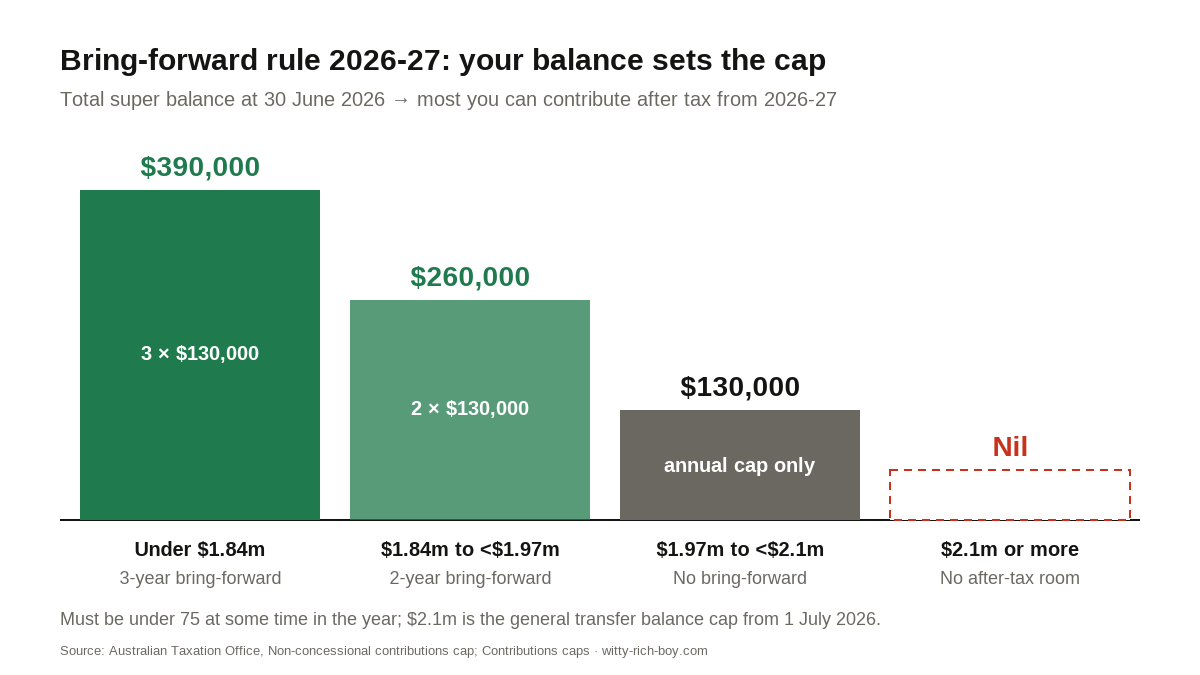
Two traps catch people. First, the cap is locked when triggered: the ATO says indexation does not apply during a bring-forward period, so someone who triggered a $360,000 bring-forward in 2025-26 does not gain the extra $30,000 in 2026-27. Second, the arrangement is triggered automatically whenever non-concessional contributions in a year exceed the annual cap — across all your funds combined. And if your TSB reaches the transfer balance cap at a later 30 June, the remaining room for the second or third year falls to nil.
How is Division 293 tax calculated?
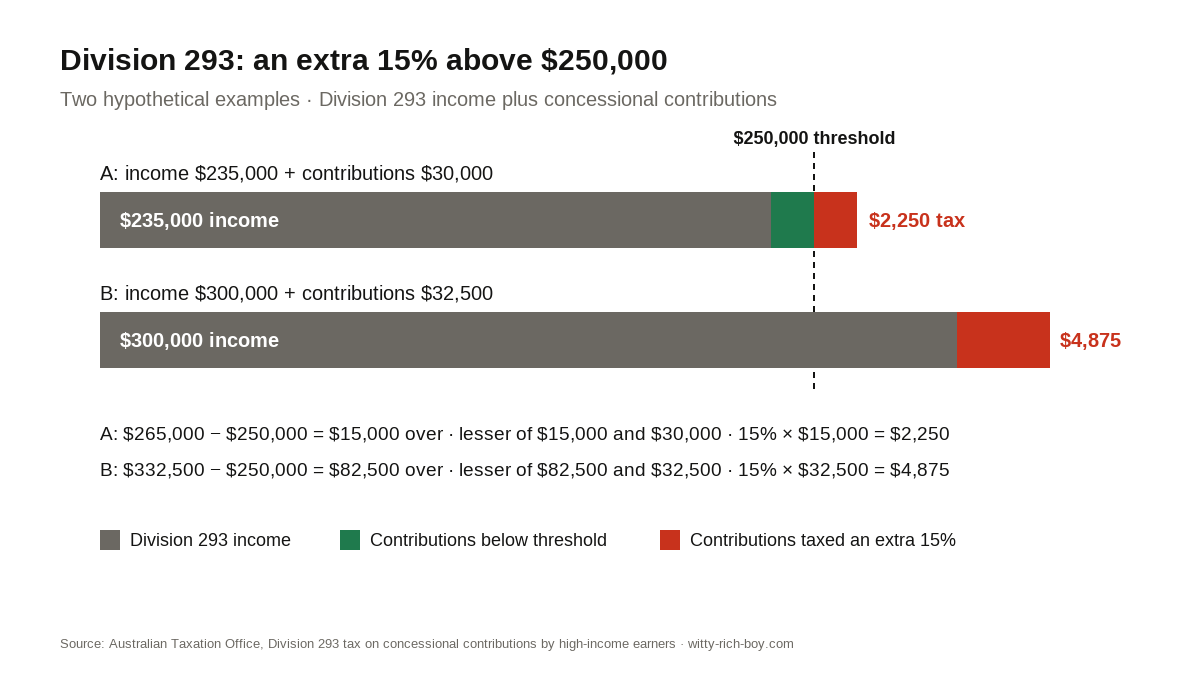
Division 293 tax is an additional 15% tax on concessional contributions for people whose income plus concessional contributions exceeds $250,000 — a threshold unchanged since 2017-18. It is calculated by the ATO and sent as a separate assessment; it effectively doubles the contributions tax on the affected amount from 15% to 30%.
The calculation, as the ATO sets it out:
- Division 293 income — broadly taxable income plus reportable fringe benefits, net financial investment losses and net rental property losses (reportable super contributions are excluded here).
- Division 293 super contributions — your concessional contributions minus any excess concessional contributions.
- Taxable contributions — the lesser of (2) and the amount by which (1) + (2) exceeds $250,000.
- Tax — 15% of (3).
| Example A | Example B | |
|---|---|---|
| Division 293 income | $235,000 | $300,000 |
| Concessional contributions | $30,000 | $32,500 |
| Combined | $265,000 | $332,500 |
| Amount over $250,000 | $15,000 | $82,500 |
| Taxable contributions (lesser of the two) | $15,000 | $32,500 |
| Division 293 tax at 15% | $2,250 | $4,875 |
Example A shows why Division 293 often surprises people with a salary below $250,000: the contributions themselves push the total over. In Example B income alone is above the threshold, so every dollar of concessional contributions is caught. You can pay the assessment personally or elect to release the amount from super.
What happens if you exceed a super contribution cap?
Exceeding a cap removes the tax benefit on the excess; the ATO issues a determination once your return and fund data are matched.
Excess concessional contributions are included in your assessable income and taxed at your marginal rate, with a non-refundable 15% tax offset for the contributions tax your fund already paid. You may elect to release up to 85% of the excess from super to pay the bill; if you release the full 85%, none of the excess counts as a non-concessional contribution. Any part not released is treated as a non-concessional contribution. The separate excess concessional contributions charge was abolished from 1 July 2021.
Example: Sam contributes $40,000 of concessional contributions in 2026-27 with no carry-forward amounts — an excess of $7,500. Assuming a combined marginal rate of 32%, the tax on the excess is $2,400, less a $1,125 offset (15% × $7,500), so $1,275 extra is payable.
Excess non-concessional contributions give you 60 days from the determination to choose:
| Option | What happens | Tax result |
|---|---|---|
| 1. Release (default) | The excess plus 85% of associated earnings is paid out of super | Associated earnings taxed at your marginal rate with a 15% offset |
| 2. Leave it in | The excess stays in super | Excess non-concessional contributions tax at 47% |
If you make no election, the ATO applies option 1 — unless your only super interest is in a defined benefit fund.
How to work out how much you can still contribute in 2026-27
A ten-minute check before any voluntary contribution:
- Find your total super balance at 30 June 2026. It is shown in ATO online services via myGov; add every fund. This decides both carry-forward (under $500,000) and bring-forward (under $1.84 million).
- Add up concessional contributions already received in 2026-27. Include employer super guarantee, salary sacrifice and any deductible personal contributions across all funds.
- Add any carry-forward amounts. If eligible, ATO online services shows your unused concessional amounts by year; add them to the $32,500 cap.
- Subtract step 2 from step 3 to get the concessional room left, remembering that your employer will keep contributing until 30 June 2027.
- Check non-concessional room. Confirm whether you triggered a bring-forward in 2024-25 or 2025-26; if so, your remaining cap is the locked amount minus what you have already contributed.
- Send money early. A contribution counts when the fund receives it, so leave margin before 30 June.
- Lodge a notice of intent with your fund and receive its acknowledgement before claiming a deduction for personal contributions.
Key dates for 2026-27
| Date | What happens |
|---|---|
| 30 June 2026 | Total super balance measured for 2026-27 carry-forward and bring-forward tests |
| 1 July 2026 | Caps rise to $32,500 and $130,000; transfer balance cap to $2.1 million; Payday Super starts; Division 296 begins |
| 30 June 2027 | Last day for contributions to count in 2026-27; unused 2021-22 concessional cap expires; first Division 296 balance test |
What is Division 296 and does it change the caps?
Division 296 tax does not change the contribution caps, but it applies a higher tax rate to earnings on very large balances. The ATO’s super funds newsroom confirms that the Better Targeted Superannuation Concessions measure is now law and applies from 1 July 2026.
According to the ATO’s Division 296 guidance, an additional 15% applies to the share of super earnings attributable to a total super balance above the large super balance threshold of $3 million, with a further 10% on the share above the very large super balance threshold of $10 million for 2026-27. Both thresholds are indexed to inflation. For the first year, only the balance at 30 June 2027 is tested, and the ATO expects to issue the first assessments later in 2027-28. People affected can pay personally or elect to release the amount from super.
How do Australian super caps compare with tax-free accounts abroad?
The super caps are large by international standards, but the money is generally preserved until retirement. The UK’s ISA allowance of £20,000 a year can be withdrawn at any time but has no carry-forward. Canada’s TFSA contribution limit of $7,000 for 2026 carries forward indefinitely and offers no up-front deduction, while the US Roth IRA adds an income test — see Roth IRA income limits for 2026. Australia’s concessional cap is the only one of the four that gives a deduction, which is exactly why it is rationed so tightly.
Assets held outside super are taxed under ordinary rules; for crypto that can include disposals many investors overlook — see whether crypto-to-crypto swaps are taxable. The wider rules, from the 12-month CGT discount to staking income, are set out in our guide to ATO crypto tax.
Three numbers sum up the year: $32,500 before tax, $130,000 after tax, and $390,000 at most if you bring forward.
Questions readers ask
What are the super contribution caps for 2026-27?
For 2026-27 (1 July 2026 to 30 June 2027) the concessional cap is $32,500 and the non-concessional cap is $130,000, according to the ATO. Both rose from 2025-26, when they were $30,000 and $120,000. Using the bring-forward rule, someone under 75 with a total super balance below $1.84 million on 30 June 2026 can contribute up to $390,000 after tax.
Did the super contribution caps change on 1 July 2026?
Yes. The concessional cap rose by $2,500 to $32,500 and the non-concessional cap rose by $10,000 to $130,000 on 1 July 2026. The concessional cap is indexed to average weekly ordinary time earnings in $2,500 steps, and the non-concessional cap is set at four times it. The general transfer balance cap also rose, from $2 million to $2.1 million.
Does my employer's super guarantee count towards the concessional cap?
Yes. Super guarantee payments, salary-sacrificed amounts and personal contributions you claim as a tax deduction are all concessional contributions and share one cap. With the super guarantee at 12% for 2026-27, an employee earning $150,000 receives $18,000 from the employer, leaving $14,500 of the $32,500 cap before any carry-forward amounts.
How does the carry-forward super rule work?
If your total super balance was under $500,000 on 30 June of the previous financial year, you can add unused concessional cap from up to five earlier years to this year's cap. Unused amounts accrue from 2018-19 onwards and expire after five years, and the oldest amounts are used first. In 2026-27 the available years are 2021-22 to 2025-26.
How much can I bring forward into super in 2026-27?
It depends on your total super balance at 30 June 2026. Below $1.84 million you can contribute up to $390,000 over three years; from $1.84 million to under $1.97 million, $260,000 over two years; from $1.97 million to under $2.1 million, only the $130,000 annual cap; at $2.1 million or more, nil. You must be under 75 at some time in the year.
How is Division 293 tax calculated?
Add your Division 293 income to your concessional contributions (excluding any excess). If the total is above $250,000, tax of 15% applies to the lesser of the amount over $250,000 and your concessional contributions. Example: income of $235,000 plus $30,000 of contributions is $15,000 over, so the extra tax is 15% of $15,000, or $2,250.
What happens if I exceed the concessional contributions cap?
The excess is added to your assessable income and taxed at your marginal rate, with a non-refundable 15% tax offset for the contributions tax your fund already paid. You can elect to release up to 85% of the excess from super to pay the bill. Any excess not released also counts towards your non-concessional cap. The old excess concessional contributions charge no longer applies from 1 July 2021.
What happens if I exceed the non-concessional cap?
The ATO sends a determination and you have 60 days to choose. You can release the excess plus 85% of the associated earnings, which are then taxed at your marginal rate with a 15% offset. Or you can leave the excess in super and pay excess non-concessional contributions tax at 47%. If you make no election, the ATO applies the release option.
Was this guide useful?
Thanks — your answer helps us decide what to cover next.
Sources
- Key superannuation rates and thresholds — Contributions caps (Australian Taxation Office)
- Concessional contributions cap (Australian Taxation Office)
- Non-concessional contributions cap (Australian Taxation Office)
- Total superannuation balance (Australian Taxation Office)
- Division 293 tax on concessional contributions by high-income earners (Australian Taxation Office)
- Key superannuation rates and thresholds — Division 293 tax (Australian Taxation Office)
- General transfer balance cap indexation on 1 July 2026 (Australian Taxation Office)
- Key superannuation rates and thresholds — Super guarantee (Australian Taxation Office)
- Better Targeted Super Concessions is now law (Australian Taxation Office)
- How Division 296 tax is calculated (Australian Taxation Office)
General information, not tax or legal advice. Rules change — check the official source or a licensed adviser before acting.