Canada · Crypto
Crypto Tax Canada (2026): 50% Inclusion, 30-Day Loss Rule
Crypto tax in Canada for 2026: half of a capital gain is taxable, business profits are taxed in full, and the 30-day superficial loss rule can deny your losses.
The short answer
- Only one-half of a capital gain on crypto is taxable under Income Tax Act s. 38; the proposed rise to two-thirds was cancelled on 21 March 2025.
- If your crypto activity is a business, 100% of the profit is taxed as income — on a $10,000 gain in the 20.5% federal bracket that is $2,050 instead of $1,025.
- Swapping one token for another is a disposition under the CRA's barter rules, valued in Canadian dollars at the time of the trade.
- The superficial loss rule (ITA s. 54) denies a loss if you or an affiliated person buy the same property in the 30 days before or after the sale and still hold it at the end of that window.
- Staking rewards on a centralised platform are generally income when credited; mining is in most cases a business, according to the CRA.
- Keep crypto records for at least six years from the end of the last tax year they relate to; the 2026 return and any balance are due 30 April 2027.
In force: 21 March 2025 (proposed two-thirds inclusion rate cancelled; one-half rate stays) · 1 January 2026 (2026 federal brackets, 14% lowest rate) · 30 April 2027 (2026 return and balance due)
In Canada, crypto is taxed under ordinary income tax rules, not a special regime. Selling, swapping, spending or gifting tokens is a disposition; if it is on capital account, only 50% of the gain is taxable. If your activity is a business, 100% is taxed. Losses are denied if you rebuy within 30 days.
The Canada Revenue Agency (CRA) has never written a crypto tax. It applies the Income Tax Act to tokens as to any other property, so three questions decide almost every bill: is the gain capital or business income, what was your adjusted cost base, and did you trip the superficial loss rule? Below, each is answered with 2026 federal rates and worked numbers.
Is crypto taxable in Canada?
Yes, when you dispose of it or receive it as income; simply buying and holding crypto is not taxable. The CRA’s guide for crypto-asset users says possessing or holding a crypto-asset is generally not taxable, but a tax consequence can arise when you dispose of it.
A disposition is any transaction in which you give up ownership of a token. According to the CRA, the main ones are:
- Selling crypto for Canadian dollars or another fiat currency.
- Trading one crypto-asset for another.
- Spending crypto on goods or services.
- Gifting crypto to someone else.
The CRA treats payment in crypto as a barter transaction. Its guide states that crypto-assets disposed of to pay for, or received as payment for, goods (including other crypto-assets) and services are generally treated as barter for income tax purposes. That is why each disposition is measured at fair market value in Canadian dollars at the moment it happens.
| What you do | Tax result | How it is measured |
|---|---|---|
| Buy crypto with dollars and hold it | Nothing to report | Record the cost (it becomes your ACB) |
| Sell crypto for dollars | Capital gain/loss or business income | Proceeds minus ACB and selling costs |
| Swap token A for token B | Disposition of token A | Fair market value of what you receive, in CAD |
| Pay for goods with crypto | Disposition (barter) | Fair market value of the goods or the crypto |
| Receive staking rewards | Income when credited | Value in CAD on receipt |
| Mine crypto as a business | Business income | Value when earned, less expenses |
Countries differ on swaps; Canada taxes them. See which countries tax crypto-to-crypto swaps.
What is the capital gains inclusion rate for crypto in 2026?
The inclusion rate is the share of a capital gain added to your taxable income, and in 2026 it is one-half (50%). Section 38 of the Income Tax Act sets a taxable capital gain at one-half of the capital gain, and an allowable capital loss at one-half of the capital loss.
The rate nearly changed. The 2024 federal budget proposed increasing it to two-thirds on part of individuals’ gains. In January 2025 the Department of Finance deferred the start date to 1 January 2026. Then, on 21 March 2025, the Prime Minister’s Office announced that the government would cancel the proposed increase altogether. The CRA has reverted to administering the enacted one-half rate, so it applies to every dollar of capital gain in 2026.
A capital gain is the amount by which your proceeds of disposition exceed your adjusted cost base plus selling costs. Outside registered accounts there is no holding-period exemption: ten years or ten weeks, the one-half basis is the same. Gains inside a TFSA are not taxed — see the TFSA contribution limit for 2026.
2026 federal tax brackets
The taxable half is added to your other income and taxed at your marginal rate. The CRA’s table for 2026 lists these federal rates; provincial or territorial tax is added on top:
| 2026 federal taxable income | Federal rate | Effective federal rate on a capital gain |
|---|---|---|
| Up to $58,523 | 14% | 7% |
| $58,523.01 – $117,045 | 20.5% | 10.25% |
| $117,045.01 – $181,440 | 26% | 13% |
| $181,440.01 – $258,482 | 29% | 14.5% |
| Over $258,482 | 33% | 16.5% |
The lowest federal rate is 14% for 2026, down from 14.5% for 2025, and the thresholds were indexed by 2.0%.
Is my crypto a capital gain or business income?
It depends on how you deal in crypto, and the CRA decides case by case. If disposing of crypto is part of a business, the profit is business income, fully taxable, rather than a capital gain of which only half is taxed.
The CRA’s guidance lists factors that point towards a business:
- Frequency of transactions — a history of many short-term buys and sells.
- Period of ownership — tokens held only briefly.
- Knowledge of crypto-asset markets.
- Time spent studying the markets and researching trades.
- Financing purchases with debt.
- Advertising that you are willing to buy or sell crypto-assets.
None is decisive alone. The CRA describes a business as activity with some regularity or continuity, pursued for profit, and it warns that even a single purchase made with the intention of selling at a profit can be an adventure or concern in the nature of trade — business income without a business in the everyday sense.
The difference in tax is exactly double at every bracket:
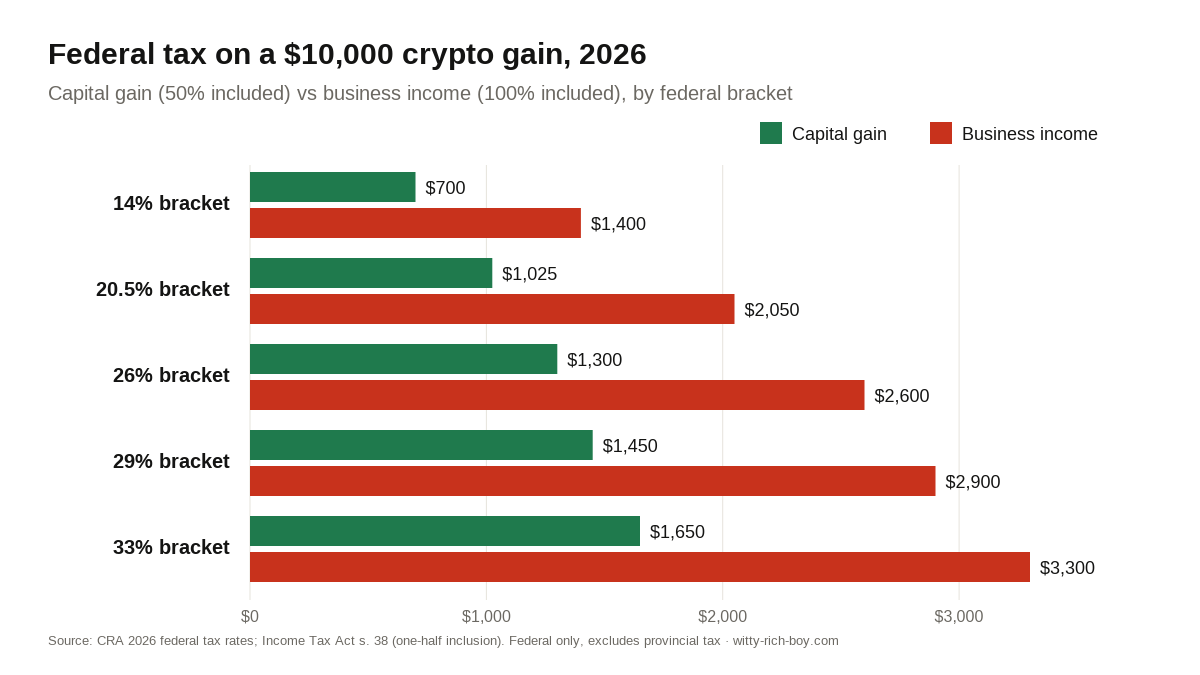
Business status cuts both ways: business losses are treated differently from capital losses, which can only be set against capital gains.
How do you calculate the adjusted cost base of crypto?
The adjusted cost base (ACB) is what you paid for your tokens, including acquisition costs, and for crypto it is usually the weighted average cost of all identical units you hold. The CRA’s guide says a capital loss arises when proceeds fall below “your adjusted cost base (usually the weighted average cost of a crypto-asset)” plus outlays and expenses — and the same arithmetic produces a gain.
Each purchase adds units and cost; each sale removes a proportional share of the cost. Holding coins on several exchanges does not create separate pools.
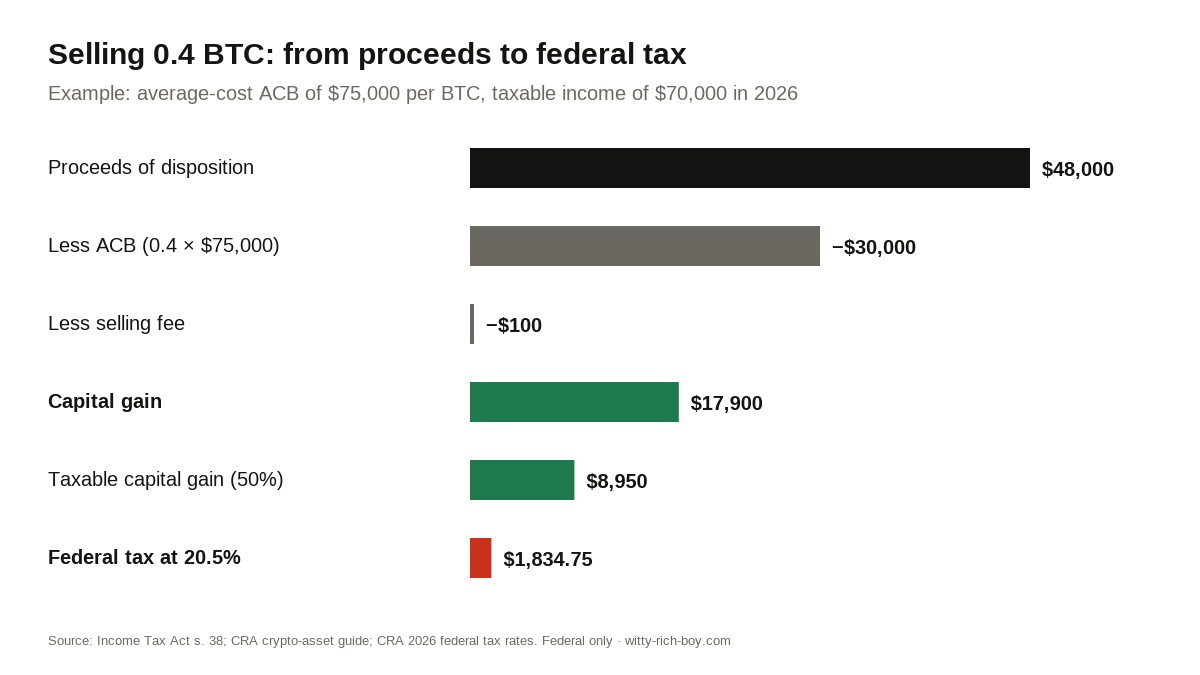
Example: Priya, an Ontario resident with $70,000 of taxable employment income, builds a bitcoin position and sells part of it in 2026.
| Date | Event | Units held | Total ACB | ACB per BTC |
|---|---|---|---|---|
| March 2024 | Buys 0.5 BTC for $30,000 | 0.5 | $30,000 | $60,000 |
| January 2025 | Buys 0.5 BTC for $45,000 | 1.0 | $75,000 | $75,000 |
| June 2026 | Sells 0.4 BTC for $48,000, $100 fee | 0.6 | $45,000 | $75,000 |
Her ACB on the sale is 0.4 × $75,000 = $30,000. The capital gain is $48,000 − $30,000 − $100 = $17,900, of which $8,950 is taxable. Her total taxable income becomes $78,950, still in the 20.5% federal bracket, so federal tax on the gain is $1,834.75 before Ontario tax.
Crypto-to-crypto example: Priya later swaps 2 ETH with an ACB of $6,000 for SOL worth $9,000 at the time. She has disposed of the ETH for proceeds of $9,000 — a $3,000 capital gain and $1,500 taxable — and her new SOL carries an ACB of $9,000.
What is the superficial loss rule for crypto?
A superficial loss is a capital loss that the Income Tax Act deems to be nil because you replaced the property you sold. Under the definition in section 54, a loss is superficial if, during the period that begins 30 days before and ends 30 days after the disposition, you or a person affiliated with you (including your spouse or common-law partner) acquires the same or identical property, and at the end of that period you or that person still owns it.
Section 40(2)(g) then sets the loss to nil. It is not lost forever: the CRA explains that the person who acquires the substituted property can usually add the superficial loss to its adjusted cost base, which reduces the gain or increases the loss when that property is eventually sold.
The rule is written for all capital property, not only shares, and the CRA treats crypto disposed of on capital account as capital property. The CRA’s archived interpretation bulletin describes identical properties as those that are the same in all material respects, so that a buyer would have no preference between them — a description that fits units of the same token. Whether two different tokens could ever be identical is not addressed in the CRA’s crypto guidance.
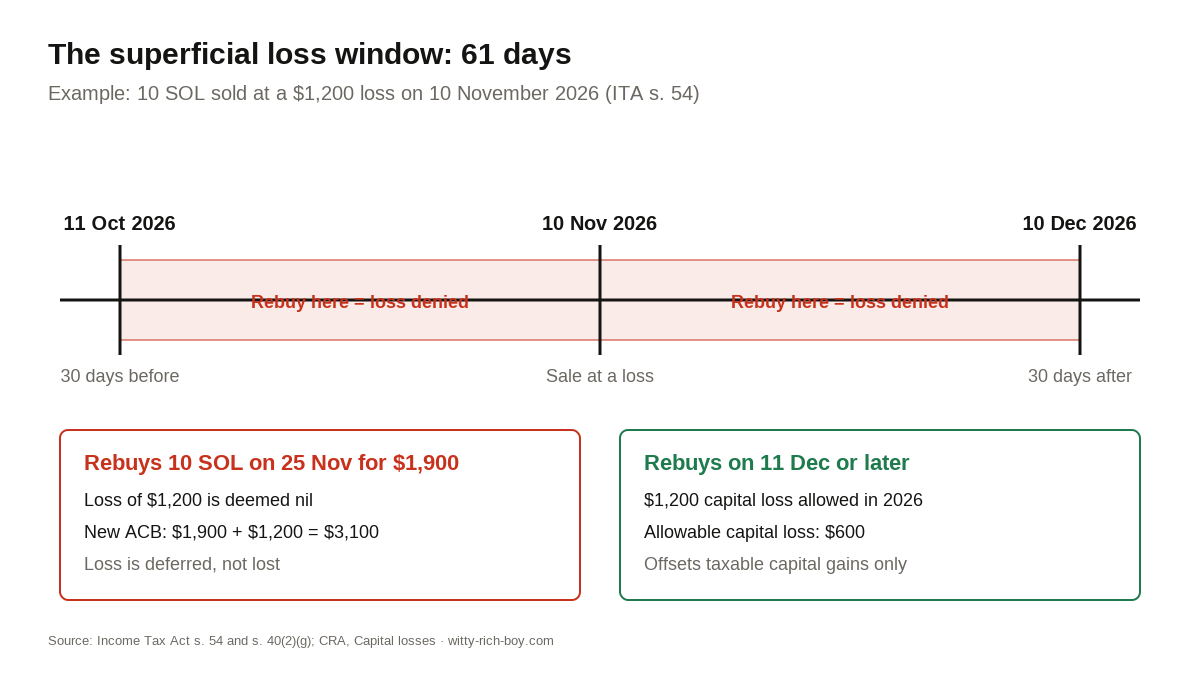
Example: Marc holds 10 SOL with an ACB of $3,000. On 10 November 2026 he sells all 10 for $1,800, a $1,200 loss he hopes to use against a gain earlier in the year.
| Marc rebuys 10 SOL on 25 November for $1,900 | Marc rebuys on 11 December or later | |
|---|---|---|
| Inside the 30-day window? | Yes (window ends 10 December) | No |
| Capital loss for 2026 | Nil (superficial loss) | $1,200 |
| Allowable capital loss | $0 | $600 |
| ACB of the new SOL | $1,900 + $1,200 = $3,100 | Purchase price |
Three traps catch people. The window also runs backwards: buying extra SOL on 20 October, and still holding it on 10 December, can make the 10 November loss superficial. A purchase by your spouse counts. And where only part of the position is replaced, the CRA’s archived guidance limits the superficial loss to the portion reacquired — if Marc had rebought 5 SOL, $600 of the loss would be denied and $600 allowed.
The US runs a similar but not identical test — see the crypto wash sale rule — and the UK matches sales with purchases in the following 30 days, explained in our UK crypto tax guide. For how Canada’s 61-day window compares with five other countries, with one worked loss run through all six, see our guide to crypto tax loss harvesting.
How are crypto losses used?
Capital losses are halved in the same way as gains. An allowable capital loss first reduces taxable capital gains in the same year. Any excess becomes a net capital loss, which the CRA says can be carried back three years or forward indefinitely, but only against taxable capital gains. A carry-back is requested on Form T1A.
Capital losses cannot reduce employment or other ordinary income; they wait for future gains.
How are crypto staking and mining taxed in Canada?
Staking rewards and mining proceeds are usually income, taxed in full at your marginal rate, not at the one-half inclusion rate.
- Staking: the CRA says rewards from staking crypto-assets on a centralised crypto-asset exchange platform will generally be considered income at the time they are credited to your wallet on the platform. The CRA’s published guidance on staking addresses centralised platforms; it does not spell out timing for self-custodied or validator staking.
- Mining: in most cases the CRA considers mining to be carrying on a business because of the scale and resources involved. Business mining income is included when earned, and equipment such as mining rigs may qualify for capital cost allowance.
- Hobby mining: the CRA says a hobby pursued in a sufficiently commercial and businesslike way is a business.
Example: in 2026 Léa’s exchange credits her with staking rewards worth $2,000 when received. She includes $2,000 in income. Those tokens join her pool with a cost of $2,000, so if she later sells them for $2,600, only the $600 rise is a capital gain, $300 of it taxable.
Do I need to file Form T1135 for crypto?
Possibly, if you hold enough foreign property. Form T1135, Foreign Income Verification Statement, must be filed by Canadian residents whose specified foreign property cost more than $100,000 in total at any time in the year. The test uses cost, not market value; a simplified method applies to totals under $250,000, and Part B is required at $250,000 or more.
The CRA’s definition of specified foreign property covers, among other things, funds or intangible property situated, deposited or held outside Canada. Its crypto guidance does not say expressly whether tokens held on a foreign platform or in a self-custodied wallet fall within that definition. If your crypto plus other foreign assets cost more than $100,000, resolve the question before filing: penalties for an inaccurate or late form are substantial, and the reassessment period can be extended by three years where foreign income goes unreported.
How do you report crypto on your Canadian tax return?
Capital gains and losses go on Schedule 3 and flow to line 12700; crypto business income is reported as self-employment business income. To get from a pile of exchange files to a filed return:
- Export every transaction from each exchange and wallet for the year, including swaps, fees, deposits and withdrawals.
- Convert each event to Canadian dollars at its fair market value at the time, using one consistent valuation method, and record which method you used.
- Decide capital or business for your activity, applying the CRA’s factors honestly.
- Update the weighted-average ACB of each token after every acquisition and disposition.
- Test each loss against the 61-day superficial loss window, including purchases by your spouse.
- Separate income from gains: staking and mining income are reported as income; dispositions on capital account go on Schedule 3.
- Apply losses: current-year allowable capital losses first, then net capital losses carried forward, or request a carry-back on Form T1A.
- Check T1135 if the cost of your foreign property exceeded $100,000 at any time.
- File and pay by 30 April 2027 for the 2026 tax year; self-employed individuals may file by 15 June 2027, but any balance is still due on 30 April.
What crypto records does the CRA expect you to keep?
The CRA requires books and records for at least six years from the end of the last tax year to which they relate. For crypto, its guidance lists:
- the date and time of each transaction;
- receipts for purchases or transfers;
- the value in Canadian dollars at the time of the transaction;
- the number of units and type of asset;
- digital wallet records and addresses;
- a description of the transaction and the other party, even if only a wallet address;
- exchange records, and the beginning and ending balance of each wallet for each year.
The CRA also advises downloading your history from exchanges at regular intervals, because access can disappear if a platform closes, stops serving Canada or locks your account.
Reporting by platforms is coming too. Canada has signed up to the OECD Crypto-Asset Reporting Framework, under which crypto-asset service providers collect user and transaction data for tax authorities; Budget 2025 listed it with a deferred application date of 1 January 2027. The EU’s equivalent is explained in our guide to DAC8 crypto reporting.
Questions readers ask
How much tax do you pay on crypto in Canada?
There is no separate crypto tax rate. If your gains are capital, half of the gain is added to your income and taxed at your marginal rate. In 2026 the federal rates run from 14% on taxable income up to $58,523 to 33% above $258,482, plus provincial or territorial tax. A $10,000 capital gain in the 20.5% federal bracket costs $1,025 in federal tax.
Is the capital gains inclusion rate 50% or two-thirds in 2026?
It is 50%. The 2024 budget proposed raising the inclusion rate to two-thirds on part of individuals' gains, and the start date was later deferred to 1 January 2026. On 21 March 2025 the Prime Minister announced the increase was cancelled, so section 38 of the Income Tax Act continues to include one-half of a capital gain in income.
Is trading one crypto for another taxable in Canada?
Yes. The CRA says that when you dispose of one crypto-asset to acquire another, the barter transaction rules apply. You are treated as disposing of the first token at its fair market value in Canadian dollars at the time of the trade, and that value becomes the cost of the token you receive. No dollars need to reach your bank account for a gain to arise.
Does the superficial loss rule apply to crypto?
The rule in section 54 of the Income Tax Act applies to any capital property, and the CRA treats crypto disposed of on capital account as capital property. If you, your spouse or another affiliated person buy the same token within 30 days before or after selling it at a loss, and still hold it 30 days after the sale, the loss is denied and added to the new tokens' cost.
Are crypto staking rewards taxable in Canada?
Generally, yes. The CRA says rewards from staking on a centralised crypto-asset platform will generally be income at the time they are credited to your wallet on the platform. The value you include in income becomes the cost of those tokens, so only later changes in value are a capital gain or loss when you sell them. Mining, in most cases, is treated as a business.
When is crypto trading business income instead of a capital gain?
The CRA decides case by case. It looks at how often you trade, how long you hold, your knowledge of crypto markets, time spent studying them, whether you borrow to buy and whether you advertise to buy or sell. Regular, organised activity aimed at profit points to business income, which is taxed in full rather than at the one-half inclusion rate.
Can I deduct crypto losses against my salary?
Not if they are capital losses. Allowable capital losses, which are half of the loss, can only reduce taxable capital gains. Unused net capital losses can be carried back three years or forward indefinitely, but only against taxable capital gains. Losses from a crypto business are business losses, which follow different rules.
How long do I need to keep crypto records in Canada?
At least six years from the end of the last tax year to which the records relate. The CRA expects you to keep the date of each transaction, its value in Canadian dollars, receipts, wallet addresses and records, a description of the transaction and the other party, and exchange records. It advises downloading exchange histories regularly in case a platform closes.
Was this guide useful?
Thanks — your answer helps us decide what to cover next.
Sources
- Information for crypto-asset users and tax professionals (Canada Revenue Agency)
- Understanding crypto-assets and your tax obligations (Canada Revenue Agency)
- Reporting income from crypto-asset transactions (Canada Revenue Agency)
- Reporting income from crypto-asset mining and staking activities (Canada Revenue Agency)
- Keeping books and records of crypto-assets for tax filing (Canada Revenue Agency)
- Prime Minister Carney cancels proposed capital gains tax increase (21 March 2025)
- Income Tax Act, section 54 — definitions including superficial loss (Justice Laws)
- Capital losses (Canada Revenue Agency)
- Current year tax rates and income brackets (2026) (Canada Revenue Agency)
- Questions and answers about Form T1135 (Canada Revenue Agency)
General information, not tax or legal advice. Rules change — check the official source or a licensed adviser before acting.