Germany · Tax
Sparerpauschbetrag 2026: €1,000 Tax-Free, Split Across Banks
Sparerpauschbetrag 2026: €1,000 of interest, dividends and gains tax-free (€2,000 for couples). How to split it across banks and reclaim tax via Anlage KAP.

The short answer
- The Sparer-Pauschbetrag is €1,000 per person and €2,000 for jointly assessed couples in 2026 (§ 20 (9) EStG), up from €801 / €1,602 until 2022.
- Above the allowance, banks withhold 25% Abgeltungsteuer plus 5.5% solidarity surcharge — 26.375% in total, or about 27.99% with 9% church tax.
- A fully used allowance saves up to €263.75 a year for a single person and €527.50 for a couple, before church tax.
- You can split a Freistellungsauftrag across any number of banks, but the total must not exceed €1,000 / €2,000; banks report the amounts used to the BZSt (§ 45d EStG).
- The 2026 ETF Vorabpauschale (base rate 3.20%) is deemed received on 4 January 2027, so it uses the 2027 allowance, not 2026's.
In force: 1 January 2023 (allowance raised from €801 to €1,000) · 2 January 2026 (Vorabpauschale base rate 3.20%) · 2026 income tax tariff
The Sparerpauschbetrag (saver's allowance) is €1,000 per person and €2,000 for jointly assessed couples in 2026, under § 20 (9) EStG. Interest, dividends, fund income and share gains up to that amount are tax-free. Above it, banks withhold 26.375% (25% Abgeltungsteuer plus solidarity surcharge), plus church tax for members.
Germany taxes most savings and investment income at a flat rate, collected by the bank before the money reaches you. The saver’s allowance is the one exemption every resident gets, from pensioner to newborn, but it only stops withholding if you tell your bank about it, and spread it across accounts in line with where income actually arises. Below are the 2026 rules, each tied to the statute or Federal Finance Ministry (BMF) guidance, with worked numbers for singles, couples, children and ETF investors.
What is the Sparerpauschbetrag in 2026?
The Sparerpauschbetrag is a flat deduction of €1,000 from capital income, set by § 20 (9) EStG; married couples and registered partners assessed jointly get a shared €2,000. The statute treats it as a lump-sum deduction for expenses, and it replaces any deduction for actual costs: bank fees, custody charges or advice fees cannot be deducted on top.
Three features matter:
- It is an allowance, not a cliff. Unlike the €1,000 Freigrenze on private sales of crypto (see crypto tax in Germany), the saver’s allowance is a Freibetrag: the first €1,000 is always tax-free, and only the excess is taxed.
- It cannot create a loss. Under § 20 (9) EStG the allowance may not exceed your net capital income for the year. Unused allowance does not carry forward.
- For couples it is pooled. The joint €2,000 is split half and half, but if one spouse earns less than €1,000 of capital income, the unused part passes to the other.
| Tax year | Single | Jointly assessed couple | Legal basis |
|---|---|---|---|
| Up to 2022 | €801 | €1,602 | § 20 (9) EStG, old version |
| 2023 onwards (incl. 2026) | €1,000 | €2,000 | § 20 (9) EStG as amended by the Jahressteuergesetz 2022 |
The rise to €1,000 applied from the 2023 tax year, according to the BMF’s January 2023 summary of tax changes. Existing Freistellungsaufträge did not need to be renewed: § 52 EStG raised orders given before 1 January 2023 by 24.844%, which is how a €801 order became €1,000.
How much tax does the allowance save?
At the standard rate, a fully used allowance saves €263.75 a year per person and €527.50 for a couple. The flat tax under § 32d (1) EStG is 25%, and the solidarity surcharge of 5.5% under § 4 SolzG 1995 is charged on that tax, giving a combined 26.375%. The income thresholds that spare most wage earners the surcharge do not apply to the flat tax on capital income.
Church tax changes the arithmetic slightly. Under § 32d (1) EStG, the 25% is reduced by a quarter of the church tax due on the same income, so the flat tax is 25% divided by (1 + 0.25 × church tax rate). The results:
| Taxpayer | Flat tax | Soli | Church tax | Total rate | Tax on €1,500 above the allowance |
|---|---|---|---|---|---|
| No church tax | 25.00% | 1.375% | — | 26.375% | €395.63 |
| Church tax at 8% | 24.51% | 1.35% | 1.96% | 27.82% | €417.28 |
| Church tax at 9% | 24.45% | 1.34% | 2.20% | 27.99% | €419.93 |
Example: Lena, single and a member of a church levying 9% church tax, receives €2,500 of interest in 2026 from one bank. With a €1,000 Freistellungsauftrag, €1,500 is taxed: €366.75 flat tax, €20.17 solidarity surcharge and €33.01 church tax, €419.93 in all. Without the order, the bank withholds on the full €2,500: about €699.88. The €279.95 difference comes back only after she files a return.
How does the Freistellungsauftrag work?
A Freistellungsauftrag (exemption order) is an instruction to your bank, on the officially prescribed form, not to withhold tax on capital income up to a stated amount; it is the mechanism in § 44a (1) and (2) EStG that turns the allowance into cash flow. Without one, the bank withholds from the first euro, even if your allowance is entirely unused.
The rules that trip people up:
- Tax ID is mandatory. Since 2016 an order is ineffective if the bank does not hold your tax identification number (§ 44a (2a) EStG). A joint order needs both spouses’ numbers.
- Banks report what they exempt. Every institution reports the income it left untaxed to the Federal Central Tax Office (BZSt) under § 45d EStG, so the authorities can see if your orders add up to more than €1,000. Over-allocation leads to back-assessment.
- Orders apply from receipt. You can raise, cut or move an order during the year, but not below the amount the bank has already used. If tax was withheld anyway, the dependable route to recover it is Anlage KAP in your return.
- Crypto is outside it. Gains on coins are private sale transactions under § 23 EStG, not capital income under § 20, so they neither use nor benefit from the saver’s allowance. Our Germany crypto tax calculator handles those separately.
How should you split the allowance across several banks?
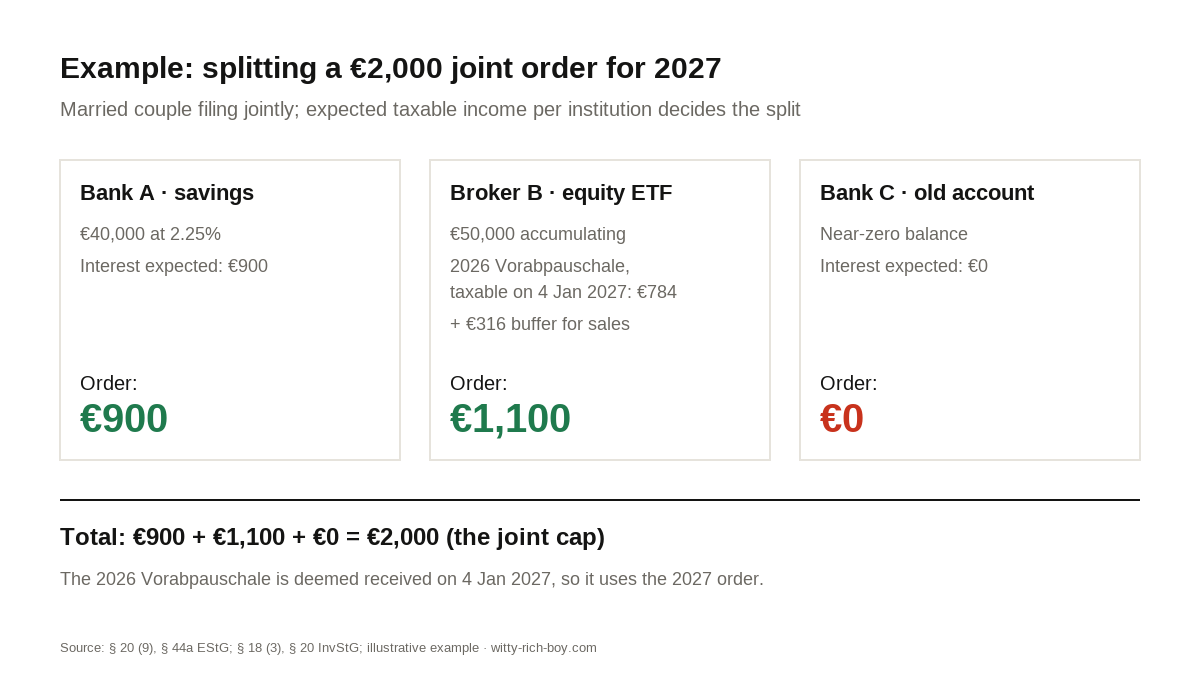
Split it in proportion to the taxable income you expect at each institution, keep the total at or under €1,000 (or €2,000), and set any account that pays nothing to €0. The overall tax bill does not change with the split; what changes is whether tax is withheld that you must then reclaim.
| Your situation | Sensible split | Why |
|---|---|---|
| All savings and investments at one bank | €1,000 there | Nothing to optimise |
| Savings account plus accumulating ETF at a broker | Expected interest at the bank; the rest at the broker | The broker needs room for the Vorabpauschale each January |
| Large sale with gains planned this year | Move headroom to the broker before the sale | Orders can be raised during the year if unused elsewhere |
| Income clearly above €1,000 in total | Put it where income arrives earliest | The 25% applies anyway; you only avoid a refund claim |
| Some investments with a foreign broker | Leave part unallocated | Foreign brokers withhold no German tax; the allowance is applied on assessment |
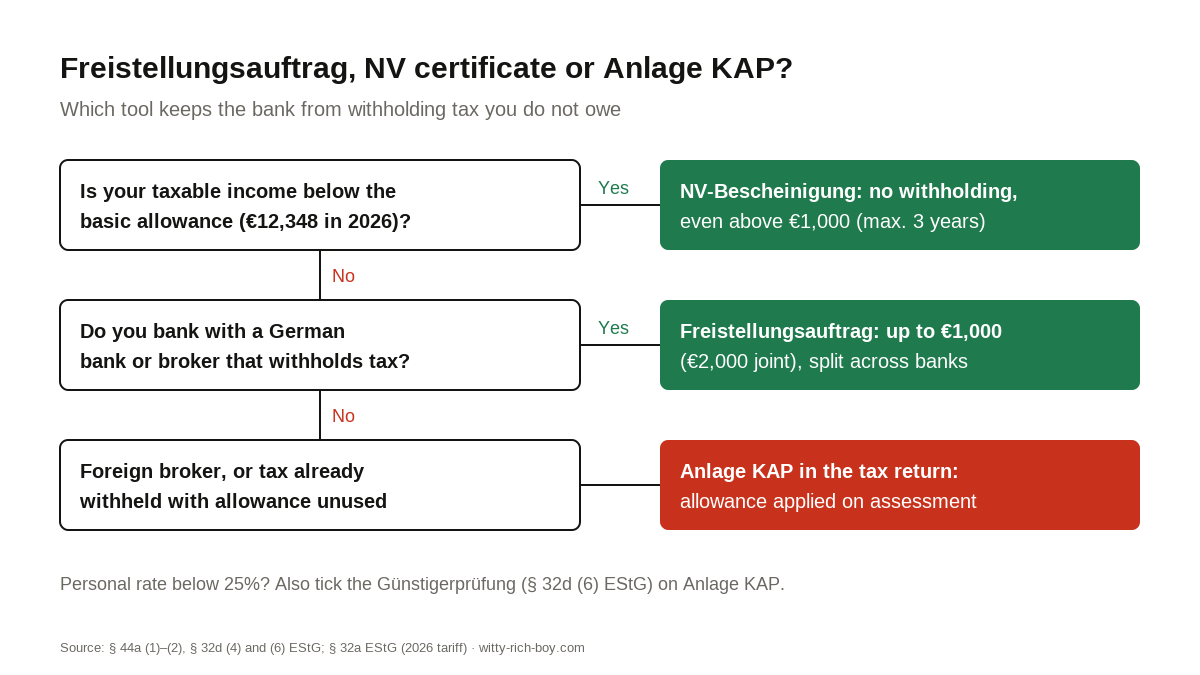
| Total income below the basic allowance | Apply for an NV-Bescheinigung instead | Stops withholding even above €1,000 |
How to set up and rebalance your orders
- List every German account and depot for yourself, your spouse and your children.
- Estimate taxable income per institution for the coming year: balance × interest rate, expected dividends, the Vorabpauschale on accumulating funds (see below) and any gains you plan to realise.
- Check existing orders in online banking, which shows both the amount allocated and the amount already used this year.
- Cut orders at dormant accounts to €0 first, so you do not breach the cap when you raise others.
- Raise orders where income arises, giving your tax ID (and your spouse’s on a joint order).
- Review in early December. If a bank has used up its share and another has spare room, shift the difference; if you hold losses at one bank and gains at another, request a loss certificate (Verlustbescheinigung) by 15 December under § 43a (3) EStG.
- Check the annual tax certificates in spring. If tax was withheld while part of your allowance stayed unused, claim it back on Anlage KAP.
How do ETFs, the Vorabpauschale and Teilfreistellung use up the allowance?
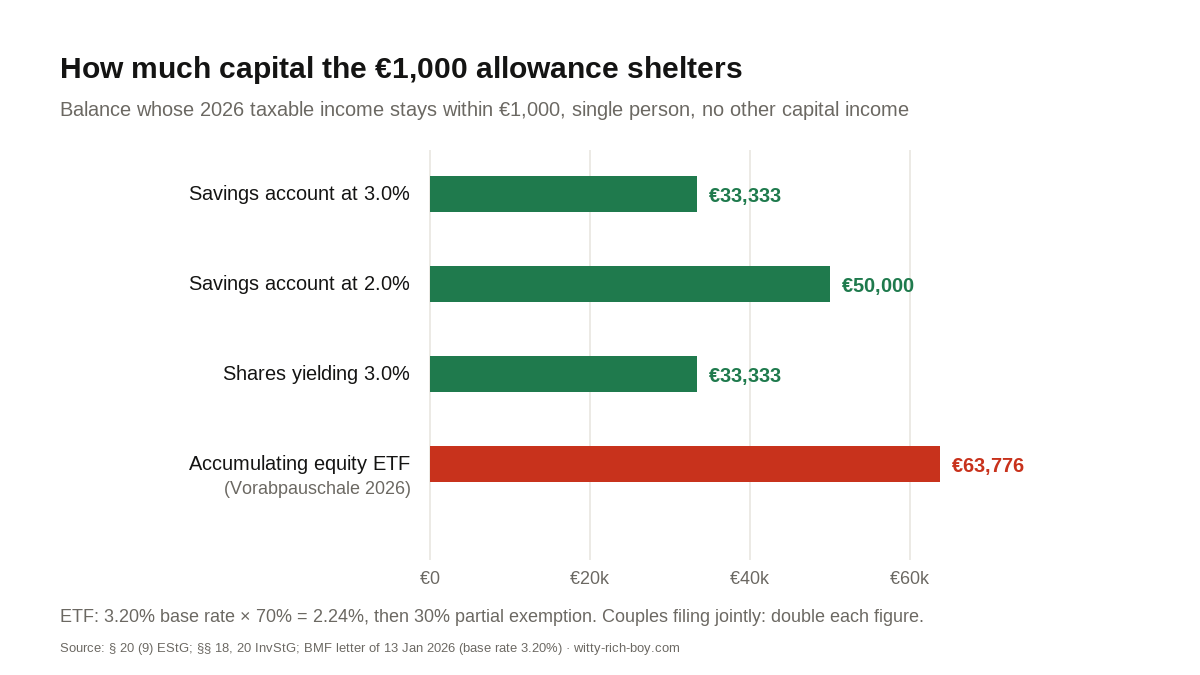
Accumulating funds consume the allowance through the Vorabpauschale, a notional annual income defined in § 18 InvStG, while equity funds get a 30% partial exemption (Teilfreistellung) under § 20 InvStG. The Vorabpauschale equals the fund value at the start of the year × 70% of the BMF base rate, minus distributions, and is capped at the fund’s actual rise in value plus distributions during the year.
The BMF set the base rate for 2026 at 3.20% in its letter of 13 January 2026. For an equity ETF bought before 2026, the taxable amount is therefore value × 3.20% × 70% × 70% = 1.568% of the start-of-year value, provided the fund rose by at least 2.24% over the year. Under § 18 (3) InvStG, it is deemed received on the first working day of the following year: 4 January 2027. That is the detail most people miss. The 2026 Vorabpauschale is set against your Freistellungsauftrag for 2027, so a broker with an order of €0 for the new year will debit tax in early January.
The partial exemption also applies to distributions and to gains on sale. If you sell equity-ETF units at a €3,000 gain, only €2,100 is taxable, and €1,000 of that can be covered by your allowance. Banks net gains against losses held in their loss pots before they apply the exemption order. Our German-language guide to the Vorabpauschale (in German) walks through the cap and the purchase-year reduction in detail.
How does the allowance work for married couples and children?
Couples assessed jointly share €2,000, and every child has their own €1,000 from birth. A joint order covers both spouses’ individual accounts and joint accounts, and lets the bank offset one spouse’s losses against the other’s gains at year-end. Separate orders of up to €1,000 each are also possible; if one spouse then leaves part unused, the return evens it out, because § 20 (9) EStG lets the unused half pass to the other spouse.
Example: Jonas and Mia, married and filing jointly, hold €40,000 in a joint savings account at 2.25% (€900 interest) and €50,000 in an accumulating equity ETF in Mia’s name. The ETF’s 2026 Vorabpauschale is €50,000 × 3.20% × 70% = €1,120, of which €784 is taxable after the 30% exemption, landing on 4 January 2027. Their 2027 joint order of €900 at the bank and €1,100 at the broker covers both, with €316 to spare for dividends or a small sale.
For children, the allowance is worth more than it looks, because a child with no wages can also use the income tax basic allowance of €12,348 for 2026 (§ 32a EStG). The order is given in the child’s name and needs the child’s tax ID, as § 44a (2a) EStG requires for every order.
| Child’s capital income in 2026 | Exemption order only | With NV-Bescheinigung | Final tax after return |
|---|---|---|---|
| €800 | €0 withheld | €0 withheld | €0 |
| €2,500 (e.g. €100,000 at 2.5%) | €395.63 withheld on €1,500 | €0 withheld | €0 (refund via Günstigerprüfung) |
| €12,000 | €2,901.25 withheld on €11,000 | €0 withheld | €0 (income below €12,348 + €1,000) |
When is an NV-Bescheinigung better than a Freistellungsauftrag?
An NV-Bescheinigung (non-assessment certificate) is better whenever your total taxable income is so low that no income tax will be due, because it stops withholding on all capital income, not just the first €1,000. It is issued by your local tax office under § 44a (2) EStG, is valid for at most three years and always ends on 31 December.
Typical holders are children with sizeable savings, students and pensioners whose taxable income stays below the basic allowance. Those just above the line do better with an exemption order plus a Günstigerprüfung in the return.
How do you reclaim tax through Anlage KAP and the Günstigerprüfung?
You reclaim it by filing an income tax return with Anlage KAP, the capital income annex, and asking for a review of withholding under § 32d (4) EStG, which explicitly covers an allowance that was not fully used. In the 2025 form, this is the box in line 5; you then copy the figures from each bank’s annual tax certificate (Jahressteuerbescheinigung).
The Günstigerprüfung (most-favourable test) under § 32d (6) EStG goes a step further: the tax office taxes your capital income at your personal progressive rate instead of 25%, if that is lower. It is requested in line 4, requires you to declare all capital income, and is independent of the line-5 review, according to the ELSTER guidance for 2025. It pays off when your marginal income tax rate is below 25%, as it is for most children and students.
Anlage KAP is also compulsory for capital income from a foreign broker or bank, which withholds no German tax (§ 32d (3) EStG). The €1,000 allowance is then deducted on assessment, which is why it pays to leave part of it unallocated if you hold money abroad.
Can expats and non-residents use the Sparerpauschbetrag?
Residents can, whatever their nationality; non-residents largely do not need it. A Freistellungsauftrag only works for creditors with unlimited German tax liability (§ 44a (1) EStG), which in practice means people who live in Germany or have their habitual abode there. An expat living in Berlin with a German broker therefore uses the allowance exactly like a German citizen.
Once you leave Germany and become a non-resident, Germany taxes only the domestic capital income listed in § 49 (1) no. 5 EStG. Ordinary interest on a German savings or fixed-term account is generally not on that list unless the debt is secured on German real estate or similar assets, so it is usually outside German income tax altogether. Dividends from German companies are a different matter and may still bear withholding tax. When you move abroad, tell each German bank, because the bank needs to know your tax status to decide whether to withhold.
For comparison, the UK gives its savers a £500 dividend allowance and a separate £20,000 ISA allowance as a wrapper, while Germany offers a single €1,000 deduction across every kind of capital income and no general tax-free investment account comparable to an ISA. Readers who prefer German can find the same rules in our Freistellungsauftrag guide (in German).
This article reflects the law as of October 2026. Figures are rounded to the cent; banks may round individual postings differently.
Questions readers ask
How much is the Sparerpauschbetrag in 2026?
The Sparerpauschbetrag is €1,000 per person for 2026 and €2,000 for married couples or registered partners who are assessed jointly, under § 20 (9) EStG. It has been at this level since the 2023 tax year; before that it was €801 and €1,602. Interest, dividends, fund income and gains on shares all count against it.
Is the Sparerpauschbetrag per bank or per person?
Per person and per calendar year, not per bank. You may hand Freistellungsaufträge to several banks, but their combined total must not exceed €1,000, or €2,000 on a joint order for a couple. Banks report the exempted income to the Federal Central Tax Office under § 45d EStG, so an over-allocation is visible to the tax authorities.
What happens if I don't set up a Freistellungsauftrag?
Your bank withholds 26.375% (25% Abgeltungsteuer plus solidarity surcharge, plus church tax if applicable) from the first euro of capital income. The allowance is not lost: you can claim it in your income tax return on Anlage KAP by ticking the review of withholding, and the tax office refunds the excess after assessment.
How much tax does the saver's allowance save?
At the 26.375% withholding rate, a fully used €1,000 allowance saves €263.75 a year, and a couple's €2,000 saves €527.50. With 9% church tax the combined rate on income above the allowance is about 27.99%, so the saving rises to roughly €279.95 per person.
Do children get their own Sparerpauschbetrag?
Yes. Every person with unlimited German tax liability, including a newborn, has their own €1,000 allowance. A Freistellungsauftrag for a child's account needs the child's tax identification number. If the child has no other income, an NV-Bescheinigung from the tax office can stop withholding even above €1,000.
Does the Vorabpauschale count towards the Sparerpauschbetrag?
Yes. The Vorabpauschale on accumulating funds is capital income and uses the allowance after the partial exemption, which is 30% for equity funds under § 20 InvStG. The 2026 Vorabpauschale is deemed received on 4 January 2027, so it is set against the Freistellungsauftrag for 2027.
Can I use the Sparerpauschbetrag if I live outside Germany?
A Freistellungsauftrag only works for creditors with unlimited German tax liability, essentially residents, under § 44a (1) EStG. Non-residents are taxed in Germany only on domestic capital income listed in § 49 (1) no. 5 EStG, which generally does not include ordinary interest on unsecured bank deposits. Tell your German banks when you move.
How do I get back tax withheld when my allowance was unused?
File an income tax return with Anlage KAP. Enter the figures from each bank's annual tax certificate and tick line 5, the review of withholding, which applies when the allowance was not fully used. If your personal tax rate is below 25%, also tick line 4 for the Günstigerprüfung under § 32d (6) EStG.
Was this guide useful?
Thanks — your answer helps us decide what to cover next.
Sources
- § 20 EStG — Kapitalvermögen; para. 9: Sparer-Pauschbetrag (gesetze-im-internet.de)
- § 44a EStG — Abstandnahme vom Steuerabzug: Freistellungsauftrag and NV-Bescheinigung (gesetze-im-internet.de)
- § 32d EStG — Gesonderter Steuertarif für Einkünfte aus Kapitalvermögen; Günstigerprüfung (gesetze-im-internet.de)
- § 4 SolzG 1995 — Zuschlagsatz 5.5% (gesetze-im-internet.de)
- § 49 EStG — Beschränkt steuerpflichtige Einkünfte (gesetze-im-internet.de)
- § 18 InvStG — Vorabpauschale (gesetze-im-internet.de)
- § 20 InvStG — Teilfreistellung (gesetze-im-internet.de)
- BMF letter of 13 January 2026: Basiszins zur Berechnung der Vorabpauschale zum 2. Januar 2026 (3.20%)
- BMF Monthly Report January 2023: Die wichtigsten steuerlichen Änderungen 2023 (allowance raised to €1,000 / €2,000)
- ELSTER — Anleitung zur Einkommensteuererklärung 2025 (Anlage KAP, lines 4 and 5)
General information, not tax or legal advice. Rules change — check the official source or a licensed adviser before acting.