United States · Tax
FBAR filing requirement (2026): the $10,000 rule explained
FBAR filing requirement: US persons file FinCEN Form 114 if foreign accounts total over $10,000 at any time in the year. Due 15 April, auto-extended to 15 October.

The short answer
- The FBAR filing requirement applies to any US person whose foreign financial accounts have maximum values adding up to more than $10,000 at any time in the calendar year (31 CFR 1010.350).
- The FBAR (FinCEN Form 114) is filed online with FinCEN, not with your tax return; it is due 15 April with an automatic extension to 15 October — for 2026 accounts, 15 April and 15 October 2027.
- Convert each account's peak balance at the Treasury Reporting Rate of Exchange for 31 December: for 2025 that was 0.8510 euros and 0.7430 pounds per dollar.
- Form 8938 is a separate IRS form with higher thresholds — from $50,000 (single, living in the US) to $400,000 at year-end (joint, living abroad) — and never replaces the FBAR.
- Under Bittner v. United States (2023), the non-willful penalty applies per report, not per account; the current maximum in 31 CFR 1010.821 is $16,536, while willful violations reach the greater of $165,353 or 50% of the balance.
In force: 15 April 2027 (FBAR for calendar year 2026, automatically extended to 15 October 2027) · 17 January 2025 (current inflation-adjusted FBAR penalty maximums in 31 CFR 1010.821)
The FBAR filing requirement applies to every US person whose foreign financial accounts have maximum values adding up to more than $10,000 at any point in the calendar year. You file FinCEN Form 114 online with FinCEN, not with your tax return, by 15 April, with an automatic extension to 15 October. The report itself creates no tax.
Few American tax obligations are as cheap to meet or as expensive to miss. The FBAR asks for little more than account numbers and peak balances, yet the penalty for skipping it starts in five figures. Below: who must file, how the $10,000 test works with Treasury-rate conversion, how it differs from Form 8938, every deadline in one place, and what Bittner means for penalties.
What is the FBAR filing requirement?
The FBAR is an annual report, FinCEN Form 114, that a US person files when they have a financial interest in, or signature or other authority over, foreign financial accounts whose aggregate value exceeds $10,000 at any time during the calendar year. The rule sits in 31 CFR 1010.350, issued under the Bank Secrecy Act, and is enforced by the IRS on behalf of the Financial Crimes Enforcement Network (FinCEN).
A US person for FBAR purposes is, in the IRS’s words on its FBAR page, a citizen, resident, corporation, partnership, limited liability company, trust or estate. Americans living abroad are not excused.
Two relationships trigger the duty:
- Financial interest — you are the owner of record or hold legal title, even if the account is held for someone else. Each joint holder has a financial interest.
- Signature or other authority — you can control the disposition of the assets by communicating directly with the institution, alone or with someone else. The Schedule B instructions add that authority only to buy and sell investments inside an account, without power to move money out, is not signature authority.
The FBAR is an information return: filing it creates no tax.
How does the $10,000 aggregate threshold work?
You add up the maximum value of every foreign account during the year, after converting each into dollars, and file if the total is more than $10,000. A single account need not cross the line on its own. FinCEN’s FBAR filing instructions set out the method:
- Find each account’s maximum value in its own currency. You may rely on periodic statements issued at least quarterly if they fairly reflect the highest value.
- Convert that figure to dollars at the Treasury Reporting Rate of Exchange for the last day of the calendar year — not the rate on the day of the peak.
- Round up to the next whole dollar; a negative value is entered as zero.
- Add the results. If the sum exceeds $10,000, report every account.
Treasury quotes foreign units per dollar, so you divide. In its table as of 31 December 2025, the euro was 0.8510 per dollar and the pound 0.7430. Where no Treasury rate exists, the IRS accepts another valid rate if you state its source.
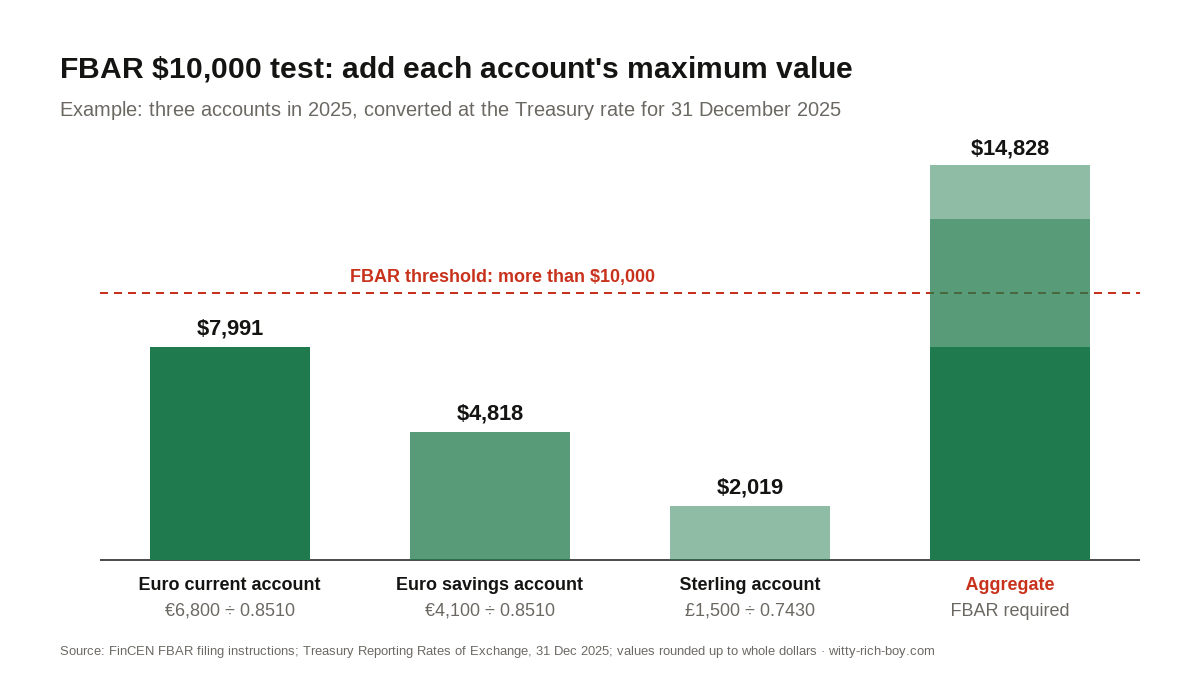
Example: an American living in Berlin had three foreign accounts in 2025. Her euro current account peaked at €6,800 in March, a euro savings account at €4,100 in November, and an old sterling account in London at £1,500.
| Account | Maximum value | Treasury rate, 31 Dec 2025 | Dollar value (rounded up) |
|---|---|---|---|
| Euro current account | €6,800 | 0.8510 per $ | $7,991 |
| Euro savings account | €4,100 | 0.8510 per $ | $4,818 |
| Sterling account | £1,500 | 0.7430 per $ | $2,019 |
| Aggregate | $14,828 |
No single account came near $10,000, but the aggregate of $14,828 did, so all three go on the FBAR.
The transfer trap
Because the test adds peaks rather than looking at one day, the same money can count twice. Example: you hold €5,000 in a foreign current account and move all of it to a savings account at another foreign bank in June. Each account’s maximum is €5,000, or $5,876 at the 2025 rate. Your aggregate is $11,752 — over the threshold — even though you never held more than about $5,900 abroad at once. FinCEN’s instructions explicitly add the maximum values of multiple accounts, so follow them rather than the looser “combined balance” wording on some IRS pages. Each of those moves can also cost money if it crosses currencies; our guide to international money transfer costs shows how to price the fee and the exchange-rate margin.
Which accounts count as foreign financial accounts?
Bank, securities and other financial accounts held at institutions outside the United States count, wherever the owner lives — including an expat’s everyday local bank account.
According to the IRS comparison, foreign currency or real estate held directly is reportable on neither the FBAR nor Form 8938, and foreign stock held outside a financial account goes only on Form 8938. Under 31 CFR 1010.350, owners of IRAs and Roth IRAs and participants in 401(a), 403(a) and 403(b) plans need not report foreign accounts held by those plans, so foreign holdings inside a Roth IRA or 401(k) do not count.
Crypto is a special case. Under FinCEN Notice 2020-2, a foreign account holding only virtual currency is not currently reportable, though FinCEN said it intends to propose adding virtual currency to 31 CFR 1010.350. An account that also holds reportable assets, such as fiat cash, remains reportable. Sales of the coins are taxable either way; US brokers now report them on Form 1099-DA, and EU platforms report users’ activity under DAC8 crypto reporting.
FBAR vs Form 8938: what is the difference?
They are two separate reports with different thresholds, recipients and scope, and many people must file both. The FBAR goes to FinCEN under the Bank Secrecy Act; Form 8938, Statement of Specified Foreign Financial Assets, goes to the IRS with your income tax return under the FATCA rules in § 6038D of the Internal Revenue Code. The IRS states plainly that the Form 8938 requirement “does not replace or otherwise affect” the FBAR obligation.
| FBAR (FinCEN Form 114) | Form 8938 (FATCA) | |
|---|---|---|
| Who files | US persons, including entities | Specified individuals |
| Threshold | Aggregate maximum value over $10,000 at any time | $50,000 to $600,000, by residence and filing status |
| Where it goes | FinCEN, via BSA E-Filing | IRS, attached to the income tax return |
| Due date | 15 April, automatic extension to 15 October | With your tax return, including extensions |
| Signature authority only | Reportable (with exceptions) | Not reportable without another interest |
| Foreign stock held directly | Not reportable | Reportable |
| Maximum non-willful penalty | $16,536 per report (inflation-adjusted) | $10,000, plus up to $50,000 after IRS notice |
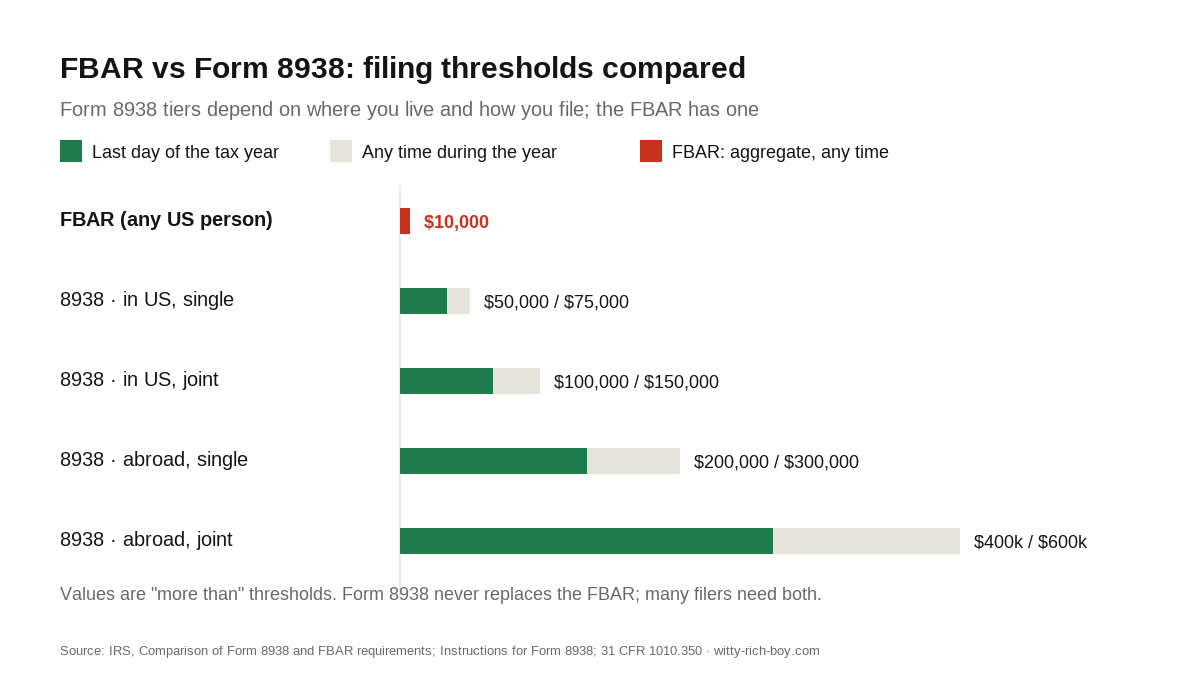
The thresholds for Form 8938 come from the Instructions for Form 8938 and depend on where you live and how you file:
| Your situation | Form 8938: last day of year | Form 8938: any time in year | FBAR |
|---|---|---|---|
| Living in the US, unmarried | more than $50,000 | more than $75,000 | over $10,000 aggregate |
| Living in the US, married filing jointly | more than $100,000 | more than $150,000 | over $10,000 aggregate |
| Living abroad, unmarried | more than $200,000 | more than $300,000 | over $10,000 aggregate |
| Living abroad, married filing jointly | more than $400,000 | more than $600,000 | over $10,000 aggregate |
A US citizen generally qualifies for the abroad thresholds by, for example, being present in a foreign country for at least 330 full days in a 12-month period ending in the tax year.
Who must file an FBAR when living abroad?
Every American abroad whose foreign accounts pass the $10,000 aggregate must file; unlike Form 8938, the FBAR has no higher tier for people living outside the United States. For most expats, a local salary account and savings account are enough to cross it. The duty follows citizenship, not where you are tax resident, so it applies even to Americans who are resident nowhere else — see digital nomad tax residency for how other countries decide who is resident.
Example: a married US couple living in Paris file jointly. Their French current, savings and brokerage accounts peaked at a combined $180,000 during 2026, with $150,000 left on 31 December. They must file an FBAR but not Form 8938, being below both $400,000 at year-end and $600,000 at any time. Living in Ohio with the same accounts, they would need Form 8938 too: $150,000 exceeds the $100,000 year-end threshold.
Joint accounts and spouses. FinCEN’s Filing for Spouse guidance allows one spouse to report jointly owned accounts for both, if all the non-filing spouse’s reportable accounts are jointly owned with the filing spouse, the report is filed on time and the couple completes FinCEN Form 114a. Form 114a is kept on file, not sent to FinCEN. If any condition fails, each spouse files separately and reports the full value of joint accounts.
Many accounts. A filer with a financial interest in 25 or more foreign accounts may report only the number of accounts and basic information, under 31 CFR 1010.350, and must provide the details if asked.
When is the FBAR due, and how does the extension work?
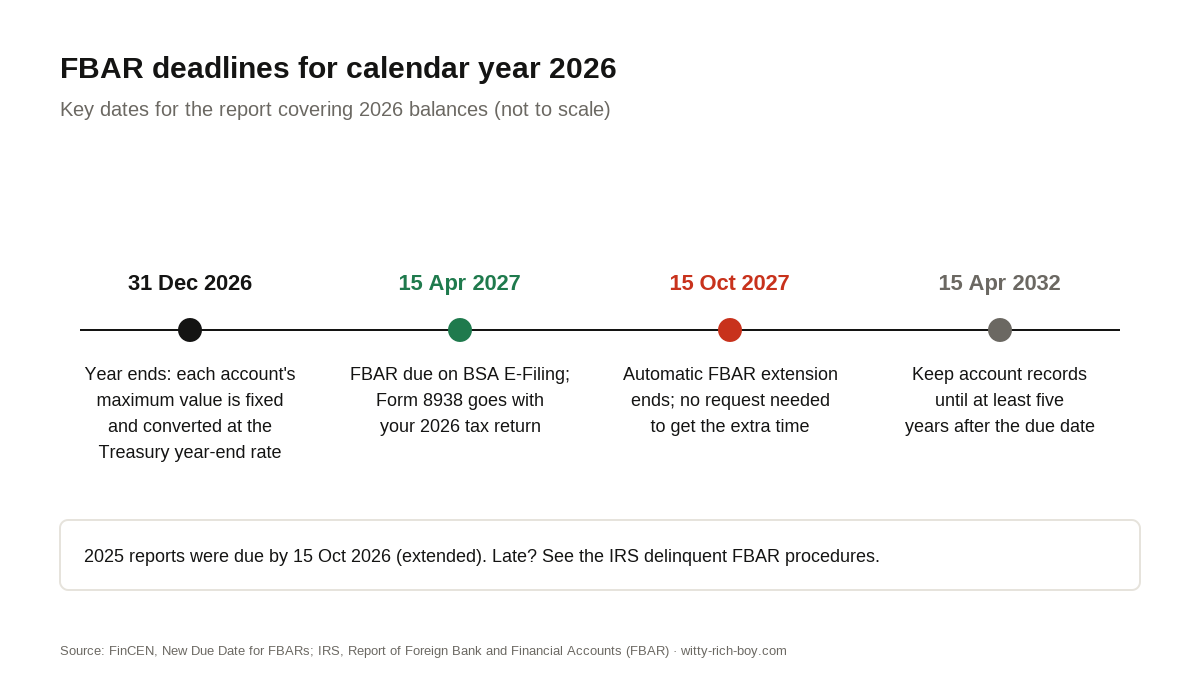
The FBAR is due on 15 April of the year after the calendar year reported, with an automatic extension to 15 October that requires no request. According to FinCEN’s New Due Date for FBARs notice, the April date comes from section 2006(b)(11) of the Surface Transportation and Veterans Health Care Choice Improvement Act of 2015. If a due date falls on a weekend or legal holiday, it moves to the next business day. The text of 31 CFR 1010.306(c) still refers to 30 June, the old date; follow the statutory dates.
| Event | Calendar year 2025 | Calendar year 2026 |
|---|---|---|
| Maximum values fixed; Treasury year-end rate applies | 31 December 2025 | 31 December 2026 |
| FBAR due | 15 April 2026 | 15 April 2027 |
| Automatic extension ends | 15 October 2026 | 15 October 2027 |
| Form 8938 | With the 2025 return | With the 2026 return |
| Keep records until at least | 15 April 2031 | 15 April 2032 |
Certain individuals with signature authority over, but no financial interest in, employer accounts have a later date — 15 April 2027 under FinCEN Notice FIN-2025-NTC3 of 8 December 2025.
How do you file an FBAR?
You file FinCEN Form 114 electronically through FinCEN’s BSA E-Filing System; it is not attached to Form 1040 and is not sent to the IRS. The steps below assume fewer than 25 accounts.
- List every foreign account in which you had a financial interest or signature authority during the calendar year, including dormant and closed ones.
- Work out the aggregate: take each account’s maximum value, divide by the Treasury rate for 31 December and round up. If the total is $10,000 or less, no FBAR is due; keep your workings.
- Open FinCEN Form 114 on BSA E-Filing and enter your personal details and taxpayer identification number.
- Enter each account: the institution’s name and address, the account number, account type and the maximum value in dollars, in the part of the form that matches your relationship to it, such as sole ownership, joint ownership or signature authority.
- Sign electronically and submit, then save the confirmation. If one spouse is filing for both, make sure Form 114a is completed and kept.
- Answer Schedule B, Part III on your Form 1040 consistently. Line 7a asks whether you had a financial interest in or signature authority over a foreign account and, if so, whether you must file FinCEN Form 114.
- Keep records for five years from the FBAR due date: account names and numbers, institutions’ addresses, account types and maximum values.
What are the FBAR penalties after Bittner?
Civil penalties under 31 U.S.C. 5321(a)(5) depend on whether the failure was willful. For a non-willful violation the statute sets a maximum of $10,000; the inflation-adjusted figure in the penalty table at 31 CFR 1010.821 is $16,536 for penalties assessed on or after 17 January 2025. No non-willful penalty applies where the violation was due to reasonable cause and the balance was properly reported.
For a willful violation, the maximum is the greater of $100,000 — adjusted to $165,353 in the same table — or 50% of the account balance at the time of the violation, and it is calculated account by account.
The Supreme Court settled the non-willful question in Bittner v. United States on 28 February 2023: the maximum penalty accrues per report, not per account. Mr Bittner’s five late reports covered 272 accounts; the government had sought $2.72 million at $10,000 per account, and the ruling cut his exposure to $50,000 — $10,000 for each of the five years.
| Scenario | Legal basis | Maximum penalty |
|---|---|---|
| Non-willful failure, one year, any number of accounts | 31 U.S.C. 5321(a)(5)(B); Bittner | $16,536 for the report |
| Non-willful failure, five years | Same, per report | Five times $16,536 |
| Non-willful, reasonable cause, balance properly reported | 31 U.S.C. 5321(a)(5)(B)(ii) | No penalty |
| Willful failure, $300,000 account | 31 U.S.C. 5321(a)(5)(C) | $165,353 or $150,000 — the greater: $165,353 |
| Willful failure, $1,000,000 account | 31 U.S.C. 5321(a)(5)(C) | $500,000 (50% of balance) |
Form 8938 has its own regime: $10,000 for failing to file, plus $10,000 for each 30 days of continued failure after 90 days from an IRS notice, up to an extra $50,000, and a 40% penalty on understatements linked to undisclosed assets.
What if you missed the FBAR deadline?
If your only failure was the FBAR itself — your tax returns reported and paid tax on all the income from the accounts — the IRS delinquent FBAR submission procedures let you file the late reports electronically with a statement explaining why they are late. The IRS says it will not impose a penalty in those cases, provided you are not under civil examination or criminal investigation and have not already been contacted about the missing FBARs.
That route matters now: the extended deadline for 2025 reports passed on 15 October 2026. Where income from the accounts went unreported, the delinquent procedures do not fit; the IRS points taxpayers to its Streamlined Filing Compliance Procedures or the Criminal Investigation Voluntary Disclosure Practice instead.
Questions readers ask
What is the FBAR filing requirement?
A US person — citizen, resident, corporation, partnership, LLC, trust or estate — must file FinCEN Form 114 if they have a financial interest in, or signature authority over, foreign financial accounts whose maximum values add up to more than $10,000 at any time during the calendar year. The report goes electronically to FinCEN through the BSA E-Filing System and creates no tax of its own.
Does the $10,000 FBAR threshold apply per account or in total?
In total. You find each account's highest value during the year, convert it to dollars at the Treasury year-end rate and add the results. If the sum exceeds $10,000, you must file and list every foreign account, including small ones. Because peaks are added even when they occur on different days, moving money between two foreign accounts can push you over the line.
When is the FBAR due for 2026?
The FBAR covering calendar year 2026 is due on 15 April 2027. FinCEN grants an automatic extension to 15 October 2027, and you do not need to request it. Individuals with only signature authority over an employer's accounts may have a later date under FinCEN Notice FIN-2025-NTC3. Reports for 2025 were due by 15 October 2026 at the latest.
Do I need to file both an FBAR and Form 8938?
Often, yes. The two have different thresholds, recipients and scope. The FBAR goes to FinCEN once foreign accounts exceed $10,000 in aggregate; Form 8938 goes to the IRS with your tax return once specified foreign financial assets pass $50,000 or more, depending on residence and filing status. The IRS states that filing Form 8938 does not replace or affect the FBAR obligation.
What is the penalty for not filing an FBAR?
For a non-willful violation, 31 U.S.C. 5321(a)(5) sets a maximum of $10,000, adjusted for inflation to $16,536 for penalties assessed from 17 January 2025, and the Supreme Court ruled in Bittner that it applies per report, not per account. A willful violation can cost the greater of $165,353 or 50% of the account balance. No penalty applies to a non-willful violation with reasonable cause where the balance was properly reported.
Do US citizens living abroad have to file an FBAR?
Yes. The FBAR has no separate tier for Americans abroad: the same $10,000 aggregate test applies whether you live in Ohio or Osaka. Only Form 8938 offers higher thresholds for people living abroad — $200,000 at year-end for single filers and $400,000 for joint filers. Local current accounts, savings accounts and brokerage accounts in your country of residence are all foreign accounts for FBAR purposes.
Is cryptocurrency on a foreign exchange reportable on the FBAR?
Not if the account holds only virtual currency. FinCEN Notice 2020-2 says the FBAR regulations do not currently define such an account as reportable, although FinCEN said it intends to propose adding virtual currency to 31 CFR 1010.350. An account that also holds other reportable assets, such as fiat currency, remains reportable. Crypto sales are still taxable whatever the FBAR position.
What if I missed the FBAR deadline?
If you reported and paid tax on all income from the accounts, are not under examination or investigation and have not been contacted by the IRS about the missing reports, the IRS delinquent FBAR submission procedures apply: file the late FBARs electronically with a statement explaining the delay. The IRS says it will not impose a penalty in those cases.
Was this guide useful?
Thanks — your answer helps us decide what to cover next.
Sources
- Report of Foreign Bank and Financial Accounts (FBAR) (IRS)
- Comparison of Form 8938 and FBAR requirements (IRS)
- Instructions for Form 8938, Statement of Specified Foreign Financial Assets (IRS)
- 31 CFR 1010.350 — Reports of foreign financial accounts (eCFR)
- 31 CFR 1010.821 — Penalty adjustment and table (eCFR)
- New Due Date for FBARs (FinCEN)
- BSA Electronic Filing Requirements for the Report of Foreign Bank and Financial Accounts (FinCEN Form 114)
- Treasury Reporting Rates of Exchange as of December 31, 2025 (Bureau of the Fiscal Service)
- Bittner v. United States, No. 21-1195 (Supreme Court, 28 February 2023)
- Delinquent FBAR submission procedures (IRS)
General information, not tax or legal advice. Rules change — check the official source or a licensed adviser before acting.