Germany · Crypto
Crypto tax Germany (2026): tax-free after one year, in numbers
Crypto tax Germany 2026: gains on coins held over a year are tax-free; sell sooner and they are taxed at 14–45%. The €1,000 cliff, staking at €256 and DAC8.

The short answer
- Gains on crypto held more than one year are tax-free for private investors under § 23 (1) no. 2 EStG, with no upper limit.
- Gains on coins held one year or less are taxed at your personal income tax rate: 0% up to €12,348 of taxable income in 2026, rising to 42% and 45%.
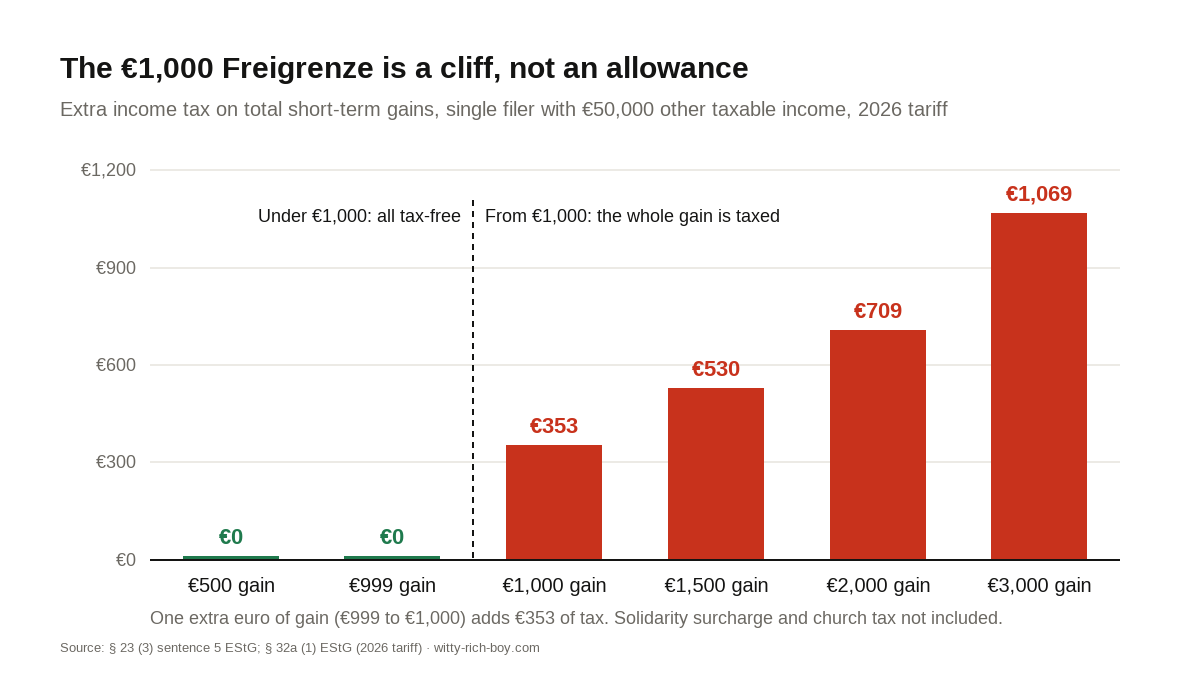
- Total short-term gains under €1,000 a year are tax-free; at €1,000 or more the whole gain is taxed. It is a cliff (Freigrenze), not an allowance.
- Staking and lending rewards are income under § 22 no. 3 EStG at their euro value on receipt, with a separate €256 cliff. Staking does not stretch the holding period to ten years.
- Under DAC8 (KStTG), exchanges record your 2026 activity and must report it to the Federal Central Tax Office by 31 July 2027.
In force: 1 January 2024 (€1,000 Freigrenze) · 6 March 2025 (BMF crypto letter) · 1 January 2026 (2026 income tax tariff; first DAC8 reporting year)
For private investors, crypto tax in Germany depends on one date. Sell, swap or spend a coin held for more than one year and the gain is tax-free under § 23 EStG. Sell sooner and the gain is taxed at your income tax rate of up to 45%, unless your total short-term gains for the year stay under €1,000.
Germany is one of very few large economies where a patient investor can pay nothing at all on crypto profits, however large. The price of that generosity is precision. The tax office cares about the exact day you bought each unit, the euro value of every swap and staking reward, and whether your annual short-term gains land at €999 or €1,000. Below are the rules for the 2026 tax year, each tied to the statute or the Federal Finance Ministry (BMF) guidance, with the numbers worked through.
What is the crypto tax rate in Germany?
There is no separate crypto tax rate in Germany: short-term gains are added to your other income and taxed at the ordinary progressive rate in § 32a EStG. For 2026 that means 0% on the first €12,348 of taxable income (the Grundfreibetrag), a marginal rate that climbs from 14% to 42% between €12,349 and €69,878, a flat 42% up to €277,825, and 45% above that.
Two surcharges may sit on top. The solidarity surcharge of 5.5% of the income tax applies only once your income tax exceeds €20,350 (€40,700 for joint filers) under § 3 (3) SolzG, with a phase-in zone above that, so most middle earners no longer pay it. Church tax applies only to registered members of a church that levies it.
| Holding period / type of income | How it is taxed | Legal basis |
|---|---|---|
| Coin sold more than 1 year after purchase | Tax-free, any amount | § 23 (1) no. 2 EStG |
| Coin sold within 1 year, annual total under €1,000 | Tax-free | § 23 (3) sentence 5 EStG |
| Coin sold within 1 year, annual total €1,000 or more | Whole gain at personal rate (0–45%) | §§ 22 no. 2, 23, 32a EStG |
| Staking, lending, some airdrops (under €256 a year) | Tax-free | § 22 no. 3 sentence 2 EStG |
| Staking, lending, some airdrops (€256 or more) | Whole amount at personal rate | § 22 no. 3 EStG |
A private sale transaction (privates Veräußerungsgeschäft) is the legal category that captures crypto: a sale of an asset held as private property within the statutory holding period. The Federal Fiscal Court confirmed crypto falls in this category (IX R 3/22, 14 February 2023), as does the BMF letter of 6 March 2025 (para. 53). Crypto held as business assets follows different rules not covered here.
Is crypto tax-free in Germany after one year?
Yes. Under § 23 (1) sentence 1 no. 2 EStG, a sale is only taxable if “the period between acquisition and sale is not more than one year”. Hold longer and the profit is outside income tax entirely, with no cap.
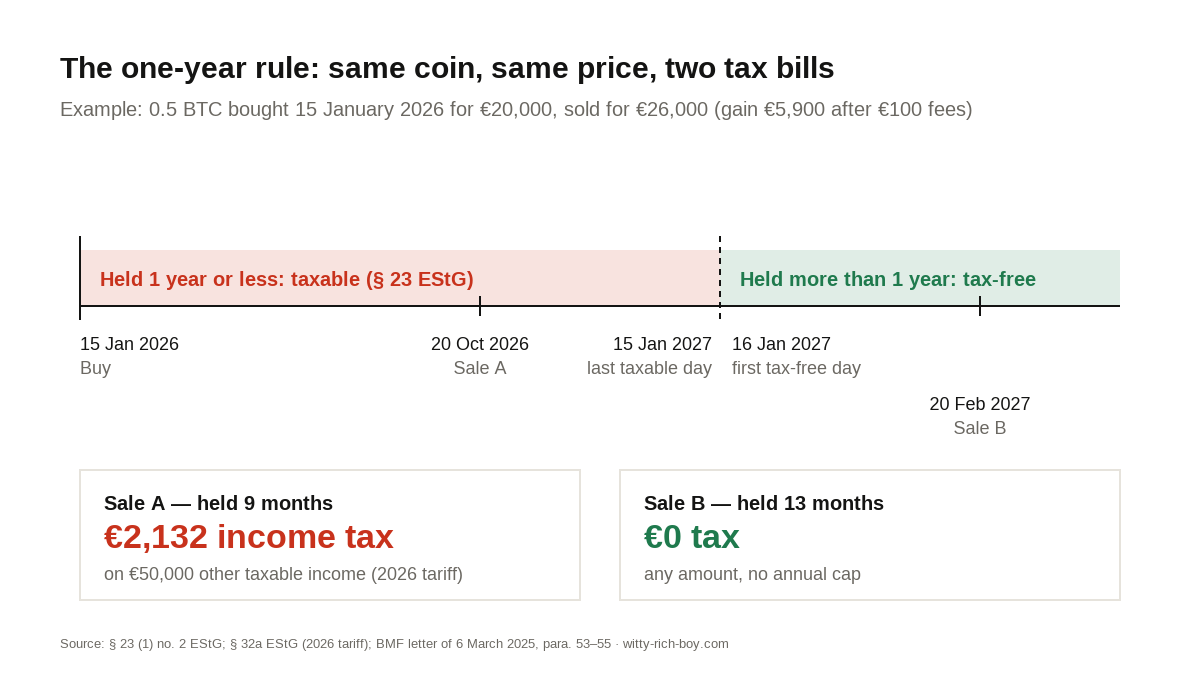
The clock is counted per unit, from purchase to sale. If you bought on 15 January 2026, a sale on 15 January 2027 is still within the year and taxable; the first tax-free day is 16 January 2027. The BMF letter (para. 55) says that on a centralised exchange the times recorded by the exchange decide, and for direct or decentralised trades the times recorded in the wallet are generally used.
Every swap restarts the clock
A swap is a sale. Exchanging bitcoin for ether, or a token for a stablecoin, counts as selling the first coin and buying the second, and “the holding periods … restart on each such exchange” (BMF letter, para. 55). Spending crypto on goods or services is also a sale (para. 54). Moving coins between your own wallets or exchange accounts is not. See how crypto-to-crypto swaps are taxed elsewhere.
Which units did you sell? FIFO, wallet by wallet
If you bought the same coin several times, the BMF prefers a unit-by-unit match. Where that is impossible, the units bought first are deemed sold first for holding-period purposes, and for valuation you may use the average cost or, as a simplification, FIFO (first in, first out) (para. 61). The analysis runs wallet by wallet, and once you pick a method for a coin in a wallet you must keep it until that wallet’s holding of the coin has been fully sold (para. 62). In practice, each exchange account and wallet has its own queue.
Gifts and inheritances keep the old date
When crypto is received without payment, as a gift or inheritance, § 23 (1) sentence 3 EStG attributes the giver’s purchase date to the recipient. A coin your parent bought in 2020 and gave you in 2026 is already past the one-year mark. Gift tax is a separate question; the allowances by relationship are compared in our crypto gift tax guide.
How does the €1,000 Freigrenze work?
Short-term gains are tax-free only if the total profit from all private sale transactions in the calendar year is less than €1,000 (§ 23 (3) sentence 5 EStG). The limit was raised from €600 by the Wachstumschancengesetz of 27 March 2024 and applies from the 2024 tax year.
A Freigrenze is an exemption limit: below it nothing is taxed, but once you reach it the entire amount becomes taxable. A Freibetrag, by contrast, is an allowance that is always deducted, like the €1,000 saver’s allowance on interest and dividends, which crypto gains cannot use. Germany’s crypto limit is a Freigrenze, which creates a cliff.
| Net short-term gains in 2026 | Taxable amount | Extra income tax (single, €50,000 other taxable income) |
|---|---|---|
| €999 | €0 | €0 |
| €1,000 | €1,000 | €353 |
| €2,000 | €2,000 | €709 |
| €5,900 | €5,900 | €2,132 |
The limit is shared with every other private sale, so a short-term gain on physical gold counts towards the same €1,000, and it is tested against the year’s total profit after short-term losses.
Near the line in December, realising a short-term loss or deferring a sale into January can move you either side of the cliff. Our Germany crypto tax calculator checks each sale against the one-year rule and shows which side of the €1,000 line your 2026 total lands on, with the income tax and Soli it adds.
Which crypto transactions are taxable in Germany?
Buying and holding crypto is never taxable; tax arises when you dispose of a coin within a year, or when you receive new coins as payment for a service. The table summarises the BMF’s treatment for private investors.
| Event | Taxable? | How |
|---|---|---|
| Buy crypto with euros | No | Starts the one-year clock |
| Hold, or move between your own wallets | No | Not a sale |
| Sell for euros within 1 year | Yes | Private sale transaction, § 23 EStG |
| Swap coin A for coin B within 1 year of buying A | Yes | Sale of A at B’s euro value (para. 58) |
| Pay for goods or services with crypto | Yes, within 1 year | Sale at the agreed euro price (para. 60) |
| Staking or lending rewards | Yes, on receipt | § 22 no. 3 EStG, €256 limit |
| Airdrop that required a service (posts, data) | Yes, on receipt | § 22 no. 3 EStG (paras. 70–71) |
| New coins from a hard fork | No, on receipt | Inherit the old coins’ purchase date (para. 68) |
| Gift or inheritance received | No income tax | Giver’s purchase date carries over |
Transaction fees on a sale are deductible as costs, and the euro value of the coin you give up, plus incidental costs, becomes the acquisition cost of the coin you receive (para. 59).
How is crypto staking taxed in Germany?
Staking is locking up coins to help secure a proof-of-stake blockchain in return for new coins. For private investors, rewards from staking, whether through a pool or on an exchange, are other income under § 22 no. 3 EStG, valued at their euro market price when received (BMF letter, para. 48). Receipt may be taken as the moment the reward reaches your wallet; unclaimed rewards count by year-end at the latest (para. 48a). Lending income is treated the same way (para. 65). Our guide to crypto staking tax in Germany works through a full year of rewards, the claiming rules and validator cases in euros.
This category has its own cliff. Under § 22 no. 3 sentence 2 EStG, the income is tax-free only if the total is less than €256 in the calendar year, shared with other income in this category. At €256 the whole amount is taxable.
Two points used to cause confusion and are now settled:
- No ten-year holding period. § 23 (1) sentence 1 no. 2 sentence 4 EStG extends the holding period to ten years for assets used to generate income. The BMF letter says this extension “does not apply to currency or payment tokens” (para. 63). Staked or lent bitcoin, ether and similar coins keep the one-year rule.
- Rewards start their own clock. Coins received from staking or lending count as acquired on receipt (para. 54), at the value already taxed as income. Sell them more than a year later and any further gain is tax-free.
Mining that is not a commercial business is also taxed under § 22 no. 3 EStG, with hardware and electricity deductible as expenses (paras. 45–47). Airdrops are taxable on receipt only where you had to do something for them, such as promoting the project or handing over personal data (paras. 70–71); where no market price yet exists, they may be valued at €0 (para. 73).
How much tax do you pay on a short-term crypto gain? A worked example
Example: Anna, single, has €50,000 of taxable income in 2026 from her job. On 15 January 2026 she buys 0.5 BTC for €20,000, fees included. On 20 October 2026 she sells for €26,000 and pays a €100 fee. During the year she also receives €300 of staking rewards.
- Gain: €26,000 − €20,000 − €100 = €5,900. Held nine months, so taxable.
- Freigrenze check: €5,900 is above €1,000, so all of it is taxable.
- Income tax: at the 2026 tariff, tax on €50,000 is €10,548; on €55,900 it is €12,680. The crypto sale costs €2,132, an average rate of 36.1% on the gain.
- Staking: €300 is above the €256 limit, so all €300 is taxable, adding €112 of tax.
- Solidarity surcharge: Anna’s total income tax of €12,792 is below €20,350, so she pays none.
Selling at the same price on 16 January 2027 would have cost €0; the staking tax is unchanged, because it arises on receipt.
The same €5,900 short-term gain costs very different amounts depending on what else you earn:
| Other taxable income (single, 2026) | Extra income tax | Extra solidarity surcharge | Total on €5,900 |
|---|---|---|---|
| €30,000 | €1,723 | €0 | €1,723 |
| €50,000 | €2,132 | €0 | €2,132 |
| €80,000 | €2,478 | €295 | €2,773 |
| €300,000 | €2,655 | €146 | €2,801 |
Figures computed with the § 32a EStG tariff for 2026 and §§ 3–4 SolzG; church tax excluded. At €80,000 the surcharge is in its phase-in zone, which is why it is higher than at €300,000.
Can you offset crypto losses in Germany?
Yes, but only within the same box. Under § 23 (3) sentences 7–8 EStG, a loss from a private sale transaction can be set off only against gains from private sale transactions, first in the same year, then carried back one year or forward indefinitely. It cannot reduce your salary, rental or investment income.
A loss is only usable if the coin was sold within the one-year period. Sell a coin that has fallen in value after holding it for more than a year and the loss is outside the tax system, just as a gain would be.
Declare short-term losses even in years with no gains, so the tax office records them for carry-forward.
How to report crypto on Anlage SO, step by step
Short-term crypto gains and staking or lending income are declared on Anlage SO, the “other income” annex of the German income tax return. Long-term disposals are not taxable, but you must be able to prove the holding period if asked.
- Export every transaction history from each exchange and wallet for the year. The BMF expects investors using foreign exchanges to download these regularly; missing records after an exchange collapse or hack count against you (para. 89).
- Choose one price source and method per wallet (FIFO or unit-by-unit) and apply it consistently. Daily prices are acceptable if determined consistently from a documented source (para. 91).
- Split disposals into those held more than one year (tax-free) and one year or less (taxable).
- Net short-term gains and losses and test the total against the €1,000 Freigrenze.
- Total staking, lending and airdrop income and test it against the €256 limit.
- Enter both figures on Anlage SO. If you use a crypto tax report, keep the underlying CSV files; the BMF may ask for them and for the report settings showing prices and FIFO (paras. 90, 101).
- File on time. Under § 149 (2) AO the return is due seven months after the year ends, so the 2026 return is due at the end of July 2027; returns prepared by a tax adviser have longer deadlines.
DAC8: what will the German tax office see?
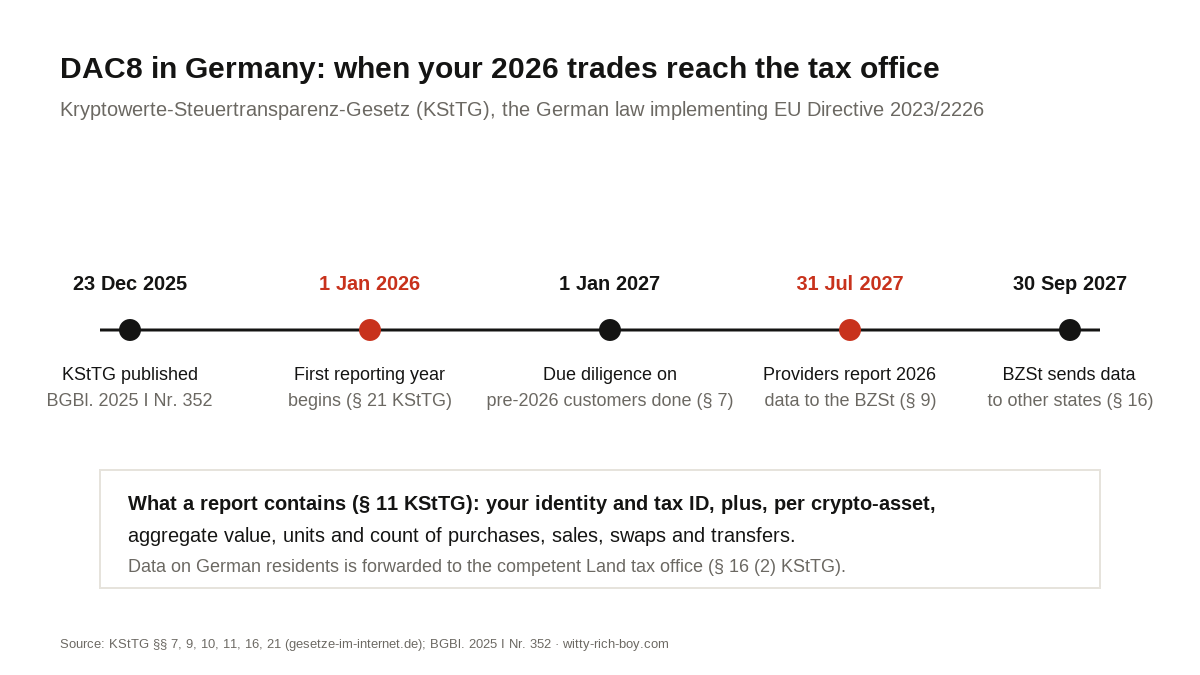
From the 2026 calendar year, crypto-asset service providers must collect and report customer data under the Kryptowerte-Steuertransparenz-Gesetz (KStTG), Germany’s implementation of EU Directive 2023/2226 (DAC8), published in the Federal Law Gazette on 23 December 2025. DAC8 is the EU directive that extends automatic tax information exchange to crypto-asset transactions.
What the statute requires:
- Reporting year: the obligations apply for the first time to calendar year 2026 (§ 21 KStTG); the reporting period is the calendar year (§ 10).
- Deadline: providers report each year by 31 July for the previous year to the Federal Central Tax Office, the BZSt (§ 9). The first deadline is therefore 31 July 2027.
- Existing customers: for users who opened accounts by 31 December 2025, providers must complete identity and tax-residence checks by 1 January 2027 (§ 7 (2)).
- Contents: per crypto-asset, the aggregate value, units and number of purchases and sales for fiat, swaps, and transfers, including transfers to external wallets (§ 11).
- Use: data on German residents is passed to the competent regional tax office (§ 16 (2)).
DAC8 changes what is visible, not what is taxable. Our guide to DAC8 crypto reporting across the EU covers the rules for providers in other member states.
Is Germany abolishing the one-year rule in 2027?
Not yet. As of 12 October 2026, the one-year rule in § 23 EStG is law and applies to every sale. In September 2026 the Federal Finance Ministry circulated a draft bill (Referentenentwurf) which, according to press reports, would tax gains on crypto acquired after 31 December 2026 at the 25% flat investment-income rate plus solidarity surcharge, regardless of holding period, while coins bought before that date would keep the one-year exemption. A ministry draft still needs cabinet approval and passage through the Bundestag and Bundesrat, and can change. The consultation period for associations on the draft closed on 6 October 2026, and press reports name 14 October 2026 as the planned cabinet date; the coalition partners have publicly disagreed on the change. The federal government’s 2027 budget draft, adopted by the cabinet in July 2026, already books revenue from adjusting the taxation of crypto-assets. Until a bill passes, a coin bought in 2026 and held for more than a year is tax-free under current law. We will update this page once a text is adopted.
For comparison, the UK taxes crypto gains above a £3,000 allowance whatever the holding period, and Japan taxes crypto as miscellaneous income at up to 55% including local tax. Across the border, Switzerland exempts private crypto gains altogether but taxes your coins’ 31 December value as wealth. Germany’s current rule remains among the most favourable in any large economy, for coins that are held long enough.
Questions readers ask
Is crypto tax-free in Germany?
Partly. For private investors, profits on crypto held for more than one year are tax-free in any amount under § 23 (1) no. 2 EStG. Profits on coins held one year or less are taxed at the personal income tax rate unless total short-term gains for the year stay under €1,000. Staking, lending and some airdrop rewards are taxed separately as income when received.
Is Bitcoin tax-free in Germany after one year?
Yes. Bitcoin held as a private asset for more than one year can be sold, swapped or spent without income tax, whatever the size of the gain. The clock runs per coin from the purchase date recorded by the exchange or wallet. If you bought on 15 January 2026, the first tax-free day is 16 January 2027.
What is the crypto tax rate in Germany?
There is no special crypto rate. Short-term gains are added to your other income and taxed at the progressive 2026 tariff in § 32a EStG: 0% up to €12,348 of taxable income, then 14% rising to 42% from €69,879 and 45% from €277,826. Solidarity surcharge applies only once your income tax exceeds €20,350 (single filers).
Is the €1,000 crypto exemption per coin or per year?
Per calendar year, and across all private sale transactions combined, including gold and other assets under § 23 EStG, not per coin or per exchange. If the net total is €999, nothing is taxed. If it reaches €1,000, the full €1,000 is taxable, because the rule is a Freigrenze (exemption limit), not a Freibetrag (allowance).
How is crypto staking taxed in Germany?
Staking rewards are other income under § 22 no. 3 EStG, valued at their euro market price when received, according to the BMF letter of 6 March 2025 (para. 48). They are tax-free only if all income in that category totals less than €256 a year. The rewarded coins start their own one-year clock, and staking does not extend the holding period to ten years (para. 63).
Is swapping one crypto for another taxable in Germany?
Yes, if the coin you give up was held for one year or less. The BMF treats a crypto-to-crypto exchange as a sale of the old coin and a purchase of the new one (para. 54). The sale price is the euro market value of the coin received, and the new coin starts a fresh one-year holding period.
Where do I declare crypto on my German tax return?
Short-term gains from private sale transactions and income such as staking rewards are declared on Anlage SO (other income) of the income tax return. Gains on coins held more than one year are not taxable and do not need to be calculated, but you should keep records proving the holding period.
Can I offset crypto losses against my salary in Germany?
No. Under § 23 (3) sentences 7–8 EStG, losses from private sale transactions can only be set against gains from private sale transactions, in the same year, the previous year or any later year. They cannot reduce salary or other income. A loss on a coin held for more than a year is not deductible at all.
Was this guide useful?
Thanks — your answer helps us decide what to cover next.
Sources
- § 23 EStG — Private Veräußerungsgeschäfte (gesetze-im-internet.de)
- § 22 EStG — Arten der sonstigen Einkünfte, incl. the €256 limit in no. 3 (gesetze-im-internet.de)
- § 32a EStG — Einkommensteuertarif from 2026 (gesetze-im-internet.de)
- BMF letter of 6 March 2025: Einzelfragen zur ertragsteuerrechtlichen Behandlung bestimmter Kryptowerte (German PDF)
- BMF letter of 6 March 2025: Questions regarding the income tax treatment of specific crypto-assets (official English courtesy translation, PDF)
- Wachstumschancengesetz of 27 March 2024, BGBl. 2024 I Nr. 108 — raises the § 23 limit from €600 to €1,000 (PDF)
- Kryptowerte-Steuertransparenz-Gesetz (KStTG) — German DAC8 implementation (gesetze-im-internet.de)
- Gesetz zur Umsetzung der Richtlinie (EU) 2023/2226, BGBl. 2025 I Nr. 352 (recht.bund.de)
- Council Directive (EU) 2023/2226 (DAC8) — EUR-Lex
- § 3 SolzG 1995 — solidarity surcharge exemption limits (gesetze-im-internet.de)
General information, not tax or legal advice. Rules change — check the official source or a licensed adviser before acting.