United Kingdom · Tax
UK ISA Allowance 2026: £20,000 Limit, LISA Maths & 2027 Cash Cap
UK ISA allowance 2026-27: £20,000 across all ISAs, £4,000 max in a Lifetime ISA, £9,000 for Junior ISAs. Cash ISAs drop to £12,000 for under-65s from April 2027.

The short answer
- The ISA allowance for 2026-27 is £20,000 per adult, shared across cash, stocks and shares, Innovative Finance and Lifetime ISAs.
- A Lifetime ISA takes up to £4,000 of that £20,000 and earns a 25% bonus (max £1,000), but a non-qualifying withdrawal costs 25% of the whole pot.
- On £4,000 saved, the LISA withdrawal charge turns a £5,000 pot into £3,750 — £250 less than you paid in.
- In a flexible ISA, cash withdrawn can be replaced in the same tax year without using fresh allowance.
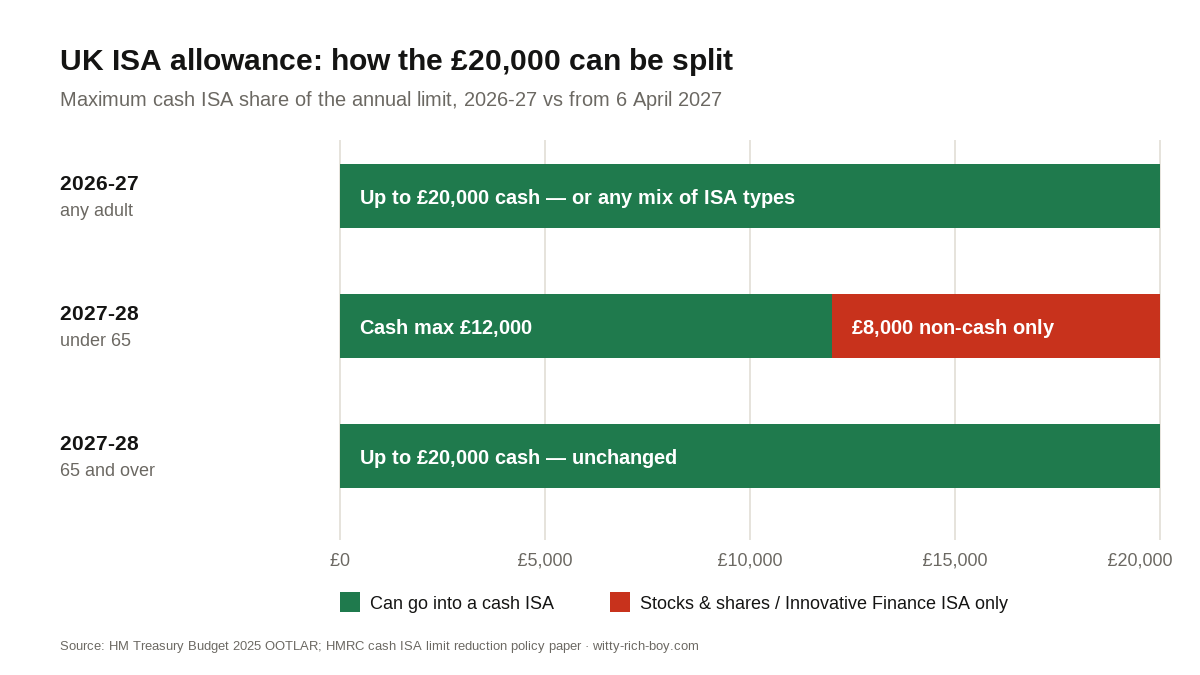
- From 6 April 2027, under-65s can put at most £12,000 a year into cash ISAs; the £20,000 overall limit is fixed until 5 April 2031.
- From April 2027 a 22% charge will apply to interest on cash held inside stocks and shares and Innovative Finance ISAs.
In force: 6 April 2026 (2026-27 tax year, £20,000 limit) · 6 April 2027 (£12,000 cash ISA limit for under-65s) · limits fixed until 5 April 2031
The UK ISA allowance for 2026-27 is £20,000 per adult, usable from 6 April 2026 to 5 April 2027 and splittable across cash, stocks and shares, Innovative Finance and Lifetime ISAs. A Lifetime ISA takes at most £4,000 of it. From 6 April 2027 under-65s can put only £12,000 into cash ISAs.
An Individual Savings Account (ISA) is a tax wrapper: interest, dividends and capital gains earned inside it are free of UK tax, and nothing needs to go on a tax return. The headline number has not moved for years — £20,000 — but the rules about how you can carve it up are in their busiest period for a decade. 2026-27 is the last tax year in which an under-65 can put the entire £20,000 into cash. Below: the split by ISA type, the Lifetime ISA arithmetic most guides gloss over, how flexible ISAs work, and a decision table.
What is the ISA allowance for 2026-27?
The ISA allowance for 2026-27 is £20,000, according to GOV.UK’s ISA overview. It is a per-person, per-tax-year limit on how much new money you pay in — not a cap on how much your ISAs can be worth. Growth, interest and dividends inside the wrapper never use allowance.
Three points define it:
- It resets on 6 April. Unused allowance cannot be carried forward. If you pay in £12,000 in 2026-27, the other £8,000 is lost on 5 April 2027.
- It is individual. A married couple or civil partners have £20,000 each, £40,000 in total.
- It counts subscriptions, not balances. Moving money between ISAs by formal transfer does not touch it; withdrawing and re-depositing usually does (see flexible ISAs below).
Budget 2025’s Overview of tax legislation and rates (OOTLAR) confirms that the annual subscription limits will remain at £20,000 for ISAs, £4,000 for Lifetime ISAs and £9,000 for Junior ISAs and Child Trust Funds until 5 April 2031. That is a freeze, so inflation steadily erodes the real value of the allowance.
How can you split the £20,000 between ISA types?
You can split the £20,000 across any combination of the four adult ISA types, subject to one sub-limit in 2026-27: no more than £4,000 into a Lifetime ISA.
| ISA type | What it holds | Max per year 2026-27 | Max per year from 6 April 2027 |
|---|---|---|---|
| Cash ISA | Savings accounts, cash deposits | £20,000 | £12,000 if under 65; £20,000 if 65+ |
| Stocks and shares ISA | Shares, funds, bonds, investment trusts | £20,000 | £20,000 |
| Innovative Finance ISA | Peer-to-peer loans, crowdfunding debentures, cETNs (new purchases since 6 April 2026) | £20,000 | £20,000 |
| Lifetime ISA | Cash or investments; age 18–39 to open | £4,000 | £4,000 |
| All adult ISAs combined | — | £20,000 | £20,000 |
| Junior ISA (separate limit, for the child) | Cash or investments | £9,000 | £9,000 |
Since 6 April 2024, HMRC’s guidance for ISA managers says you can pay into more than one ISA of the same type in a tax year — two cash ISAs with different providers, for instance — as long as total subscriptions stay within £20,000. Two exceptions survive: you may subscribe to only one Lifetime ISA per year, and a child may have only one cash and one stocks and shares Junior ISA. Partial transfers of current-year subscriptions between providers have also been allowed since that date.
One footnote for crypto holders: HMRC’s policy paper on cryptoasset exchange traded notes (cETNs) says that from 6 April 2026 new cETN purchases belong in an Innovative Finance ISA, not a stocks and shares ISA; cETNs already held in a stocks and shares ISA before that date may stay. Crypto held directly — coins on a platform or in your own wallet — is outside any ISA and taxed under the ordinary HMRC crypto tax rules.
What changes for cash ISAs from April 2027?
From 6 April 2027, the annual cash ISA limit falls to £12,000 for anyone under 65, inside an unchanged £20,000 overall limit. The other £8,000 can go only into non-cash ISAs. Savers aged 65 or over keep a £20,000 cash limit.
The measure was announced at Budget 2025 and is set out in HMRC’s policy paper Cash Individual Savings Account (ISA) limit reduction, which says it amends the Individual Savings Account Regulations 1998 by secondary legislation. That legislation now exists: the Individual Savings Account (Amendment) (No. 2) Regulations 2026 (SI 2026/1018) were laid before Parliament on 14 September 2026 and come into force on 6 April 2027, bringing in the £12,000 cash limit, the anti-circumvention rules and the charge on cash interest inside non-cash ISAs. The stated purpose is to steer more savings into investment.
How the anti-avoidance rules work
A cash cap would be easy to sidestep — park money in a stocks and shares ISA, then transfer it to cash. The government’s ISA reform 2027: anti-circumvention rules factsheet closes those routes from April 2027:
- No transfers into cash ISAs from stocks and shares or Innovative Finance ISAs for anyone under 65. Transfers the other way, cash to stocks and shares, stay permitted.
- A 22% flat-rate charge on interest paid on cash held inside a non-cash ISA, to discourage using a stocks and shares ISA as a deposit account. You can still hold cash there; its interest is simply no longer fully tax-free.
- Money market funds become the only “cash-like” assets allowed in non-cash ISAs, and only as a partial holding, not 100% of the account.
The age-65 test applies from the start of the tax year in which you turn 65. Someone whose 65th birthday falls in, say, January 2028 gets the £20,000 cash limit — and the lifted transfer restriction — from 6 April 2027.
How does the Lifetime ISA bonus and penalty work?
A Lifetime ISA (LISA) is an ISA for first-home purchase or retirement. You can open one if you are 18 or over but under 40, pay in up to £4,000 a year until you turn 50, and the government adds a 25% bonus — at most £1,000 a year. Those £4,000 count towards your £20,000 allowance; the bonus does not.
Money comes out charge-free in only three situations, per GOV.UK’s guidance on Lifetime ISA withdrawals:
- Buying your first home, worth £450,000 or less, at least 12 months after your first payment into the LISA.
- Reaching age 60.
- Being terminally ill, with less than 12 months to live.
Any other withdrawal — an “unauthorised withdrawal” — triggers a 25% withdrawal charge on the amount taken out.
Why the 25% charge takes more than the 25% bonus
The trap is in the base. The bonus is 25% of your contribution; the charge is 25% of the withdrawal, which includes the bonus. 25% of a larger number is a larger number.
Example: Sam pays £4,000 into a Lifetime ISA. Assume no growth.
| Step | Amount |
|---|---|
| Sam’s own money paid in | £4,000 |
| Government bonus (25% of £4,000) | +£1,000 |
| Pot | £5,000 |
| Withdrawal charge (25% of £5,000) | −£1,250 |
| Sam receives | £3,750 |
| Loss of Sam’s own money | −£250 (6.25%) |
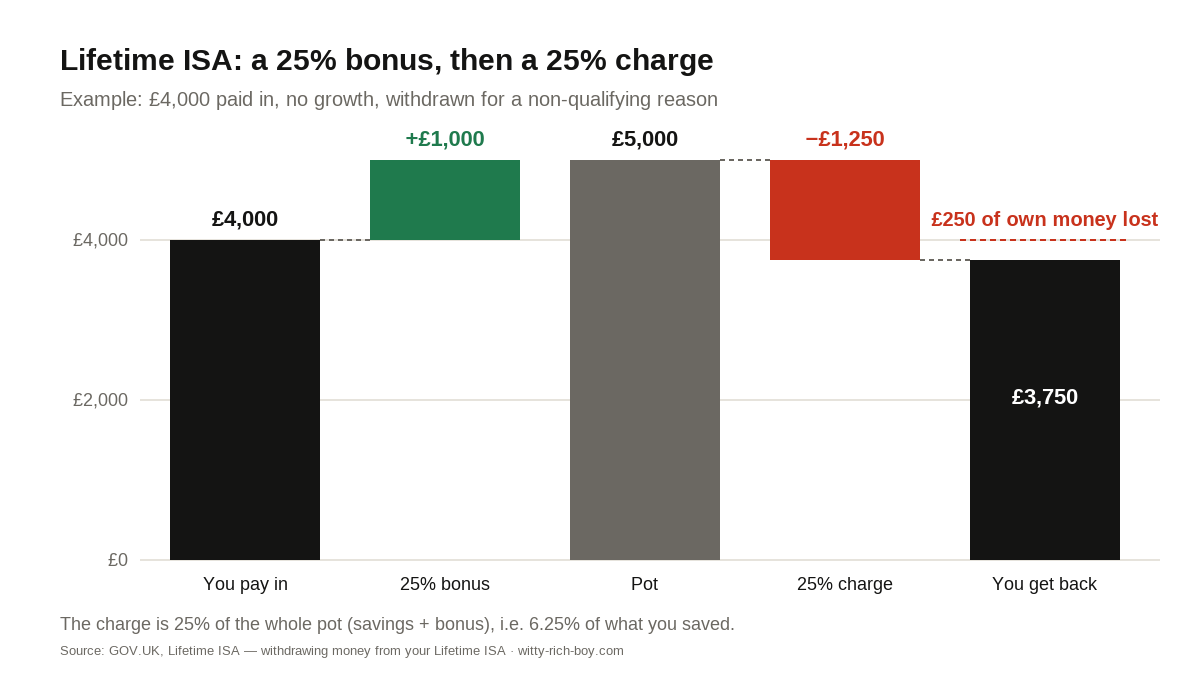
Put generally: a 25% bonus followed by a 25% charge leaves you with 1.25 × 0.75 = 93.75% of what you saved. Only investment growth can offset that. GOV.UK’s own worked example uses £800 and arrives at the same 6.25% loss (£750 back).
The £450,000 cap is the other sting: a buyer whose first home costs more cannot withdraw for it without the charge.
The Lifetime ISA is being replaced
In June 2026 the government opened a consultation (closed 18 August 2026) on a First Time Buyer ISA that will be offered in place of the Lifetime ISA once available. The proposal pays the bonus only when money is withdrawn for a first home, removing the withdrawal charge, and has no upper age limit. Until it launches, existing LISAs continue under today’s rules and new ones can still be opened. No start date has been confirmed.
What is a flexible ISA?
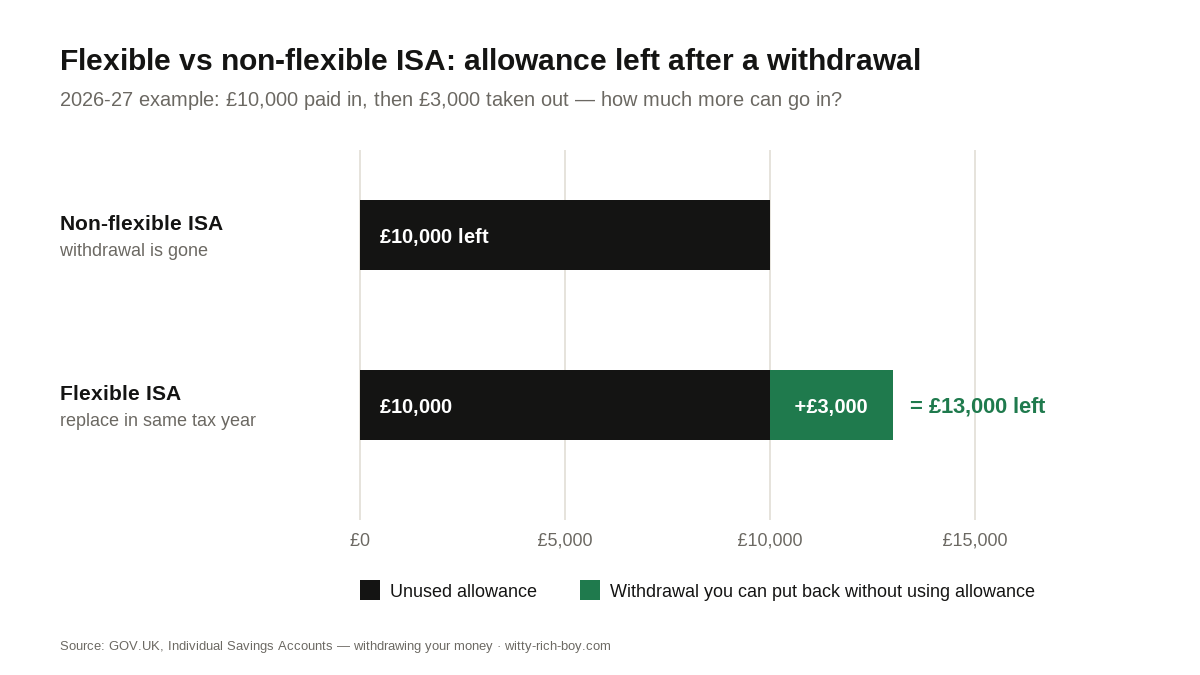
A flexible ISA lets you withdraw cash and replace it in the same tax year without the replacement using any of your allowance. Flexibility is optional for providers, so not every ISA has it; your provider can tell you.
GOV.UK’s worked example: your allowance is £20,000 and you pay in £10,000 during 2026-27, then take out £3,000.
| Non-flexible ISA | Flexible ISA | |
|---|---|---|
| Paid in so far | £10,000 | £10,000 |
| Withdrawn | £3,000 | £3,000 |
| Allowance left for 2026-27 | £10,000 | £13,000 |
| Can money from earlier years be put back? | No — it is new subscription | Yes, to the same account, same tax year |
The fine print is in HMRC’s guidance to ISA managers, How to manage ISA subscriptions:
- Current-year money withdrawn from a flexible ISA reduces your current-year subscriptions. Since 15 July 2025, that freed-up amount may be subscribed to any ISA that year, not only the one it came from.
- Previous-year money — savings built up before 6 April 2026 — can be replaced only in the same account, and only before 5 April 2027. Miss the deadline and that tax-free headroom is gone for good.
- Lifetime ISAs follow their own rules: any withdrawal outside the three permitted reasons attracts the 25% charge, whatever the provider’s flexibility terms.
Which ISA fits which goal? A decision table
The right ISA depends on your timeframe, age and whether you need access. This table maps common situations to the rules above; it describes how each product behaves, not what you should buy.
| Your situation | ISA that fits the rules | Key constraint to check |
|---|---|---|
| Emergency fund, may need money within months | Cash ISA, ideally flexible | From 2027-28, £12,000 cash cap if under 65 |
| Saving for a first home under £450,000, aged 18–39 | Lifetime ISA (up to £4,000) plus cash or S&S ISA | Account must be open 12 months; 25% charge if plans change |
| First home likely above £450,000 | Cash or stocks and shares ISA | LISA withdrawal would cost 25% |
| Investing for 5+ years | Stocks and shares ISA | Value can fall; from 2027, 22% charge on cash interest held inside |
| Want exposure to crypto via listed notes | Innovative Finance ISA (cETNs since 6 April 2026) | Provider needs HMRC approval to offer cETNs |
| Aged 65+ wanting cash | Cash ISA | £20,000 cash limit continues after April 2027 |
| Saving for a child | Junior ISA | £9,000 a year across the child’s Junior ISAs |
| Using all £20,000 in cash before the cap | Cash ISA in 2026-27 | Must be paid in by 5 April 2027 |
How to use your ISA allowance before 5 April 2027
Using the 2026-27 allowance in full takes five steps:
- Add up what you have already paid in since 6 April 2026 across every ISA and provider. The £20,000 is shared, and providers cannot see each other’s figures. Our ISA allowance calculator totals them and shows what is left, including your Lifetime ISA room.
- Decide the split. If you want more than £12,000 in cash and are under 65, 2026-27 is the last year you can do it.
- Check the Lifetime ISA sub-limit. No more than £4,000 into a LISA, and only one LISA subscription per year.
- Ask whether your accounts are flexible before withdrawing. In a non-flexible ISA, money taken out cannot be put back without using new allowance.
- Move money between ISAs by transfer, not withdrawal. Ask the receiving provider to arrange an ISA transfer; withdrawing cash yourself breaks the wrapper. Remember that from April 2027 under-65s can no longer transfer from stocks and shares into cash.
What happens if you pay in more than £20,000?
Subscriptions over the limit do not qualify for ISA tax relief. HMRC’s guidance How to close, void or repair an ISA says the excess and any related gains are removed from the account, and income earned on the over-subscription is taxable; the rest of the ISA keeps its exemption. For over-subscriptions in earlier years, HMRC contacts the investor. Over-subscription most often happens when someone has several ISAs with different providers — now easier since the 2024 rules allowed multiple ISAs of the same type.
How do ISAs compare with investing outside them?
Outside an ISA, gains on shares, funds and crypto are subject to Capital Gains Tax above a £3,000 annual exempt amount, at 18% or 24% in 2026-27 — see our guide to the UK capital gains tax allowance and rates. Dividends and savings interest have their own allowances and rates — for shares, see our guide to UK dividend tax and the £500 dividend allowance. Inside an ISA, none of that applies, and nothing needs reporting. Canada’s equivalent, the TFSA, works differently on one key point: unused room carries forward indefinitely — see our guide to the TFSA contribution limit for 2026.
The value of the wrapper therefore rises with the size of the gains. A £15,000 gain on shares held outside an ISA leaves £12,000 taxable after the allowance; you can estimate the bill with our UK Capital Gains Tax calculator. Held in a stocks and shares ISA, the same gain carries no tax. Direct crypto cannot sit in an ISA at all, so the matching rules, swaps and reporting described in our guides on whether crypto-to-crypto swaps are taxable and on DAC8 and CARF crypto reporting continue to apply to it.
Key dates for the ISA allowance
| Date | What happens |
|---|---|
| 6 April 2024 | Multiple ISAs of the same type allowed in one year; partial transfers of current-year money |
| 15 July 2025 | Current-year flexible ISA withdrawals can be re-subscribed to any ISA |
| 6 April 2026 | 2026-27 tax year starts: £20,000 limit; new cETN purchases move to Innovative Finance ISAs |
| 5 April 2027 | Last day to use the 2026-27 allowance, and the last day of £20,000 cash for all ages |
| 6 April 2027 | £12,000 cash limit for under-65s; 22% charge on cash interest in non-cash ISAs |
| 5 April 2031 | End of the confirmed freeze of £20,000 / £4,000 / £9,000 limits |
The overall allowance is frozen; what the government is reshaping is what goes into it. For 2026-27 the rules are still simple: £20,000, any mix, by 5 April 2027.
Questions readers ask
What is the ISA allowance for 2026/27?
The ISA allowance for the 2026-27 tax year, which runs from 6 April 2026 to 5 April 2027, is £20,000 per adult. You can put it all in one ISA or split it across cash, stocks and shares, Innovative Finance and Lifetime ISAs, as long as the Lifetime ISA share does not exceed £4,000 and the total stays at or below £20,000.
Is the cash ISA allowance being cut to £12,000?
Yes, from 6 April 2027. Budget 2025 set an annual cash ISA limit of £12,000 within the £20,000 overall limit for people under 65. Savers aged 65 or over keep a £20,000 cash limit from the start of the tax year in which they turn 65. For the current 2026-27 tax year, anyone can still put the full £20,000 into cash ISAs.
Can I have more than one ISA of the same type?
Yes. Since 6 April 2024 you can pay into several ISAs of the same type in one tax year — two cash ISAs with different providers, for example — provided your total subscriptions stay within £20,000. The exceptions are the Lifetime ISA, where you can pay into only one per year, and Junior ISAs, which are limited to one of each type.
Do you lose money withdrawing from a Lifetime ISA?
Usually, yes. Unless you are buying a first home worth up to £450,000, are 60 or over, or are terminally ill, a 25% charge applies to the amount withdrawn. Because it is levied on savings plus bonus, it takes back more than the bonus: on £4,000 saved and £1,000 bonus, the £1,250 charge leaves you £3,750, £250 below what you paid in.
Does a Lifetime ISA count towards my £20,000 ISA allowance?
Yes. Whatever you pay into a Lifetime ISA, up to its £4,000 annual maximum, counts towards the overall £20,000 ISA allowance. If you put the full £4,000 into a LISA in 2026-27, you can put a further £16,000 into other ISAs. The government's 25% bonus does not count towards your allowance.
What is a flexible ISA?
A flexible ISA is one whose provider lets you take money out and put it back in the same tax year without that replacement counting as a new subscription. Example: you pay in £10,000 and withdraw £3,000; in a flexible ISA you can still add £13,000 that year, against £10,000 in a non-flexible one. Your provider can tell you whether your ISA is flexible.
What happens if I go over my ISA allowance?
Payments above the £20,000 limit are not entitled to ISA tax relief. Under HMRC's repair rules the excess and any related gains are removed from the account, and income earned on it is taxable, while the rest of the ISA stays tax-free. For earlier years HMRC contacts you. Checking your total across every provider before topping up avoids the problem.
Is the Junior ISA allowance changing?
No. The Junior ISA limit is £9,000 for 2026-27, shared between a child's cash and stocks and shares Junior ISAs. Budget 2025 confirmed that the Junior ISA and Child Trust Fund limit stays at £9,000 until 5 April 2031, alongside the £20,000 adult limit and the £4,000 Lifetime ISA limit.
Was this guide useful?
Thanks — your answer helps us decide what to cover next.
Sources
- Individual Savings Accounts (ISAs): overview (GOV.UK)
- Individual Savings Accounts (ISAs): withdrawing your money (GOV.UK)
- Lifetime ISA: withdrawing money from your Lifetime ISA (GOV.UK)
- Lifetime ISA: who can open a Lifetime ISA (GOV.UK)
- Junior Individual Savings Accounts: add money to an account (GOV.UK)
- Budget 2025 — Overview of tax legislation and rates (HM Treasury / HMRC)
- Cash Individual Savings Account (ISA) limit reduction — policy paper (HMRC)
- The Individual Savings Account (Amendment) (No. 2) Regulations 2026, SI 2026/1018 (legislation.gov.uk)
- ISA reform 2027: anti-circumvention rules factsheet (GOV.UK)
- How to manage ISA subscriptions — guidance for ISA managers (HMRC)
- Tax treatment of cryptoasset Exchange Traded Notes — policy paper (HMRC)
General information, not tax or legal advice. Rules change — check the official source or a licensed adviser before acting.