Germany · Crypto
Germany Crypto Staking Tax (2026): The €256 Cliff in Numbers
Germany crypto staking tax 2026: rewards are income at their euro value on receipt, taxed at 0–45% once the year's total hits €256. Each reward has a 1-year clock.

The short answer
- For private investors, staking rewards are other income under § 22 no. 3 EStG, taxed at their euro market value on receipt at the personal rate of 0–45% (BMF letter of 6 March 2025, para. 48).
- The €256 Freigrenze is a cliff: €255 of staking and lending income a year is tax-free, €256 is taxed in full. For a single filer on €55,000 that first euro over the line costs €94.
- Each reward counts as acquired on receipt and starts its own one-year holding period; the taxed receipt value is its cost. Staking does not extend the period to ten years (para. 63).
- Receipt can be taken as the day you claim a reward into your wallet, but unclaimed rewards count by 31 December at the latest (para. 48a), so delaying a claim cannot push income into the next year.
- Running your own validator is block creation, which the BMF says is not private asset management (para. 39); depending on scale it can be a business under § 15 EStG with no €256 limit.
- 2026 staking income goes on Anlage SO; a self-prepared 2026 return is due by 31 July 2027 (§ 149 (2) AO), the same day providers send 2026 data to the BZSt under DAC8.
In force: 2026 tax year · § 22 no. 3 EStG (€256 Freigrenze) · § 23 EStG (€1,000 Freigrenze since 2024) · BMF letter of 6 March 2025 · § 32a EStG 2026 tariff · as of 30 October 2026
In Germany, staking rewards received by a private investor are other income under § 22 no. 3 EStG. Each reward is valued at its euro market price on receipt and taxed at your personal rate of 0–45%, but only if the year's total reaches €256. Every reward then starts its own one-year holding period; staking never triggers a ten-year period.
Staking looks like a savings account for crypto, yet Germany taxes it nothing like bank interest. No one withholds tax, and the tax office expects you to know the euro value of every reward on the day it arrived. Two clocks then run side by side: one for the coins you stake, one for each reward. This guide covers staking and lending only, based on the Federal Finance Ministry’s (BMF) letter of 6 March 2025 and the statute, with a full 2026 year worked through in euros. For buying, selling and swapping in general, see our overview of crypto tax in Germany.
How is crypto staking taxed in Germany?
Rewards from passive staking are taxed on receipt as other income from services under § 22 no. 3 EStG, at your ordinary progressive income tax rate. The BMF letter of 6 March 2025 says in para. 48 that income from providing crypto to staking pools or platforms, without taking part in block creation yourself, is as a rule a return on private wealth taxed under that provision. The ministry also publishes an official English courtesy translation; the German text is binding.
Staking is locking coins on a proof-of-stake blockchain to help secure it, in exchange for newly issued coins. Passive staking means delegating those coins to a pool or platform rather than running a validator node yourself. That is the normal case, with three consequences:
- No flat tax, no saver’s allowance. Rewards are not investment income under current law, so the 25% Abgeltungsteuer and the €1,000 saver’s allowance (Sparerpauschbetrag) do not apply.
- Your personal rate. The income is added to your other income and taxed under the 2026 tariff in § 32a EStG: 0% up to €12,348 of taxable income, rising through 14% to 42% and 45% at the top.
- Tax without a sale. If the price falls after receipt, the tax on the higher value stays; the loss only counts if you sell within a year.
| Type of income | Tax category | Annual limit | Holding period afterwards |
|---|---|---|---|
| Pool or platform staking | Other income, § 22 no. 3 EStG | €256 Freigrenze, shared | Each reward: 1 year from receipt |
| Crypto lending for a fee | Generally § 22 no. 3 EStG (para. 65) | Same €256, shared with staking | Rewards: 1 year; lent coins: 1 year |
| Own validator / block creation | Not private asset management (para. 39); possibly business, § 15 EStG | None if a business | No exemption for business assets |
| Selling rewards | Private sale transaction, § 23 EStG | €1,000 Freigrenze, all sales | Tax-free after more than 1 year |
| The staked coins themselves | § 23 EStG | €1,000 Freigrenze | 1 year, never 10 (para. 63) |
When is a staking reward received, and at what value?
A reward is received when you can dispose of it, and it is valued at the euro market price at that moment. That figure is both your taxable income and the reward’s cost for any later sale.
Under para. 48a, the BMF accepts, as a simplification during the year, the moment a reward is booked into your wallet, known as claiming (defined in para. 13), as the time of receipt. Rewards not yet claimed must be recognised by the end of the calendar year at the latest. Leaving rewards unclaimed over New Year does not move them into the next tax year.
For the price, the market rate at the time of acquisition decides (para. 43). Rates from a trading platform or web price list are accepted, and under certain conditions a daily rate (para. 91). Pick one documented source and use it for every reward.
Example: On 31 March 2026 a pool credits you with 0.06 coins, which you claim the same day. Your documented price source shows €1,800 per coin. Your income is 0.06 × €1,800 = €108, and €108 is also the cost of those 0.06 coins when you sell them.
Does claiming timing matter at all?
Within the year, yes. Claiming fixes both the valuation date and the start of the reward’s one-year clock: a reward claimed in March 2026 is tax-free to sell from April 2027, while one left until 31 December 2026 waits until January 2028. Network fees for claiming count as expenses against this income.
How does the €256 Freigrenze work for staking income?
Income from services is not taxable “if it amounted to less than 256 euros in the calendar year”, under § 22 no. 3 sentence 2 EStG. This is a Freigrenze (exemption limit), not a Freibetrag (allowance): below €256 nothing is taxed, but at €256 or more the whole amount is taxed, not just the excess.
Three details decide the outcome:
- Net income, not gross receipts. The test applies after expenses, such as claiming fees or separately charged commissions.
- All services together. Staking, lending, airdrops received for doing something and non-crypto items such as occasionally renting out a car all count. Our airdrop tax by country guide explains which airdrops count as a service under the BMF letter and how they are treated elsewhere.
- Separate from the €1,000 limit. Gains on private sales under § 23 (3) EStG have their own €1,000 Freigrenze. In one year you can have €255 of staking income and €999 of short-term gains, both tax-free.
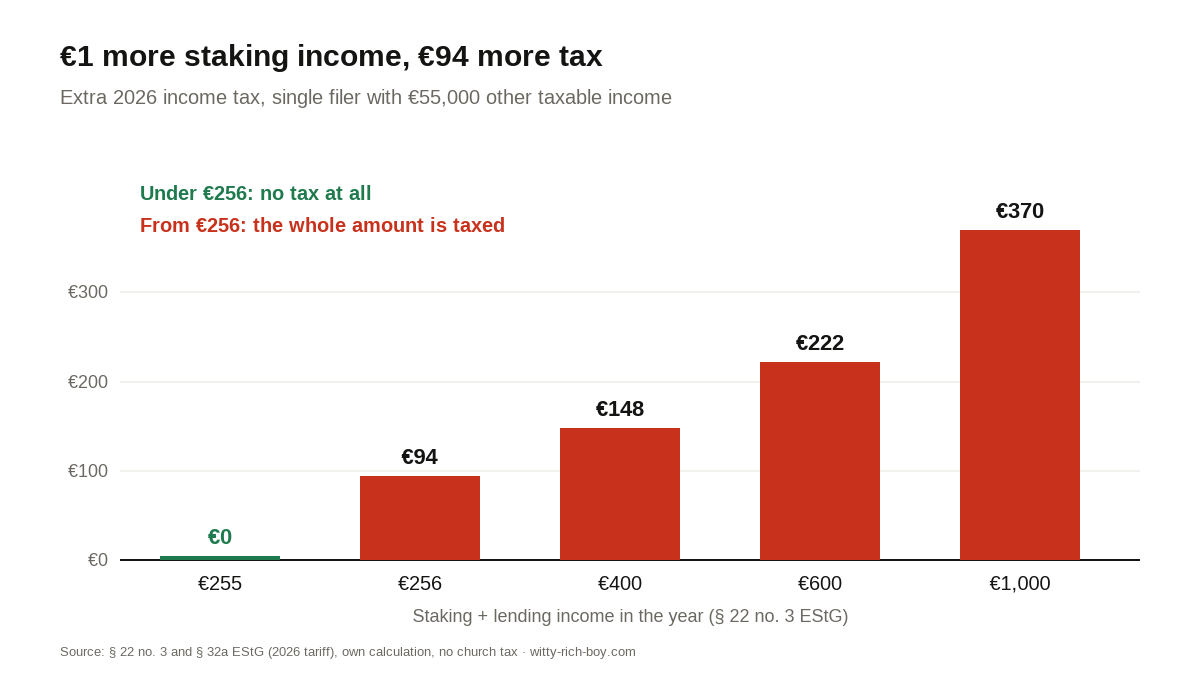
What the cliff costs depends on your other income. Extra 2026 income tax for a single filer, computed with the § 32a EStG tariff (no solidarity surcharge arises at these levels; church tax excluded):
| Other taxable income (single, 2026) | Staking income €255 | €256 | €600 | €1,500 |
|---|---|---|---|---|
| €20,000 | €0 | €64 | €149 | €375 |
| €35,000 | €0 | €76 | €180 | €452 |
| €55,000 | €0 | €94 | €222 | €557 |
| €70,000 | €0 | €107 | €252 | €630 |
Jointly assessed spouses each have their own €256 limit (R 22.8 of the income tax guidelines). Losses in this category cannot be set against salary; under § 22 no. 3 sentence 3 EStG they only offset income from services in other years, under § 10d EStG.
How much tax do you pay on staking rewards? A worked 2026 example
The prices below are hypothetical.
Example: Jonas is single with €55,000 of taxable income from his job in 2026. He delegates coins bought in 2024 to a staking pool, claims rewards at each quarter-end, and earns €132 over the year from lending stablecoins. He has no deductible costs.
| Date claimed | Reward (coins) | Price on receipt | Income | Running total |
|---|---|---|---|---|
| 31 March 2026 | 0.06 | €1,800 | €108 | €108 |
| 30 June 2026 | 0.06 | €1,500 | €90 | €198 |
| 30 September 2026 | 0.06 | €2,000 | €120 | €318 |
| 31 December 2026 | 0.06 | €2,500 | €150 | €468 |
| Lending, whole year | — | — | €132 | €600 |
- Add up the category. Staking €468 plus lending €132 makes €600.
- Test the limit. €600 is above €256, so all of it is taxable.
- Apply the tariff. Income tax on €55,000 is €12,347; on €55,600 it is €12,569. The rewards cost Jonas €222, or 37% of their value.
- Check the surcharges. Income tax of €12,569 is below the €20,350 threshold, so no solidarity surcharge.
Had he stopped after June and lent nothing, his €198 would have been tax-free; €58 of lending on top, making exactly €256, would have cost €94. Our Germany crypto tax calculator tests 2026 figures against both the €256 and €1,000 limits.
When can you sell staking rewards tax-free?
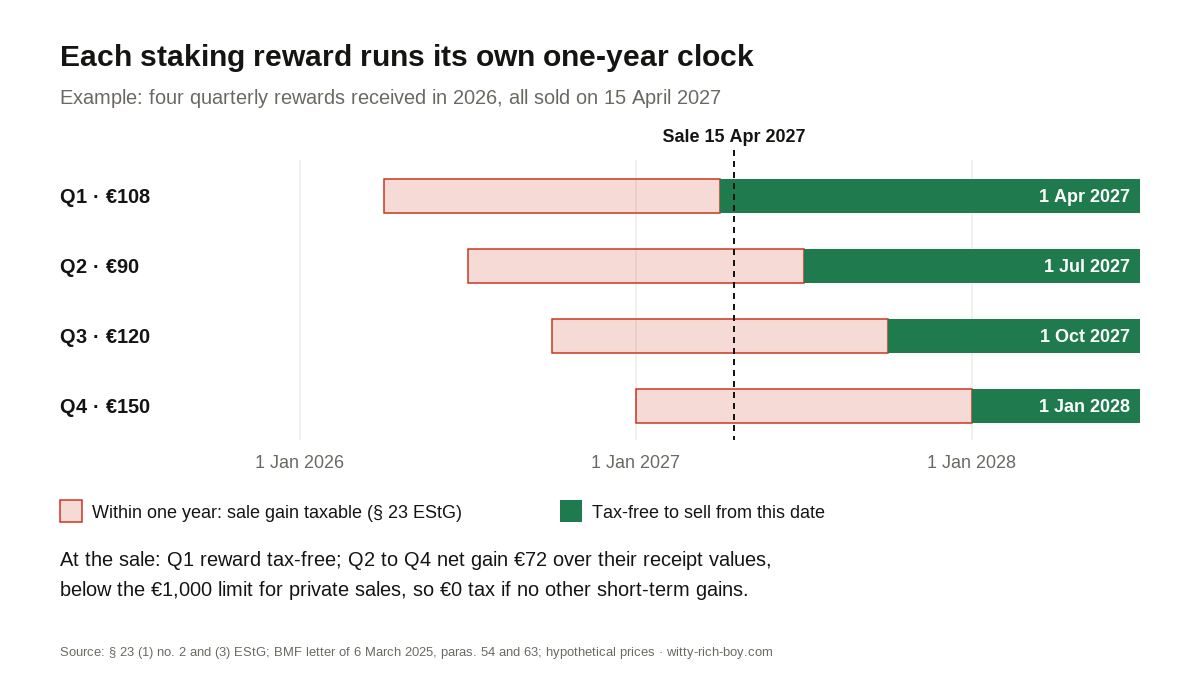
Each reward counts as acquired on receipt (BMF letter, para. 54) and so has its own one-year holding period under § 23 (1) sentence 1 no. 2 EStG. Its cost is the euro value already taxed as income, so nothing is taxed twice.
There is no ten-year period. § 23 (1) sentence 1 no. 2 sentence 4 EStG extends the holding period to ten years where an asset is used to generate income. A 2021 BMF draft wanted to apply that to staking and lending; the final letters of 2022 and 2025 dropped it, stating that the extension does not apply to currency and payment tokens (para. 63).
Example (continued): On 15 April 2027 Jonas sells all 0.24 reward coins at €2,400 each, €576 in total.
The Q1 reward is more than a year old and tax-free. Each of the other three sells for €144: a €54 gain on Q2 (cost €90), €24 on Q3 (€120) and a €6 loss on Q4 (€150). The net short-term gain of €72 is under the €1,000 limit for private sales, so with no other short-term gains in 2027 he pays €0. From 1 January 2028 all four would have been tax-free.
Rewards mixed with bought coins
If rewards sit in the same wallet as bought coins of the same type and units cannot be matched individually, the first units acquired count as sold first (FIFO), wallet by wallet. A separate rewards wallet keeps dates clean. Swapping rewards for another coin is also a sale, as explained in our guide to whether crypto-to-crypto swaps are taxable.
Pool staking, validator or lending: which rules apply?
What you actually do decides, not the product’s name: delegating and lending stay private; creating blocks yourself does not.
| What you do | Category | €256 limit? | One-year exemption on coins? |
|---|---|---|---|
| Stake through an exchange or platform | § 22 no. 3 EStG (para. 48) | Yes | Yes |
| Delegate to a pool, no own node | § 22 no. 3 EStG (para. 48) | Yes | Yes |
| Lend coins for a fee | Generally § 22 no. 3 EStG (para. 65) | Yes, shared | Yes |
| Run your own validator | Block creation, not private asset management (para. 39) | Only if not a business | Lost if coins are business assets |
| Liquidity pools on decentralised exchanges | Not specifically addressed in the BMF letter | Unclear | Unclear |
Running a validator
Under para. 39, block creation, which covers validating as well as mining, is not private asset management. Whether that becomes a business under § 15 (2) EStG depends on the usual tests: independent, continuous activity with a profit motive and participation in general commerce. Own hardware, permanent operation and accepting third-party delegations for a commission point that way; otherwise the income stays under § 22 no. 3 EStG.
In a business the €256 limit falls away, profit is receipts minus costs such as hardware and electricity, coins can be business assets taxable on sale even after a year, and trade tax may arise.
Lending and liquidity pools
Crypto lending means handing coins to a platform or borrower for a period in return for a fee, usually paid in the same coin. The BMF generally treats the fee as § 22 no. 3 income (para. 65), although depending on the contract it says income from capital assets under § 20 EStG or business income may apply instead. Liquidity mining, depositing pairs of coins in a pool on a decentralised exchange, has no specific rules in the letter. How the fees are taxed, and whether depositing coins for a pool token is a swap that restarts the clock, remain open.
What records does the tax office expect?
You must be able to prove each reward’s date, amount, price and price source. The BMF letter sets out heightened duties to cooperate and keep records from para. 87, especially for foreign platforms and decentralised applications. Keep, per platform and wallet:
- Full transaction exports (CSV), including reward credits and claim dates.
- Your price source and its settings, applied consistently, exact-time or daily rate (para. 91).
- Product terms: type of staking or lending, lock-ups, commission.
- Tax software reports with raw data and settings; the BMF notes their results depend on those settings (para. 29b).
From the 2026 calendar year, crypto-asset service providers collect customer and transaction data under the Kryptowerte-Steuertransparenz-Gesetz (KStTG), Germany’s implementation of DAC8, and report it to the Federal Central Tax Office (BZSt) by 31 July of the following year. Our guide to DAC8 crypto reporting in the EU explains what is shared.
How to declare staking income in your German tax return
Staking and lending income for 2026 goes on Anlage SO, the other-income annex of the income tax return. Work through it in this order:
- Collect every reward. Export 2026 credits from every platform and wallet; rewards not claimed by year-end are added at their 31 December 2026 value (para. 48a).
- Value each one in euros. Multiply each reward by the market price at receipt from your documented source.
- Total the category and deduct costs. Add staking, lending and other income from services, minus separately charged fees.
- Test the €256 Freigrenze. Below €256, the income is tax-free. At €256 or more, enter the full amount in the services section of Anlage SO.
- Report sales of rewards separately. Rewards sold within a year go in the private sale transactions section of Anlage SO, with the receipt value as cost, and are tested against the €1,000 limit.
- File on time. Under § 149 (2) AO a self-prepared 2026 return is due by 31 July 2027; returns prepared by a tax adviser have later deadlines.
Employees are not obliged to file because of staking unless income not subject to wage tax exceeds €410 (§ 46 (2) no. 1 EStG); if you file anyway, taxable staking income must be included.
Which deadlines matter for 2026 staking income?
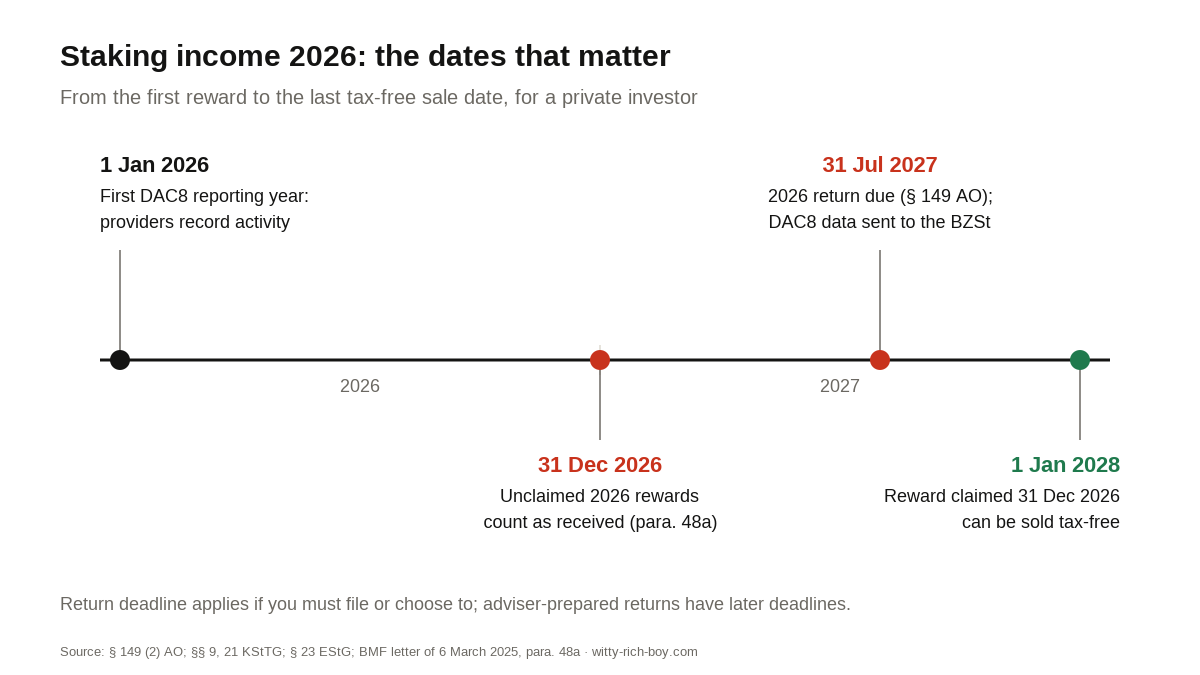
Every date that matters for 2026 rewards, in one place:
| Date | What happens | Source |
|---|---|---|
| 1 January 2026 | First reporting year: providers record your 2026 activity | §§ 10, 21 KStTG |
| 31 December 2026 | Unclaimed 2026 rewards count as received at their value that day | BMF letter, para. 48a |
| 31 July 2027 | Self-prepared 2026 return due; providers report 2026 data to the BZSt | § 149 (2) AO; § 9 KStTG |
| 1 January 2028 | A reward claimed on 31 December 2026 can be sold tax-free | § 23 (1) no. 2 EStG |
Will Germany change staking tax in 2027?
Not yet: as of 30 October 2026 the rules above apply unchanged. According to press reports, a Federal Finance Ministry draft bill from September 2026 would tax gains on crypto acquired after 31 December 2026 at the 25% flat rate regardless of holding period, and would treat staking and lending income as investment income. A draft is not law and still needs cabinet, Bundestag and Bundesrat approval. Until then, § 22 no. 3 EStG with its €256 limit and the one-year rule in § 23 EStG apply. For comparison, the UK taxes rewards as income at receipt and then charges capital gains tax on any rise, as set out in our guide to crypto staking tax in the UK.
Questions readers ask
Do I have to pay tax on staking rewards in Germany if I don't sell them?
Yes. The tax charge arises when the reward is received, not when it is sold. Its euro market value at that moment is other income under § 22 no. 3 EStG, taxed at your personal rate. It is only tax-free if your total income of this kind for the calendar year stays below €256. A later sale is a separate event with its own one-year holding period.
Does staking extend the crypto holding period to ten years in Germany?
No. § 23 EStG stretches the holding period to ten years for assets used to generate income, but the BMF letter of 6 March 2025 (para. 63) says this extension does not apply to currency and payment tokens. Staked or lent coins keep the normal one-year rule, and so do the rewards they produce.
Is the €256 staking allowance per coin, per exchange or per year?
Per person and per calendar year, across all income from services under § 22 no. 3 EStG combined. Staking, lending and unrelated items such as occasionally renting out a car are added together. At €255 nothing is taxed; at €256 the whole amount is. Spouses filing jointly each have their own limit for their own income in this category.
When can I sell staking rewards tax-free in Germany?
More than one year after each reward was received. Every reward counts as acquired on receipt, so each has its own clock. A reward received on 31 March 2026 can be sold tax-free from 1 April 2027. Sell earlier and only the difference between the sale price and the already-taxed receipt value counts as a private sale gain, under its own €1,000 limit.
How is crypto lending taxed in Germany?
Payments for lending crypto are generally treated like staking rewards: other income under § 22 no. 3 EStG at their euro value on receipt (BMF letter, para. 65). Lending and staking share the same €256 limit. The coins you lend keep their one-year holding period. Depending on the contract, the BMF says income from capital assets or business income may apply instead.
Can I avoid tax by not claiming my staking rewards until next year?
No. The BMF accepts the day a reward is claimed into your wallet as the time of receipt during the year, but rewards not yet claimed must be counted by the end of the calendar year at the latest (para. 48a). Rewards earned in 2026 but left unclaimed are therefore still 2026 income, valued on 31 December 2026.
Is running an Ethereum validator a business in Germany?
Not automatically, but it leaves private asset management. The BMF letter (para. 39) treats taking part in block creation as not private asset management. Whether it becomes a business under § 15 EStG depends on scale, continuity and serving third parties, for example accepting delegations for a fee. A business has no €256 limit, and coins held as business assets lose the one-year exemption.
Where do I report staking income on my German tax return?
On Anlage SO, the annex for other income, in the section for income from services under § 22 no. 3 EStG. Enter the euro value of rewards received and any separately charged costs. Sales of rewards within one year go in the private sale transactions section of the same annex. The self-prepared 2026 return is due by 31 July 2027.
Was this guide useful?
Thanks — your answer helps us decide what to cover next.
Sources
- § 22 EStG — Arten der sonstigen Einkünfte, incl. the €256 limit in no. 3 (gesetze-im-internet.de)
- § 23 EStG — Private Veräußerungsgeschäfte (gesetze-im-internet.de)
- § 15 EStG — Einkünfte aus Gewerbebetrieb (gesetze-im-internet.de)
- § 32a EStG — Einkommensteuertarif from 2026 (gesetze-im-internet.de)
- § 46 EStG — assessment of employees, €410 threshold (gesetze-im-internet.de)
- § 149 AO — Abgabe der Steuererklärungen (gesetze-im-internet.de)
- BMF letter of 6 March 2025: Einzelfragen zur ertragsteuerrechtlichen Behandlung bestimmter Kryptowerte (German PDF)
- BMF letter of 6 March 2025: Questions regarding the income tax treatment of specific crypto-assets (official English courtesy translation, PDF)
- Kryptowerte-Steuertransparenz-Gesetz (KStTG) — German DAC8 implementation (gesetze-im-internet.de)
General information, not tax or legal advice. Rules change — check the official source or a licensed adviser before acting.