Global ·
Crypto Gift Tax (2026): $19,000, £3,000 and €400,000 Rules
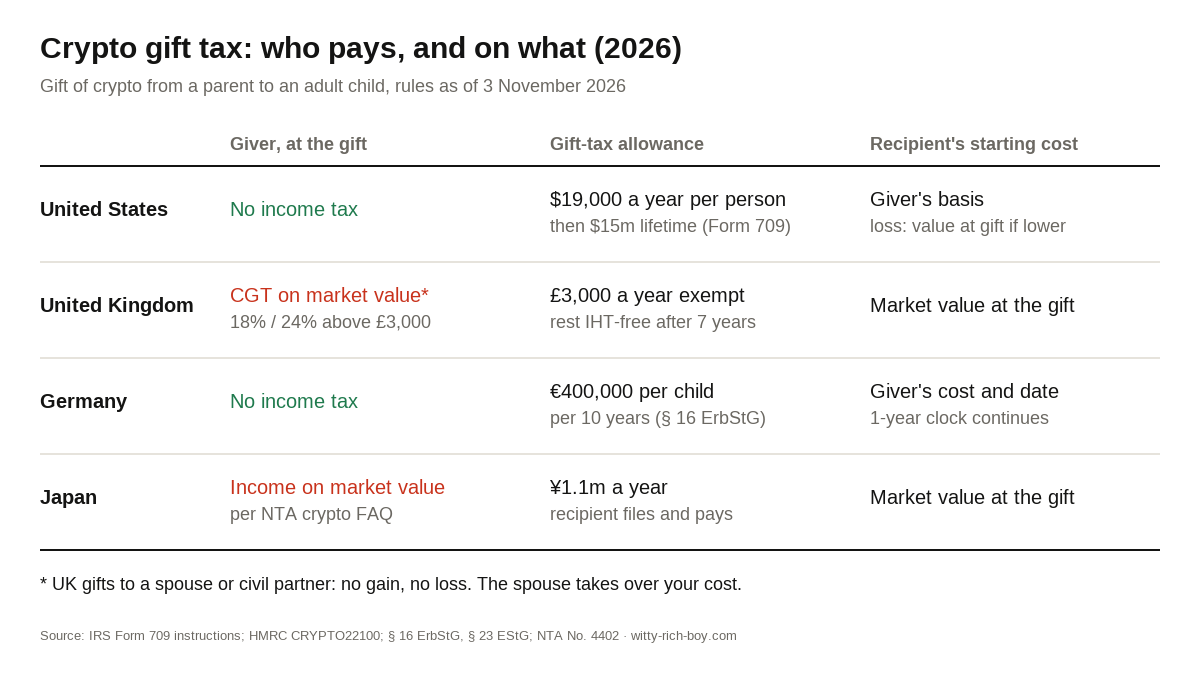
Crypto gift tax in 2026: the US lets you give $19,000 per person a year, the UK taxes most gifts as a sale, and Germany allows €400,000 per child every 10 years.

The short answer
- In the US you can give each person $19,000 in 2026 with no return; above that you file Form 709 by 15 April 2027, but tax is due only once the $15,000,000 lifetime amount is used.
- A US recipient takes over the giver's cost basis; if the coins were worth less than that basis at the gift, the dual-basis rule uses the lower value for losses.
- HMRC treats a gift of crypto as a disposal at market value (CRYPTO22100), so the giver can owe 18% or 24% CGT, except on gifts to a spouse or civil partner, which are no gain, no loss.
- For UK Inheritance Tax, £3,000 of gifts a year is exempt and other gifts to individuals escape IHT if the giver lives 7 years.
- Germany taxes the recipient, after allowances of €500,000 (spouse), €400,000 (child), €200,000 (grandchild) and €20,000 (others) per giver every 10 years; the giver's purchase date carries over under § 23 EStG.
- Japan lets a recipient receive ¥1.1 million a year without gift tax (NTA No. 4402), and the recipient's crypto cost is its market value at the gift.
In force: Rules as in force on 3 November 2026 · US: 2026 annual exclusion $19,000 and basic exclusion amount $15,000,000 (Form 709 instructions for 2026) · UK: 2026-27 tax year · Germany: §§ 14–19 ErbStG and § 23 EStG · Japan: gifts received in calendar 2026
Crypto gift tax depends on where you live. In 2026 the US lets you give $19,000 per person without a return, and the recipient takes over your cost basis. The UK taxes most gifts as a sale at market value, except to a spouse. Germany taxes the recipient only above €400,000 per child every 10 years.
Giving crypto to family looks simpler than selling it: no buyer, no price, no exchange. Tax systems disagree about what that means. Some treat the gift as a sale, others pass the tax bill to the recipient, and some do both at once. The questions are the same everywhere. Does the giver pay tax on the gain? Is there a separate gift or inheritance tax? What cost and purchase date does the recipient inherit? This guide answers all three for the United States, the United Kingdom, Germany and Japan, with the official source linked beside each rule and worked numbers for each country.
What is crypto gift tax?
Crypto gift tax is the tax that can arise when you transfer digital assets to someone for nothing in return. In practice it covers two different taxes. One is a tax on the gain in the coins, such as Capital Gains Tax in the UK. The other is a transfer tax on the value given away, such as the US gift tax, German Schenkungsteuer or Japanese zōyo-zei (贈与税).
A gift is “bona fide” when nothing is received in return. If your child pays you half the market value, most systems treat the deal as part sale and part gift. And a token received for doing something, such as promotional posts, is not a gift but income; our guide to airdrop tax by country covers that case.
| Country | Giver taxed on the gain at the gift? | Gift or transfer tax | Annual or periodic allowance | Who pays the gift tax |
|---|---|---|---|---|
| United States | No; gain passes to recipient | Federal gift tax | $19,000 per recipient (2026); $15,000,000 lifetime | Giver |
| United Kingdom | Yes, CGT at market value (not spouse) | Inheritance Tax if giver dies within 7 years | £3,000 a year in total | Giver’s estate / recipient |
| Germany | No income tax | Schenkungsteuer | €20,000–€500,000 per giver per 10 years | Recipient (giver liable too) |
| Japan | Yes, per NTA crypto FAQ | Gift tax (贈与税) | ¥1.1 million a year per recipient | Recipient |
How does the US tax a gift of crypto?
In the US, a gift of crypto does not trigger income tax for the giver, but gifts above the annual exclusion must be reported on Form 709. The giver, not the recipient, is responsible for any gift tax.
The 2026 Instructions for Form 709 set the annual exclusion at $19,000 per recipient for 2026. A married couple can elect gift splitting and give $38,000 to each person, according to the IRS gift tax FAQ. Gifts to a US-citizen spouse are not taxable gifts at all. For a spouse who is not a US citizen, the annual exclusion is $194,000 in 2026.
Above the exclusion, tax is rarely due. Public Law 119-21 (signed on 4 July 2025) raised the basic exclusion amount to $15,000,000 for 2026. A taxable gift simply reduces that lifetime amount, which is shared with the estate tax. The return is still compulsory: Form 709 for 2026 gifts is due on 15 April 2027, and Form 8892 gives an automatic six-month extension to file. Each spouse files their own Form 709; there is no joint gift tax return.
The giver’s Form 1040 also counts the gift. The IRS digital asset FAQ notes that someone who disposed of a digital asset by gift may need to file Form 709. Keep your own records of the transfer: what brokers send the IRS is explained in our guide to Form 1099-DA, and a gift is not a sale.
Worked example: a $60,000 gift to a child
Example: a parent gives an adult child bitcoin worth $60,000 in March 2026. The parent paid $20,000 for it in 2021.
| Step | Single giver | With gift splitting |
|---|---|---|
| Value of gift | $60,000 | $30,000 per spouse |
| Less annual exclusion | −$19,000 | −$19,000 each |
| Taxable gift | $41,000 | $11,000 each |
| Gift tax payable in 2026 | $0 (uses $41,000 of $15,000,000) | $0 |
| Form 709 due | 15 April 2027 | 15 April 2027 (with consent) |
| Child’s basis | $20,000, holding period from 2021 | Same |
The $40,000 gain has not disappeared. It moves to the child, who pays tax on it when they sell.
What cost basis does the US recipient get?
The recipient of gifted crypto generally takes over the giver’s cost basis, plus any gift tax paid on the gift, when working out a gain. The IRS digital asset FAQ says a bona fide gift is not income for the recipient until they sell, exchange or otherwise dispose of the coins.
Losses follow a stricter rule. Under IRS Publication 551, if the market value at the time of the gift was below the giver’s basis, the recipient uses the lower market value to work out a loss. This is the dual-basis rule. If the sale price lands between the two figures, there is neither a gain nor a loss. The rule stops a giver from passing on a paper loss to someone who can use it.
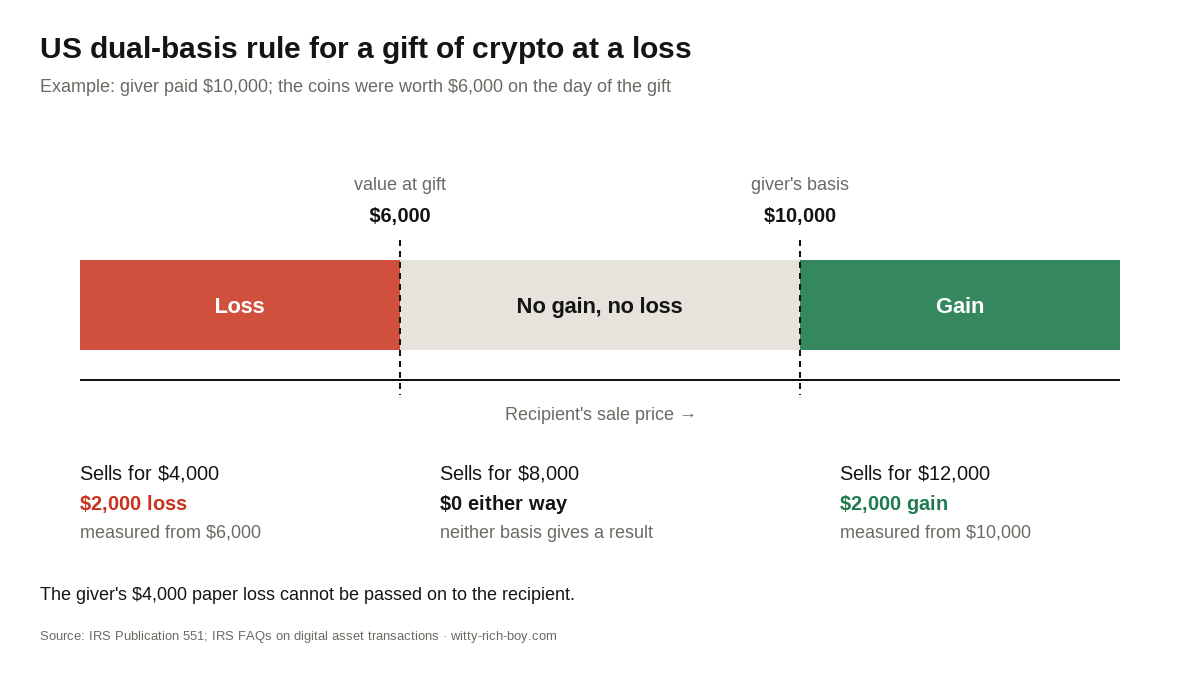
Two details matter for crypto. First, if the recipient has no record of the giver’s basis, the IRS FAQ says the basis is zero, so the whole sale price is taxable gain. Second, the holding period follows the basis. Under Publication 544, it carries over from the giver when the giver’s basis is used, but starts the day after the gift when market value is used.
Does gifting crypto trigger Capital Gains Tax in the UK?
Yes, unless the gift is to your spouse or civil partner. HMRC CRYPTO22100 lists “giving them away to another person” as a disposal of tokens. The giver must work out the sterling value of the tokens given away and is treated as having received that amount, even though nothing was paid.
The gain is the market value minus your allowable cost from the section 104 pool. It is added to your other gains for the year. In 2026-27 the first £3,000 of net gains is covered by the annual exempt amount; the rest is taxed at 18% within the basic-rate band and 24% above it. Our UK crypto tax guide explains pooling, and the Capital Gains Tax guide covers rates and reporting.
The spouse and civil partner rule
Transfers between spouses or civil partners who live together are treated as made for a value that gives neither a gain nor a loss (TCGA 1992 s58, HMRC CG22200). The receiving spouse takes over your cost and acquisition date. That makes a spousal transfer the one gift in the UK that does not crystallise tax, and it can also let a couple use two £3,000 allowances and two basic-rate bands on a later sale.
Example: you bought 1 BTC for £20,000 and give it to your adult daughter when it is worth £60,000. Your gain is £40,000. After the £3,000 allowance, £37,000 is taxable; for a higher-rate taxpayer at 24% that is £8,880 of CGT, payable by you. Your daughter’s cost is £60,000. Give the same coin to your husband and there is no tax: his cost is £20,000, and the full £40,000 gain is taxed only when he sells.
How does Inheritance Tax apply to crypto gifts in the UK?
There is no annual gift tax in the UK, but gifts can be pulled back into your estate for Inheritance Tax if you die within seven years. According to gov.uk’s rules on giving gifts, you can give away £3,000 a year in total without it being added to your estate, and carry an unused allowance forward for one tax year only.
Other gifts to individuals are free of IHT if you live 7 years after making them. Gifts between spouses or civil partners are exempt with no limit, provided the recipient lives in the UK permanently. Separate allowances cover small gifts of up to £250 per person and wedding gifts of up to £5,000 to a child.
| Years between gift and death | IHT rate on the gift (if total gifts exceed £325,000) |
|---|---|
| Less than 3 | 40% |
| 3 to 4 | 32% |
| 4 to 5 | 24% |
| 5 to 6 | 16% |
| 6 to 7 | 8% |
| 7 or more | 0% |
For crypto, the value that counts is the sterling value on the day of the gift. A later crash does not reduce it, so keep a dated record of the price you used.
How much crypto can you gift tax-free in Germany?
In Germany the giver pays no income tax on a gift, and the recipient owes gift tax only above a personal allowance. § 16 ErbStG sets the allowances by relationship: €500,000 for a spouse or registered partner, €400,000 for each child, €200,000 for each grandchild and €20,000 for everyone else in tax classes II and III. Parents and grandparents fall into class II for lifetime gifts, so they also get €20,000; class I treatment for them applies only on death (§ 15 ErbStG).
The allowances renew every ten years. Under § 14 ErbStG, all gifts from the same person within ten years are added together. A parent and child can therefore move €400,000 now and another €400,000 ten years later. Each parent has a separate allowance, so two parents can give a child €800,000 in a ten-year period.
Above the allowance, rates under § 19 ErbStG start at 7% in class I, 15% in class II and 30% in class III, for taxable amounts up to €75,000. Gifts must be reported to the tax office within three months under § 30 ErbStG, and the giver is also obliged to report.
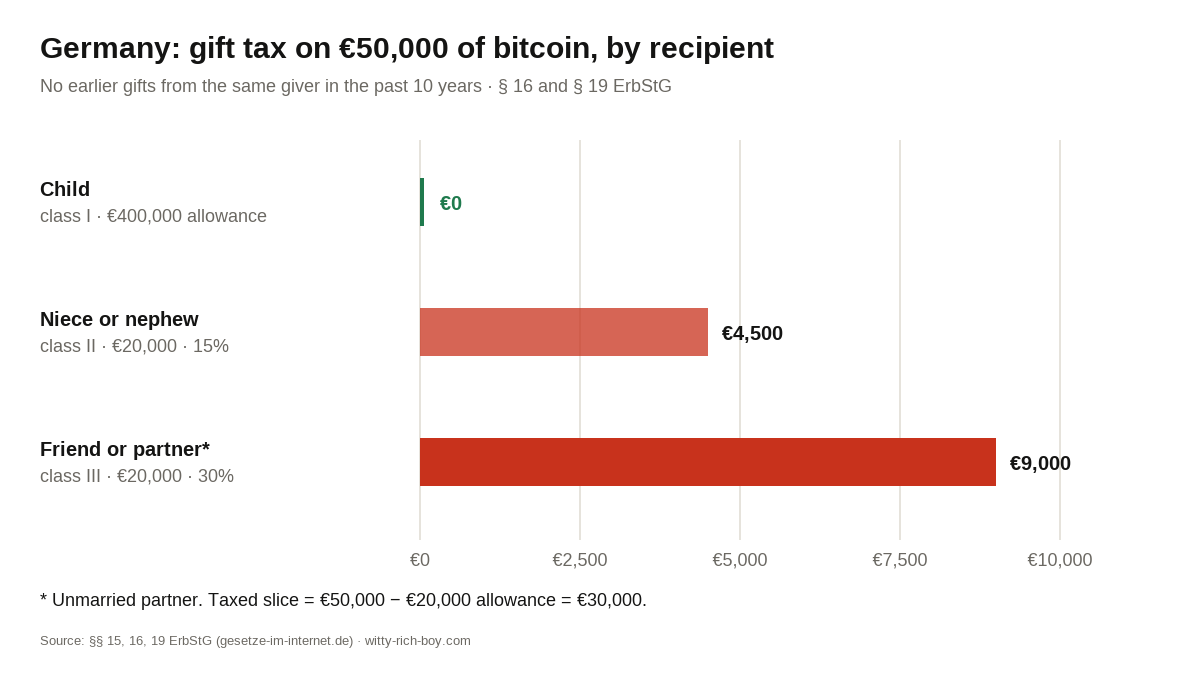
Example: a mother gives her son bitcoin worth €450,000, and nothing else in ten years. The taxable amount is €50,000 above the €400,000 allowance, and at 7% the gift tax is €3,500, paid by the son.
Does the German one-year holding period carry over to the recipient?
Yes. § 23 (1) sentence 3 EStG attributes the giver’s acquisition to the recipient of a free transfer. The recipient therefore keeps the giver’s purchase date and cost. If your father bought ether in 2022 and gives it to you in 2026, you can sell it at once and the gain is tax-free, because the coin has been held for more than a year.
The reverse also applies. If your father bought the coins only six months ago, the gift does not restart the clock. You must wait until the first anniversary of his purchase, or your gain is taxed at your personal rate under the €1,000 exemption limit. Our Germany crypto tax guide works through that limit.
Is there a crypto gift tax in Japan?
Yes. Japan taxes the recipient of a gift when the total received from individuals in a calendar year exceeds the ¥1.1 million basic exemption. Below that, no gift tax is due and no return is needed, according to NTA Tax Answer No. 4402. Above it, the recipient files and pays between 1 February and 15 March of the following year.
The income tax side differs from the US and Germany. The National Tax Agency’s crypto FAQ states that an individual who gives crypto away must include its market value at the time of the gift in their income, and that the recipient’s acquisition cost is that same market value. In effect, both the giver’s gain and the recipient’s gift are measured on one day’s price.
How to gift crypto to family without surprises
These steps apply to all four countries, with the local rule in brackets.
- Record the giver’s cost and purchase date for the exact units being transferred, with exchange statements or wallet exports (US basis carryover, German § 23 date).
- Fix the value on the day of the gift from a single source in your currency and save a dated copy (UK disposal value, US Form 709 value, German and Japanese gift tax value).
- Check the recipient’s relationship and allowance: $19,000 per person (US), spouse or not (UK), class I, II or III (Germany), or ¥1.1 million (Japan).
- Add up earlier gifts from the same giver: the same calendar year (US, Japan), the last 7 years (UK IHT) or the last 10 years (Germany).
- Send the coins to a wallet the recipient controls, and keep the transaction hash with a short signed note saying it is a gift.
- File on time: Form 709 by 15 April 2027, UK Self Assessment for any gain, the German notice within three months, or the Japanese return by 15 March.
- Hand the records to the recipient, because their gain on a later sale depends on figures only the giver holds.
Which country’s rules are kinder to the giver?
The answer depends on whether the coins carry a gain. With a large unrealised gain, the US and Germany are gentler. A US gift moves the gain to the recipient without taxing it, and a German gift of coins held over a year carries no income tax at all. The UK and Japan tax the giver as if the coins had been sold, so a gift there is a sale with no money coming in.
The table below runs the same hypothetical gift through each system: coins bought for 20,000 units of local currency and given to an adult child when worth 60,000, with no other gifts or gains.
| Example: 20,000 cost, 60,000 value, adult child | US ($) | UK (£) | Germany (€), held over 1 year |
|---|---|---|---|
| Giver’s tax on the gain at the gift | $0 | £8,880 (24% on £37,000) | €0 |
| Transfer tax on the gift | $0 (Form 709, $41,000 of lifetime used) | £0 if giver lives 7 years | €0 (within €400,000) |
| Recipient’s cost for a later sale | $20,000 | £60,000 | €20,000, held since purchase |
| Gain taxed if recipient sells at 60,000 | $40,000 | £0 | €0 |
Rules and allowances change, and some of these figures are adjusted every year. Check the linked official pages before a large gift, especially for UK spousal transfers after separation and US gifts to non-citizen spouses. For the related question of whether swapping one token for another is a sale, see are crypto swaps taxable?
Questions readers ask
Is gifting crypto a taxable event?
It depends on the country. In the US a bona fide gift is not a sale: the recipient takes over your basis and reports nothing until they dispose of the coins. In the UK a gift to anyone except a spouse or civil partner is a disposal at market value for Capital Gains Tax. Germany charges no income tax on the gift but may levy gift tax on the recipient.
How much crypto can I gift tax-free in 2026?
In the US, $19,000 per recipient in 2026 without filing Form 709, or $38,000 if spouses split gifts. In the UK, the Inheritance Tax annual exemption is £3,000 a year in total, though Capital Gains Tax may still apply. In Germany a child can receive €400,000 from each parent every 10 years free of gift tax; in Japan the recipient's annual basic exemption is ¥1.1 million.
Do I have to file Form 709 for a crypto gift?
Yes, if your gifts to any one person other than your spouse exceed $19,000 in 2026. The return is due by 15 April 2027 and can be extended by six months with Form 8892. Filing usually means no tax: the excess simply uses part of your $15,000,000 basic exclusion amount. Spouses who want to split gifts must both consent to the election.
What is the cost basis of crypto received as a gift?
In the US it is the giver's basis, plus any gift tax paid on the gift, for working out a gain. For a loss, it is the lower of the giver's basis and the market value at the time of the gift. Without records of the giver's basis, the IRS says the basis is zero. In the UK and Japan the recipient's cost is the market value on the day of the gift.
Can I gift crypto to my spouse without paying tax?
In the US and the UK, generally yes. US gifts to a citizen spouse are not taxable gifts; a non-citizen spouse has a $194,000 annual exclusion for 2026. In the UK, transfers between spouses or civil partners living together are no gain, no loss under TCGA 1992 s58, and IHT-free if the spouse lives permanently in the UK. Germany's spousal allowance is €500,000 per 10 years.
Does the 1-year holding period restart if I am gifted crypto in Germany?
No. Under § 23 (1) sentence 3 EStG, a recipient who acquires an asset free of charge is treated as having bought it when the giver did. If your parent bought bitcoin in 2021 and gives it to you in 2026, you can sell it straight away without income tax, because the one-year period has already passed.
Who pays gift tax on crypto, the giver or the recipient?
In the US, the giver is responsible for gift tax, although the IRS can collect from the recipient if the giver does not pay. In Germany and Japan the recipient is the taxpayer, although in Germany the giver must also notify the tax office. In the UK there is no separate gift tax; the giver may owe CGT, and IHT on a gift arises only if the giver dies within seven years.
Is it better to gift crypto or sell it and gift cash?
It depends on the gain and the country. In the UK both routes usually produce the same CGT, because a gift is treated as a sale at market value. In the US, gifting the coins moves the unrealised gain to the recipient, which can help if they pay a lower rate. In Germany, coins held over a year can be sold tax-free either way.
Was this guide useful?
Thanks — your answer helps us decide what to cover next.
Sources
- Frequently asked questions on gift taxes (Internal Revenue Service)
- 2026 Instructions for Form 709 — draft (Internal Revenue Service, PDF)
- Frequently asked questions on digital asset transactions (Internal Revenue Service)
- Publication 551, Basis of Assets — property received as a gift (Internal Revenue Service)
- CRYPTO22100 — Capital Gains Tax: what is a disposal (HMRC Cryptoassets Manual)
- CG22200 — Transfer of assets between spouses or civil partners living together (HMRC Capital Gains Manual)
- How Inheritance Tax works: rules on giving gifts (gov.uk)
- § 16 ErbStG — Freibeträge (gesetze-im-internet.de)
- § 19 ErbStG — Steuersätze (gesetze-im-internet.de)
- § 23 EStG — Private Veräußerungsgeschäfte (gesetze-im-internet.de)
General information, not tax or legal advice. Rules change — check the official source or a licensed adviser before acting.