Global ·
Airdrop Tax by Country (2026): Income or Zero Cost in 6 Systems
Airdrop tax by country in 2026: the US taxes airdrops as income on receipt, the UK and Germany only if you did something for them; Japan and Australia split cases.

The short answer
- In the US, Rev. Rul. 2019-24 makes airdropped coins ordinary income at fair market value once you have dominion and control; that value becomes your basis.
- HMRC CRYPTO21250 says an airdrop received without doing anything in return may escape Income Tax, while airdrops for a service are miscellaneous income; a later disposal can still give a capital gain.
- Germany taxes an airdrop under § 22 no. 3 EStG only where you performed a service, such as posts or personal data (BMF letter of 6 March 2025, paras. 70–71), and only once the year's total reaches €256.
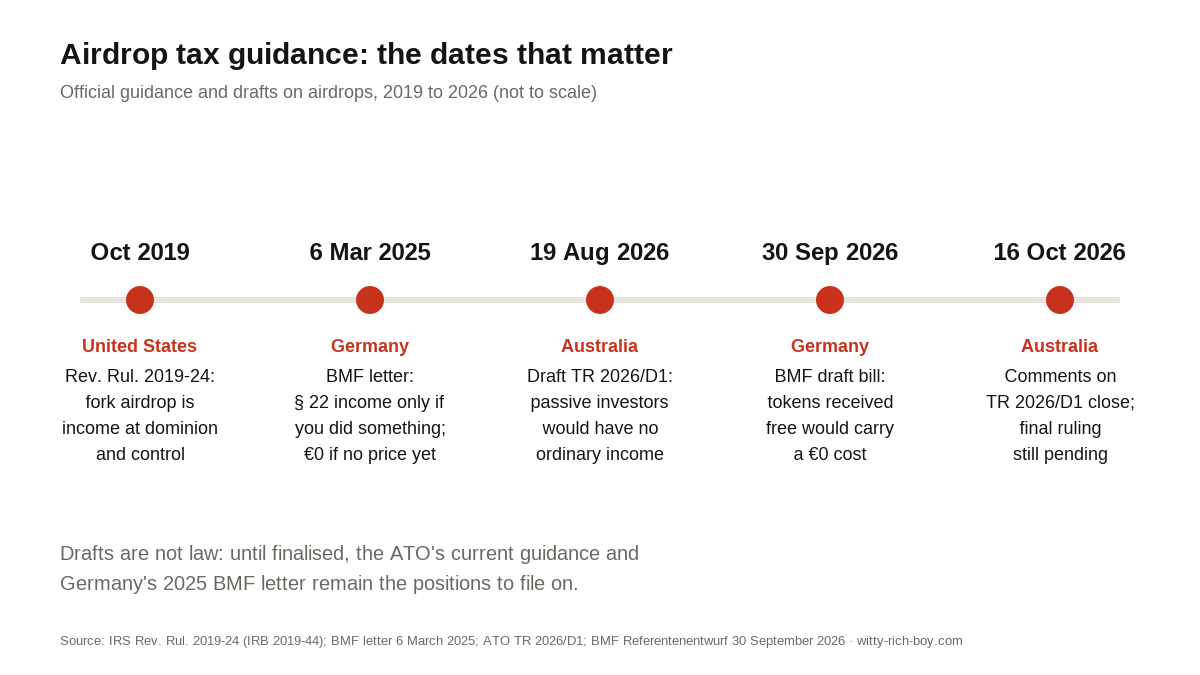
- Australia's draft ruling TR 2026/D1 (19 August 2026) would end ordinary-income treatment for passive investors, but the ATO's current guidance still treats airdropped established tokens as income.
- Japan classes free tokens received occasionally as occasional income (NTA No. 1525-2), which gets a ¥500,000 special deduction and only half of the rest taxed (No. 1490).
- In our example, a passive airdrop worth 2,000 and sold at 5,000 after 14 months leaves 5,000 taxed in the US and UK, 3,500 in Australia today and 0 in Germany.
In force: Rules as in force on 2 November 2026 · US Rev. Rul. 2019-24 · HMRC CRYPTO21250 · German BMF letter of 6 March 2025 and § 22 no. 3 EStG · ATO guidance and draft TR 2026/D1 (19 August 2026, not final) · NTA Tax Answers Nos. 1525-2 and 1490
Airdrop tax depends on the country. The US taxes airdropped coins as ordinary income at fair market value once you control them. The UK and Germany tax an airdrop as income only if you did something for it, Germany only from €256 a year. Japan gives occasional airdrops a ¥500,000 deduction. Sales are taxed later.
Free tokens are rarely free of tax, but the bill arrives at different moments. One country taxes the value the day the coins land in your wallet; another ignores the receipt and taxes the entire sale price later; a third may never tax a long-held airdrop at all. Below: the rule in each major system with its legal source, one worked example run through all of them, a decision table, a step list and the two 2026 drafts that could change the answer. It covers private individuals, not traders.
How are airdrops taxed in different countries?
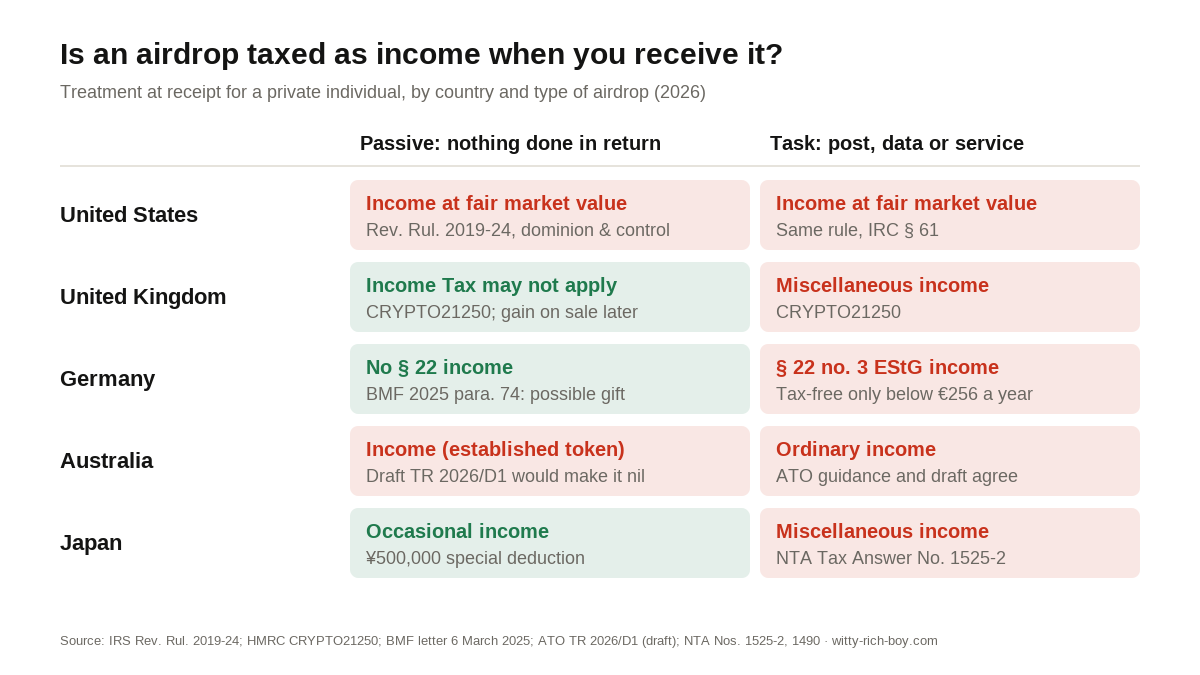
The deciding questions are the same everywhere: did you do anything for the tokens, and did the tax authority treat the receipt as income or simply as acquiring an asset with a low or nil cost? The table below gives the short answer for each system.
| Country | Passive airdrop (nothing done) | Airdrop for a task or service | Cost for a later sale | Legal source |
|---|---|---|---|---|
| United States | Ordinary income at fair market value | Ordinary income at fair market value | Amount included in income | Rev. Rul. 2019-24; IRC § 61 |
| United Kingdom | Income Tax may not apply | Miscellaneous income (or trading receipt) | Nil where s17(2) applies; market value for services | HMRC CRYPTO21250; TCGA 1992 s17 |
| Germany | No § 22 income; possibly a gift | § 22 no. 3 EStG income, tax-free below €256 a year | Value of the service; €0 if no price yet | BMF letter 6 Mar 2025, paras. 70–74 |
| Australia | Income for established tokens today; none under draft | Ordinary income | Market value on receipt (nil if negligible) | ATO guidance; draft TR 2026/D1 |
| Japan | Occasional income (¥500,000 deduction) | Business, salary or miscellaneous income | Value on receipt; hard-fork coins ¥0 | NTA Nos. 1525-2, 1490 |
| Canada | No airdrop-specific CRA rule published | Facts decide: business income or capital | Adjusted cost base rules | CRA crypto-asset guide |
What counts as an airdrop for tax purposes?
An airdrop is a distribution of crypto tokens to wallet addresses, usually free of charge, to promote a project, reward early users or follow a blockchain split. Tax authorities split them into two kinds.
A passive airdrop arrives because you held a token or once used a protocol, with nothing asked of you at the time. A task airdrop (sometimes called a bounty) requires something in return: posting about the project, joining a channel, handing over an email address or identity data. That distinction drives the income question in the UK, Germany and Japan.
Two more terms recur. Dominion and control is the US test for when income arises: the moment you can actually transfer, sell or otherwise dispose of the coins. A zero-cost acquisition means the tokens enter your records with a nil base cost, so nothing is taxed on receipt but the entire sale price later counts as gain. A hard fork — a chain split that hands holders of the old coin units of a new one — is treated separately in several countries.
Is an airdrop taxable income in the US?
Yes. In the US, airdropped crypto is ordinary income at its fair market value on the date you gain dominion and control over it, and that value becomes your basis.
The IRS set this out in Rev. Rul. 2019-24, which deals with a hard fork followed by an airdrop. A holder who receives no new units has no income; one who receives units through the airdrop has ordinary income under IRC § 61, measured at fair market value when the airdrop is recorded on the ledger, because from then the taxpayer can dispose of the coins. The IRS’s digital asset FAQ repeats that basis equals the amount included in income.
Three points follow:
- Timing follows control, not the snapshot. If tokens are allocated to you but cannot yet be claimed or moved, income generally arises when you can claim or move them, at the value on that day.
- Asking is irrelevant. Nothing in the ruling turns on whether you requested the tokens.
- The sale is a second event. Selling later produces a capital gain or loss against the basis, short-term if held one year or less. Brokers report sales, not your receipt value, on the new Form 1099-DA, so the income figure must come from your own records.
How does HMRC tax airdrops in the UK?
In the UK an airdrop is taxed as income only if you received it in return for, or in expectation of, a service; otherwise Income Tax may not apply, but Capital Gains Tax can when you dispose of the tokens.
HMRC’s manual page CRYPTO21250 says Income Tax may not apply where tokens are received without doing anything in return — not related to any service or other conditions — and not as part of a trade involving exchange tokens or mining. Airdrops tied to a service are miscellaneous income, or receipts of an existing trade, and where a trade is involved Income Tax takes priority over CGT.
The base cost of an untaxed airdrop is where the arithmetic bites. TCGA 1992 section 17 normally substitutes market value when an asset is acquired otherwise than at arm’s length or in connection with services, which is why a task airdrop typically carries its taxed sterling value as cost. But s17(2) switches that off where there is no corresponding disposal and no consideration is given — the typical position when a project mints and distributes new tokens. The likely result for a passive airdrop is a nil cost: no income on receipt, and the full sale proceeds as a gain. The tokens then join your section 104 pool for that token, as explained in our UK crypto staking tax guide, which works through the same pooling arithmetic.
Are airdrops taxable in Germany?
Only if you did something for them. Germany taxes an airdrop as other income under § 22 no. 3 EStG where the allocation is linked to a service, and even then only once that year’s total of such income reaches €256.
The BMF letter of 6 March 2025 sets out four rules:
- Active service (para. 70): despite their marketing character, airdrops lead to § 22 no. 3 income where recipients must do something, for example mention the airdrop in social media posts.
- Data (para. 71): if the allocation depends on providing data beyond what is technically needed to deliver the tokens — and always where personal data is required — that is a service.
- Chance (para. 72): if the allocation is partly left to chance, the economic link between service and reward falls away, so there is no § 22 income.
- Valuation (para. 73): tokens are valued at their market price on receipt; where no price can yet be determined, valuing them at €0 is not objected to.
Without any service, the letter says the airdrop may be a gift for which gift-tax rules apply (para. 74).
The €256 limit in § 22 no. 3 sentence 2 EStG is a Freigrenze (exemption threshold), not an allowance: the income is tax-free only if it totals less than €256 in the calendar year, shared with staking, lending and other income of this type. Example: €250 of task airdrops is tax-free; €260 is taxed in full at your personal rate. Our German crypto staking tax guide shows the same cliff in euros.
On a later sale, the one-year holding period of § 23 EStG applies: sell within a year and the gain is taxed; hold longer and it is tax-free. A Federal Finance Ministry draft bill dated 30 September 2026 would give tokens received free a €0 acquisition cost; it is a draft, not law.
How does the ATO treat airdrops in Australia?
Under current ATO guidance, airdropped established tokens are income at their market value on receipt, and airdrops received for services or by a crypto trading business are ordinary income; a draft ruling would narrow this for passive investors.
The ATO’s page on staking rewards and airdrops says airdrops for goods or services are ordinary income, with a cost base equal to market value on the day received. Where an airdropped asset has no or negligible value on receipt, the first element of its cost base will generally be nil. Airdrops received through a hobby or entertainment are not income.
Draft ruling TR 2026/D1, published on 19 August 2026 with comments closing on 16 October 2026, proposes that someone who is not trading and did not receive the tokens for services or as part of an income-producing activity includes nothing as ordinary income under section 6-5. The airdropped tokens would be a separate CGT asset with a first cost-base element of market value on receipt. The draft would generally apply to airdrops before and after its final issue date, except initial allocation airdrops — the first distribution of a token with no prior trading — which it would cover only after it is finalised.
Until it is final, file on the existing guidance. Our Australia crypto tax guide covers the 50% CGT discount for assets held at least 12 months.
How are airdrops taxed in Japan and Canada?
Japan splits airdrops by why you received them; Canada has published no airdrop-specific rule, so general income-versus-capital principles apply.
The National Tax Agency’s Tax Answer No. 1525-2 covers NFTs and fungible tokens (FTs) that can be exchanged for crypto or other assets. Tokens received as consideration for services are business, salary or miscellaneous income; tokens obtained occasionally or by chance are occasional income (一時所得); anything else is miscellaneous income. Occasional income is reduced by a special deduction of up to ¥500,000 a year, and only half of what remains is added to your other income (No. 1490). Selling the tokens later is miscellaneous income, as set out in our Japan crypto tax guide. Coins received from a hard fork are different again: the NTA treats them as producing no income on receipt and gives them an acquisition cost of ¥0.
In Canada, the CRA’s crypto-asset guide says income from crypto transactions is generally business income or a capital gain depending on the circumstances, and that the CRA will usually accept fair market value at the time of a transaction. It does not set out a separate airdrop rule, so a task airdrop earned through regular, commercial-looking activity points towards income, and a casual one towards capital. Record the value on receipt either way.
What does the same airdrop cost in tax? A worked example
Example: Ben receives a passive airdrop worth 2,000 in his local currency (read ¥200,000 for Japan), does nothing for it, and sells the tokens 14 months later for 5,000 (¥500,000). We assume an individual investor, tokens with a market price on receipt, and no other occasional income in Japan.
| Country | Taxed at receipt | Cost for the sale | Taxed on sale | Total amount taxed |
|---|---|---|---|---|
| United States | 2,000 ordinary income | 2,000 | 3,000 long-term gain | 5,000 |
| United Kingdom | 0 (nothing in return) | Nil (s17(2)) | 5,000 gain | 5,000 |
| Germany | 0 (no service) | — | 0 (held over one year, § 23 EStG) | 0 |
| Australia, current guidance | 2,000 ordinary income | 2,000 | 3,000 gain, 1,500 after 50% discount | 3,500 |
| Australia, draft TR 2026/D1 | 0 | 2,000 (market value) | 1,500 after discount | 1,500 |
| Japan | ¥200,000 − ¥500,000 deduction = ¥0 | ¥200,000 | ¥300,000 miscellaneous income | ¥300,000 |
The totals are amounts brought into tax, not tax due; the rate then depends on your income and, in the US and UK, on separate capital gains rates.
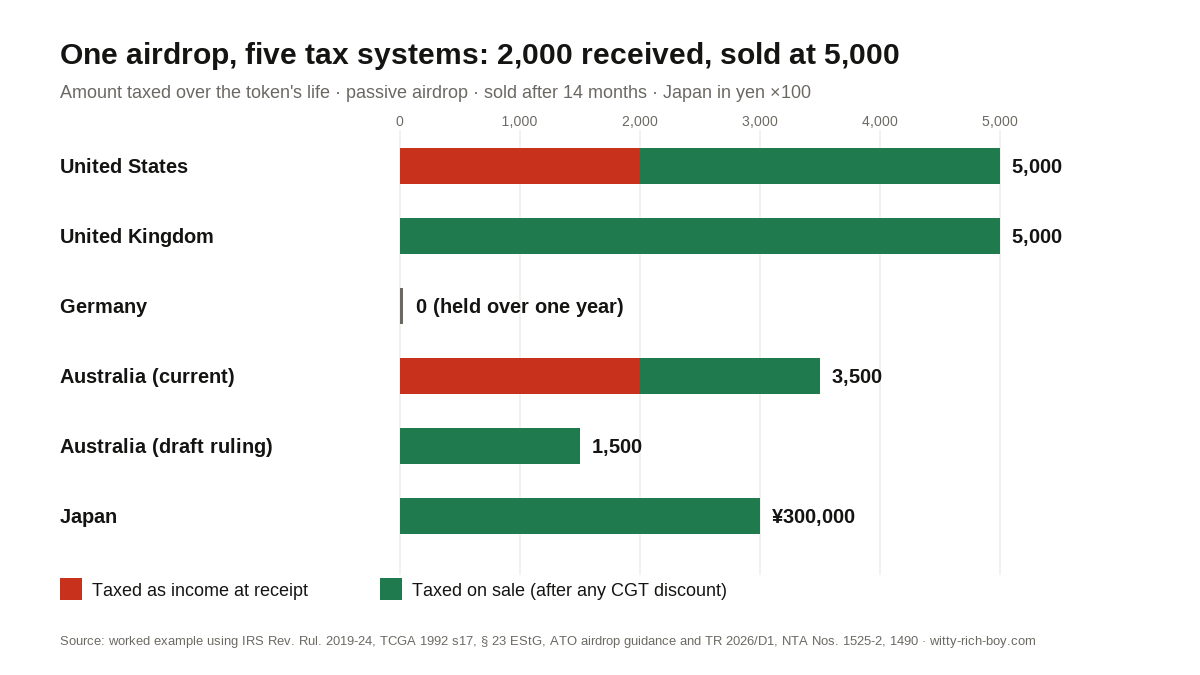
Change one fact — Ben had to post about the project — and the picture shifts. The UK taxes 2,000 as miscellaneous income and, with market value as cost, a further 3,000 gain: still 5,000 in total, but 2,000 at income rates. Germany taxes the 2,000 under § 22 no. 3 EStG because it exceeds €256, yet the sale after 14 months stays tax-free. Japan moves the ¥200,000 into miscellaneous income with no ¥500,000 deduction, bringing ¥500,000 into tax. Australia stays at 3,500.
How to work out the tax on an airdrop, step by step
- Record the receipt. Note the date you could first claim or move the tokens, the quantity and the wallet. In the US this dominion-and-control date fixes both income and basis.
- Classify the airdrop. Passive, task or hard fork? Keep evidence of what you did, if anything — posts, sign-ups, data handed over.
- Value it in your currency. Use a reasonable market price at receipt. If no market price exists yet, Germany allows €0 (BMF para. 73) and the ATO’s first cost-base element will generally be nil.
- Apply your country’s income rule. US: income now. UK and Germany: income only for a service; Germany then tests the €256 Freigrenze across all § 22 no. 3 income. Japan: occasional or miscellaneous income. Australia: current guidance until TR 2026/D1 is final.
- Fix the cost. Usually the amount taxed as income; nil for UK passive airdrops caught by s17(2) and Japanese hard-fork coins.
- Start the holding clock. Germany’s one-year period, Australia’s 12-month discount test and the US long-term threshold all run from acquisition.
- Tax the disposal. Selling, spending or swapping the tokens is a disposal; see our explainer on whether crypto-to-crypto swaps are taxable.
- Keep the file. Store the receipt value, the source of the price and your classification for as long as you hold the tokens and the years after sale.
Which airdrop cases cause the most trouble?
Four situations cause most disputes, usually over evidence rather than law.
- Tokens worth nothing on day one. A low or nil receipt value saves income tax now but leaves a low cost, so the later sale carries most of the value as gain.
- Claimable allocations. Where you must actively claim, the receipt date and value can differ from the snapshot date; in the US income follows control.
- Lottery-style allocations. In Germany, a partly random allocation breaks the service link (BMF para. 72), so a task airdrop decided by draw is not § 22 income.
- Hard forks dressed as airdrops. A chain split is not always taxed like a promotional airdrop: the US taxes new units only once they are airdropped to you and under your control (Rev. Rul. 2019-24), while Japan gives hard-fork coins a ¥0 cost and no income on receipt.
Questions readers ask
Are crypto airdrops taxable?
Usually somewhere along the way, but not always on receipt. The US taxes airdropped coins as ordinary income at fair market value once you control them. The UK and Germany tax them as income only if you did something in return, such as posting or handing over data. In every system here, selling the tokens later can be taxable, so the value and date of receipt matter.
What is the cost basis of an airdrop?
Where the airdrop was taxed as income, the cost is normally the value that was taxed: US basis equals the amount included in income, and in Australia the cost base is market value on receipt. Where it was not taxed, the cost can be nil, as for UK tokens caught by TCGA 1992 s17(2) and Japanese hard-fork coins, so the whole sale price becomes the gain.
Do I pay tax on an airdrop I did not ask for?
In the US, probably yes once you have dominion and control, because Rev. Rul. 2019-24 does not depend on asking. In the UK, an unsolicited airdrop given without anything in return may fall outside Income Tax (CRYPTO21250). In Germany there is no § 22 income without a service. You still need the receipt value and date for when you sell.
Are airdrops taxable in the UK?
Sometimes. HMRC's manual page CRYPTO21250 says Income Tax may not apply where tokens arrive without you doing anything in return and not as part of a trade. Airdrops received for, or in expectation of, a service are miscellaneous income or trading receipts. Separately, disposing of airdropped tokens may produce a chargeable gain for Capital Gains Tax even if nothing was taxed on receipt.
How are airdrops taxed in Germany?
Under the BMF letter of 6 March 2025, an airdrop is other income under § 22 no. 3 EStG only if you performed a service, such as promotional posts or providing data beyond what is technically needed. It is tax-free if all such income is below €256 in the year. Allocations partly left to chance break the link, and airdrops without any service may be gifts.
Are airdrops taxable in Australia?
Under current ATO guidance, airdropped established tokens are income at their market value on receipt, and airdrops for services or received by a crypto trading business are ordinary income. Draft ruling TR 2026/D1, published on 19 August 2026, proposes that passive investors who did nothing for an airdrop include nothing as ordinary income. It is not yet final.
How are airdrops taxed in Japan?
The National Tax Agency's Tax Answer No. 1525-2 classes fungible tokens received for services as business, salary or miscellaneous income, and tokens received occasionally or by chance as occasional income. Occasional income gets a special deduction of up to ¥500,000 a year and only half the rest is taxed (No. 1490). A later sale is taxed as miscellaneous income.
Is an airdrop with no market value taxable?
Generally there is little or nothing to tax on receipt. Germany's BMF letter allows tokens to be valued at €0 where no market price can yet be determined (para. 73), and the ATO says the first element of the cost base will generally be nil where an airdrop has no or negligible value. The flip side is a low cost, so more of a later sale is taxable.
Was this guide useful?
Thanks — your answer helps us decide what to cover next.
Sources
- Rev. Rul. 2019-24 — hard forks and airdrops (Internal Revenue Service, PDF)
- Frequently asked questions on digital asset transactions (Internal Revenue Service)
- CRYPTO21250 — Cryptoassets for individuals: Income Tax: airdrops (HMRC Cryptoassets Manual)
- Taxation of Chargeable Gains Act 1992, section 17 — market value rule (legislation.gov.uk)
- BMF letter of 6 March 2025 — Einzelfragen zur ertragsteuerrechtlichen Behandlung bestimmter Kryptowerte (PDF)
- § 22 EStG — Arten der sonstigen Einkünfte, incl. the €256 limit in no. 3 (gesetze-im-internet.de)
- Staking rewards and airdrops (Australian Taxation Office)
- TR 2026/D1 — Income tax: receipt and disposal of crypto assets by an airdrop (ATO draft ruling)
- No. 1525-2 — Tax treatment of transactions using NFTs and FTs (National Tax Agency, Japan)
- No. 1490 — Occasional income (National Tax Agency, Japan)
General information, not tax or legal advice. Rules change — check the official source or a licensed adviser before acting.