Global ·
Crypto Tax Loss Harvesting (2026): 30-Day Rules in 6 Countries
Crypto tax loss harvesting in 2026: UK and Canadian 30-day rules erase losses on quick rebuys, Australia uses Part IVA, and the US, Germany and Japan have no rule.
The short answer
- In the UK, a crypto sale is matched first with same-day purchases and then with purchases of the same token in the next 30 days (TCGA 1992 ss105 and 106A, HMRC CRYPTO22200), so a quick rebuy erases most of the loss.
- Canada's superficial loss rule looks 30 days before and 30 days after the sale, catches purchases by affiliated persons such as a spouse, and adds the denied loss to the replacement's adjusted cost base.
- The US wash sale rule, 26 U.S.C. § 1091, still covers only stock or securities; H.R. 10357, ordered reported 38–5 on 16 September 2026, would extend it to traded digital assets if enacted.
- Australia has no day count: under TR 2008/1 and Part IVA the ATO can cancel a capital loss from a sale and reacquisition that leaves your exposure essentially unchanged.
- Germany and Japan have no repurchase rule, but German losses only offset § 23 EStG private sale gains, and Japanese crypto losses cannot reduce salary or be carried forward.
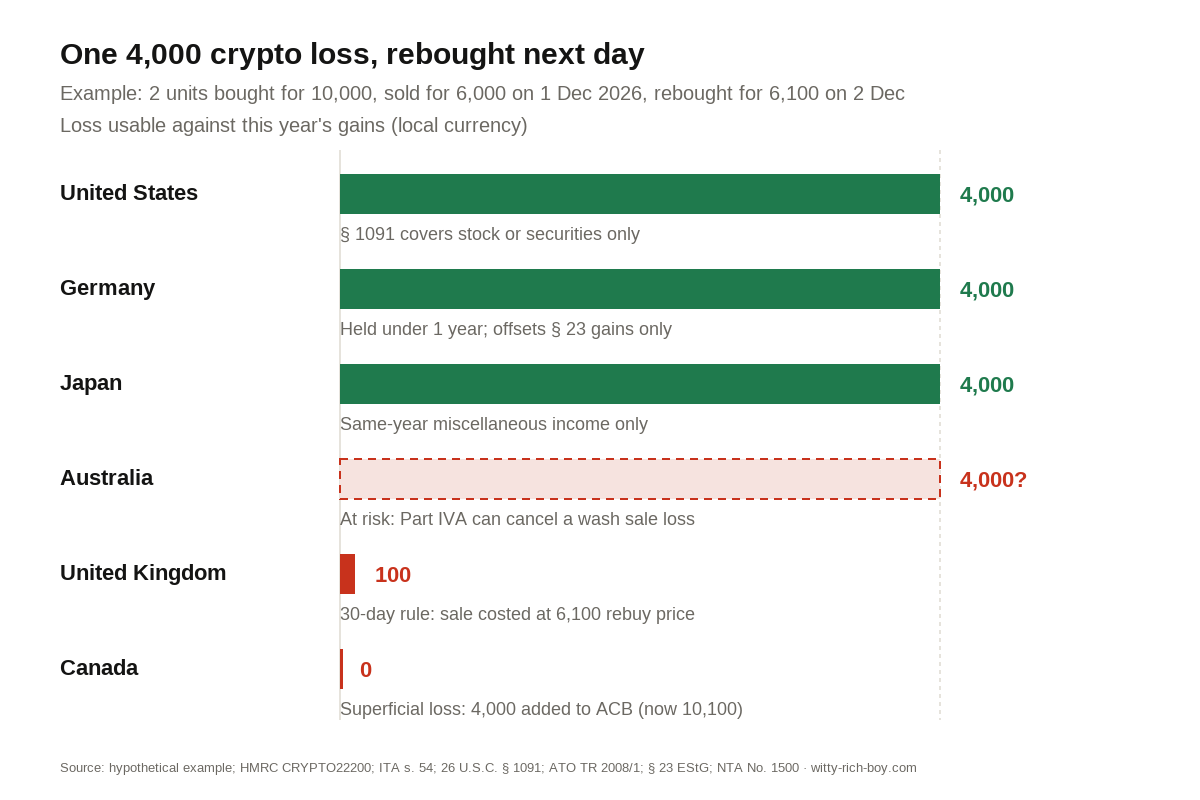
- In our example, a 4,000 loss rebought the next day is fully usable in the US, Germany and Japan, shrinks to 100 in the UK and to 0 this year in Canada.
In force: Rules as in force on 26 October 2026 · UK 2026-27 tax year · Australia 2026-27 income year (to 30 June 2027) · US: H.R. 10357 ordered reported on 16 September 2026, not enacted
Crypto tax loss harvesting means selling coins below cost to offset gains. In 2026 the UK (30 days after the sale) and Canada (30 days before or after) neutralise the loss if you rebuy the same token; Australia can cancel it under Part IVA; the US, Germany and Japan have no crypto repurchase rule.
Every December — or June, in Australia — the same idea goes round: sell the coins that have fallen, bank the loss, buy them straight back. Whether that works depends on where you are tax resident: the same 4,000 loss can be worth its full value, a fortieth of it or nothing this year. Below: the rule in six tax systems with its legal source, one worked example run through all six, a decision table and a step list. It covers individual investors, not traders.
What is crypto tax loss harvesting?
Crypto tax loss harvesting is selling a crypto-asset below cost so that the realised loss reduces tax on other gains, now or later. Only a disposal — a sale, a swap for another token, spending the coin — turns a paper loss into one the tax system recognises.
A wash sale is a loss sale combined with a purchase of the same asset shortly before or after, so the investor’s position barely changes. Countries respond with a mechanical matching rule (the UK, Canada, and the US for shares), general anti-avoidance law (Australia) or no specific rule (Germany, Japan, and the US for crypto). Just as important is what a loss may offset: every country here fences crypto losses in some way.
Which countries have a wash sale rule for crypto?
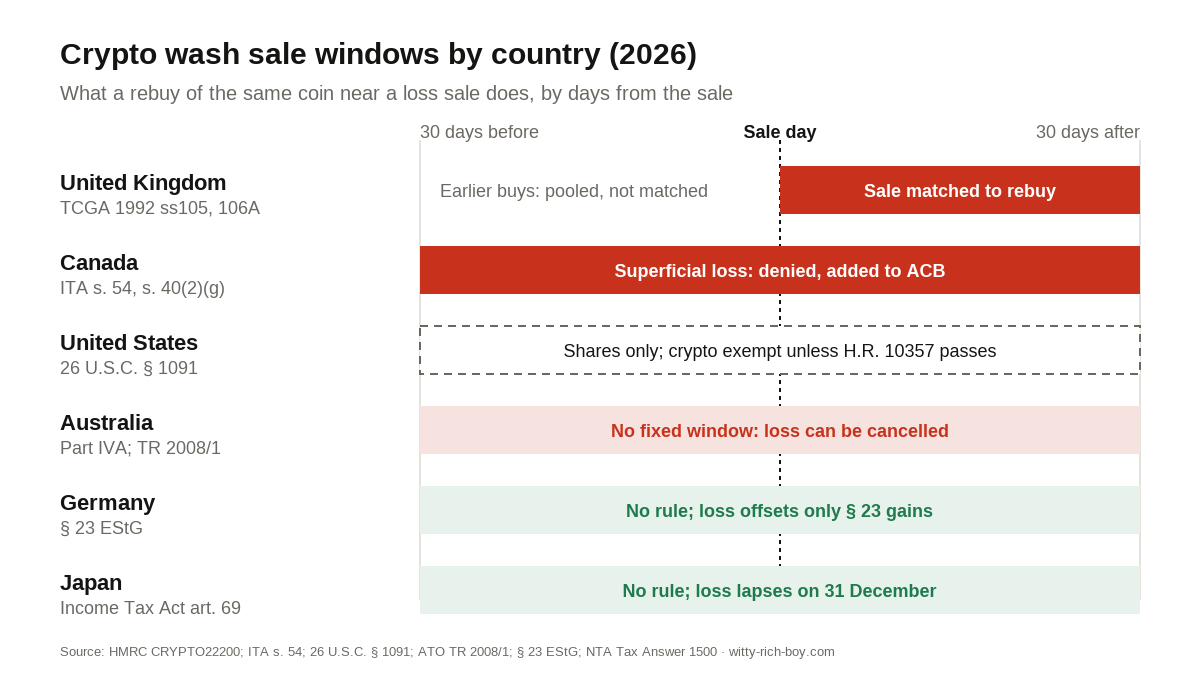
Two of the six — the UK and Canada — apply a fixed 30-day rule to crypto; Australia applies anti-avoidance law case by case; the US, Germany and Japan have no repurchase rule for crypto held directly.
| Country | Repurchase rule for crypto? | Window | What happens to the loss | Legal source |
|---|---|---|---|---|
| United Kingdom | Yes — “bed and breakfast” matching | Same day, then next 30 days | Sale is costed against the rebuy; the loss mostly vanishes | TCGA 1992 ss105, 106A; HMRC CRYPTO22200 |
| Canada | Yes — superficial loss | 30 days before to 30 days after | Set to nil and added to the replacement’s adjusted cost base | ITA s. 54, s. 40(2)(g) |
| United States | No (shares only) | 61 days for shares | Allowed for crypto; deferred for shares | 26 U.S.C. § 1091; IRS Notice 2014-21 |
| Australia | No fixed rule | None defined | Commissioner may cancel it under Part IVA | ITAA 1936 Part IVA; TR 2008/1 |
| Germany | No | — | Allowed, but only against § 23 private sale gains | § 23 EStG |
| Japan | No | — | Allowed only against same-year miscellaneous income | Income Tax Act art. 69; NTA No. 1500 |
How does the UK 30-day rule affect crypto losses?
The UK rule does not deny the loss outright; it re-costs the sale against the tokens you buy back, which usually leaves almost no loss at all.
HMRC’s manual page CRYPTO22200 sets the order. A disposal is matched first with tokens of the same type acquired on the same day (TCGA 1992 s105), then with tokens acquired in the following 30 days (s106A), earliest disposal first, and only then with the section 104 pool at average cost. Tokens caught by the 30-day rule never enter the pool. HMRC’s example CRYPTO22253 splits later purchases between two earlier sales.
The window looks forward only, and it bites only on the same type of token.
Two UK details change the arithmetic. First, losses must be reported before they can be used; GOV.UK allows a claim up to 4 years after the end of the tax year of the disposal. Second, same-year losses are deducted from same-year gains before the £3,000 annual exempt amount, so harvesting more loss than you need can waste the allowance. A UK investor with £4,000 of gains needs only £1,000 of loss to bring the taxable amount to nil. Rates and pooling are covered in our UK crypto tax guide.
How does Canada’s superficial loss rule work for crypto?
Canada denies the loss if you, or a person affiliated with you, buy the same or identical property in a window starting 30 days before and ending 30 days after the sale, and still own it when the window closes.
The definition sits in section 54 of the Income Tax Act, and paragraph 40(2)(g) sets a superficial loss to nil. The CRA’s page on capital losses and deductions lists affiliated persons, including your spouse or common-law partner and a corporation controlled by you or your spouse. The loss is deferred rather than destroyed: the person who acquired the substituted property can usually add it to that property’s adjusted cost base (ACB).
Two features make the Canadian rule the strictest of the six for crypto: it runs backwards as well as forwards, so topping up in the month before a loss sale can taint it, and it catches a spouse’s purchase.
Only half of a capital gain or loss counts; allowable capital losses offset taxable capital gains only, carried back three years or forward indefinitely. Our Canada crypto tax guide works through a partial rebuy.
Does the US wash sale rule apply to crypto in 2026?
No. Section 1091 of the Internal Revenue Code disallows losses only on stock or securities, and IRS Notice 2014-21 treats virtual currency as property. An American can sell a coin at a loss, buy it back the next day and still deduct the loss under current law.
The risk is legislative. H.R. 10357, the Digital Asset Tax Certainty Act, was introduced on 14 September 2026 and ordered reported by the Ways and Means Committee, 38 to 5, on 16 September. It would extend the wash sale rule to “specified assets”, including traded digital assets, with the usual 30 days either side, and would apply to dispositions after 14 September 2026. We found no record of a House floor vote as of 26 October 2026; nothing changes unless both chambers pass it and it is signed.
Net capital losses beyond your gains are limited to $3,000 a year against ordinary income ($1,500 married filing separately), with the rest carried forward. Our crypto wash sale rule guide covers the bills and Form 8949 reporting.
Can you harvest crypto losses in Australia?
Yes, but a sale and quick repurchase can be cancelled. Australia has no day-count rule; it relies on the general anti-avoidance provisions in Part IVA of the Income Tax Assessment Act 1936.
Taxation Ruling TR 2008/1 describes a wash sale as an arrangement under which a taxpayer disposes of an asset and reacquires the same or substantially the same asset, with no significant change in economic exposure, to obtain a capital loss. An asset is substantially the same if it is economically equivalent to, or fungible with, the one sold — which describes one unit of a token and the next almost perfectly. Where Part IVA applies, the Commissioner may cancel the tax benefit. Whether it applies depends on all the circumstances; there is no safe number of days.
The ATO’s media release Wash sales: the ATO is cleaning up dirty laundry says wash sales typically involve crypto and shares sold just before the end of the financial year — 30 June — and that its data analytics, drawing on share registries and crypto asset exchanges, can identify them, after which the capital loss is rejected.
The ATO’s guidance on using capital losses confirms that capital losses reduce capital gains only, not salary, and that an unused net capital loss carries forward with no time limit. See our Australia crypto tax guide for the CGT discount and record-keeping.
How do Germany and Japan limit crypto losses?
Neither has a wash sale rule; instead, each narrows what a crypto loss can offset.
Germany: the one-year rule and the § 23 box
Private crypto sales are taxed under § 23 EStG only if the coin was held one year or less; a loss on a coin held longer does not count. Short-term losses may be set only against gains from private sale transactions — in the same year, carried back one year or carried forward under § 10d — never against salary (§ 23 (3) sentences 7–8).
Section 23 contains no matching rule for repurchases. For securities, the Federal Fiscal Court holds that rebuying identical papers shortly after a sale at a different price is generally not an abuse under § 42 AO, though it can be where the taxpayer could expect to rebuy without price risk (BFH, IX R 5/16, 8 March 2017). We found no equivalent crypto ruling.
The German twist is the €1,000 Freigrenze in § 23 (3) sentence 5: if the year’s net private sale gains are under €1,000, they are tax-free; at €1,000 or more, all of it is taxed. A harvested loss that pulls €4,500 of short-term gains down to €500 removes the tax on the whole remainder. Rebuying restarts the one-year clock on the new units; our Germany crypto tax guide explains the wallet-by-wallet FIFO rules.
Japan: losses stay inside one year and one box
Individuals’ crypto gains are miscellaneous income. The National Tax Agency’s Tax Answer No. 1500 states that a loss within miscellaneous income cannot be offset against other income, and Article 69 of the Income Tax Act does not allow it. A crypto loss can reduce only other miscellaneous income of the same calendar year; anything left lapses on 31 December. A three-year carry-forward is enacted for the planned separate regime, expected from 1 January 2028 — see our Japan crypto tax guide.
What does the same harvest look like in six countries?
The same trade produces six different results.
Example (hypothetical, amounts in local currency): Sam holds 2 units of a token bought nine months earlier for 10,000. On 1 December 2026 they are worth 6,000. Sam sells both, a 4,000 loss, and buys 2 units back on 2 December for 6,100. Earlier in the same tax year Sam realised 4,000 of gains on other coins held under a year.
| Sam’s outcome | Loss usable now | What happens to the rest | Gains left to tax |
|---|---|---|---|
| United States | 4,000 | Nothing disallowed; new basis 6,100 | 0 |
| United Kingdom | 100 (6,000 − 6,100 rebuy cost) | Pool keeps its 10,000 cost | 3,900, less the £3,000 allowance = 900 |
| Canada | 0 (superficial loss) | 4,000 added to ACB: 10,100 | Taxable capital gain 2,000 (50%) |
| Australia | 4,000 claimed, but at risk | Part IVA may cancel it | 0 if allowed; 4,000 if cancelled |
| Germany | 4,000 | One-year clock restarts on new units | 0 |
| Japan | 4,000 | Any excess would lapse on 31 December | 0 |
Had Sam rebought on 1 January 2027 — day 31 — both windows would have closed: the UK loss becomes the full 4,000, and Canada’s 2,000 allowable capital loss wipes out the 2,000 taxable gain. In the UK, a smaller sale producing about 1,000 of loss would have done the job while keeping the £3,000 allowance in use.
Should you rebuy, wait 31 days or switch coins?
Waiting more than 30 days is the only choice that keeps the loss in all six systems, though in Australia even that is no safe harbour.
| If you are taxed in… | Rebuy the same coin next day | Wait 31+ days, then rebuy | Switch to a different coin |
|---|---|---|---|
| United Kingdom | Loss matched away | Full loss | Full loss (rule covers the same token type only) |
| Canada | Loss denied, added to ACB | Full loss, if no purchase in the 30 days before | Full loss, unless the property is identical |
| United States | Loss allowed today | Allowed under any pending bill | Allowed unless substantially identical |
| Australia | High Part IVA risk | Lower risk; no defined safe period | Lower risk if exposure genuinely changes |
| Germany | Allowed; one-year clock restarts | Allowed | Allowed |
| Japan | Allowed | Allowed | Allowed |
A swap into a different token is itself a disposal that realises the loss. Wrapped or bridged versions of the same coin are the weakest switch, being closest to economically identical.
How do you harvest crypto losses step by step?
- Confirm your tax residence and year-end. 31 December in the US, Canada, Germany and Japan; 5 April in the UK; 30 June in Australia. The sale must fall inside the year you want the loss in.
- List unrealised losses lot by lot. Use acquisition cost in your local currency and the date of each purchase; in Germany, check that the units were held one year or less, or the loss will not count. Which lot a sale is costed against depends on your country’s crypto cost basis method — pooling in the UK and Canada, FIFO per wallet in Germany.
- Total your realised gains for the year. Harvest only what you can use: in the UK, stop once gains fall to £3,000; in Germany, watch the €1,000 Freigrenze; in Japan, never exceed the year’s miscellaneous profits.
- Check the 30 days before the sale. In Canada, any purchase of the same coin by you or your spouse in that period, still held at the end of the window, makes the loss superficial.
- Sell before the year-end. Record the time, price, fees and exchange rate.
- Decide how to re-enter. Rebuying at once is fine in Germany, Japan and, for now, the US. In the UK and Canada wait until day 31; in Australia, avoid reacquiring an essentially unchanged exposure.
- Report the loss. UK losses must be claimed within four years; German short-term losses should be declared even in a year without gains so they can be carried forward; Canadian net capital losses can be carried back three years.
Across all six, a crypto loss is worth something only if it is realised in the right year, against the right kind of gain, without buying back the same coin inside a window your country polices.
Questions readers ask
Does the wash sale rule apply to crypto?
It depends on the country. The US wash sale rule in 26 U.S.C. § 1091 covers only stock or securities, so crypto held directly is outside it in 2026, although H.R. 10357 would change that if enacted. The UK and Canada have their own 30-day rules that do reach crypto. Australia relies on its general anti-avoidance law, Part IVA. Germany and Japan have no repurchase rule.
Can I sell crypto at a loss and buy it back in the UK?
You can, but the loss will mostly disappear. HMRC matches a disposal first with tokens of the same type bought that day and then with those bought in the next 30 days (TCGA 1992 ss105 and 106A, CRYPTO22200). The sale is costed against the repurchase price instead of your pool cost. Waiting until day 31, or buying a different token, keeps the loss.
How long do I have to wait to rebuy crypto in Canada?
More than 30 days after the sale, and you must not have bought the same coin in the 30 days before it either. Under section 54 of the Income Tax Act a loss is superficial if you or an affiliated person, such as your spouse, acquire identical property in that 61-day period and still hold it at the end. The denied loss is added to the new coins' adjusted cost base.
Is crypto tax loss harvesting legal in Australia?
Selling crypto to realise a genuine loss is legal. What the ATO targets is a wash sale: disposing of crypto, typically just before 30 June, and reacquiring the same or substantially similar asset shortly after, mainly to create a loss. Taxation Ruling TR 2008/1 says Part IVA can then apply, and the Commissioner may cancel the loss. There is no fixed safe waiting period.
Can I offset crypto losses against my salary?
Generally not in the countries compared here, except in the US. Australia and Canada let capital losses reduce only capital gains. Germany allows § 23 EStG losses only against private sale gains. Japan bars miscellaneous income losses from reducing other income. The UK sets them against chargeable gains. The US allows up to $3,000 a year of net capital loss against ordinary income.
Is there a wash sale rule for crypto in Germany?
No. Section 23 EStG contains no rule matching a sale with a later repurchase, and the Federal Fiscal Court has held for securities that rebuying shortly after a sale is generally not abusive under § 42 AO. The limits lie elsewhere: losses count only on coins held one year or less, and only against gains from private sale transactions in the same, previous or later years.
Can crypto losses be carried forward in Japan?
Not under the rules for 2026. Crypto gains are miscellaneous income, and the National Tax Agency states that a loss within miscellaneous income cannot be offset against other income such as salary. It can only reduce other miscellaneous income of the same year, and any excess lapses. A three-year carry-forward is enacted for Japan's planned separate crypto regime, but only for losses after it starts.
Was this guide useful?
Thanks — your answer helps us decide what to cover next.
Sources
- CRYPTO22200 — Cryptoassets for individuals: Capital Gains Tax: pooling (HMRC Cryptoassets Manual)
- CRYPTO22253 — Pooling examples: example 3, application of the 30 day rule (HMRC Cryptoassets Manual)
- Capital Gains Tax: if you make a loss (GOV.UK)
- Capital losses and deductions — superficial loss (Canada Revenue Agency)
- Income Tax Act, section 54 — definition of superficial loss (Justice Laws)
- Notice 2014-21: virtual currency treated as property (IRS)
- H.R.10357, 119th Congress — Digital Asset Tax Certainty Act (Congress.gov)
- Taxation Ruling TR 2008/1 — Income tax: application of Part IVA to wash sale arrangements (ATO, PDF)
- § 23 EStG — Private Veräußerungsgeschäfte (Gesetze im Internet)
- Tax Answer No. 1500 — Miscellaneous income (National Tax Agency, Japan)
General information, not tax or legal advice. Rules change — check the official source or a licensed adviser before acting.