United States · Tax
Crypto wash sale rule 2026: exempt today, but watch H.R. 10357
Crypto wash sale rule 2026: § 1091 still covers only stock and securities, so crypto losses can be harvested and rebought. H.R. 10357 would reach sales after 14 Sept.

The short answer
- Under 26 U.S.C. § 1091, the wash sale rule disallows a loss only on stock or securities rebought within 30 days before or after the sale; crypto held directly is property under IRS Notice 2014-21.
- So in 2026 a crypto investor can sell at a loss, buy the same coin back the next day and still deduct the loss — the IRS has issued no guidance applying § 1091 to digital assets.
- Net capital losses offset gains in full, then up to $3,000 of ordinary income a year ($1,500 married filing separately) under § 1211(b); the rest carries forward.
- H.R. 10357, the Digital Asset Tax Certainty Act, was approved 38–5 by Ways and Means on 16 September 2026; as amended, it would reach traded digital assets sold after 14 September 2026 if enacted.
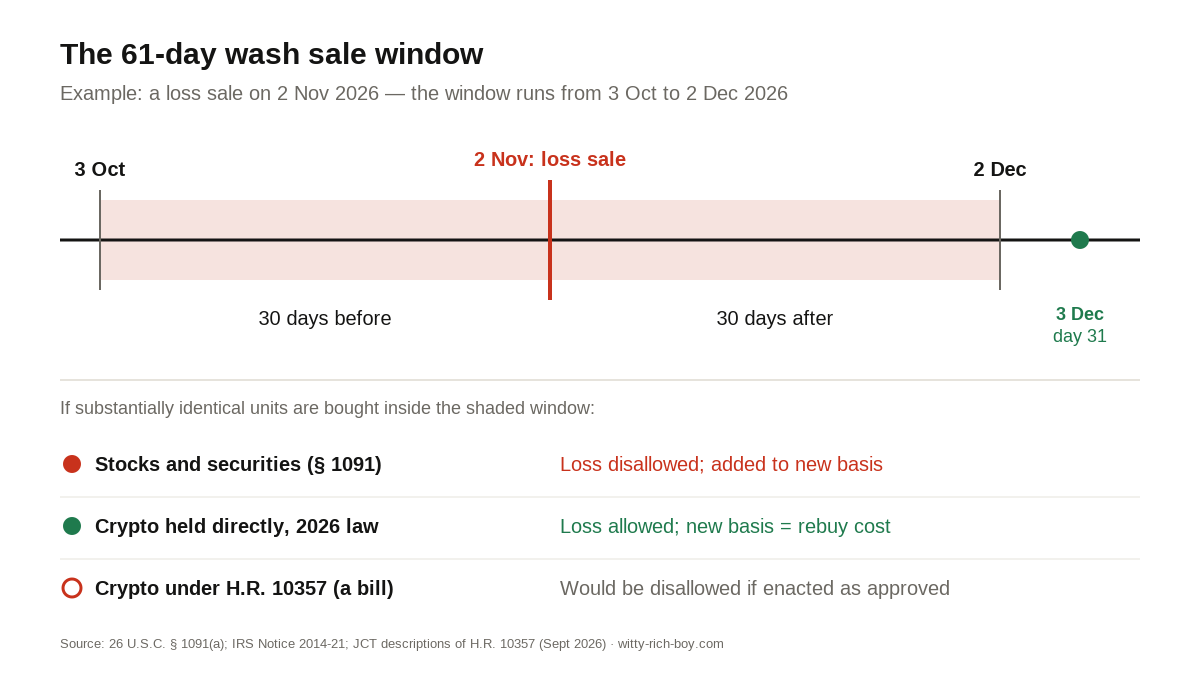
- Waiting until day 31 to rebuy — 3 December for a 2 November sale — keeps a harvest outside the window under any of the pending bills.
In force: Current law: 26 U.S.C. § 1091 applies to stock or securities only · H.R. 10357, approved in committee on 16 September 2026, would reach traded digital assets disposed of after 14 September 2026 if enacted in that form
The wash sale rule does not apply to crypto in 2026: § 1091 disallows losses only on stock or securities rebought within 30 days before or after a sale, and the IRS treats crypto as property. You can sell at a loss, rebuy and deduct the loss — though H.R. 10357 would end that for sales after 14 September 2026.
Every December American investors comb their portfolios for losers, sell them to bank a tax loss and, with shares, wait a month before buying back. Crypto holders have never had to wait. That asymmetry, an accident of a rule written for “stock or securities”, is now the subject of three bills, one of which cleared the House Ways and Means Committee in September with a start date already behind us. Below: the current law in precise terms, what each proposal would change, a worked loss-harvest example under both regimes, and a step-by-step method for harvesting and reporting losses safely. This guide covers US federal income tax only; we have not reviewed state rules.
What is the wash sale rule?
The wash sale rule is 26 U.S.C. § 1091, which denies a deduction for a loss on the sale of stock or securities if, within a period beginning 30 days before and ending 30 days after the sale, you acquire — or contract or take an option to acquire — substantially identical stock or securities. Counting the sale day, that is a 61-day window.
The rule defers rather than destroys the loss. Under § 1091(d), the disallowed amount is added to the basis of the replacement shares, and IRS Publication 550 adds that your holding period for the new shares includes the period you held the old ones. Publication 550’s own example: shares bought for $1,000 are sold for $750 and replaced within 30 days for $800; the $250 loss is disallowed, and the new basis becomes $1,050.
Publication 550 also widens the net. A wash sale occurs if your spouse or a corporation you control buys the substantially identical stock, or if you buy it for your IRA or Roth IRA. In the IRA case, Rev. Rul. 2008-5 holds that the loss is disallowed and your IRA basis is not increased — so the loss is gone for good. “Substantially identical” is a facts-and-circumstances test; shares of one company are ordinarily not substantially identical to shares of another.
If you rebuy only part of the position, only part of the loss is disallowed. Sell 100 shares at a loss and buy back 25 inside the window, and a quarter of the loss is deferred; the rest is deductible.
Does the wash sale rule apply to crypto in 2026?
No. Section 1091 is written for “stock or securities”, and cryptocurrency held directly is neither: IRS Notice 2014-21 states that virtual currency is treated as property and that general tax principles applicable to property transactions apply. The IRS digital asset FAQs follow the same framework.
The Joint Committee on Taxation’s September 2026 description of H.R. 10357 puts the present-law position plainly: digital assets are not expressly within the scope of § 1091, and the IRS has not issued guidance addressing whether the wash sale rule may apply to them. Until Congress amends the statute, a loss on a coin you sell and promptly repurchase is generally deductible, and the replacement coin simply takes the new purchase price as its basis.
Two edges matter:
- Tokenised securities. A digital asset that is also a stock or security remains inside § 1091. The 2026 Instructions for Form 1099-DA require brokers to report the disallowed loss in box 1i when the sale and repurchase of a tokenised security with the same CUSIP occur in the same account. Our Form 1099-DA guide explains the rest of that form.
- Exchange-traded products. Shares of crypto exchange-traded products sit in ordinary brokerage accounts and are reported on Form 1099-B, which has its own wash sale box. The IRS has not published guidance specific to them, so the cautious assumption is that § 1091 can apply.
| Shares, ETFs, options | Crypto held directly (current law) | |
|---|---|---|
| Legal basis | 26 U.S.C. § 1091 | Property under IRS Notice 2014-21 |
| Rebuy within 30 days before or after a loss sale | Loss disallowed | Loss allowed |
| Basis of replacement | Cost plus disallowed loss | Cost only |
| Holding period of replacement | Includes old holding period | Restarts the day after purchase |
| Spouse or IRA purchase | Triggers the rule (Pub. 550; Rev. Rul. 2008-5) | No rule applies |
| Broker reporting | Form 1099-B box 1g | Form 1099-DA; box 1i only for tokenised securities |
What would the crypto wash sale proposals change?
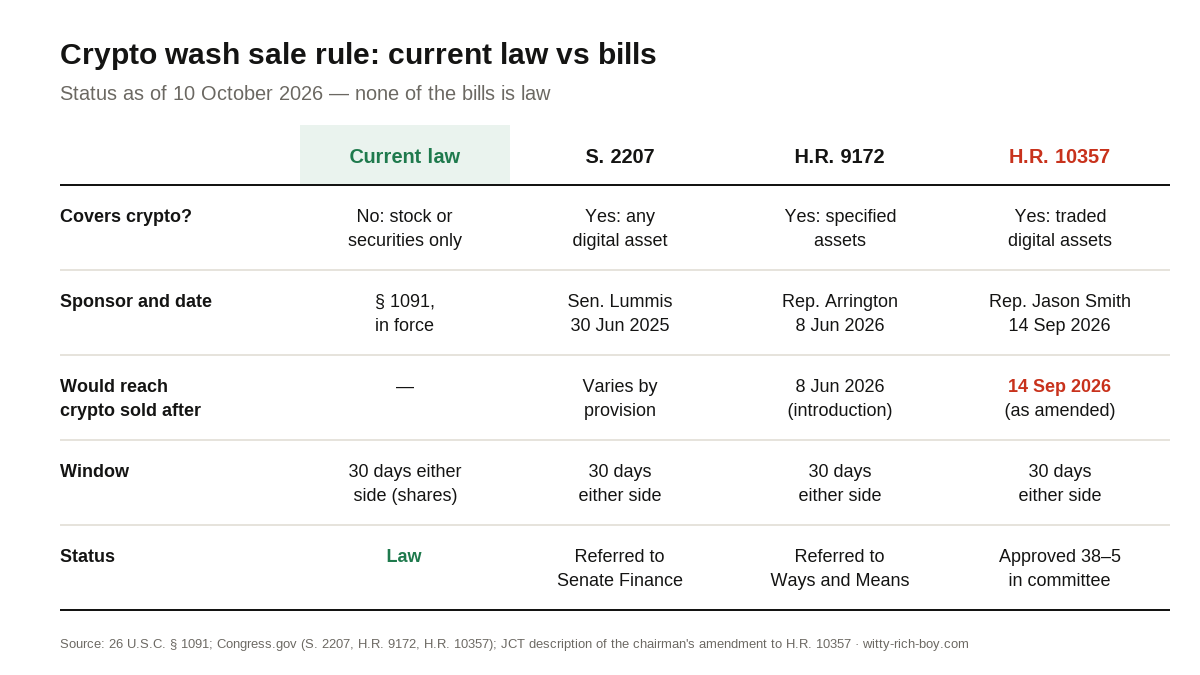
Each live proposal works the same way: it rewrites § 1091 so that “stock or securities” becomes “specified assets”, a term that includes digital assets, keeping the 30-day window on either side. They differ in scope, start date and progress.
H.R. 10357, the Digital Asset Tax Certainty Act, is the one that has moved. Congress.gov lists Rep. Jason Smith as sponsor, introduction on 14 September 2026, and a Ways and Means vote on 16 September 2026 ordering it reported in the nature of a substitute by 38 to 5. According to the JCT’s description, the wash sale rule would cover specified assets, defined to include securities and traded digital assets, with an exception for digital assets acquired in connection with validating transactions — staking and mining rewards would not count as replacement purchases. The chairman’s amendment replaces every reference to the bill’s date of introduction with 14 September 2026, and the wash sale section applies to dispositions after that date.
H.R. 9172, the Applying Existing Tax Anti-Abuse Rules to Digital Assets Act, was introduced by Rep. Jodey Arrington on 8 June 2026 and referred to Ways and Means. Its text strikes “stock or securities” in § 1091 and inserts “specified assets”, applying to dispositions after the date of introduction.
S. 2207, Sen. Cynthia Lummis’s digital asset tax bill, was introduced on 30 June 2025 and referred to the Senate Finance Committee. It would retitle § 1091 “Loss from wash sales of specified assets” and extend it to any digital asset and notional principal contracts on digital assets.
The idea is not new. The House text of the Build Back Better Act, H.R. 5376, in Rules Committee Print 117-17 of October 2021, would have extended § 1091 to digital assets for sales after 31 December 2021. The Senate rewrote the bill, and it became the Inflation Reduction Act, Public Law 117-169, without that provision.
| Bill | Sponsor and introduced | Crypto covered | Would apply to | Status, 10 October 2026 |
|---|---|---|---|---|
| Current law, § 1091 | In force | No — stock or securities only | — | Law |
| S. 2207 | Sen. Lummis, 30 June 2025 | Any digital asset | Varies by provision | Referred to Senate Finance |
| H.R. 9172 | Rep. Arrington, 8 June 2026 | Specified assets incl. digital assets | Dispositions after 8 June 2026 | Referred to Ways and Means |
| H.R. 10357 | Rep. Jason Smith, 14 September 2026 | Traded digital assets | Dispositions after 14 September 2026 (as amended) | Ordered reported 38–5, 16 September 2026 |
We found no record of a House floor vote on H.R. 10357 as of 10 October 2026. A bill becomes law only after passing both chambers in identical form and being signed, and its text can change on the way.
Why does the 14 September 2026 date matter now?
Because a harvest you make this autumn may be judged by a rule that does not yet exist. If H.R. 10357 became law with its committee text intact, a coin sold at a loss after 14 September 2026 and repurchased within 30 days before or after the sale would have its loss disallowed and added to the basis of the new coin — exactly as with shares.
That would not destroy the tax benefit, but it would push it into the future, and for a short-term holder it would also carry the old holding period across. The practical response is cheap: if you want the loss to survive any version of the bills, leave a gap of at least 31 days before buying back, or move into an asset that is not substantially identical. We found no definition of “substantially identical” for tokens in the bill materials, so a wrapped or bridged version of the same coin is a poor replacement.
There is also a separate, older doctrine. Section 7701(o) codifies the economic substance doctrine, under which tax benefits are disallowed if a transaction lacks economic substance or a business purpose; for individuals it applies to transactions entered into for the production of income. The IRS has not said it would apply the doctrine to crypto harvests, but a sale and repurchase within seconds carries more risk than one with a genuine change in market exposure.
How does a crypto loss harvest work in numbers?
The arithmetic is the same as for any capital loss; only the wash sale step differs.
Example: Maya, a single filer, buys 4 units of a token on 3 February 2026 for $40,000 including fees. By 2 November the price has fallen and she sells all 4 for $24,000 net, a $16,000 short-term capital loss. On 3 November she buys 4 units back for $24,200. Earlier in 2026 she realised $10,000 of short-term gains on other coins, and her marginal rate is an assumed 24%.
Under current law the loss is allowed. It wipes out her $10,000 of gains, leaving a $6,000 net capital loss. Section 1211(b) lets her deduct $3,000 of that against salary and other ordinary income; the remaining $3,000 carries forward to 2027. Her tax saving for 2026 is ($10,000 + $3,000) × 24% = $3,120. Her new units have a basis of $24,200 and a holding period starting on 4 November 2026, the day after purchase.
Had Maya done the same with shares — or with crypto under H.R. 10357 as approved — the $16,000 loss would be disallowed. Her $10,000 of gains would stay taxable, her 2026 saving from the loss would be $0, and the new units would carry a basis of $24,200 + $16,000 = $40,200, with her February holding period tacked on.
| Maya’s 2026 outcome | Crypto, current law | Shares, or crypto under H.R. 10357 |
|---|---|---|
| Loss recognised in 2026 | $16,000 | $0 |
| Gains offset | $10,000 | $0 |
| Deducted against ordinary income | $3,000 | $0 |
| Carried forward to 2027 | $3,000 | $0 |
| Tax saved in 2026 at 24% | $3,120 | $0 |
| Basis of new units | $24,200 | $40,200 |
| Holding period of new units | Starts 4 November 2026 | Includes the old period from 4 February 2026 |
| If she rebuys on 3 December instead | $16,000 loss allowed | $16,000 loss allowed |
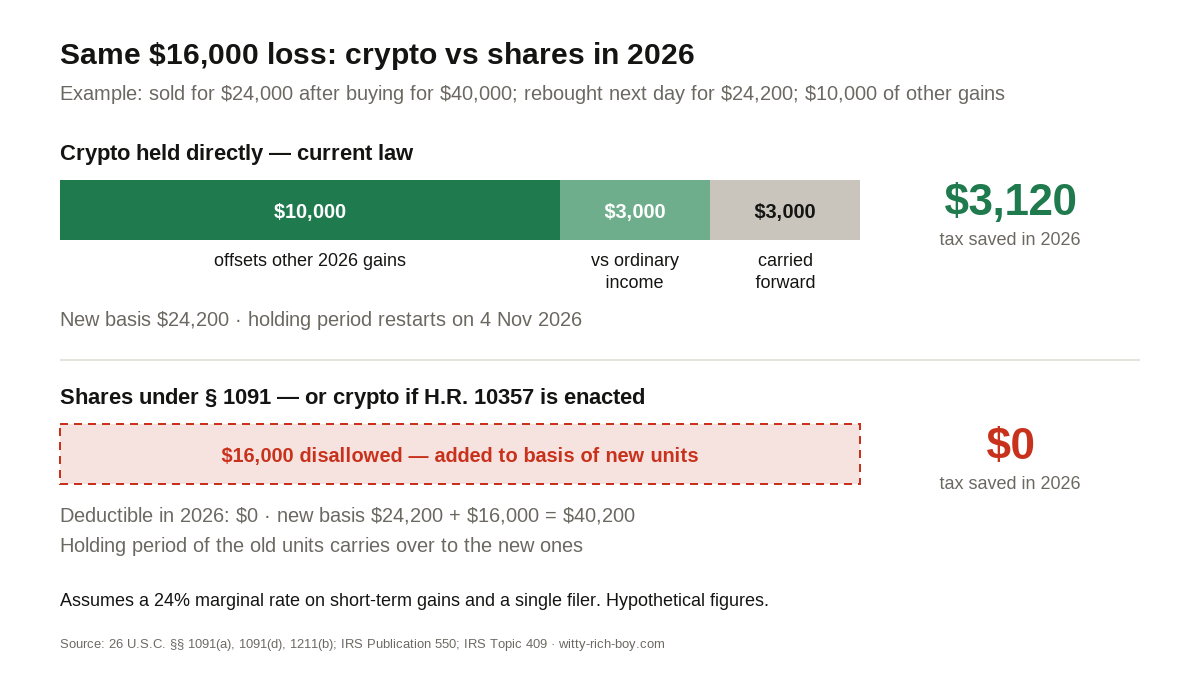
The deferred loss is not wasted: the higher $40,200 basis shrinks her eventual gain or enlarges her eventual loss. But for offsetting 2026 gains, timing is the whole point.
Note one cost of the crypto route: the clock restarts. A coin held for more than one year produces long-term gain at lower rates; selling and rebuying a long-held coin at a loss resets its holding period, so a later recovery could be taxed as short-term gain.
How do you tax-loss-harvest crypto and report it?
- List unrealised losses by lot. Since 1 January 2025 basis is tracked wallet by wallet and account by account, so check each lot’s cost and acquisition date where it is actually held.
- Choose the lots to sell. Brokers default to first-in, first-out. Notice 2026-20 lets you identify specific units in your own records before the sale until 31 December 2026; choosing the highest-cost lots maximises the loss.
- Check the other side of the ledger. Total your realised gains for the year. Losses offset gains first; only $3,000 of any excess ($1,500 married filing separately) reduces ordinary income.
- Sell by 31 December. A loss counts in the tax year of the sale.
- Decide how to rebuy. Under current law an immediate rebuy keeps the loss. To protect it against H.R. 10357 or H.R. 9172 as drafted, wait until day 31 — 3 December for a 2 November sale — or buy something not substantially identical. Do not buy the same token in the 30 days before the sale either.
- Watch related accounts. If you hold shares or exchange-traded products alongside coins, apply § 1091 to those, including purchases by your spouse or in your IRA.
- Keep records of each sale, lot identification and repurchase date.
- Report on Form 8949. Digital asset sales go in boxes G, H or I (short-term) or J, K or L (long-term), depending on whether a Form 1099-DA showed basis. For a wash sale on shares, enter code W in column (f) and the disallowed loss as a positive number in column (g), as the Form 8949 instructions require.
- Carry totals to Schedule D and track any carryforward for next year’s return.
How does the US compare with the UK and Germany?
The US currently has no matching rule for crypto; the UK does. There, HMRC matches a disposal with tokens of the same type bought in the following 30 days under TCGA 1992 s106A — the “bed and breakfast” rule explained in our UK crypto tax guide. Unlike § 1091, it looks only forward, and it does not disallow the loss: it matches the sale against the new purchase price, which usually shrinks the loss to almost nothing. Canada’s superficial loss rule is closer to § 1091: it looks 30 days both before and after the sale and adds the denied loss to the cost of the replacement property — see our Canada crypto tax guide.
Germany needs no such rule for long-term holders, because gains on coins held more than one year are tax-free under § 23 EStG; see our Germany crypto tax guide. The common thread is that a sale, including a swap for another coin, is the taxable event — the principle set out in our guide to whether crypto-to-crypto swaps are taxable. Our country-by-country guide to crypto tax loss harvesting runs the same loss through the US, UK, Canada, Australia, Germany and Japan side by side.
Does the wash sale rule apply inside retirement accounts?
Gains and losses inside an IRA are not recognised year by year, so there is nothing to harvest there. The trap runs the other way: selling shares at a loss in a taxable account and buying them in your IRA within the window is a wash sale under Publication 550, and Rev. Rul. 2008-5 denies any basis increase, making the loss permanent. Contributions to those accounts are capped — see the Roth IRA income limits for 2026.
For crypto held directly, the rule does not apply today in any account. The sensible plan for the rest of 2026 is to harvest as current law allows, while leaving 31 days between loss sale and repurchase until Congress decides what H.R. 10357 becomes.
Questions readers ask
Does the wash sale rule apply to crypto in 2026?
Not under current law. Section 1091 of the Internal Revenue Code disallows losses only on stock or securities, and the IRS treats cryptocurrency held directly as property under Notice 2014-21. The IRS has not issued guidance applying the wash sale rule to digital assets. Bills to change that are pending in Congress, but as of 10 October 2026 none had become law.
Can I sell crypto at a loss and buy it back immediately?
Under current federal law, yes: the loss is generally deductible even if you buy the same coin back minutes later, and your new basis is simply the repurchase price. The risk is legislative. H.R. 10357, as approved in committee, would apply the wash sale rule to traded digital assets sold after 14 September 2026 if it became law in that form.
What is the 30-day wash sale rule?
It is the rule in 26 U.S.C. § 1091 that disallows a loss on selling stock or securities if you acquire substantially identical stock or securities within 30 days before or 30 days after the sale. The disallowed loss is not lost for good: it is added to the basis of the replacement shares, and their holding period includes the time you held the old ones.
How much crypto loss can I deduct in a year?
Capital losses first offset capital gains without limit. If losses exceed gains, you can deduct up to $3,000 of the excess against ordinary income, or $1,500 if married filing separately, under § 1211(b). Anything above that carries forward to later years with no expiry, keeping its short-term or long-term character, and is used the same way each year.
Does the wash sale rule apply to crypto ETFs?
Shares of crypto exchange-traded products are held in ordinary brokerage accounts and reported on Form 1099-B, which carries a box for wash sale losses disallowed. The IRS has not published guidance specific to crypto exchange-traded products. The cautious approach is to assume § 1091 can apply to them, and to wait 31 days before buying back the same fund after a loss sale.
Would the new crypto wash sale rule be retroactive?
Possibly, if enacted as approved. The Joint Committee on Taxation's description of the chairman's amendment to H.R. 10357 replaces the bill's references to its date of introduction with 14 September 2026, and its wash sale section applies to dispositions after that date. Losses harvested and rebought this autumn could therefore be caught. Nothing changes unless the bill passes both chambers and is signed.
How do I report a crypto loss on my tax return?
Report each sale on Form 8949 — boxes G, H or I for short-term digital asset sales and J, K or L for long-term, depending on whether a Form 1099-DA was issued and showed basis — then carry the totals to Schedule D. For stock wash sales, code W goes in column (f) and the disallowed loss is entered as a positive number in column (g).
Does buying crypto in my IRA count as a wash sale?
For crypto held directly, no wash sale rule applies under current law. For shares, it does: Publication 550 lists buying substantially identical stock for your IRA or Roth IRA as a wash sale trigger, and under Rev. Rul. 2008-5 the loss is disallowed without any increase in your IRA basis, so it is lost permanently rather than deferred.
Was this guide useful?
Thanks — your answer helps us decide what to cover next.
Sources
- 26 U.S. Code § 1091 — Loss from wash sales of stock or securities (Cornell LII)
- 26 U.S. Code § 1211 — Limitation on capital losses (Cornell LII)
- Notice 2014-21: tax treatment of virtual currency (IRS)
- Frequently asked questions on digital asset transactions (IRS)
- Publication 550 (2025), Investment Income and Expenses — wash sales (IRS)
- Instructions for Form 8949 (2025), Sales and Other Dispositions of Capital Assets (IRS)
- Instructions for Form 1099-DA (2026) — box 1i wash sale loss disallowed (IRS)
- H.R.10357, 119th Congress — Digital Asset Tax Certainty Act (Congress.gov)
- JCT description of the chairman's amendment in the nature of a substitute to H.R. 10357 (Ways and Means)
- S.2207, 119th Congress — bill to reform the tax treatment of digital assets (Congress.gov)
General information, not tax or legal advice. Rules change — check the official source or a licensed adviser before acting.