Japan · Crypto
Japan Crypto Tax Rate (2026): Up to 55% Now, 20% Expected in 2028
Japan's crypto tax rate in 2026 is 15.105% to 55.945%, as gains are miscellaneous income. A flat 20.315% rate is enacted but expected only from 1 January 2028.

The short answer
- For individuals, crypto gains are miscellaneous income (zatsu shotoku), stacked on top of salary and taxed at 5–45% national rates plus 10% inhabitant tax and a 2.1% surtax.
- The combined marginal rate runs from 15.105% to 55.945%; the top band starts at ¥40m of taxable income.
- Crypto losses cannot be offset against salary and cannot be carried forward under the current rules (Article 69, Income Tax Act).
- The separate 20% rate (15% national + 5% inhabitant, 20.315% with surtax) was enacted on 31 March 2026, but it only starts on 1 January of the year after the amended FIEA takes effect — expected 1 January 2028.
- The FIEA amendment was enacted on 15 July 2026 and promulgated as Act No. 64 of 2026; its crypto provisions must take effect by 22 July 2027.
- Non-permanent residents (5 years or less in Japan in the past 10) are generally still taxed on crypto gains even if the money never reaches Japan, because crypto gains are not usually treated as foreign-source income.
In force: Tax year 2026 (miscellaneous-income rules) · Separate 20% regime: 1 January of the year after the amended FIEA takes effect (expected 1 January 2028)
In 2026 Japan taxes individuals' crypto gains as miscellaneous income: progressive national rates of 5–45%, plus 10% inhabitant tax and a 2.1% surtax, for a combined 15.105% to 55.945%. A flat 20.315% rate is already law, but it starts only after the amended FIEA takes effect — expected 1 January 2028.
Japan has one of the heaviest crypto tax regimes in the rich world, and the reason is classification, not a special levy. Crypto gains are treated as side income and piled on top of your salary. That is about to change — the law has passed — but not yet, and the gap between “enacted” and “in force” is where most of the confusion lies.
What is the crypto tax rate in Japan in 2026?
The crypto tax rate in Japan in 2026 is your marginal income tax rate, between 5% and 45%, plus 2.1% of that tax as reconstruction surtax, plus a flat 10% inhabitant tax. Combined, that is 15.105% at the bottom and 55.945% at the top.
The national brackets come from the National Tax Agency’s rate table (NTA Tax Answer No. 2260). Inhabitant tax (juminzei) adds 6% municipal and 4% prefectural income-based tax, a flat 10% in total, according to the Ministry of Internal Affairs and Communications. The reconstruction special income tax is 2.1% of the base income tax for every year from 2013 to 2037.
| Taxable income (all income combined) | National rate | Quick deduction | Combined marginal rate on crypto |
|---|---|---|---|
| Up to ¥1,949,000 | 5% | ¥0 | 15.105% |
| ¥1,950,000 – ¥3,299,000 | 10% | ¥97,500 | 20.210% |
| ¥3,300,000 – ¥6,949,000 | 20% | ¥427,500 | 30.420% |
| ¥6,950,000 – ¥8,999,000 | 23% | ¥636,000 | 33.483% |
| ¥9,000,000 – ¥17,999,000 | 33% | ¥1,536,000 | 43.693% |
| ¥18,000,000 – ¥39,999,000 | 40% | ¥2,796,000 | 50.840% |
| ¥40,000,000 and over | 45% | ¥4,796,000 | 55.945% |
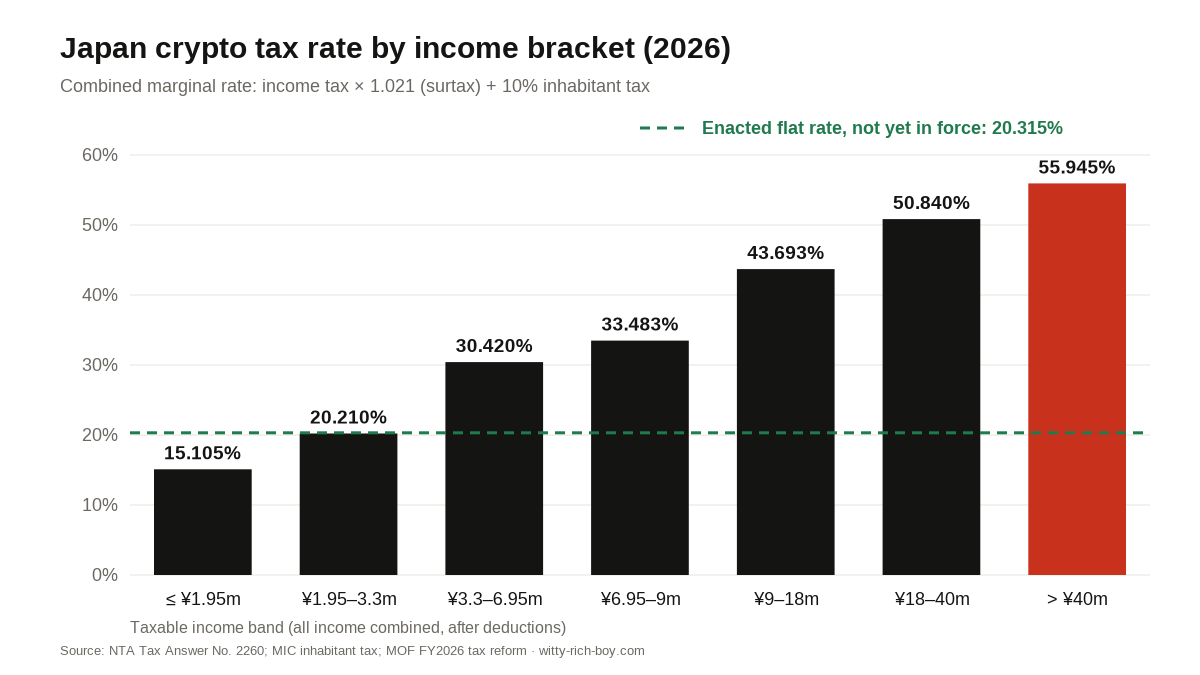
From tax year 2027 the FY2026 tax law cuts the reconstruction surtax to 1.1% (extended to 2047) and adds a new defence special income tax of 1%. The two still total 2.1%, so the 55.945% ceiling is unchanged.
How does Japan classify crypto gains?
Japan classifies crypto gains made by individuals as miscellaneous income (zatsu shotoku, “other miscellaneous income”), in principle. Miscellaneous income is the residual category of Japanese income tax: income that is not salary, business, property, interest, dividend or capital-gains income under the Income Tax Act. It is taxed together with everything else you earn, not separately.
The NTA’s crypto FAQ (revised December 2025, Q2-2) adds a threshold: if annual crypto proceeds (not profit) exceed ¥3 million and you keep books, the activity is in principle business income, judged case by case. Most investors remain in miscellaneous income.
What counts as a taxable event is set out in the same FAQ:
| Transaction | Taxable now? | How the gain is measured | NTA FAQ |
|---|---|---|---|
| Selling crypto for yen | Yes | Sale price minus cost | Q1-1 |
| Paying for goods or services in crypto | Yes | Value of the goods minus cost of the coins | Q1-2 |
| Swapping one crypto for another | Yes | Market value of the coin received minus cost of the coin given | Q1-3 |
| Receiving staking, lending or mining rewards | Yes, as income | Market value when received | Q1-7 |
| Margin and leveraged crypto trading | Yes | Comprehensive taxation, not the futures regime | Q2-12 |
| Moving coins between your own wallets | No | — | — |
Swaps catch active traders: tax is due though no yen arrives. Japan is mainstream here — see which countries tax crypto-to-crypto swaps.
Which cost method do you use?
Individuals use either the total average method (sō-heikin-hō) or the moving average method (idō-heikin-hō); with no election filed, the default is total average (NTA FAQ Q2-4, Q2-5). Switching later needs the tax office’s approval.
Worked example: how much tax on a ¥3m crypto gain?
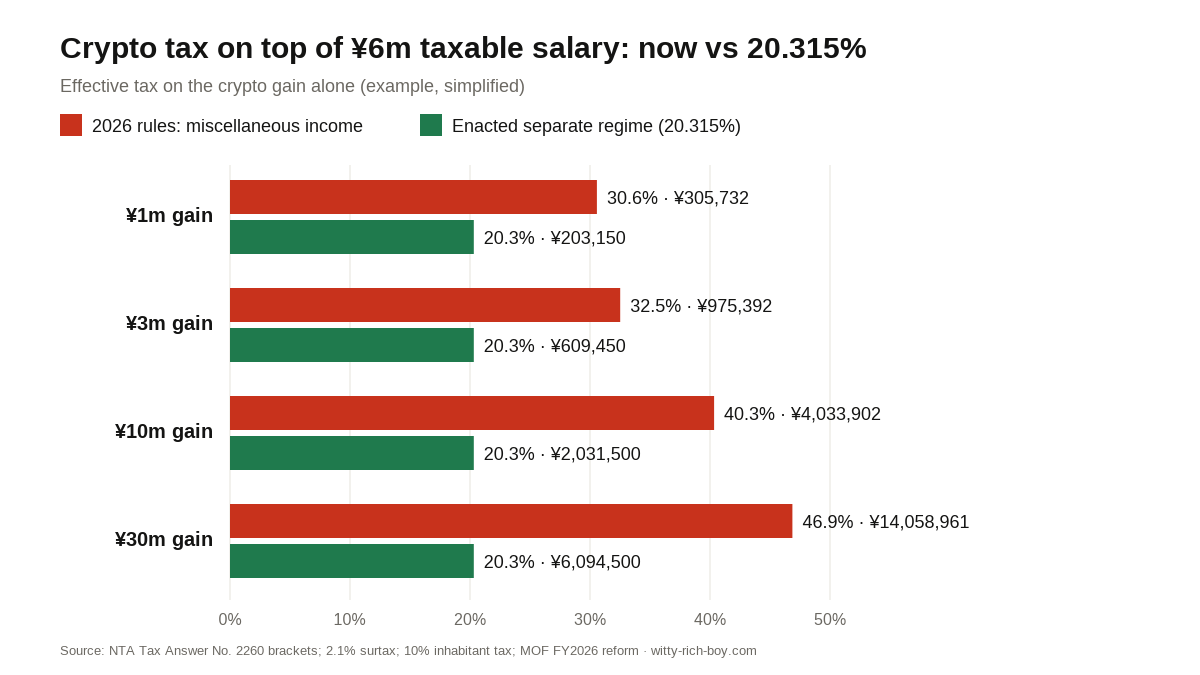
A ¥3 million crypto gain for someone with ¥6 million of other taxable income costs about ¥975,000 in tax in 2026 — an effective 32.5%. Under the enacted separate regime the same gain would cost ¥609,450.
Example: Aiko has taxable salary income of ¥6,000,000 after deductions and realises a ¥3,000,000 gain selling Bitcoin in 2026. (Simplified: it assumes inhabitant-tax deductions match national ones.)
| Step | 2026 rules (miscellaneous income) | Separate regime (once in force) |
|---|---|---|
| Income tax without crypto | ¥6,000,000 × 20% − ¥427,500 = ¥772,500 | ¥772,500 (unchanged) |
| Income tax with crypto | ¥9,000,000 × 33% − ¥1,536,000 = ¥1,434,000 | — |
| Extra income tax from crypto | ¥661,500 | ¥3,000,000 × 15% = ¥450,000 |
| Surtax (2.1% of the extra tax) | ¥13,892 | ¥9,450 |
| Inhabitant tax on the gain | 10% = ¥300,000 | 5% = ¥150,000 |
| Total tax on the gain | ¥975,392 (32.5%) | ¥609,450 (20.315%) |
The gain pushes Aiko from the 20% band into the 33% band. Larger gains widen the gap:
Can you offset crypto losses in Japan?
You cannot offset crypto losses against salary or other income in Japan, and you cannot carry them forward. Under Article 69 of the Income Tax Act, only losses from real estate, business, timber and capital-gains (jōto) income can be set against other income categories. Miscellaneous income is not on that list (NTA FAQ Q2-11).
What you can do is net gains and losses inside miscellaneous income in the same calendar year: a loss on one coin reduces a gain on another. Once 31 December passes, an unused loss disappears. Compare that with Germany, where crypto held for more than a year is tax-free, or the UK, where capital losses can be carried forward indefinitely.
The enacted reform adds a three-year loss carry-forward, but only for losses on specified crypto-assets sold to a registered exchange on or after the regime’s start date, and only against future gains of the same type. Losses from 2026 and 2027 will not carry into the new system.
Is Japan’s 20% crypto tax enacted? The 2026 reform, step by step
Yes, the 20% crypto tax is enacted, but it is not in force. The tax provisions became law on 31 March 2026; they switch on only from 1 January of the year after the amended Financial Instruments and Exchange Act (FIEA) takes effect, and that date has not yet been fixed.
Here is the chain, as of 1 October 2026:
- 26 December 2025 — The Cabinet adopted the FY2026 Tax Reform Outline. It proposed taxing gains on “specified crypto-assets” separately at 20% (15% income tax, 5% inhabitant tax), on the premise that the FIEA would be amended.
- 31 March 2026 — The Income Tax Act etc. amendment, submitted on 20 February, was enacted and promulgated. It creates new Articles 38-2 and 38-3 of the Act on Special Measures Concerning Taxation: a separate 15% national rate, a three-year loss carry-forward and exchange reporting.
- 15 July 2026 — The Diet enacted the amendment to the FIEA and the Payment Services Act, moving crypto from payment-services regulation into securities-style regulation. It was submitted on 10 April and passed the lower house on 11 June.
- 23 July 2026 — Promulgated as Act No. 64 of 2026. Its crypto provisions take effect on a date set by cabinet order, no later than one year after promulgation — that is, by 22 July 2027. No such order had been published by 1 October 2026.
- 1 January of the following year — The separate rate applies to disposals from 1 January of the year after the FIEA date. If the FIEA takes effect during 2027, that is 1 January 2028.
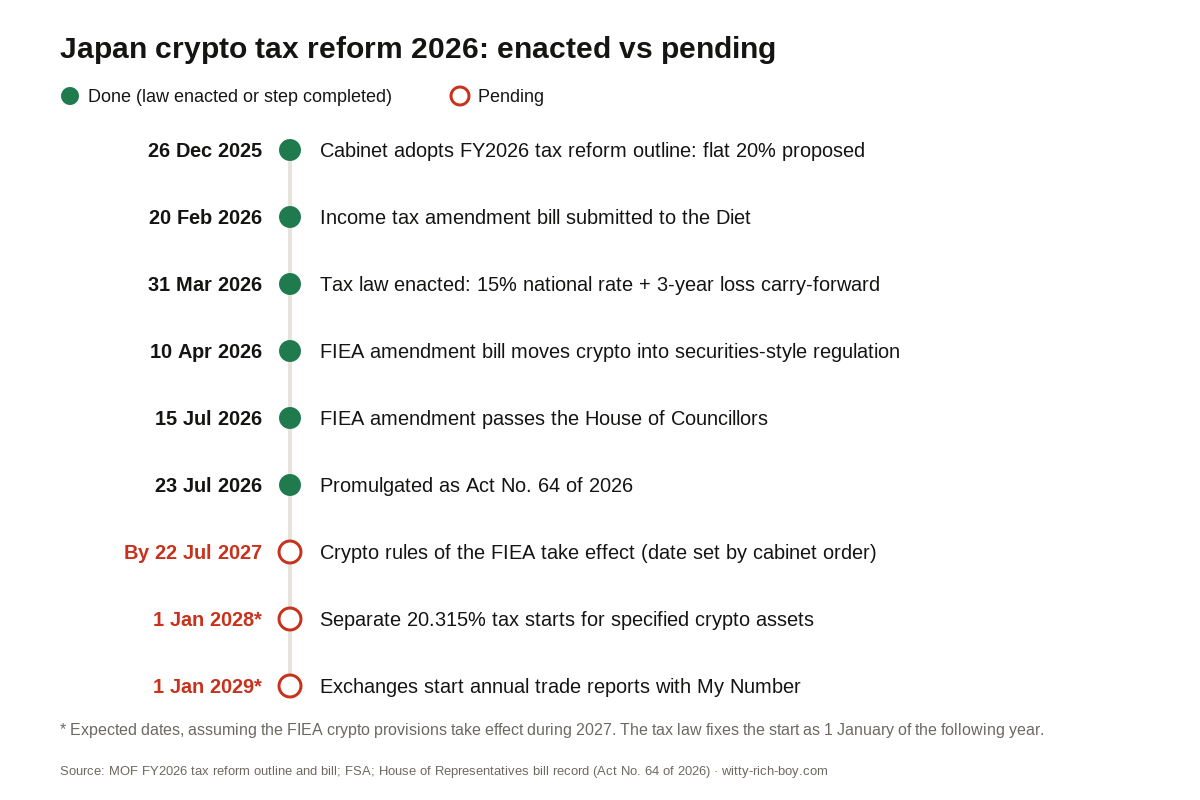
The 20% figure is the outline’s own headline. With the 2.1% surtax applied to the 15% national part, the effective rate is 20.315%, the same as on listed shares. The enacted law also requires registered exchanges to report each customer’s name, My Number and trades to the tax office by 31 January of the following year — for trades from the year after the start year, so 2029 on current expectations.
Which crypto will qualify for the 20% rate?
Only specified crypto-assets qualify: crypto whose name is entered in the Financial Instruments Business Operator Register, sold to a registered crypto-asset trading business. Everything else stays under progressive taxation, and the enacted law makes that residual treatment slightly harsher.
| Situation after the start date | Expected treatment |
|---|---|
| Selling a registered coin (e.g. BTC, ETH) to a registered Japanese exchange | Separate 20.315%, 3-year loss carry-forward |
| Crypto derivatives on specified crypto via a registered business | Joins the futures separate-taxation regime (Article 41-14, Act on Special Measures Concerning Taxation) |
| Crypto ETFs or investment trusts holding specified crypto | Taxed like listed shares (subject to the investment-trust rules being amended) |
| Selling on an overseas exchange | Progressive rates (not a sale to a registered Japanese business) |
| Decentralised exchange, DeFi swap or wallet-to-wallet sale | Progressive rates |
| Tokens not listed by any registered Japanese platform | Progressive rates |
For crypto taxed as comprehensive capital-gains income, the enacted Income Tax Act amendment also denies the ¥500,000 special deduction, the halving of gains on assets held over five years, and loss offsetting. Perpetual futures on offshore venues stay outside the new regime; see how funding rates work on those positions.
Crypto tax for foreigners in Japan: residents, non-permanent residents and non-residents
Crypto tax for foreigners in Japan depends on residency status, not nationality alone. Under the Income Tax Act, as summarised in NTA Tax Answer No. 2010, there are three categories.
| Status | Definition | Taxable crypto income |
|---|---|---|
| Resident (other than non-permanent) | Domicile in Japan, or residence for one year or more, and not a non-permanent resident | Worldwide crypto gains |
| Non-permanent resident | Resident without Japanese nationality who has had a domicile or residence in Japan for 5 years or less in total in the past 10 years | Income that is not foreign-source, plus foreign-source income paid in Japan or remitted to Japan |
| Non-resident | Anyone who is not a resident | Japan-source income only; per NTA FAQ Q1-8, selling crypto to a Japanese exchange is not taxed |
Does the remittance rule protect non-permanent residents?
Usually not for crypto. The remittance basis shelters foreign-source income — interest on a home-country bank account, say — unless it is paid in Japan or sent to Japan. Crypto gains are generally not treated as foreign-source income, because they do not appear on the statutory list of foreign-source asset transfers. The prevailing view among Japanese tax practitioners is that a non-permanent resident’s crypto gain is taxable in Japan whether the trade is on a Japanese or an overseas exchange and whether or not the proceeds are remitted.
Example: Lena, a German national, has lived in Tokyo for three years. She sells ETH on a European exchange for a ¥2m gain and leaves the euros in Germany. As the gain is not foreign-source income, it is generally taxable in Japan at her marginal rate. Her foreign bank interest, by contrast, becomes taxable only if paid in or remitted to Japan.
Two more points for internationally mobile investors:
- Leaving Japan. Once you are a non-resident, the NTA states that selling crypto to a Japanese exchange is not taxable in Japan and is not subject to withholding (FAQ Q1-8). Crypto is not currently among the assets covered by Japan’s exit tax, which applies to securities and certain unsettled derivative positions, though that may be revisited.
- After five years. After five years in Japan within ten, a non-permanent resident becomes an ordinary resident taxed on worldwide income. Your home country may also tax the same gain; check the relevant tax treaty.
How to file crypto tax in Japan
You report crypto gains on the final income tax return (kakutei shinkoku), filed between mid-February and 15 March of the following year. Gains from 2026 are therefore due by 15 March 2027.
- Check whether you must file. Employees taxed through year-end adjustment generally need not file a national return if income other than salary and retirement income is ¥200,000 or less (NTA Tax Answer No. 1900). The amount is still subject to inhabitant tax and must be declared to your municipality.
- Collect each exchange’s annual transaction report (nenkan torihiki hōkokusho); for overseas exchanges and wallets, export full histories.
- Value every swap, purchase and reward in yen at the time it happened, using a consistent price source.
- Calculate cost with your chosen method. The NTA publishes a crypto calculation sheet for both the total average and moving average methods (FAQ Q2-8).
- Net gains and losses for the calendar year. Remember that a net loss is lost — it neither reduces salary nor carries forward.
- Enter the result as miscellaneous income on the return, via e-Tax or on paper, and keep records.
- Pay income tax by 15 March. Inhabitant tax on the gain is assessed by your municipality and collected from June, either by bill or through payroll.
Japan vs Germany vs the UK: how does crypto tax compare?
Japan taxes crypto far more heavily than most peers today, but the enacted reform will narrow the gap.
| Japan (2026) | Japan (expected 2028) | Germany | United Kingdom | |
|---|---|---|---|---|
| Rate | 15.105–55.945% marginal | 20.315% flat (specified crypto) | 0% if held over a year; else income tax | 18% / 24% capital gains tax |
| Loss carry-forward | None | 3 years | Yes, within private sales | Indefinitely |
| Swaps taxable | Yes | Yes | Yes (within one year) | Yes |
Europe is moving the same way on transparency: EU exchanges report customer trades under DAC8 from 2026, while Japan’s new My Number-linked exchange reports follow the separate regime.
Until the cabinet order sets the FIEA date and the following 1 January arrives, every yen of crypto profit is taxed at your marginal rate and every loss expires on 31 December. Anyone timing a large disposal should confirm the dates with a licensed tax accountant (zeirishi).
Questions readers ask
What is the crypto tax rate in Japan in 2026?
Crypto gains made by individuals in 2026 are miscellaneous income, taxed together with salary at national rates of 5% to 45%, plus 10% inhabitant tax and a 2.1% reconstruction surtax on the national tax. The combined marginal rate therefore runs from 15.105% to 55.945%, depending on your total taxable income.
Is Japan's 20% crypto tax already in effect?
No. The separate 20% rate was written into law on 31 March 2026, but it applies only to disposals from 1 January of the year after the amended Financial Instruments and Exchange Act takes effect. That Act must take effect by 22 July 2027, so the 20% rate is expected from 1 January 2028. Gains in 2026 and 2027 are taxed at progressive rates.
Do I pay tax when I swap one crypto for another in Japan?
Yes. The National Tax Agency treats a crypto-to-crypto swap as a disposal of the coin you give up, valued at the market price of the coin you receive. Buying goods with crypto is also a disposal. The gain is miscellaneous income in the year of the trade, even though you never received yen.
Can I deduct crypto losses from my salary in Japan?
No. Losses within miscellaneous income cannot be offset against salary or other income, under Article 69 of the Income Tax Act, and they cannot be carried forward. They can only reduce other miscellaneous income in the same year. A three-year carry-forward is enacted for the new separate regime, but only for losses after it starts.
Do salaried workers need to file a tax return for small crypto gains?
An employee whose salary is settled through year-end adjustment generally does not need to file a national return if income other than salary and retirement income, including crypto, totals ¥200,000 or less for the year. The gain is still subject to inhabitant tax, so it must be declared to your municipality.
How are foreigners taxed on crypto in Japan?
It depends on residency status. Permanent residents for tax purposes are taxed on worldwide income. Non-permanent residents are taxed on income that is not foreign-source plus foreign-source income paid in or remitted to Japan, and crypto gains are generally not treated as foreign-source. Non-residents are not taxed on selling crypto to a Japanese exchange, according to the NTA.
Which coins will qualify for the 20% crypto tax in Japan?
Only 'specified crypto-assets': coins whose names are entered in the Financial Instruments Business Operator Register, sold to a registered crypto-asset trading business. Trades on overseas exchanges, decentralised exchanges or between private wallets are expected to stay under progressive taxation, as are tokens not listed by a registered Japanese platform.
How is staking income taxed in Japan?
Coins received from staking, lending or mining are income at their market value when you receive them, according to the NTA crypto FAQ. That value becomes the coin's cost for later disposals. Under current rules it is miscellaneous income taxed at your marginal rate.
Was this guide useful?
Thanks — your answer helps us decide what to cover next.
Sources
- National Tax Agency — FAQ on the tax treatment of crypto-assets (revised December 2025, PDF)
- National Tax Agency — Tax Answer No. 2260: Income tax rates
- National Tax Agency — Tax Answer No. 2010: Individuals liable to income tax (residents, non-permanent residents, non-residents)
- National Tax Agency — Tax Answer No. 1900: Salaried employees who must file a return
- Ministry of Finance — FY2026 Tax Reform Outline (Cabinet decision, 26 December 2025, PDF)
- Ministry of Finance — Outline of the Income Tax Act etc. amendment bill, 221st Diet (enacted 31 March 2026, PDF)
- Financial Services Agency — Bills submitted to the Diet (FIEA and Payment Services Act amendment, enacted 15 July 2026)
- House of Representatives — Bill record, 221st Diet Cabinet Bill No. 57 (promulgated 23 July 2026, Act No. 64)
- Ministry of Internal Affairs and Communications — Individual inhabitant tax rates
General information, not tax or legal advice. Rules change — check the official source or a licensed adviser before acting.