Global ·
Send Money Abroad the Cheapest Way (2026): Fee vs Margin Maths
Send money abroad the cheapest way by pricing the fee plus the exchange-rate margin against the mid-market rate. The World Bank average is 6.36% on $200 (Q3 2025).

The short answer
- The total cost of a transfer is the fee plus the exchange-rate margin: cost = fee + amount × (mid-market rate − offered rate) ÷ mid-market rate.
- Sending $200 cost 6.36% on the World Bank global average in Q3 2025, down from 6.49% in Q1 2025; banks averaged 14.99% and digital services 4.59%.
- The UN's SDG target 10.c is to cut remittance costs to less than 3% by 2030 and to eliminate corridors costing more than 5%.
- A 'no fee' quote with a 3% margin costs €30 on €1,000; a €5 fee with a 0.5% margin costs €10, a third as much.
- A fixed fee beats a wider margin above the break-even amount = fee difference ÷ margin difference: €10 ÷ (3% − 1%) = €500.
- In the US, a remittance can be cancelled within 30 minutes of payment (12 CFR 1005.34); in the euro area, instant euro transfers may not cost more than standard ones since 9 January 2025.
In force: Rules as in force on 23 October 2026 · EU Regulation 2021/1230 (cross-border payments, currency conversion) · EU Regulation 2024/886 (instant payments: equal charges from 9 January 2025 and verification of payee from 9 October 2025 in the euro area) · US 12 CFR 1005.30–1005.36 · UK Payment Services Regulations 2017, regs 43 and 86 · World Bank data for Q3 2025
The cheapest way to send money abroad is the option with the lowest total cost: the upfront fee plus the exchange-rate margin, measured against the mid-market rate. Sending $200 cost 6.36% on the World Bank global average in Q3 2025, with banks at 14.99% and digital services at 4.59%; the UN target is under 3%.
Every money-transfer quote has two prices, and only one of them is labelled. The fee is printed. The second price is hidden in the exchange rate: the provider converts your money at a rate worse than the market’s and keeps the difference. A transfer advertised as “free” can therefore cost more than one with a visible fee. This guide shows how to put both prices on one line with a single formula, works through five quotes on €1,000, finds the amount at which a fixed fee beats a wide margin, and sets out the consumer rules in the US, the EU and the UK. It names no providers: the maths works on any quote.
What does it actually cost to send money abroad?
The real cost of an international transfer is the fee plus the exchange-rate margin, and the margin is often the larger part. That is how the World Bank measures it: its Remittance Prices Worldwide methodology defines the total cost as “the fee charged to the sender plus the exchange rate margin”, collected on the same day in each corridor for amounts equivalent to $200 and $500.
On that basis, the World Bank’s Q3 2025 report puts the global average cost of sending $200 at 6.36%, down from 6.49% in Q1 2025 and below 7% since Q1 2019. Averages hide a wide spread:
| Type of service (World Bank, Q3 2025) | Average total cost of sending $200 |
|---|---|
| Banks | 14.99% |
| Non-digital services (cash, agent, branch) | 7.30% |
| Global average, all services | 6.36% |
| Digital services | 4.59% |
| UN SDG target for 2030 | Less than 3% |
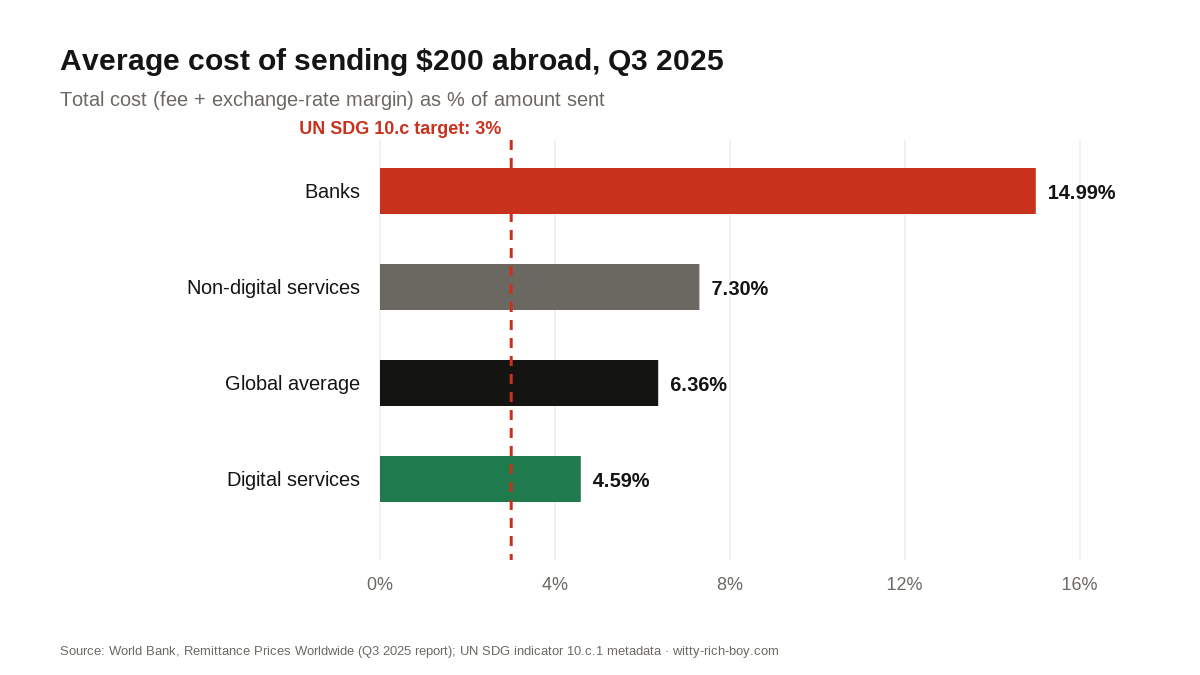
The 3% line comes from UN Sustainable Development Goal target 10.c: by 2030, reduce the transaction costs of migrant remittances to less than 3% and eliminate corridors costing more than 5%. According to the UN indicator metadata, the World Bank is custodian of the indicator and measures it as the global average total cost of sending $200, expressed as a percentage of the amount sent.
What is the mid-market rate, and why does it matter?
The mid-market rate is the midpoint between the buying and selling prices of a currency on the wholesale market at a given moment. It is the price with no margin built in, which makes it the benchmark against which every retail quote should be judged.
You will rarely be offered it. A provider buys currency at one price and sells it to you at a worse one; the gap, expressed as a percentage of the mid-market rate, is its margin.
The exchange-rate margin (also called the spread or mark-up) is the percentage difference between the mid-market rate and the rate a provider applies to your transfer. On a quote of 1.1385 against a mid-market rate of 1.1500, the margin is (1.1500 − 1.1385) ÷ 1.1500 = 1.0%.
Central-bank reference rates are a useful public yardstick but are not live dealing prices. The European Central Bank publishes euro foreign exchange reference rates at about 16:00 CET on working days, and says they are “for information purposes only” and not intended for market transactions. Use them to sanity-check a quote taken at a similar time, not as the rate you are owed.
How do you calculate the total cost of a transfer?
Use one formula, expressed in the currency you send:
Total cost = fee + amount × (mid-market rate − offered rate) ÷ mid-market rate
Divide by the amount sent to get the cost as a percentage. The formula assumes the rate is quoted as “units of foreign currency per unit of yours”. If it is quoted the other way round, or you are not sure, use the version that works for any quote: margin = 1 − amount received ÷ (amount sent × mid-market rate).
Example: you send €1,000 to a US dollar account. The mid-market rate is a hypothetical 1.1500 dollars per euro, so at that rate the recipient would get $1,150. A provider charges a €15 fee and converts at 1.1385.
- Margin: (1.1500 − 1.1385) ÷ 1.1500 = 1.0%.
- Margin cost: €1,000 × 1.0% = €10. Check: the recipient gets $1,138.50, which is $11.50 short of $1,150; $11.50 ÷ 1.15 = €10.
- Total cost: €15 + €10 = €25, or 2.5% of the amount sent.
Five hypothetical quotes on the same €1,000, at the same 1.1500 mid-market rate:
| Quote (hypothetical) | Fee | Rate offered | Margin | Recipient gets | Margin cost | Total cost | % of €1,000 |
|---|---|---|---|---|---|---|---|
| A: “No fee” | €0 | 1.1040 | 4.0% | $1,104.00 | €40 | €40 | 4.0% |
| B: “No fee” | €0 | 1.1155 | 3.0% | $1,115.50 | €30 | €30 | 3.0% |
| C: Fee plus margin | €15 | 1.1385 | 1.0% | $1,138.50 | €10 | €25 | 2.5% |
| D: Small fee, thin margin | €5 | 1.1443 | 0.5% | $1,144.30 | €5 | €10 | 1.0% |
| E: Mid-market rate plus fee | €6 | 1.1500 | 0% | $1,150.00 | €0 | €6 | 0.6% |
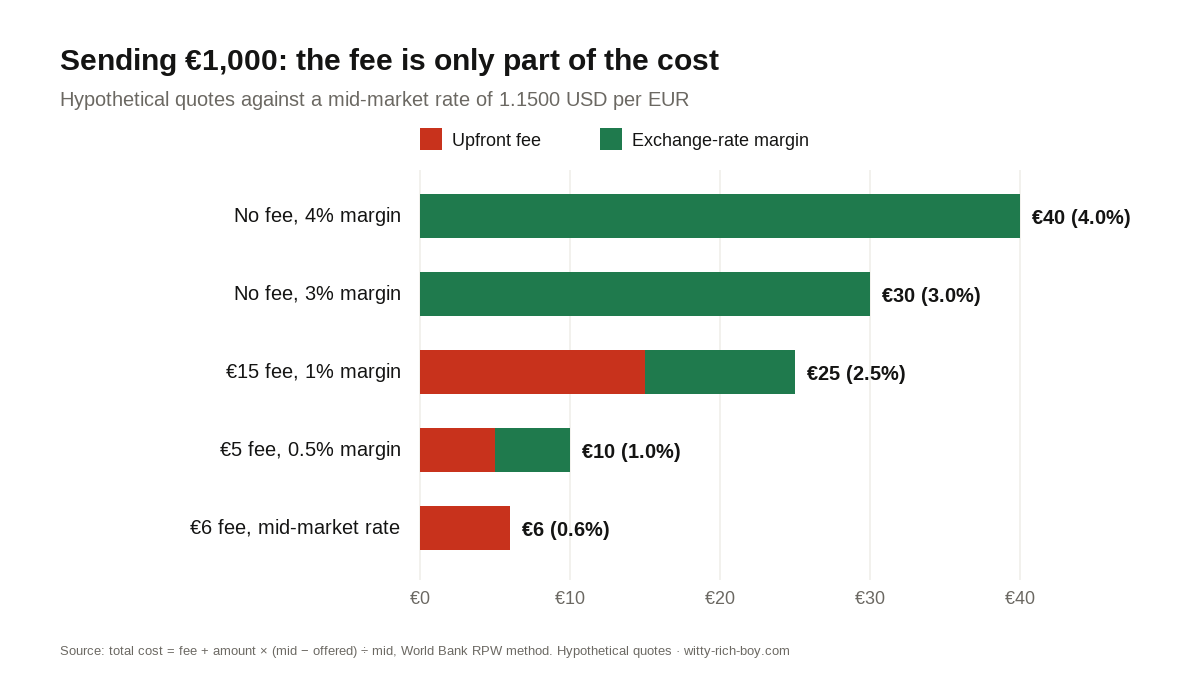
In this example the fee is printed and the margin is not, yet quote B costs three times as much as quote D and five times as much as quote E. Assume fees are paid on top of the €1,000; if a provider deducts its fee from the amount instead, the recipient gets slightly less but the cost to you is the same.
Fixed fee or exchange-rate margin: which is cheaper?
A fixed fee is cheaper above a certain amount and dearer below it, because a fee is a flat sum while a margin grows with the amount. The crossover point is easy to calculate:
Break-even amount = (fee B − fee A) ÷ (margin A − margin B)
Example: quote A charges no fee and a 3% margin; quote B charges €10 and a 1% margin. Break-even = €10 ÷ (3% − 1%) = €500. Below €500, A is cheaper; above it, B is.
| Amount sent | A: €0 fee + 3% margin | B: €10 fee + 1% margin | Cheaper |
|---|---|---|---|
| €200 | €6 (3.0%) | €12 (6.0%) | A |
| €500 | €15 (3.0%) | €15 (3.0%) | Equal |
| €1,000 | €30 (3.0%) | €20 (2.0%) | B |
| €5,000 | €150 (3.0%) | €60 (1.2%) | B |
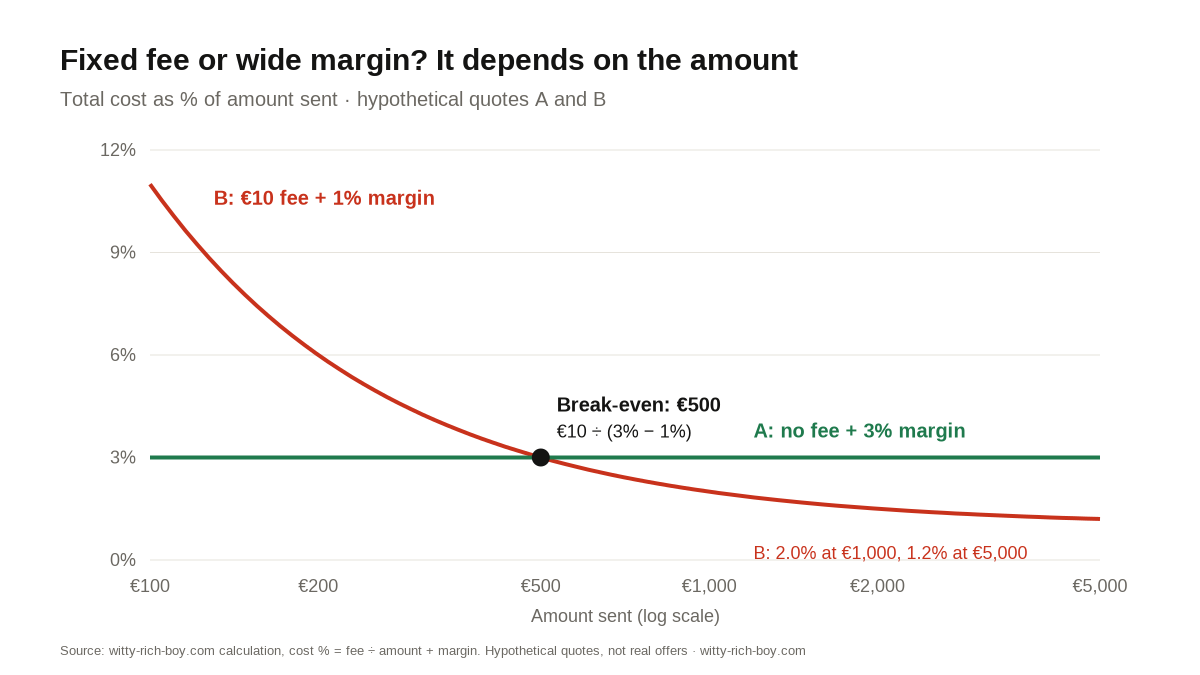
This is also why the World Bank benchmark uses small amounts: on $200, a $5 fee alone is 2.5% before any margin. People sending small, regular sums to family are hit hardest by fixed fees; people moving savings when relocating as a digital nomad or buying property abroad are hit hardest by margins. Pricing can change with the amount, so always request a quote at your actual amount.
What other costs and traps should you look for?
The fee and the margin are the main costs, but four others can turn up on the bill.
Charges at the receiving end
When a payment travels through correspondent banks, an intermediary or the recipient’s bank may deduct a charge before the money lands. The World Bank notes that fees and taxes charged in the receiving country may not be captured in its database, so its averages can understate what a recipient loses. Ask whether the “amount received” in your quote is guaranteed.
Card funding and payment method
A provider may price a transfer differently depending on whether you fund it by bank transfer or by card, and your card issuer’s own terms may add charges. Check the quote for the funding method you will actually use, and your card terms.
Currency conversion at the till or cash machine
Abroad, a card terminal or cash machine may offer to charge you in your home currency. That conversion uses a rate set by the merchant’s or machine’s provider. In the EU, Regulation (EU) 2021/1230 requires that for card payments the total conversion charge be shown as a percentage mark-up over the latest ECB reference rate, and that you be told before paying that you can pay in the merchant’s currency instead.
Rates that move before you pay
Exchange rates move continuously, so a quote is a snapshot. Compare quotes at the same time, on the day you send, and check how long a quoted rate stays valid before it is recalculated.
What consumer protections apply in the US, EU and UK?
Each region forces providers to show you what you need to compute total cost, though the rules differ in reach.
| Rule | United States | European Union | United Kingdom |
|---|---|---|---|
| Main law | Remittance Transfer Rule, 12 CFR 1005.30–1005.36 | Regulations (EU) 2021/1230 and 2024/886 | Payment Services Regulations 2017 |
| Exchange-rate disclosure | Exchange rate, fees, taxes and amount received, before payment (§ 1005.31) | Card payments: mark-up over ECB rate; online credit transfers: estimated conversion charges and total before initiation | Actual or reference exchange rate before a single payment (reg 43) |
| Price rules | Must disclose; no price cap | Euro cross-border payments cost the same as domestic ones; instant euro transfers no dearer than standard ones | Must disclose; no price cap |
| Cancellation, errors, safety | Cancel within 30 minutes; report errors within 180 days | Free verification of payee name before sending (euro area, from 9 October 2025) | Payment credited by end of next business day for in-scope payments (reg 86) |
United States: the Remittance Transfer Rule
Regulation E, subpart B, covers consumer transfers abroad of more than $15. Under § 1005.31, the provider must disclose before you pay the amount to be transferred, its fees and taxes, the total, the exchange rate and the amount the recipient will receive, which reflects the rate, fees and taxes. Under § 1005.34, you can cancel within 30 minutes of paying, provided the funds have not been picked up or deposited, and get a full refund, including fees, within three business days. Under § 1005.33, you have 180 days from the disclosed date of availability to report an error; the provider must investigate and decide within 90 days. US residents moving larger sums into foreign accounts should also check the FBAR reporting threshold.
European Union: equal charges and instant euro transfers
Regulation 2021/1230 requires that a cross-border payment in euro cost the same as a corresponding domestic payment; currency conversion charges are outside that rule but must be disclosed. The conversion transparency rules were first added by Regulation (EU) 2019/518 and are now codified in 2021/1230. For a credit transfer started online, the payer’s provider must show the estimated conversion charges and the total in the payer’s currency, fees included, before the payment is initiated.
The Instant Payments Regulation (EU) 2024/886 adds two rules. In the euro area, an instant euro transfer may not cost more than a standard credit transfer from 9 January 2025; non-euro member states follow on 9 January 2027. And from 9 October 2025, euro-area providers must offer a free check that the payee’s name matches the IBAN (9 July 2027 outside the euro area), according to the ECB’s summary of the regulation. Instant euro transfers settle within ten seconds, around the clock.
United Kingdom: Payment Services Regulations 2017
Before a single payment, a UK provider must give you the actual or reference exchange rate to be used (PSRs 2017, reg 43(2)(d)). For payments within the scope of regulation 85, which include sterling payments within the UK and euro payments, regulation 86 requires the money to reach the payee’s provider by the end of the next business day after the order is received (one day more for paper orders).
How to send money abroad the cheapest way: step by step
- Fix the amount and the currencies. Decide exactly what you will send, or what the recipient must receive, and in which currency.
- Note the mid-market rate for that pair at the time you compare quotes. A central-bank reference rate is a rough check only.
- Get two or three quotes at your real amount, each showing the fee, the rate and the amount the recipient will receive.
- Compute the total cost of each: fee + amount × (mid − offered) ÷ mid, or the gap between the mid-market value and the amount received.
- Check the break-even if one quote has a higher fee and a lower margin: fee difference ÷ margin difference.
- Ask about receiving-end charges and whether the amount received is guaranteed.
- Choose the funding method (bank transfer or card) and check that it does not change the price.
- Verify the recipient’s details, using the free payee check for euro transfers inside the EU, before you authorise.
- Keep the receipt with the rate, fees and amount received; you will need it for disputes, and in the US to use the 180-day error window.
Which quote formats make costs hard to compare?
Quotes are hardest to compare when the fee and the rate are shown on separate screens, when the rate is shown to only two decimal places, or when the amount received is labelled “estimated”. In each case go back to the one number that cannot be disguised: what arrives in the recipient’s account, divided by what left yours.
Be wary of three framings. “Zero commission” or “no fee” means only that the cost is in the rate. A percentage “fee” may sit on top of a margin, not instead of one. And a “guaranteed rate” is useful only if the rate is good; guaranteed is not the same as fair. Similar arithmetic applies if you convert through crypto rails: each swap has its own spread and, in many countries, a tax event, as our guide to whether crypto swaps are taxable explains, and EU platforms now report users’ transactions under DAC8.
Is sending money abroad getting cheaper?
Slowly. The World Bank’s global average fell from 6.49% in Q1 2025 to 6.36% in Q3 2025 and has stayed below 7% since Q1 2019, but it is still more than double the 3% target the UN set for 2030. Digital services averaged 4.59%, under 5% but still above 3%, while banks, at 14.99%, cost about five times the target.
Regulation is pushing in the same direction by making costs visible and cutting the price of speed: in the euro area, instant transfers now cost the same as standard ones. None of it removes the margin. That stays the provider’s choice, and the reader’s job is to measure it every time.
Questions readers ask
What is the cheapest way to send money abroad?
The cheapest transfer is the one where the recipient gets the most money for what you pay, so compare total cost rather than headline fees. Multiply your amount by the mid-market rate, subtract what the recipient will actually receive, convert that gap back and add the fee. Across World Bank data for Q3 2025, digital services averaged 4.59% on $200 and banks 14.99%.
What is the mid-market exchange rate?
The mid-market rate is the midpoint between the prices at which banks buy and sell a currency on the wholesale market at a given moment. It carries no margin, so it is the fairest benchmark for a quote. Retail providers rarely deal at it; the gap between it and the rate you are offered is the exchange-rate margin, a cost that is often not shown as a fee.
Is a no-fee international transfer really free?
Rarely. A provider that charges no fee can still earn money through the exchange rate. On €1,000 converted at a rate 3% worse than mid-market, the recipient gets 3% less, so the transfer costs €30 even though the fee line says zero. The World Bank counts this margin as part of total cost for exactly that reason.
How do I calculate the exchange-rate margin?
Divide the gap between the mid-market rate and the rate offered by the mid-market rate. Example: mid-market 1.1500, offered 1.1385: (1.1500 − 1.1385) ÷ 1.1500 = 1.0%. If the rate is quoted the other way round, use the simpler test: margin = 1 − amount received ÷ (amount sent × mid-market rate), which works for any quote format.
Is it cheaper to send a large amount in one transfer?
Usually, if the provider charges a fixed fee, because that fee shrinks as a share of a bigger amount: €10 is 5% of €200 but 0.2% of €5,000. The margin, being a percentage, does not shrink. Pricing can also vary with the amount, so ask for quotes at your real amount and compare total cost, not the fee alone.
Can I cancel an international money transfer?
In the United States, yes, within limits. Under 12 CFR 1005.34, a remittance transfer provider must cancel a transfer if you ask within 30 minutes of paying, as long as the money has not been picked up or deposited, and refund the full amount, fees included, within three business days. Elsewhere, cancellation depends on the provider's terms and the payment system used.
Do intermediary banks charge fees on international transfers?
They can. When a payment passes through correspondent banks, one of them may deduct a charge before the money arrives, and the World Bank notes that fees charged at the receiving end may not be captured in its price data. Ask your provider whether the quoted amount received is guaranteed, and for US remittances check the disclosed amount the recipient will receive.
Should I pay in my home currency or the local currency abroad?
When a card terminal or cash machine offers to charge you in your home currency, that conversion is done at a rate set by the merchant's or machine's provider. In the EU, Regulation 2021/1230 requires the conversion charge to be shown as a percentage mark-up over the ECB reference rate and requires you to be told you can pay in the local currency, which lets you compare.
Was this guide useful?
Thanks — your answer helps us decide what to cover next.
Sources
- World Bank — Remittance Prices Worldwide, main report and annex, Q3 2025
- World Bank — Remittance Prices Worldwide: Methodology
- UN SDG indicator metadata — Indicator 10.c.1, remittance costs as a proportion of the amount remitted
- Regulation (EU) 2021/1230 on cross-border payments in the Union (EUR-Lex)
- Regulation (EU) 2024/886 on instant credit transfers in euro (Official Journal)
- European Central Bank — Instant Payments Regulation
- European Central Bank — Euro foreign exchange reference rates
- eCFR — 12 CFR Part 1005 Subpart B, Requirements for Remittance Transfers
- CFPB — § 1005.34 Procedures for cancellation and refund of remittance transfers
- The Payment Services Regulations 2017, regulation 86 (legislation.gov.uk)
General information, not tax or legal advice. Rules change — check the official source or a licensed adviser before acting.