Global ·
Digital Nomad Tax Residency (2026): 183-Day Myth vs Treaties
Digital nomad tax residency: staying under 183 days is no shield. A home, ties or family can make you resident, and treaties settle dual residence in four steps.

The short answer
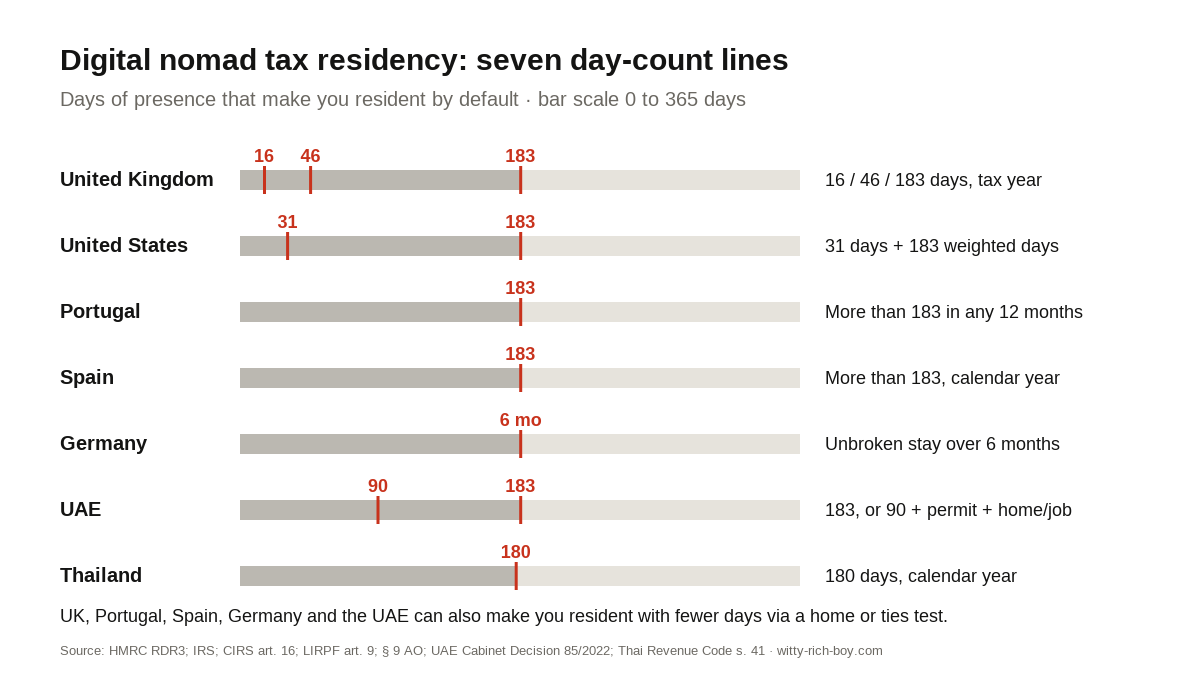
- There is no universal 183-day rule: Spain and Portugal require more than 183 days, Thailand 180, the UK 183 in a tax year, and Germany an unbroken stay of more than six months.
- Staying under the line does not protect you: a home (Portugal art. 16 CIRS, Germany § 8 AO), your economic centre (Spain art. 9 LIRPF) or enough UK ties can make you resident with fewer days.
- If two countries both claim you, the OECD tie-breaker (Art. 4(2)) runs in order: permanent home, centre of vital interests, habitual abode, nationality, then mutual agreement.
- The UAE treats you as resident after 183 days in 12 months, or 90 days if you are a UAE/GCC national or permit holder with a UAE home or job (Cabinet Decision 85 of 2022).
- Thailand taxes residents (180+ days) on foreign income earned from 1 January 2024 and brought into the country; pre-2024 income remitted later is not taxed.
- US citizens are taxed on worldwide income wherever they live; the foreign earned income exclusion needs 330 full days abroad in 12 consecutive months.
In force: Rules as in force on 22 October 2026 · UK SRT (Finance Act 2013, Sch. 45) · Portugal CIRS art. 16 · Spain LIRPF arts 9 and 93 · UAE Cabinet Decision 85 of 2022 (from 1 March 2023) · Thailand Por. 161/2566 (income remitted from 1 January 2024) · Germany §§ 8–9 AO
Digital nomad tax residency is decided by each country's own tests, not by a universal 183-day rule. Day thresholds differ (more than 183 in Spain and Portugal, 180 in Thailand, six months in Germany), and a home, family or economic ties can make you resident with fewer days. Dual residents are sorted by the OECD treaty tie-breaker.
Keep moving, never spend 183 days anywhere, and no country can tax you: the promise is popular and wrong. The number 183 appears in many tax laws, but it means different things in each, is counted over different windows, and is almost never the only test. Below are the residence rules in Portugal, Spain, the UAE, Thailand and Germany, the UK and US tests, a day-count decision table and a worked tie-breaker.
What is tax residency for a digital nomad?
Tax residency is the status that gives a country the right to tax your income, usually your worldwide income, rather than only income earned within its borders. It is not a visa or citizenship: you can hold a visa without being tax resident, and become resident without any visa. A non-resident is generally taxed only on income sourced in that country.
Each country sets its own domestic test, so in any year a nomad can be resident in one country, in two at once or, rarely, in none. Treaties resolve the second case. The OECD Model Tax Convention, on which most bilateral treaties are based, defines a resident in Article 4(1) as a person liable to tax in a state “by reason of his domicile, residence, place of management or any other criterion of a similar nature”, and adds a tie-breaker in Article 4(2).
Is the 183-day rule a myth?
As a universal rule, yes: no single 183-day test applies everywhere, and staying under 183 days does not by itself keep you non-resident.
The line differs. Portugal and Spain require more than 183 days, so day 183 is not enough. Thailand uses 180. The UK’s automatic test is 183 or more. Germany’s statute has no day count; it uses an unbroken stay of more than six months.
The window differs. Spain and Thailand count a calendar year, the UK its tax year (6 April to 5 April), Portugal any 12-month period beginning or ending in the year (art. 16 CIRS), and the UAE any consecutive 12 months. Two 100-day stays straddling New Year can pass Portugal’s test while failing a calendar-year one.
Days are only one test. Portugal can treat you as resident with fewer days if you keep a home there as your habitual residence; Spain if your main economic interests are there; Germany if you keep a flat (Wohnsitz). The UK can make you resident on as few as 16 days if you have enough ties.
The myth partly comes from treaties. Article 15(2) of the OECD Model has a genuine 183-day rule, counted in any twelve-month period starting or ending in the fiscal year, but it decides where an employee’s salary may be taxed, not where the employee is resident.
Can you be tax resident nowhere?
It is legally possible to fail every country’s domestic test in a year, but the status is fragile and rarely useful.
A person resident nowhere has no treaty protection, because treaties only cover residents of one of the two states, so each country can tax income sourced there without limit, and no country will issue a residence certificate. Under the EU’s DAC8 crypto reporting rules, and the parallel OECD standard for banks, platforms collect a self-certification of your tax residence and tax number; “nowhere” is not an answer those forms accept.
Two groups cannot achieve it. US citizens are taxed on worldwide income wherever they live (IRS Publication 54). And anyone who keeps a home in a country with a home-based test, such as Germany under § 8 AO, stays resident however little time they spend there.
How do the OECD tie-breaker rules work?
When two treaty countries both treat you as resident, the residence article applies a fixed sequence of tests and stops at the first that gives a clear answer.
Under Article 4(2) of the OECD Model:
- Permanent home. You are resident where a permanent home is available to you. The Commentary accepts any form of home, owned or rented, even a furnished room, but it must be available continuously.
- Centre of vital interests. With a home in both states, you are resident where personal and economic relations are closer: family, occupation, business, the place you manage your property from.
- Habitual abode. If that cannot be determined, or you have a home in neither, you are resident where you habitually stay. Only here does time decide.
- Nationality. With a habitual abode in both or neither, you are resident in your state of nationality.
- Mutual agreement. If you are a national of both or neither, the two competent authorities decide.
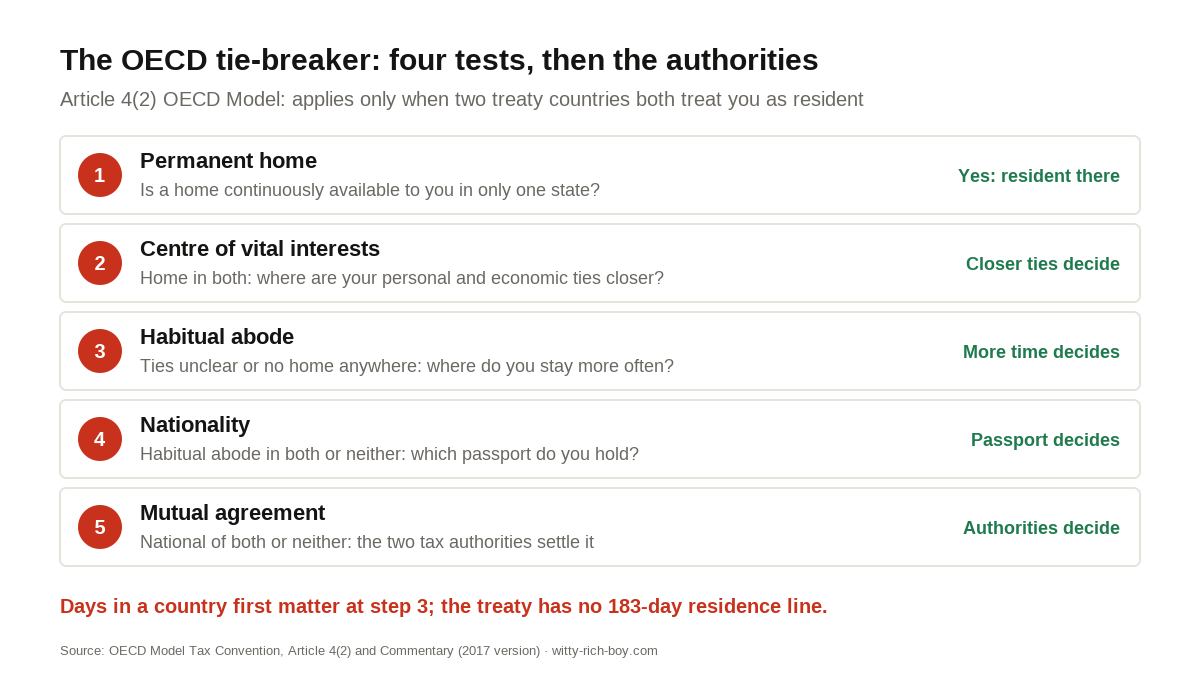
The ladder settles residence for that treaty only: the losing country still taxes what it may tax as a source country. Most treaties follow the OECD wording for individuals, but read the residence article of your actual treaty before relying on it.
Digital nomad tax residency by country: Portugal, Spain, UAE, Thailand, Germany
Every country below has a day count, and most also have a non-day test that can make you resident earlier.
| Country | Day test | Window | Other ways to become resident | Legal basis |
|---|---|---|---|---|
| Portugal | More than 183 days | Any 12 months beginning or ending in the year | A home kept as your habitual residence | Art. 16(1) CIRS |
| Spain | More than 183 days (sporadic absences count) | Calendar year | Main economic interests in Spain; spouse and minor children there (rebuttable) | Art. 9(1) LIRPF |
| UAE | 183 days; or 90 days for UAE/GCC nationals and permit holders with a UAE home or job | Any consecutive 12 months | Usual residence and centre of interests in the UAE | Cabinet Decision 85 of 2022 |
| Thailand | 180 days or more | Calendar year | None | Revenue Code s. 41 |
| Germany | Unbroken stay of more than six months | Any period | A dwelling (Wohnsitz) kept for continued use | §§ 8, 9 AO; § 1(1) EStG |
| United Kingdom | 183 days (automatic) | Tax year | UK home; full-time UK work; ties from 16 days | Finance Act 2013, Sch. 45; HMRC RDR3 |
| United States (non-citizens) | 31 days, and 183 weighted days over three years | Calendar year | Citizens taxable wherever they live | IRS substantial presence test |
Portugal
Under article 16 of the Código do IRS you are resident after more than 183 days, consecutive or not, in any 12-month period beginning or ending in the year, or if, with fewer days, you have a dwelling there on any day of that period in conditions suggesting an intention to keep and occupy it as your habitual residence. Any whole or partial day that includes an overnight stay counts. Residence starts on the first day of the stay. The non-habitual resident (NHR) regime closed to new entrants from 1 January 2024 under Lei 82/2023, with transitional rules. Becoming or ceasing to be resident also matters for coins: Portugal crypto tax excludes gains after 365 days but treats leaving the country as a sale.
Spain
The Agencia Tributaria’s residence page sets out article 9 LIRPF: more than 183 days in the calendar year, counting sporadic absences unless you prove residence elsewhere, or the main base of your activities or economic interests in Spain. A spouse (not legally separated) and dependent minor children living in Spain create a rebuttable presumption.
Spain’s digital nomad visa, the international teleworking visa added to Ley 14/2013 by Ley 28/2022, lets non-EU remote workers live in Spain while working for employers or clients abroad. It does not decide tax residence; article 9 does. If you become resident, the special regime in article 93 LIRPF may apply: per the AEAT’s 2025 manual, the base is taxed at 24% up to €600,000 and 47% above, for the year of the move and five more, if you were not resident in the previous five tax years. Remote work under the teleworking visa can satisfy the relocation condition.
United Arab Emirates
Cabinet Decision No. 85 of 2022, in force from 1 March 2023, makes you resident if your usual residence and centre of financial and personal interests are in the UAE; or you are present 183 days or more in a consecutive 12-month period; or present 90 days or more as a UAE or GCC national or residence-permit holder who has a permanent place of residence or a job or business there. Ministerial Decision 27 of 2023 counts any part of a day and accepts a rented home if continuously available. With no personal income tax on salaries, UAE residence matters mainly for the Federal Tax Authority’s residence certificate and treaty access; how crypto gains, Corporate Tax and VAT work once you are there is covered in our UAE crypto tax guide.
Thailand
Staying 180 days or more in a calendar year makes you resident under section 41 of the Revenue Code. Under Departmental Order Por. 161/2566, residents are taxed on foreign income brought into Thailand from 1 January 2024; Por. 162/2566 exempts foreign income earned before that date. The Revenue Department’s Manual for Foreign Tax Credit (November 2025) confirms the two conditions, arising in a resident year from 2024 and remitted in that or a later year, and that partial remittances are apportioned.
Germany
Individuals with a Wohnsitz or gewöhnlicher Aufenthalt in Germany are taxed on worldwide income (§ 1(1) EStG). A Wohnsitz is a dwelling held in circumstances suggesting you will keep and use it (§ 8 AO). Under § 9 AO, an unbroken stay of more than six months is always a habitual abode from its first day, ignoring short interruptions, unless purely for visits or recreation and no longer than a year. So a German who keeps a Berlin flat can stay resident while spending 300 days abroad. For the crypto consequences, see our Germany crypto tax guide.
What do 90, 180, 183 or 184 days actually do?
The same day count produces different results in each country, and in two of them day 183 is still one day short.
The table assumes one stay inside each country’s window and, for the US, a non-citizen with no days in the two prior years.
| Days in the country | 90 | 180 | 183 | 184+ |
|---|---|---|---|---|
| United Kingdom | Ties decide (3 or 4 needed) | Ties decide (1 or 2 needed) | Resident | Resident |
| United States | Not resident | Not resident | Resident | Resident |
| Portugal | Only via home test | Only via home test | Only via home test | Resident |
| Spain | Only via economic or family ties | Same | Same | Resident |
| Germany | Only via a Wohnsitz | Same | Same | Resident if unbroken for over six months |
| UAE | Resident if permit holder with UAE home or job | Same | Resident | Resident |
| Thailand | Not resident | Resident | Resident | Resident |
The UK figures come from the ties tables in HMRC’s RDR3: with 46–90 days you need three ties if UK resident in any of the previous three tax years, four if not; above 120 days, one or two.
Worked example: one nomad, two residences, one tie-breaker
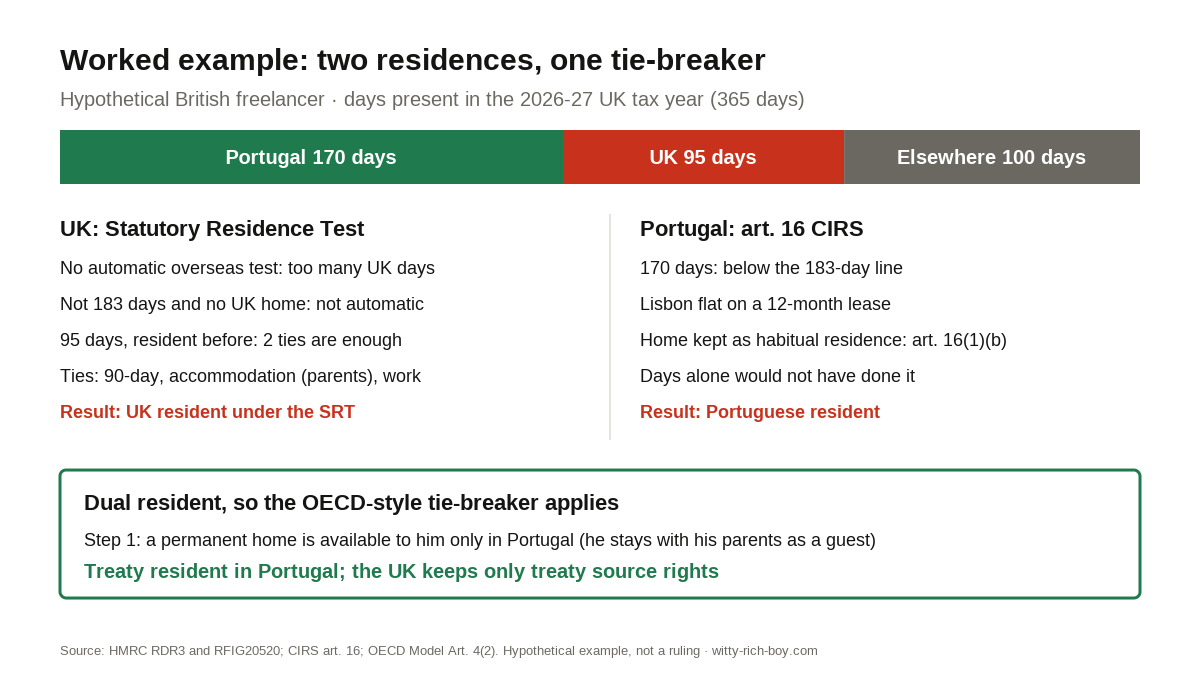
Example (hypothetical): Tom, a British freelance developer and long-time UK resident, spends the 2026-27 UK tax year as follows: 170 days in Portugal, where he rents a Lisbon flat on a 12-month lease; 95 days in the UK in his parents’ spare room; 100 days elsewhere. He works more than three hours a day on 45 UK days.
UK. Having been resident in the previous three years, he fails the 16-day overseas test; assume he does not meet the full-time-work-abroad test. With under 183 days and no UK home of his own, no automatic UK test applies. A previously resident person with 91–120 days needs two ties (RFIG20520). Tom has three: the 90-day tie (more than 90 UK days in either of the two previous tax years), the accommodation tie (16 or more nights at a close relative’s home) and the work tie (40 or more UK days of over three hours’ work). He is UK resident.
Portugal. 170 days is short of “more than 183”, but a leased flat used as his base meets the home test in art. 16(1)(b) CIRS. He is Portuguese resident too.
Tie-breaker. Assuming the UK–Portugal treaty follows the OECD ladder, step 1 asks where a permanent home is available. On these facts only the Lisbon flat is; a room he uses as a guest is not continuously at his disposal. He is treaty-resident in Portugal, though that spare room still counted as a UK tie: the SRT and the treaty ask different questions.
If Tom sells investments, that answer decides whose rules apply: compare the UK capital gains tax allowance and rates with the rules in are crypto swaps taxable?. A move to Switzerland changes the question entirely: Swiss crypto tax leaves private gains untaxed but charges cantonal wealth tax on year-end holdings. Singapore goes further: Singapore crypto tax has no capital gains tax and no wealth tax, although trading profits count as income.
How do the UK and US decide who is resident?
The UK applies automatic tests before weighing ties; the US uses a weighted day formula for non-citizens and taxes its citizens regardless.
UK Statutory Residence Test
Under HMRC’s RDR3 you are automatically non-resident with fewer than 16 UK days if resident in one of the previous three tax years, or fewer than 46 if not. You are automatically resident with 183 days or more, or under the UK home or full-time UK work tests. Otherwise ties decide. A day counts if you are in the UK at midnight; certain transit days are ignored, and up to 60 days caused by exceptional circumstances can be disregarded.
US substantial presence test and the 330-day rule
A non-citizen is US resident under the substantial presence test with at least 31 days this year and 183 days over three years: all current-year days, one-third of last year’s, one-sixth of the year before. The IRS example: 120 days in each of three years gives 120 + 40 + 20 = 180, not resident. A closer-connection exception (Form 8840) can apply below 183 current-year days.
US citizens owe tax on worldwide income wherever they live. The foreign earned income exclusion’s physical presence test needs 330 full days abroad in any 12 consecutive months, each midnight to midnight; time over international waters does not count. Foreign accounts still need reporting: see our FBAR requirements guide.
How to work out your tax residency as a digital nomad
Work country by country, then treaty by treaty:
- Start with citizenship. A US citizen files in the US regardless; the rest decides where else tax is due.
- Log every day by country, noting each country’s counting rule: overnight (Portugal), part-day (UAE, US), midnight (UK).
- Run each day test with its own threshold and window: more than 183, 183, 180 or six unbroken months.
- Run the non-day tests: a home you keep (Portugal, Germany, UAE), economic interests or family (Spain), ties (UK).
- List every country that claims you. None means source taxation everywhere and no treaty protection.
- Apply the treaty tie-breaker to each pair: permanent home, vital interests, habitual abode, nationality, mutual agreement.
- Get a residence certificate from the winning country; the AEAT says certificates are valid for one year, and the UAE FTA asks for an entry and exit report on the 183-day route.
- Keep evidence: leases, travel records, contracts and a day log. Spain’s TEAC builds day counts from certified and presumed presence, so gaps in your record can be filled against you.
Residence is a set of facts about where you live, not a number to stay under. A lease, a family home or a flat you never gave up may already have decided the matter. Moving income between those countries carries its own cost, and the cheapest way to send money abroad depends on the exchange-rate margin as much as the fee.
Questions readers ask
Is the 183-day rule for tax residency a myth?
As a universal rule, yes. Many countries use a day count near 183, but the exact line differs (more than 183 in Spain and Portugal, 180 in Thailand, a six-month stay in Germany) and the window differs too. Above all, days are only one test: a home, family or economic interests can make you resident with far fewer days in the country.
Can a digital nomad be tax resident nowhere?
It is possible on paper but rarely clean. If no country's domestic test catches you, you have no residence country and no tax treaty to fall back on, so each country can still tax income sourced there. Banks and crypto platforms ask for a tax residence for CRS and DAC8 reporting, and US citizens remain taxable on worldwide income regardless.
What happens if two countries both say I am tax resident?
If they have a tax treaty, its residence article settles it. Under the OECD Model, Article 4(2), you are treated as resident where you have a permanent home; if you have one in both, where your centre of vital interests lies; then where you habitually stay; then your nationality. If all of these fail, the two tax authorities decide by mutual agreement.
Does a partial day count towards tax residency?
It depends on the country. Portugal counts any day, whole or partial, that includes an overnight stay. The UAE counts any part of a day under Ministerial Decision 27 of 2023. The UK counts a day if you are in the country at midnight, with an exception for transit. The US counts any day of presence, except some transit days of under 24 hours.
Does the Spanish digital nomad visa make me tax resident in Spain?
Not by itself. Residence for income tax still follows article 9 LIRPF: more than 183 days in the calendar year, or your main economic interests in Spain. A remote worker who does become resident can apply for the special regime in article 93 LIRPF, which taxes the base at 24% up to €600,000 and 47% above, if you were not resident in Spain in the previous five years.
Do I pay tax in Thailand as a digital nomad?
Only if you are resident, meaning 180 days or more in Thailand in a calendar year under section 41 of the Revenue Code. A resident pays Thai tax on Thai-source income and on foreign income earned from 1 January 2024 onwards that is brought into Thailand, in the same or a later year. Foreign income earned before 2024 and remitted later is not taxed.
How do I prove my tax residency as a nomad?
Ask the country you claim for a tax residence certificate. The UAE Federal Tax Authority issues one to individuals who meet Cabinet Decision 85 of 2022, supported by an entry and exit report; Spain's Agencia Tributaria says a certificate is valid for one year. Back it with a lease, a day-count log and evidence of where your family and business are.
Does a US citizen escape US tax by living abroad?
No. IRS Publication 54 states that US citizens are taxed on their worldwide income wherever they live. Living abroad can reduce the bill through the foreign earned income exclusion, which under the physical presence test requires 330 full days in foreign countries in 12 consecutive months, and through foreign tax credits, but a return is still required above the filing threshold.
Was this guide useful?
Thanks — your answer helps us decide what to cover next.
Sources
- OECD — 2017 Update to the OECD Model Tax Convention (Article 4 and Commentary)
- HMRC — RDR3: Statutory Residence Test (SRT) guidance notes
- IRS — Substantial presence test
- IRS — Foreign earned income exclusion: physical presence test
- Código do IRS, artigo 16.º — Residência (Portal das Finanças)
- Agencia Tributaria — Persona física residente en España
- Agencia Tributaria — Régimen fiscal especial aplicable a los trabajadores desplazados (Manual IRPF 2025)
- UAE Cabinet Decision No. 85 of 2022 on the Determination of Tax Residency (Federal Tax Authority)
- Thai Revenue Department — Manual for Foreign Tax Credit (November 2025)
- § 9 AO — Gewöhnlicher Aufenthalt (gesetze-im-internet.de)
General information, not tax or legal advice. Rules change — check the official source or a licensed adviser before acting.