European Union · Policy changes
MiCA Regulation Explained (2026): What Changed on 1 July
MiCA regulation explained: since 1 July 2026 every crypto provider serving EU clients needs a MiCA licence. Stablecoin rules, your rights and what MiCA leaves out.

The short answer
- MiCA (Regulation (EU) 2023/1114) has applied in full since 30 December 2024; its stablecoin titles applied from 30 June 2024.
- The transitional period under Article 143(3) ran no later than 1 July 2026, and national periods were as short as 6 months. A provider serving EU clients without a MiCA licence is now in breach of EU law.
- A CASP licence from one member state can be passported EU-wide: the home regulator forwards the notification within 10 working days (Art. 65).
- Issuers and providers may not pay interest on e-money tokens or asset-referenced tokens (Arts 40 and 50). E-money tokens must be redeemable at par, at any time, with no fee (Art. 49).
- The 14-day right of withdrawal (Art. 13) covers only some token offers. It does not apply to coins already admitted to trading, which is most of what people buy on an exchange.
- MiCA sets no tax rules. It also leaves out fully decentralised services, unique NFTs and central-bank money. Tax reporting comes from DAC8, and transfer data from Regulation (EU) 2023/1113.
In force: Regulation (EU) 2023/1114 · in force 29 June 2023 · Titles III–IV (stablecoins) from 30 June 2024 · full application 30 December 2024 · transitional period ended 1 July 2026 (Art. 143(3)) · as of 1 November 2026
MiCA, Regulation (EU) 2023/1114, is the EU's single rulebook for crypto-assets. It has applied in full since 30 December 2024. Exchanges, brokers and custodians need a licence that can be passported EU-wide. Stablecoin issuers need authorisation and may not pay interest. The transitional period ended no later than 1 July 2026, so unlicensed providers must stop serving EU clients.
For years, a European crypto user’s protection depended on where the platform happened to be registered. MiCA replaced that patchwork with one set of rules, and on 1 July 2026 the last national grace periods expired. Every provider serving EU clients now needs a MiCA licence or has to leave. This guide explains what changed for users, what MiCA does not do, and how to check a provider yourself.
What is the MiCA regulation?
MiCA is the Markets in Crypto-Assets Regulation, Regulation (EU) 2023/1114. Published in the Official Journal on 9 June 2023, it entered into force on 29 June 2023. As a regulation, it applies directly in every member state without national transposition.
MiCA sorts crypto-assets into three groups:
- An e-money token (EMT) is a crypto-asset that aims to keep a stable value by referencing one official currency, such as a euro or dollar stablecoin (Title IV).
- An asset-referenced token (ART) aims to keep a stable value by referencing another value or right, or a combination, such as a basket of currencies or commodities (Title III).
- Other crypto-assets are everything else in scope, from bitcoin-like coins to utility tokens (Title II).
A crypto-asset service provider (CASP) is a firm authorised to provide crypto-asset services such as custody, running a trading platform, exchanging crypto for money or other crypto, and transfers. Supervision sits with a national competent authority, coordinated by ESMA and, for stablecoins, the EBA.
When did MiCA apply? The full timeline
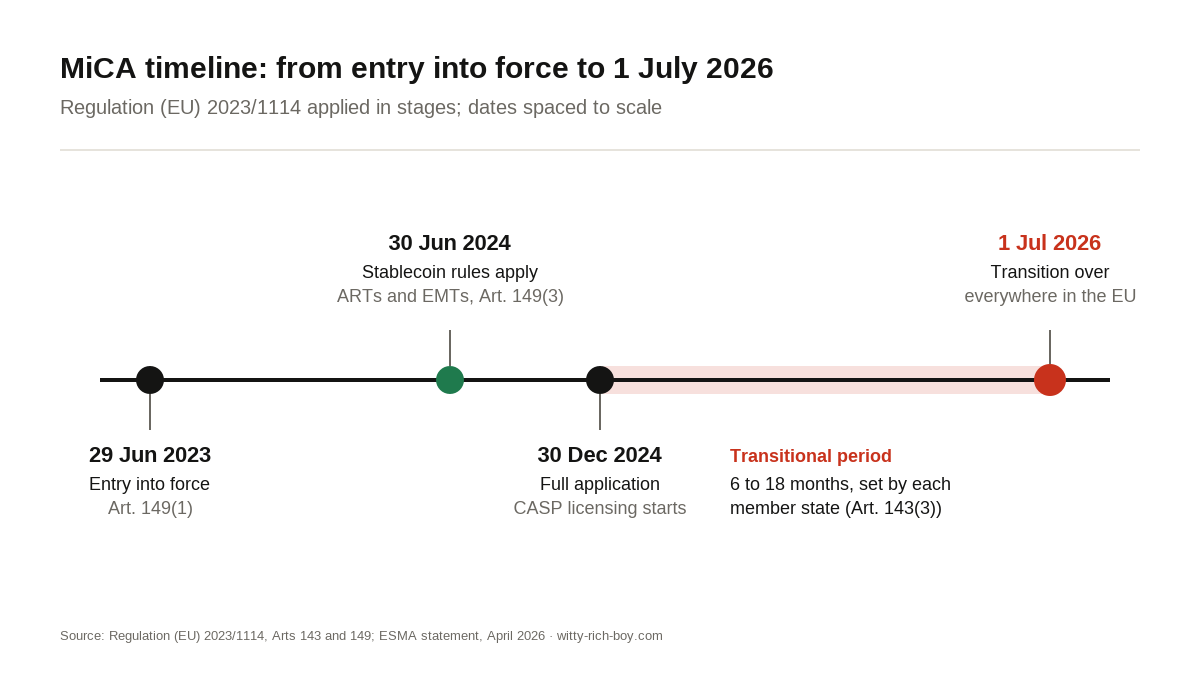
MiCA applied in stages. The stablecoin titles started first, on 30 June 2024. Everything else followed on 30 December 2024, and the transitional period ended on 1 July 2026 at the latest (Article 149 and Article 143).
| Date | What happened | Legal basis |
|---|---|---|
| 9 Jun 2023 | MiCA published in the Official Journal | OJ L 150, pp. 40–205 |
| 29 Jun 2023 | Entry into force (20th day after publication) | Art. 149(1) |
| 30 Jun 2024 | Stablecoin rules apply: ARTs (Title III) and EMTs (Title IV) | Art. 149(3) |
| 30 Dec 2024 | Full application: CASP licensing, white papers, market-abuse rules; Transfer of Funds Regulation also applies | Art. 149(2); Reg. 2023/1113 |
| Q1 2025 | ESMA deadline for providers to stop offering non-compliant stablecoins (sell-only allowed until then) | ESMA statement, Jan 2025 |
| 1 Jan 2026 | DAC8 tax reporting starts, using MiCA definitions | Directive (EU) 2023/2226 |
| 1 Jul 2026 | Last possible end of any national transitional period | Art. 143(3) |
| 8 Oct 2026 | ESMA opinion: licensed providers should stop servicing unauthorised stablecoins for EU clients | ESMA opinion |
Has the MiCA transitional period ended?
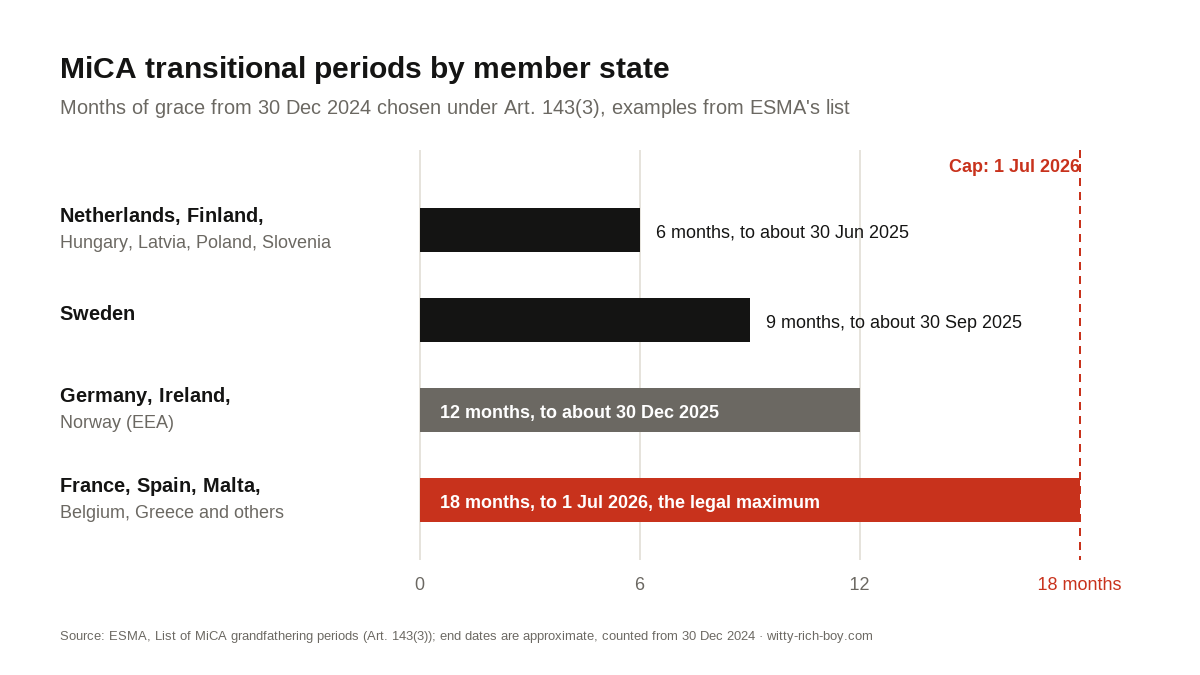
Yes, everywhere, by 1 July 2026. Under Article 143(3), firms that were providing crypto services under national law before 30 December 2024 could continue “until 1 July 2026 or until they are granted or refused an authorisation pursuant to Article 63, whichever is sooner”. Member states could skip or shorten it, and many did, as ESMA’s list of grandfathering periods shows:
| Period chosen | Member states (examples from ESMA’s list) | Grace period ended (counted from 30 Dec 2024) |
|---|---|---|
| 6 months | Netherlands, Finland, Hungary, Latvia, Poland, Slovenia | Around 30 Jun 2025 |
| 9 months | Sweden | Around 30 Sep 2025 |
| 12 months | Germany, Ireland, Norway | Around 30 Dec 2025 |
| 18 months | France, Spain, Belgium, Malta, Greece, Czechia, Denmark, Estonia, Bulgaria, Iceland, Liechtenstein | 1 Jul 2026 |
Some states added conditions: in Czechia, firms had to apply by 31 July 2025; in Italy, firms on the anti-money-laundering register had to file by 30 December 2025. End dates are our arithmetic from 30 December 2024; a firm’s period ended earlier if its application was decided first.
ESMA’s position is clear. Its April 2026 statement said the period “will officially expire across the EU on 1 July 2026”. After that date, an entity serving EU clients without a MiCA licence is in breach of EU law. A June 2026 public statement told unlicensed firms to stop onboarding and marketing, limit services to letting clients sell or transfer assets, and give clients a deadline after which leftover positions are closed. Clients of unauthorised providers do not get MiCA’s safeguards.
How does MiCA licensing and passporting work?
A crypto firm needs one licence from one national authority to serve clients anywhere in the EU. Article 59 makes authorisation a precondition for providing crypto-asset services in the Union. Article 65 then sets out the passport. The provider tells its home regulator which other member states and services it plans to cover, and from what date. The home regulator forwards this to the host states, ESMA and the EBA within 10 working days. The firm may start once it receives that communication, or at the latest on the 15th calendar day after it filed.
For users this matters in two ways. Your provider’s supervisor may sit in another country: a French resident may use a firm licensed in Ireland, supervised from Dublin. And the passport covers only the services and countries notified, which ESMA’s register lists one by one.
Non-EU firms cannot simply serve EU residents. Reverse solicitation, where a client approaches the firm entirely on their own initiative, is the only exception, and ESMA’s guidelines treat it as narrow.
What does MiCA change for stablecoins?
MiCA is strictest on stablecoins. An EMT may be offered to the public only by its issuer, and that issuer must be an authorised credit institution or electronic money institution (Article 48). An ART issuer needs authorisation from its home regulator under Article 16. Four rules matter most for holders:
- Redemption at par. EMT holders can ask the issuer to redeem “at any time and at par value”, in funds other than e-money, and redemption may not carry a fee (Article 49).
- No interest. Issuers may not grant interest on EMTs or ARTs. Nor may crypto-asset service providers when providing services related to them (Article 50 and Article 40). Any reward linked to how long you hold the token counts as interest, so “stablecoin yield” from a licensed provider is a red flag. Where yield is offered through another structure, how it is taxed is covered in our stablecoin yield tax guide.
- Caps on non-euro stablecoins used for payments. If an ART is used widely as a means of exchange within a single currency area, the issuer must stop issuing it and present a plan to bring use back down. The thresholds are an estimated quarterly average of more than 1 million transactions and €200 million a day (Article 23). Article 58(3) applies the same limits to EMTs referencing a non-EU currency. The cap binds the issuer, not you.
- Unauthorised stablecoins are being squeezed out. ESMA’s October 2026 opinion expects licensed providers to stop offering services in non-compliant ARTs and EMTs to EU clients. Existing exposures should be remediated within three months, with any remaining service limited to winding down or safekeeping.
The EBA’s response to the Commission’s 2026 MiCA review noted that no ART had been authorised as of 1 September 2026. The authorised stablecoins EU users see are e-money tokens.
What protections does MiCA give crypto users?
MiCA gives you disclosure, custody and complaint rights, but no compensation scheme:
- Segregated custody. Under Article 75 clients’ crypto-assets must be segregated from the custodian’s own, so its creditors have no claim on them in insolvency. Liability for losses attributable to the custodian is capped at the asset’s market value when lost.
- Client money. Client funds other than e-money tokens must be placed with a credit institution or central bank by the end of the next business day, in accounts kept apart from the firm’s own (Article 70).
- Complaints. Providers must handle complaints promptly and fairly, and filing a complaint must be free of charge (Article 71).
- White papers. Anyone offering a Title II token to the public must publish a crypto-asset white paper, a standardised disclosure of the project, rights and risks. It is notified to the home regulator at least 20 working days before publication but not approved by it (Article 8).
- A 14-day withdrawal right, but only for some purchases. Article 13 gives retail buyers 14 calendar days to withdraw, without fees or reasons, for tokens bought from the offeror or a provider placing them on its behalf, but not if the token was already admitted to trading, or after a time-limited offer has closed.
The EU supervisors’ joint consumer factsheet stresses the limit: protection is less extensive than for traditional financial products, and you will not benefit from compensation schemes. MiCA makes a provider’s failure less likely and less chaotic; it does not stop prices falling.
What changes for you? A decision table
What MiCA means for you depends on how you hold and use crypto. As of 1 November 2026:
| Your situation | What MiCA means for you | What to do |
|---|---|---|
| You use a provider listed as an authorised CASP | Custody segregation, free complaints, disclosure rules apply | Check that the services you use are on its listed services |
| Your provider is not on the register and serves EU clients | Since 1 July 2026 it should be winding down; MiCA safeguards do not apply | Withdraw or move assets; watch for its closing deadline |
| Your provider is on the non-compliant list | A regulator has found a breach of the authorisation rules | Treat as high risk |
| You hold a non-compliant stablecoin on a licensed platform | ESMA expects services to be wound down | Expect delisting, sell-only or transfer-only access |
| You are offered “interest” on a euro or dollar stablecoin | Banned for issuers and CASPs (Arts 40, 50) | Ask what legal form the product takes |
| You buy a new token in a public sale | White paper required; 14-day withdrawal right if bought from the offeror | Read the white paper; note the withdrawal deadline |
| You use self-custody wallets or DeFi only | MiCA does not regulate your own wallet or fully decentralised protocols | Transfers to or from a provider still carry travel-rule data |
| You file your tax return | Nothing changes under MiCA | Tax rules and DAC8 reporting apply separately |
How to check whether a crypto provider is MiCA-authorised
ESMA’s interim MiCA register is the central EU list. It is published as downloadable files on ESMA’s MiCA page under Articles 109 and 110, with data supplied by national regulators and the EBA. ESMA’s own advice is to check it before investing or transferring funds.
- Find the provider’s legal entity name in its terms of service; brand and legal names often differ.
- Download the CASP file from the interim register on ESMA’s MiCA page. Separate files cover white papers, ART issuers, EMT issuers and non-compliant entities.
- Search for the legal name or LEI. Each entry shows the national regulator, home member state, website and authorisation date, plus a withdrawal date if the licence was withdrawn.
- Check that the services (listed one per row) include the one you use, such as custody.
- Check that your country appears among the member states where each service is offered.
- Check the non-compliant entities file, which records firms found operating without authorisation.
- Confirm with the home regulator’s own register before moving large sums, as the interim register is updated periodically.
A stablecoin whose issuer is missing from the EMT and ART files is not MiCA-authorised; expect licensed platforms to restrict it.
What does MiCA not cover?
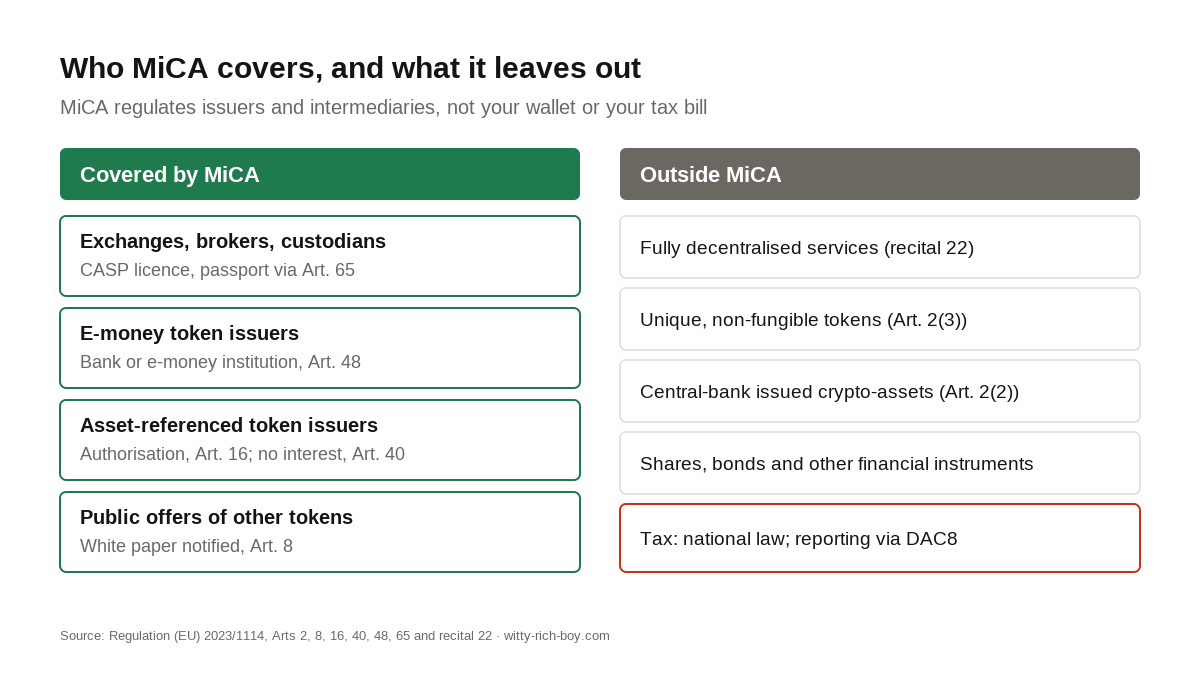
MiCA is narrower than headlines suggest. It leaves out:
- Tax. MiCA contains no tax rules. Whether a swap is a taxable disposal, as it is in most countries (how crypto swaps are taxed), or whether coins are tax-free after a year as in Germany’s crypto tax regime, is set by national law. The same goes for loss relief (crypto tax-loss harvesting rules). Your residence decides which country taxes you (digital nomad tax residency).
- Fully decentralised services. Recital 22 excludes services provided “in a fully decentralised manner without any intermediary”. Regulators decide case by case; partly decentralised services stay in scope, and ESMA has asked the Commission to define DeFi in law.
- Unique NFTs (Article 2(3)), though large series or collections can still be caught.
- Central-bank money. Crypto-assets issued by the ECB or national central banks acting as monetary authorities, or by other public authorities, are excluded under Article 2(2).
- Financial instruments, which fall under securities law instead.
How do MiCA, the travel rule and DAC8 fit together?
Three EU laws now apply to the same platforms. MiCA licenses the provider. The Transfer of Funds Regulation, Regulation (EU) 2023/1113, has also applied since 30 December 2024. It makes providers attach originator and beneficiary information to crypto transfers, with no minimum amount. For transfers above €1,000 to or from a self-hosted address, the provider must assess whether you own or control that address; our crypto travel rule explainer shows what that means on a withdrawal screen and how the UK, US and others compare. DAC8, Council Directive (EU) 2023/2226, makes providers report your transaction totals to tax authorities from the 2026 tax year, using MiCA’s definitions. Our guide to DAC8 crypto reporting covers the deadlines and what each report contains.
| Law | Question it answers | Applies since | What you notice |
|---|---|---|---|
| MiCA (Reg. 2023/1114) | Who may serve you, and on what terms? | 30 Dec 2024 (stablecoins 30 Jun 2024) | Licences, white papers, stablecoin limits, custody rules |
| Transfer of Funds Regulation (Reg. 2023/1113) | Who is sending crypto to whom? | 30 Dec 2024 | Name and wallet questions on transfers; ownership checks above €1,000 for self-hosted wallets |
| DAC8 (Dir. 2023/2226) | What should the tax office know? | 1 Jan 2026 | Tax ID requests; annual reports to your tax authority |
A licensed EU provider now means a supervised custodian, traceable transfers and a tax office that sees your totals; what you owe is still set nationally.
Questions readers ask
What is MiCA in simple terms?
MiCA is the EU's Markets in Crypto-Assets Regulation, Regulation (EU) 2023/1114. It sets one rulebook for all 27 member states. Crypto platforms and brokers need a licence. Stablecoin issuers need authorisation and full reserves. Token sellers must publish a white paper. In return, a licensed provider can serve clients across the EU, and clients get rules on custody, complaints and disclosure. MiCA has applied in full since 30 December 2024.
Is the MiCA transitional period over?
Yes. Article 143(3) let firms already operating under national law carry on until 1 July 2026 at the latest, or until their application was decided if that came first. Many member states chose shorter periods of 6, 9 or 12 months. ESMA confirmed the transition expired across the EU on 1 July 2026. Providers serving EU clients without a MiCA licence must now wind down.
How do I know if my crypto exchange is MiCA-licensed?
Check ESMA's interim MiCA register, published on ESMA's MiCA page as downloadable files. The CASP file lists each authorised provider's legal name, home member state, national regulator, authorisation date, services and the member states it has notified. A separate file lists non-compliant entities. Search by legal entity name rather than app brand, and confirm with the national regulator's own register.
Does MiCA protect my crypto if an exchange goes bust?
Partly. Licensed custodians must keep clients' crypto-assets legally and operationally separate from their own, so creditors cannot claim them in insolvency (Art. 75). Client cash must sit with a bank or central bank in separate accounts (Art. 70). But there is no deposit-guarantee or investor-compensation scheme for crypto, as the EU supervisors' consumer factsheet stresses.
Can I still use dollar stablecoins in the EU?
MiCA does not stop you holding any token in your own wallet. It regulates issuers and providers. Stablecoins whose issuer has no MiCA authorisation are 'non-compliant', and ESMA's October 2026 opinion expects licensed providers to stop offering services in them to EU clients. Authorised non-euro e-money tokens remain allowed, but their issuers face caps on use as a means of exchange (Arts 23 and 58).
Does MiCA cover DeFi and NFTs?
Mostly not. Recital 22 says services provided in a fully decentralised way, without any intermediary, fall outside MiCA. Regulators decide case by case whether a platform really is fully decentralised. Unique, non-fungible crypto-assets are excluded under Article 2(3). NFTs issued in large series or collections can still fall within MiCA, according to the EU supervisors' factsheet.
Does MiCA change how crypto is taxed?
No. MiCA contains no tax rules. Gains, staking income and swaps are still taxed under each country's national law. The tax change comes from DAC8, Directive (EU) 2023/2226. Since 1 January 2026 it has required crypto providers to collect users' tax IDs and report annual transaction totals to tax authorities. MiCA definitions decide which providers and tokens DAC8 covers.
What is the 14-day withdrawal right under MiCA?
Under Article 13, a retail buyer of a crypto-asset other than a stablecoin gets 14 calendar days to withdraw without fees or reasons. This applies when you buy directly from the offeror, or from a provider placing the tokens on the offeror's behalf. It does not apply once the token is admitted to trading, or after a time-limited offer closes. So it covers new token sales, not normal exchange purchases.
Was this guide useful?
Thanks — your answer helps us decide what to cover next.
Sources
- Regulation (EU) 2023/1114 on markets in crypto-assets (MiCA), OJ L 150, 9.6.2023 — EUR-Lex
- ESMA Interactive Single Rulebook — MiCA Article 143: Transitional measures
- ESMA — List of MiCA grandfathering periods decided by Member States under Article 143(3)
- ESMA — Statement on the end of transitional periods under MiCA (April 2026)
- ESMA — Public Statement calling on unauthorised crypto-asset service providers to wind down (June 2026)
- ESMA — Markets in Crypto-Assets Regulation (MiCA), incl. the interim MiCA register
- ESMA — Supervisory expectations on services related to unauthorised stablecoins (October 2026)
- Joint ESAs factsheet — Crypto-assets explained: what MiCA means for you as a consumer (October 2025)
- Regulation (EU) 2023/1113 on information accompanying transfers of funds and certain crypto-assets — EUR-Lex
General information, not tax or legal advice. Rules change — check the official source or a licensed adviser before acting.