Italy · Crypto
Italy crypto tax (2026): 33% on gains, 0.2% a year on holdings
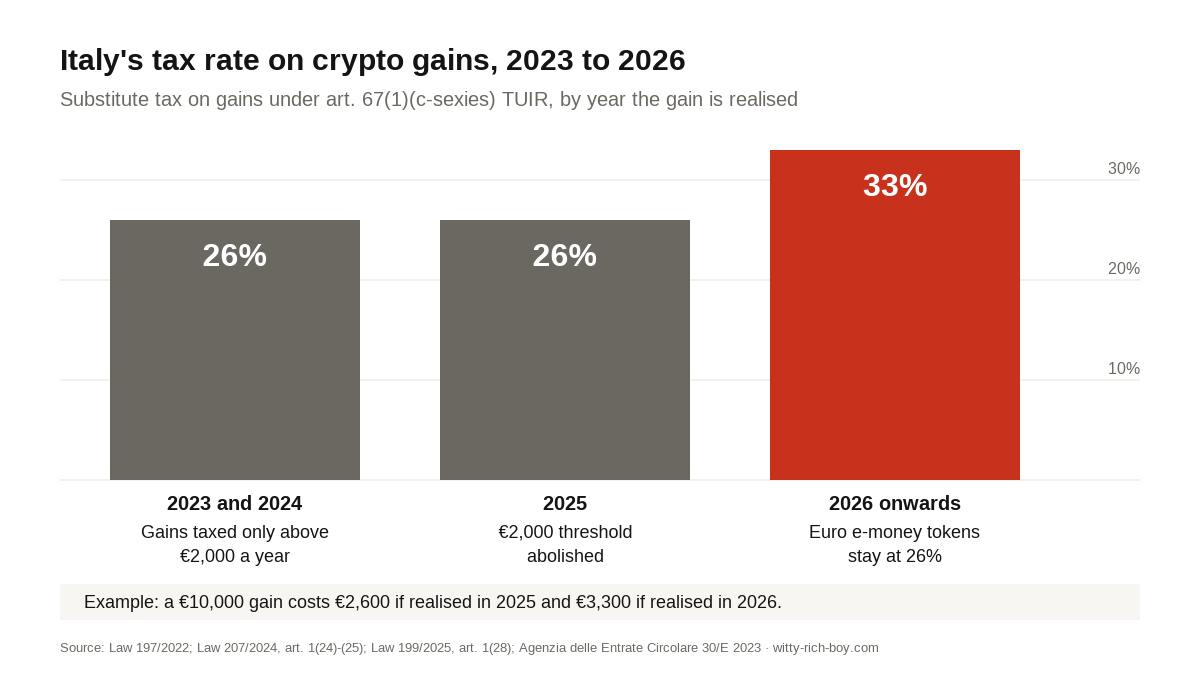
Italy crypto tax 2026: gains pay 33% from 1 January 2026, up from 26%, with no €2,000 threshold, and coins held bear a 0.2% annual value tax.

The short answer
- Gains and other income from crypto-assets are taxed at 26% if realised in 2025 and 33% from 1 January 2026 (art. 1(24) Law 207/2024); gains on euro e-money tokens stay at 26% (art. 1(28) Law 199/2025).
- The €2,000 annual threshold below which crypto gains went untaxed in 2023–2024 was abolished from 2025, so every euro of net gain is now taxable: a €10,000 gain costs €2,600 in 2025 and €3,300 in 2026.
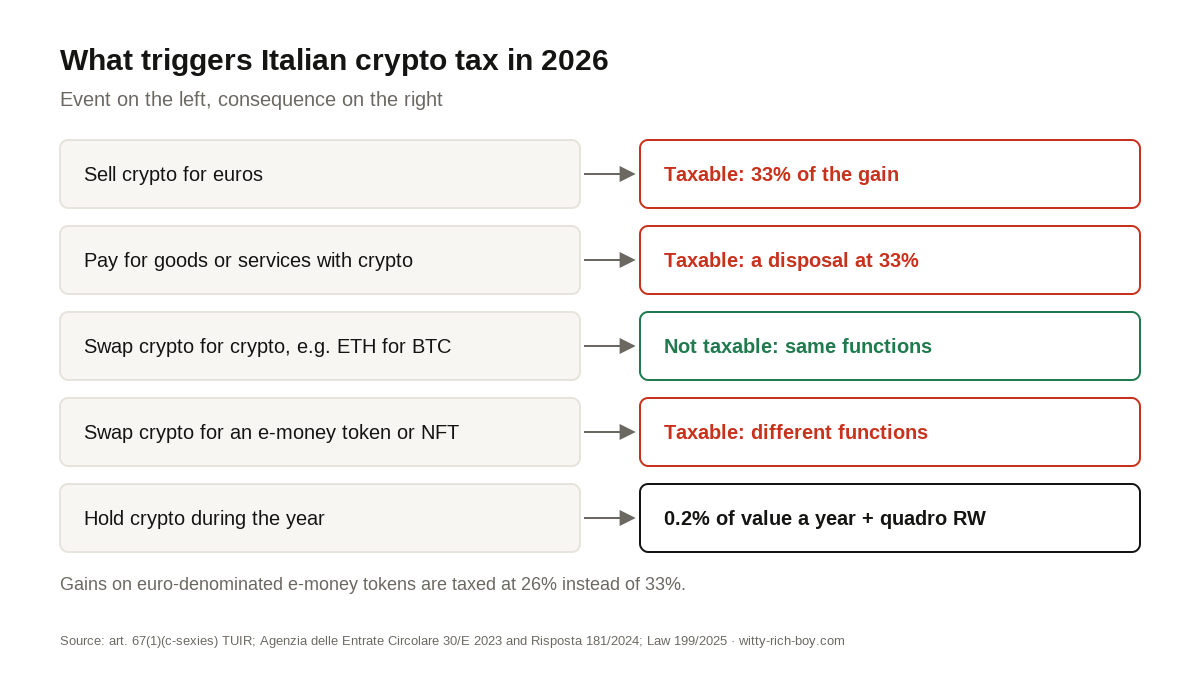
- A swap between crypto-assets with the same characteristics and functions, such as ETH for BTC, is not a taxable event; swapping into an e-money token or an NFT is.
- Net losses can be carried forward against crypto gains of the following periods, up to the fourth, if reported in the return for the year they arise (art. 68(9-bis) TUIR).
- Holdings bear a 0.2% (2 per mille) annual tax on value: stamp duty if an Italian intermediary applies it, otherwise the imposta sul valore delle cripto-attività paid via quadro RW, where all crypto must be reported.
- The option to step up the cost to the 1 January 2025 value by paying 18% on that value closed with the 30 November 2025 payment deadline.
In force: Tax year 2026 (Redditi PF filed in 2027) · 33% rate on crypto gains realised from 1 January 2026 under art. 1(24) Law 207/2024 · 26% for euro e-money tokens under art. 1(28) Law 199/2025 · €2,000 threshold abolished from 1 January 2025 under art. 1(25) Law 207/2024 · 0.2% value tax under art. 19 DL 201/2011 as extended by Law 197/2022
Italian residents pay a flat 33% substitute tax on crypto gains realised from 1 January 2026, up from 26% in 2025, with no tax-free threshold since 2025. Gains on euro e-money tokens stay at 26%. Holdings also bear a 0.2% annual tax on value, declared with the coins themselves in quadro RW.
Italy rewrote its crypto rules three times in three budgets. Law 197/2022 gave crypto-assets their own category of taxable income from 2023 with a €2,000 threshold; Law 207/2024 (the 2025 budget) removed the threshold and pushed the rate to 33% from 2026; Law 199/2025 (the 2026 budget) carved euro e-money tokens back to 26%. The result is a high flat rate with no reward for holding long, softened by a generous rule on swaps. Below are the 2026 rules, each tied to the TUIR (the income tax code) or Agenzia delle Entrate guidance, with worked numbers and a comparison with Spain, Portugal and Germany.
How is crypto taxed in Italy?
As “miscellaneous income” (redditi diversi) under article 67(1)(c-sexies) TUIR, taxed separately from salary at a flat rate. The provision, added by Law 197/2022, covers gains and other income realised through the redemption, sale for consideration, exchange or holding of crypto-assets, however they are called. A crypto-asset (cripto-attività) is a digital representation of value or rights that can be transferred and stored electronically using distributed ledger or similar technology. That covers coins, tokens, stablecoins and NFTs alike.
The Agenzia delle Entrate’s Circolare 30/E of 27 October 2023 is still the main guide to the regime. Article 68(9-bis) TUIR sets how the gain is measured: the price received, or the market value of the crypto-assets received in an exchange, minus the cost or purchase value. The Agenzia’s 2026 return instructions add that the cost must be documented; where it is not, it is taken as zero, so the whole sale price is taxed.
| Event | Tax treatment | Rate for 2026 | Legal basis |
|---|---|---|---|
| Sale of crypto for euros | Taxable gain or loss | 33% | Art. 67(1)(c-sexies), art. 68(9-bis) TUIR |
| Paying for goods or services with crypto | Taxable disposal | 33% | Art. 67(1)(c-sexies) TUIR |
| Swap for a crypto-asset with the same functions | Not a taxable event | — | Art. 67(1)(c-sexies) TUIR; Circ. 30/E |
| Swap for an NFT or e-money token | Taxable exchange | 33% | Circ. 30/E 2023 |
| Gain on a euro e-money token | Taxable gain | 26% | Art. 1(28) Law 199/2025 |
| Income from holding crypto-assets | Taxable income, no costs deducted | 33% | Art. 67(1)(c-sexies) TUIR; Redditi PF instructions |
| Holding coins over the year | 0.2% annual tax on value | 0.2% | Art. 19 DL 201/2011; Law 197/2022 |
What is the crypto tax rate in Italy for 2025 and 2026?
26% on gains realised in 2025 and 33% on gains realised from 1 January 2026. Article 1(24) of Law 207/2024 raised the substitute tax on income under letter c-sexies from 26% to 33% for income realised from 2026, as the Chamber of Deputies’ dossier on the 2025 budget law records. The rate is flat: it does not depend on your other income, the size of the gain or how long you held the coins.
The 2026 budget added one exception. Article 1(28) of Law 199/2025 inserted a sentence into Law 207/2024 so that income from e-money tokens denominated in euro is taxed at 26% “instead of the ordinary 33%”. The Senate’s budget dossier describes these as tokens whose value is pegged to the euro and whose reserves are held entirely in euro-denominated assets. Dollar stablecoins and every other crypto-asset sit at 33%. The Agenzia’s 2026 instructions for non-commercial entities already carry new quadro RT sections V-A1 and V-B1 for the two rates.
Was the €2,000 crypto tax exemption abolished?
Yes, from 2025. Under the 2023 rules, crypto gains were taxable only if the year’s total exceeded €2,000, and the same threshold applied before excess losses could be carried forward: Circolare 30/E’s own example lets a €2,500 bitcoin loss carry forward only €500. Article 1(25) of Law 207/2024 struck the threshold out of article 67(1)(c-sexies) (letter a) and out of the loss rule in article 68(9-bis) (letter b), for income realised from 1 January 2025.
Small traders now owe tax from the first euro: a €1,500 gain costs €390 in 2025 and €495 in 2026. Losses, in turn, are usable in full.
How much is the tax on a crypto gain: 2025 vs 2026?
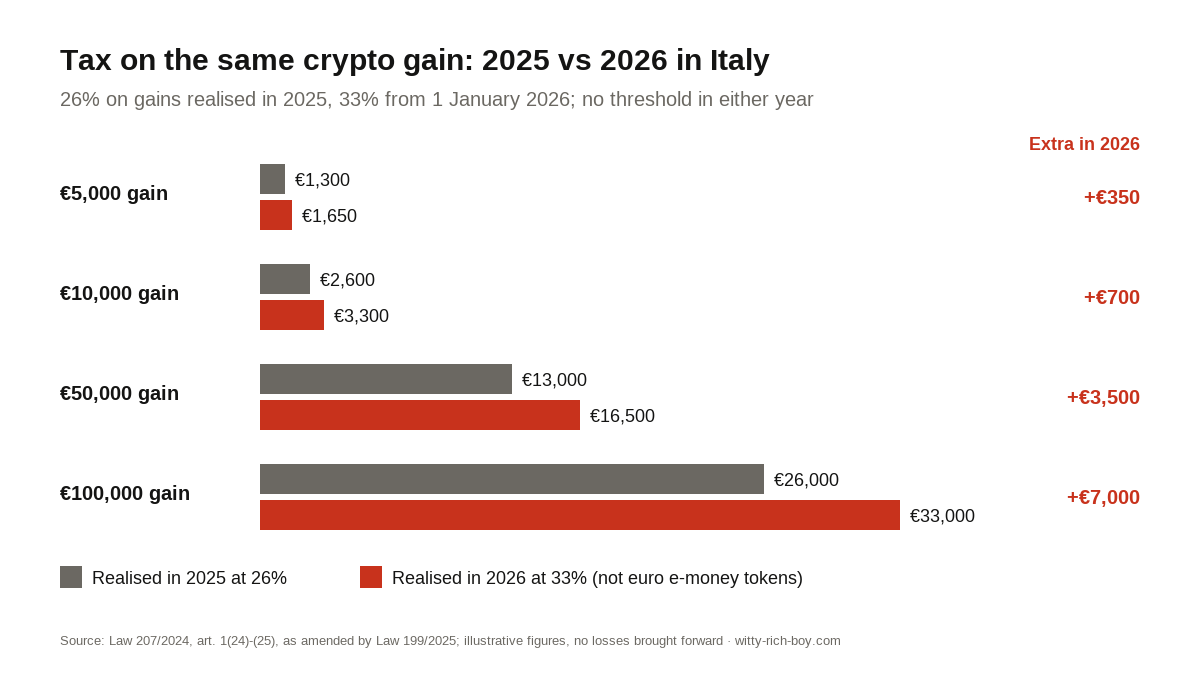
Seven points more on every euro of gain. Because the rate is flat and there is no threshold, the calculation is one multiplication.
| Net gain | Tax if realised in 2025 (26%) | Tax if realised in 2026 (33%) | Extra cost | Euro e-money token gain in 2026 (26%) |
|---|---|---|---|---|
| €1,500 | €390 | €495 | €105 | €390 |
| €5,000 | €1,300 | €1,650 | €350 | €1,300 |
| €10,000 | €2,600 | €3,300 | €700 | €2,600 |
| €50,000 | €13,000 | €16,500 | €3,500 | €13,000 |
| €100,000 | €26,000 | €33,000 | €7,000 | €26,000 |
Example: Giulia bought 0.5 BTC for €20,000 and sells it for €30,000. A sale in December 2025 costs her €2,600; in January 2026, €3,300.
Are crypto-to-crypto swaps taxable in Italy?
Not when both crypto-assets have the same characteristics and functions. Article 67(1)(c-sexies) TUIR states that such an exchange is not fiscally relevant, and Circolare 30/E gives the examples: from 1 January 2023, exchanging one cryptocurrency for another, such as ether for bitcoin, is not a realisation, and neither is swapping one NFT for another. Buying an NFT with a cryptocurrency, by contrast, is a taxable exchange because the two assets have different functions.
Stablecoins are the grey zone. A parliamentary question to the Chamber (5/03682) notes that the circular treats a swap between a cryptocurrency and an e-money token, which gives the holder a claim at par against a legal-tender currency, as taxable, but does not say whether other stablecoins with equivalent features are caught. Keep records of every swap whatever its treatment.
Italy’s same-function rule puts it closer to Portugal, which defers tax on crypto-to-crypto swaps, than to most of Europe. Our guide to whether crypto swaps are taxable compares nine countries.
How do crypto losses work in Italy?
They offset crypto gains only, for up to four years. Under article 68(9-bis) TUIR, net income under letter c-sexies is the gains minus the losses of the same tax period. If losses exceed gains, the excess is deducted in full from crypto gains of the following periods, but not beyond the fourth, provided it is reported in the return for the year the loss arose. Since the 2025 change, the whole excess carries forward, not just the part above €2,000.
The rate change creates an asymmetry: a loss realised in 2025, when gains paid 26%, offsets 2026 gains taxed at 33%.
Example: Marco realises a €4,000 net loss in 2025 and reports it in his Redditi PF 2026 return. In 2026 he sells ETH at a €10,000 gain. His taxable crypto income is €6,000 and his tax €1,980, against €3,300 without the loss, a saving of €1,320. An unused 2025 loss would expire after 2029.
Our guide to crypto tax-loss harvesting covers realising losses before 31 December.
What was the 1 January 2025 crypto revaluation (rideterminazione)?
A one-off chance to reset the cost basis, now closed. Article 1(26) of Law 207/2024 let residents use, for each crypto-asset held on 1 January 2025, the value on that date instead of the purchase cost, provided an 18% substitute tax was paid on that value. Under article 1(27) the tax was due by 30 November 2025, or in up to three equal annual instalments with 3% annual interest on those after the first. Article 1(29) adds the catch: anyone who revalued cannot then realise deductible losses on those coins. The values are reported in quadro RT of the Redditi PF return. The 2026 budget did not renew the option.
The tax applied to the whole value, not the gain, so it paid off only for coins with large unrealised gains.
| Example: a coin bought for €20,000, worth €60,000 on 1 Jan 2025, sold in 2026 for €70,000 | Without revaluation | With revaluation |
|---|---|---|
| Revaluation tax (18% × €60,000) | — | €10,800 |
| Taxable gain on the 2026 sale | €50,000 | €10,000 |
| Tax on the sale at 33% | €16,500 | €3,300 |
| Total tax | €16,500 | €14,100 |
The revaluation saved €2,400 here. Had the coin cost €50,000, tax without revaluation would have been €6,600 (33% of a €20,000 gain) against €14,100 with it, so the option would have cost €7,500.
What is the 0.2% tax on crypto holdings, and is it IVAFE?
It is the imposta sul valore delle cripto-attività (often called IVCA), a cousin of IVAFE rather than IVAFE itself. Law 197/2022 extended the stamp duty of 2 per mille (0.2%) a year to statements on crypto-assets held through Italian intermediaries, and added a parallel tax under article 19 of Decree-Law 201/2011 for residents whose coins are not taxed that way. In Risposta 181/2024 the Agenzia confirms that the value tax is due, at the same 2 per mille, where no intermediary applies stamp duty: coins with foreign platforms, or on USB keys, computers or phones.
The rules for the value tax, set out in the Agenzia’s Redditi PF 2026 instructions (Fascicolo 2):
- Base. The value at the end of each calendar year as shown by the platform where the coins were bought; failing that, another platform or specialist sites; failing that, the purchase cost.
- Pro rata. Due in proportion to the days held and your share, for jointly held coins.
- Credit. Any foreign wealth tax paid definitively on the same coins is credited, up to the Italian tax.
- Payment. By the same deadlines as income tax, computed in quadro RW.
Example: Sara keeps crypto worth €50,000 on 31 December 2026 in a hardware wallet, held all year. She owes €50,000 × 0.2% = €100, paid with her income tax balance in 2027.
Do you have to declare crypto in quadro RW?
Yes, in most cases. The Agenzia’s quadro RW guidance says the section must report crypto-assets held through “wallets”, “digital accounts” or other storage systems, however acquired, and quadro RW is also where the 0.2% value tax is calculated. The €15,000 exemption in the RW rules applies only to foreign bank deposits and current accounts, not to crypto. Circolare 30/E states that monitoring applies whatever the storage method and whether the coins are held in Italy or abroad; it exempts coins entrusted to Italian intermediaries only where those intermediaries have applied withholding or substitute tax on the flows and income.
From 2026, the EU’s DAC8 directive also makes crypto platforms collect and report users’ data to tax authorities; our DAC8 crypto reporting guide explains what is shared and when.
How to declare crypto in Italy, step by step
Everything goes in the annual Redditi Persone Fisiche (Redditi PF) return; for tax year 2025, crypto gains went in quadro RT section V-A (rows RT41–RT45).
- Export every transaction for the year from each platform and wallet: date, asset, quantity, euro value and counterparty asset.
- Classify each event: sale, payment, swap with the same functions (not taxable), swap into an NFT or e-money token (taxable), or income from holding.
- Document the cost of every coin sold; an undocumented cost counts as zero. Use the 1 January 2025 value only if you paid the 18% revaluation tax.
- Net gains and losses for the year, then deduct losses brought forward from the previous four years.
- Apply the rate: 33% on 2026 net gains, 26% on gains from euro e-money tokens, in quadro RT.
- Fill in quadro RW with each holding, its 31 December value and days held, and compute the 0.2% value tax unless an Italian intermediary charged stamp duty.
- Pay the substitute tax and the value tax by F24 with the income tax balance (Risoluzione 36/E of 2023 created code 1715 for crypto gains), then file the return electronically.
- Keep records of every lot and any reported loss until the carry-forward window closes.
When are the Italian crypto tax deadlines?
The Agenzia’s page on submitting Redditi PF sets the electronic filing date at 31 October of the following year. In 2026 that day was a Saturday, so the deadline for 2025 income moved to 2 November 2026, with the balance of tax due by 30 June 2026.
| Date | What happens | Applies to |
|---|---|---|
| 30 November 2025 | Last day for the 18% revaluation tax or its first instalment | Holders who revalued 1 Jan 2025 values |
| 1 January 2026 | 33% rate begins; DAC8 data collection starts | All gains realised from this date |
| 31 December 2026 | Year-end value for quadro RW and the 0.2% tax | All holdings |
| 30 June 2027 (ordinary date) | Balance of 2026 substitute tax and value tax | You, by F24 |
| 31 October 2027 (moves if non-working day) | Redditi PF return for 2026 filed online | You |
| Up to tax year 2030 | Window to use a net 2026 loss | You |
How does Italy compare with Spain, Portugal and Germany?
Italy is the strictest on rates and the most lenient on swaps among its neighbours, using the rules in our country guides:
| Italy | Spain | Portugal | Germany | |
|---|---|---|---|---|
| Rate on 2026 gains | Flat 33% (26% euro e-money tokens) | 19–30% savings scale | 28%, or 0% after 365 days | Personal rate up to 45%, 0% after one year |
| Tax-free threshold | None since 2025 | None | — | €1,000 short-term gains (cliff) |
| Long-term holding relief | None | None | Yes, 365 days | Yes, over one year |
| Crypto-to-crypto swap | Not taxed if same functions | Taxable | Deferred | Taxable |
| Loss carry-forward | Four years, crypto gains only | Four years, 25% cap on other savings income | Five years, only if aggregating | Indefinitely, against private sale gains |
| Annual tax on holdings | 0.2% of value | Wealth tax above €700,000 exempt minimum | None | None |
| €10,000 short-term gain | €3,300 | €1,980 | €2,800 | Depends on income |
For a buy-and-hold investor, Spain’s 19%–30% scale tops out at 30%, below Italy’s flat rate at every size of gain, and both Portugal and Germany, where gains are tax-free after a year, reward patience in a way Italy does not. What Italy offers instead is room to rebalance between coins without a tax bill, and a full four-year carry-forward that, after the 2026 rise, lets a loss realised in 2025 save 33 cents per euro against 2026 gains.
Questions readers ask
How much tax do you pay on crypto in Italy?
Italian residents pay a flat substitute tax on net crypto gains: 26% on gains realised in 2025 and 33% on gains realised from 1 January 2026, under article 1(24) of Law 207/2024. Gains on e-money tokens denominated in euro stay at 26% under Law 199/2025. The rate is flat, so a €10,000 gain realised in 2026 costs €3,300 regardless of your other income.
Is there still a €2,000 crypto tax exemption in Italy?
No. In 2023 and 2024 crypto gains were taxed only when the year's total exceeded €2,000. Article 1(25) of Law 207/2024 removed that threshold from 2025, both for gains and for the deductibility of losses. Since 2025 every euro of net gain is taxable, so even a €1,500 gain costs €390 in 2025 and €495 in 2026.
Are crypto-to-crypto swaps taxable in Italy?
Not when the two crypto-assets have the same characteristics and functions. Article 67(1)(c-sexies) TUIR says such a swap is not fiscally relevant, and Circolare 30/E of 2023 gives exchanging one cryptocurrency for another, such as ether for bitcoin, as an example. Swapping a cryptocurrency for an NFT or an e-money token is a taxable exchange.
How long can you carry forward crypto losses in Italy?
Under article 68(9-bis) TUIR, net crypto losses that exceed the year's crypto gains can be deducted from crypto gains of the following tax periods, but not beyond the fourth, provided they are reported in the return for the year in which they arise. A 2026 loss is therefore usable until 2030. Losses cannot reduce salary or other income.
What is the 0.2% tax on crypto in Italy?
It is an annual tax of 2 per mille on the value of crypto-assets held by Italian residents. Where an Italian intermediary holds the coins it charges the equivalent stamp duty. Otherwise, as Agenzia delle Entrate Risposta 181/2024 explains, residents pay the imposta sul valore delle cripto-attività themselves through quadro RW, pro rata to days and share held. On €50,000 held all year it is €100.
Do I need to report crypto in quadro RW?
Generally yes. The Agenzia's quadro RW guidance says crypto-assets held through wallets, digital accounts or other storage systems must be reported, and quadro RW is also where the 0.2% value tax is computed. The €15,000 exemption in the RW rules applies to foreign bank deposits and current accounts, not crypto. Circolare 30/E sets narrow exemptions for coins with Italian intermediaries that withhold tax.
Can I still revalue my crypto at its 1 January 2025 value?
No longer. Law 207/2024 let residents replace the cost of crypto held on 1 January 2025 with its value on that date by paying an 18% substitute tax on that value, by 30 November 2025 or in up to three annual instalments with 3% interest. Choosing it rules out deductible losses on those coins. The Law 199/2025 budget did not renew the option.
When do you declare crypto gains in Italy?
In the annual Redditi Persone Fisiche return, in quadro RT for gains and quadro RW for holdings and the 0.2% value tax. For tax year 2025 the electronic filing deadline was 2 November 2026, because 31 October fell on a Saturday, and the balance of tax was due by 30 June 2026. Gains realised in 2026 go in the return filed in 2027.
Was this guide useful?
Thanks — your answer helps us decide what to cover next.
Sources
- Circolare n. 30/E del 27 ottobre 2023 — Trattamento fiscale delle cripto-attività (Agenzia delle Entrate, PDF)
- Legge di bilancio 2025 (Law 207/2024) — Dossier, Volume I, art. 1, commi 1-366 (Camera dei deputati)
- Legge 30 dicembre 2025, n. 199 — consolidated text (Normattiva)
- Legge di bilancio 2026, A.S. n. 1689 — Dossier, Volume I (Senato della Repubblica, PDF)
- Risposta n. 181/2024 — imposta sul valore delle cripto-attività and quadro RW (Agenzia delle Entrate, PDF)
- Quadro RW — Dichiarazione precompilata, info e assistenza (Agenzia delle Entrate)
- Redditi Persone Fisiche 2026 — Istruzioni, Fascicolo 2 (quadri RT and RW) (Agenzia delle Entrate, PDF)
- Redditi ENC 2026 — Istruzioni per la compilazione, quadro RT sections V-A1 and V-B1 (Agenzia delle Entrate, PDF)
- Risoluzione n. 36/E del 26 giugno 2023 — F24 tax codes for crypto-assets (Agenzia delle Entrate, PDF)
- When and how to submit a Redditi PF form (Agenzia delle Entrate, English)
General information, not tax or legal advice. Rules change — check the official source or a licensed adviser before acting.