Portugal · Crypto
Portugal crypto tax (2026): 0% after 365 days, 28% before
Portugal crypto tax 2026: gains on coins held 365 days or more are excluded, shorter-term gains pay 28%, swaps are deferred and leaving Portugal counts as a sale.
The short answer
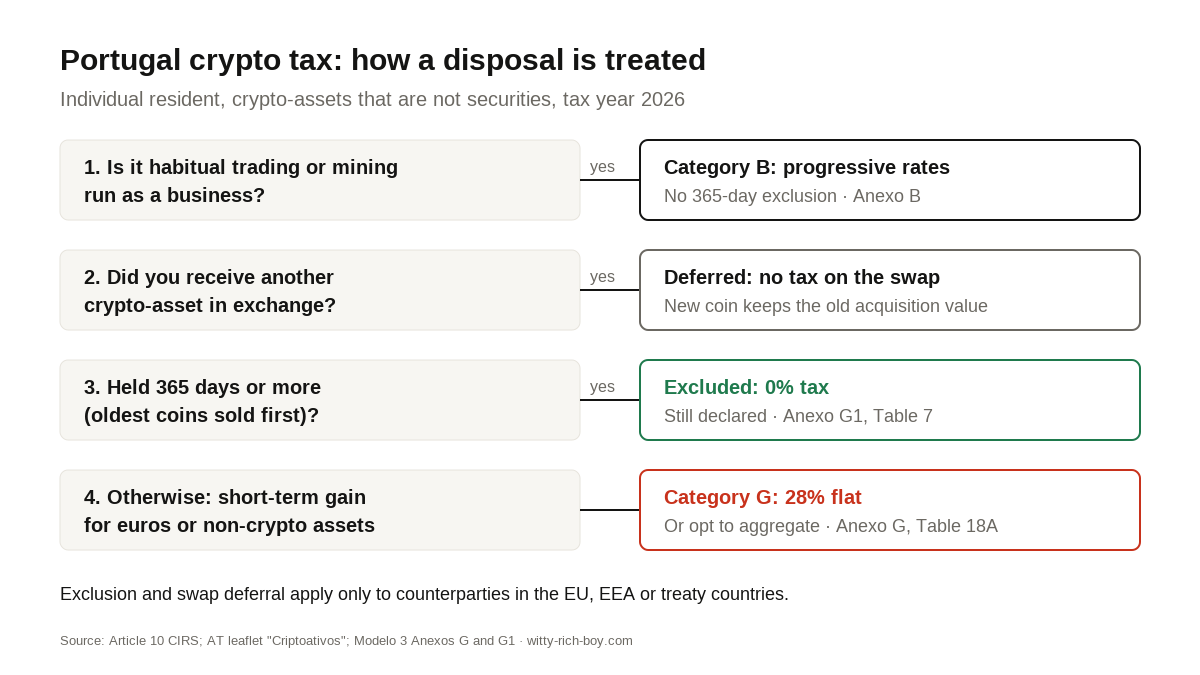
- Gains on crypto-assets that are not securities and were held 365 days or more are excluded from tax under Article 10 CIRS; holding time before 1 January 2023 counts.
- Shorter-term gains are Category G income taxed at a flat 28%, or at progressive rates of up to 48% if you opt to aggregate; in our example a €11,800 gain costs €3,304 at 28%.
- A crypto-to-crypto swap is not taxed when it happens: the coin received inherits the acquisition value of the coin given up.
- Ceasing to be resident in Portugal is treated as a sale of your coins at market value, and gifts or inheritances of crypto can bear 10% stamp duty.
- The NHR regime closed to new entrants from 1 January 2024; its successor IFICI taxes qualifying work at 20% and generally exempts foreign Category G income for 10 years.
In force: Tax year 2026 (Modelo 3 due 1 April to 30 June 2027) · crypto rules in the Código do IRS since 1 January 2023 (Lei 24-D/2022) · Article 10 CIRS as consolidated after Decreto-Lei 97/2026 · DAC8 reporting under Lei 26/2026, in effect from 1 January 2026
In Portugal, gains on crypto held for 365 days or more are excluded from income tax under Article 10 of the Código do IRS. Shorter-term gains are taxed at a flat 28%, or at progressive rates if you opt to aggregate. Crypto-to-crypto swaps are not taxed until you cash out, and leaving Portugal counts as a sale.
Portugal has a reputation as Europe’s crypto tax haven, and since 2023 it has a written crypto regime to go with it. That regime is generous to patient holders and not to anyone else. Short-term gains pay the same 28% as shares, trading as a business is taxed as business income, and the rules on swaps, emigration and gifts all have catches. Below are the 2026 rules, each tied to the Código do IRS (CIRS) or guidance from the Autoridade Tributária e Aduaneira (AT), with worked numbers and the boxes on the return.
Is crypto taxed in Portugal?
Yes, but whether you pay depends on how long you held the coin and what kind of income it is. Since 1 January 2023, when the State Budget law (Lei 24-D/2022) wrote crypto into the CIRS, the AT’s crypto-asset leaflet sorts crypto income into three categories: Category G (capital gains), Category B (business and professional income) and Category E (investment income).
A crypto-asset (criptoativo), for tax purposes, is any digital representation of value or rights that can be transferred or stored electronically using distributed ledger or similar technology. Unique, non-fungible tokens are excluded from that definition.
| Event | Tax treatment | Legal basis |
|---|---|---|
| Sale for euros, coin held 365 days or more | Excluded from IRS (still declared) | Art. 10(1)(k) and 10(22) CIRS |
| Sale for euros, coin held under 365 days | Category G gain, flat 28% or optional aggregation | Art. 10(1)(k), art. 72 CIRS |
| Swap of one crypto-asset for another | No tax now; cost carries over to the new coin | Art. 10 CIRS |
| Staking and other rewards from crypto operations | Category E income, 28% or optional aggregation | Art. 5(2)(u) CIRS |
| Habitual trading as a business, mining | Category B income at progressive rates | Art. 31 CIRS; AT leaflet |
| Ceasing to be resident | Deemed sale at market value | Art. 10 CIRS |
| Gift or inheritance | Stamp duty at 10%, family exemptions | Item 1.2, stamp duty table |
How does the 365-day crypto exemption work?
Gains and losses on disposals of crypto-assets that are not securities are excluded from taxation when the coins were held for 365 days or more. The rule sits in Article 10 CIRS, which the AT’s consolidated text now numbers as paragraph 22 following the May 2026 amendments by Decreto-Lei 97/2026; return forms and older rulings still cite it as paragraph 19. The substance has not changed.
Three details decide whether the exclusion applies.
Older coins count
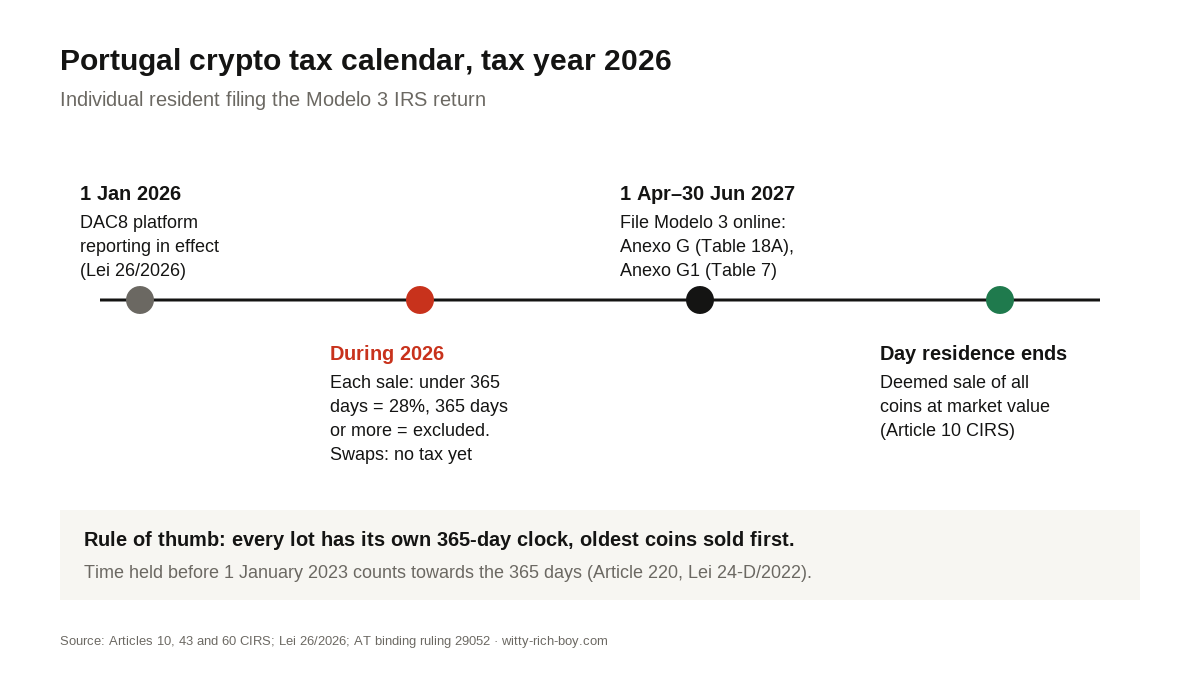
Under Article 220 of Lei 24-D/2022, time held before the rules took effect counts towards the 365 days. In binding ruling 29052 the AT applied this to coins bought in 2019: their holding period runs from 2019, not from 2023.
Oldest coins are sold first
Under Article 43 CIRS the crypto-assets you sell are deemed to be those acquired earliest, a first-in, first-out (FIFO) rule. Where coins are held with more than one entity, the AT says the rule applies to each one separately. You cannot choose to sell your oldest lot on one platform and your newest on another to pick the result.
The counterparty must be in the EU, the EEA or a treaty country
The exclusion, and the swap deferral below, apply only to transactions with residents of an EU or EEA state, or of a country with which Portugal has a tax treaty or an agreement providing for exchange of tax information, as the AT states in its leaflet and in binding ruling 28122. That is why the return asks for the counterparty’s country.
How much tax do you pay on short-term crypto gains in Portugal?
A flat 28% on the net gain, unless you choose to aggregate it with your other income. The AT leaflet confirms that positive gains not excluded from tax are taxed at the autonomous rate of 28% under Article 72 CIRS, with an option to aggregate (englobamento). Aggregated income is taxed at the general rates of Article 68 CIRS, which reach 48% above €86,634 of taxable income in the 2026 table set by Lei 73-A/2025.
The taxable gain is the sale proceeds minus the acquisition value and the necessary expenses actually incurred on buying and selling, which the Anexo G instructions let you enter in a separate column. For crypto, the CIRS presumes the sale value is the market value on the date of the disposal.
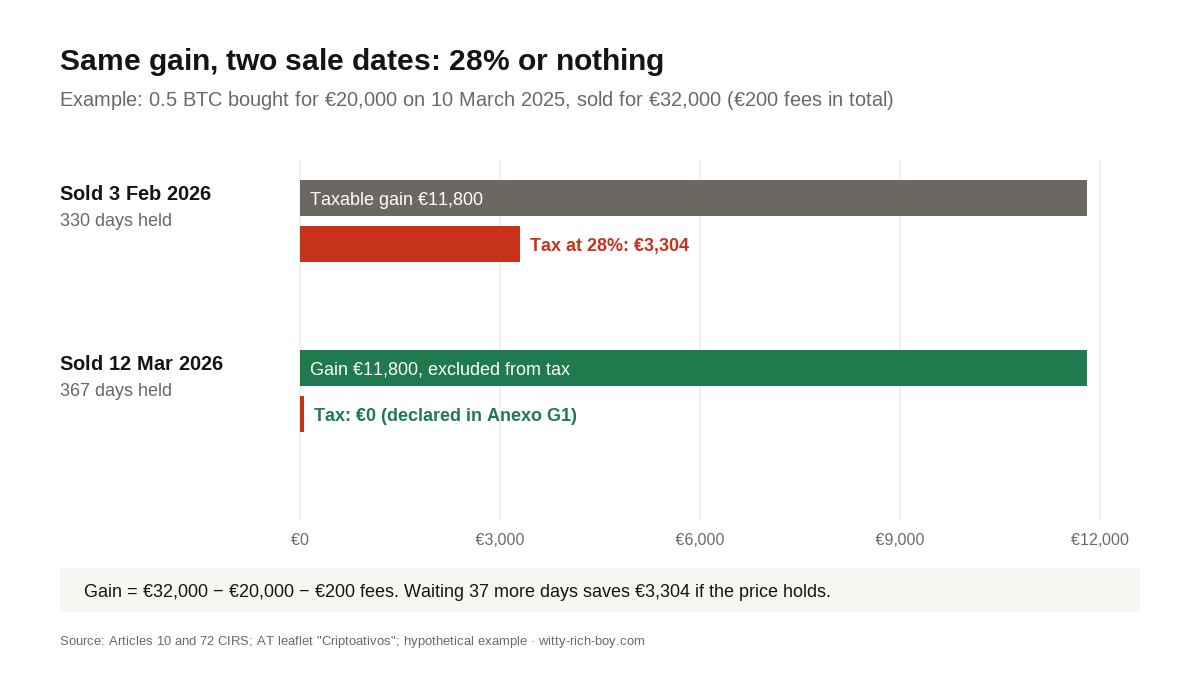
Example: Ana, resident in Lisbon, buys 0.5 BTC for €20,000 on 10 March 2025, paying €100 in fees. She sells it for €32,000, with another €100 in fees.
| Scenario | Days held | Taxable gain | Tax at 28% | Where it goes on the return |
|---|---|---|---|---|
| Sells on 3 February 2026 | 330 | €11,800 | €3,304 | Anexo G, Table 18A |
| Sells on 12 March 2026 | 367 | €0 (excluded) | €0 | Anexo G1, Table 7 |
Waiting 37 more days, with the price unchanged, saves Ana €3,304. In practice the price will not stand still, which is the real decision: a 10% fall before day 365 would cost her €3,200, roughly the tax saved.
When aggregation helps, and the loss rule
Aggregation only pays if your average rate on total income would stay below 28%, typically in a low-income year. It also decides what happens to losses: the AT leaflet states that a net loss on crypto can be carried forward for five years under Article 55 CIRS only if you opt to aggregate. Losses on transactions with counterparties in jurisdictions on Portugal’s blacklist of clearly more favourable tax regimes are excluded. Our guide to crypto tax-loss harvesting explains how other countries police losses realised just before year-end.
Are crypto-to-crypto swaps taxable in Portugal?
No, not when they happen. Article 10 CIRS (paragraph 23 in the current consolidation, paragraph 20 in rulings issued before 2026) says that where the consideration for a crypto disposal takes the form of crypto-assets, there is no taxation, and the coins received take over the acquisition value of the coins given up. Tax arises only on a later disposal for money or for anything other than crypto. Binding ruling 28122 applied this to a taxpayer who bought and sold only in crypto: nothing was taxable until a disposal whose consideration was not a crypto-asset.
Example: Ana swaps 0.5 BTC, bought for €20,000, into ETH worth €30,000. Nothing is taxed and her ETH has a cost of €20,000. She later sells the ETH for €33,000. The gain is €13,000, taxed at 28% (€3,640) unless the 365-day exclusion applies.
A swap into a stablecoin is a swap between crypto-assets, so it stays deferred. The AT guidance confirms the cost carries over; it does not spell out how the holding period of the new coin is counted, so keep the original purchase dates. For how other countries treat swaps, see are crypto swaps taxable?, where Portugal is one of only two deferral systems.
Category G vs Category B: when are you a professional crypto trader?
When buying and selling crypto is habitual enough to amount to a business or profession. The AT’s leaflet says sales are taxed in Category B only where habitual dealing constitutes a professional or business activity, and that habitualness depends on the intention behind the transactions as well as their number. There is no numeric test. Mining and transaction validation are commercial activities in Category B.
The difference is large. Category B income is aggregated and taxed at the progressive rates, and the 365-day exclusion does not apply. Under the simplified regime in Article 31 CIRS, taxable profit is a fixed share of turnover.
| Category B activity | Share of revenue taxed (simplified regime) | When income is recognised |
|---|---|---|
| Operations with crypto-assets (trading) | 15% (coefficient 0.15) | On the onerous disposal of the coins |
| Mining of crypto-assets | 95% (coefficient 0.95) | On the onerous disposal of the coins |
Example: a trader under the simplified regime with €200,000 of revenue from crypto operations in a year has €30,000 of taxable Category B income (€200,000 × 0.15), added to her other income and taxed at progressive rates. Someone unsure which side of the line they fall on can ask the AT for a binding ruling (informação vinculativa).
How are staking rewards taxed?
Rewards earned from crypto operations, staking included, are Category E investment income under Article 5(2)(u) CIRS. The AT leaflet says they are exempt from withholding and taxed at the special rate of 28%, with residents able to opt for aggregation. Where those rewards are paid in crypto-assets, Article 5 CIRS defers the tax: nothing is taxed on receipt, and the gain is taxed as a Category G disposal when the coins received are later sold.
Validating transactions as a business is a different matter: as noted above, the AT places transaction validation and mining in Category B, so where a staking reward falls depends on the facts.
What happened to NHR, and does IFICI help crypto investors?
The non-habitual resident (NHR) regime was revoked from 1 January 2024 by the 2024 State Budget (Lei 82/2023), with transitional rules in its Article 236. The AT’s NHR FAQ confirms that anyone registered as NHR on 1 January 2024 keeps the regime until their ten-year period runs out; people who became resident in 2024 under the transitional conditions had to apply by 31 March 2025.
Its successor is the IFICI (Incentivo Fiscal à Investigação Científica e Inovação), often called “NHR 2.0”, in Article 58-A of the Tax Benefits Statute. According to the AT’s IFICI leaflet, it taxes Category A and B income from qualifying research, innovation and skilled jobs at 20%, and foreign-source income in Categories A, B, E, F and G is, as a rule, exempt. Income paid by entities in blacklisted jurisdictions is taxed at 35% instead. The benefit runs for ten consecutive years and requires that you were not tax-resident in Portugal in the previous five years.
IFICI is not a crypto regime. It applies only to people in qualifying activities, and whether a crypto gain is foreign-source income depends on the facts; the AT’s crypto guidance does not settle it. For a long-term holder the 365-day exclusion already does most of the work.
Do you pay stamp duty on crypto gifts, inheritances and fees?
Yes, potentially, at 10% on gratuitous transfers. The AT leaflet states that gifts and inheritances of crypto-assets fall under item 1.2 of the General Stamp Duty Table (TGIS) where the coins are deposited with an entity based or with a permanent establishment in Portugal; on death, where the deceased was domiciled in Portugal; and for other free transfers, where the recipient is domiciled there. According to the Diário da República’s glossary, gratuitous transfers to a spouse or unmarried partner, descendants and ascendants are exempt. The AT adds that withdrawing gifted or inherited crypto requires proof that the tax was paid or, where exempt, that the Modelo 1 stamp duty declaration was filed.
Example: a gift of crypto worth €50,000 from a Portuguese resident to a friend domiciled in Portugal bears €5,000 of stamp duty; the same gift to the giver’s daughter is exempt.
Separately, stamp duty of 4% applies to commissions and other fees charged by or through crypto-asset service providers, according to the AT leaflet.
What happens to your crypto when you leave Portugal?
Leaving is taxed as if you had sold. Article 10 CIRS treats ceasing to be resident in Portugal as an onerous disposal of crypto-assets, and the AT computes the gain as the market value on the date residence ends minus the acquisition value. Coins held under 365 days at that date go in Table 18A of Anexo G and are taxed at 28%; coins held longer are reported in Anexo G1 as excluded.
Example: Tom, about to move abroad, holds ETH bought eight months earlier for €10,000 and worth €16,000 when his residence ends. He has a deemed gain of €6,000 and owes €1,680 at 28%, with no cash in hand. Selling or waiting is a timing question worth settling before departure. When residence actually ends is decided by Article 16 CIRS; our guide to digital nomad tax residency explains the day-count and home tests.
The AT is also getting better data. Lei 26/2026, published on 3 June 2026, transposes the EU’s DAC8 directive: crypto-asset service providers must report users resident in Portugal, with effect generally from 1 January 2026. Our DAC8 crypto reporting guide covers what is shared and when.
How to declare crypto on the Portuguese tax return (Modelo 3)
Crypto goes on the annual IRS return, Modelo 3, filed online between 1 April and 30 June of the following year under Article 60 CIRS, so 2026 disposals are declared in 2027.
- Export every transaction for the year from each platform and wallet: date, coin, quantity, euro value and fees.
- Match sales to purchases first-in, first-out, separately for each entity holding your coins.
- Set swaps aside. Crypto-to-crypto trades are not taxed; carry the old acquisition value onto the new coin.
- Split disposals at 365 days. Short-term disposals go in Table 18A of Anexo G; long-term ones in Table 7 of Anexo G1, with the counterparty’s country entered using the Anexo J country codes.
- Report staking and other crypto rewards received in money as Category E income.
- Decide on aggregation. Opt in if your average rate would be below 28%, or if you want to carry forward a net loss.
- If trading is a business, register the activity and report it in Anexo B instead of Anexo G.
- Keep records of acquisition dates and costs for every lot, including coins received in swaps.
How does Portugal compare with Germany and Switzerland?
Portugal’s rule looks like Germany’s: in Germany, private crypto gains are tax-free after one year, and taxed at personal rates before. Portugal differs in three ways: a flat 28% rather than progressive rates on short-term gains, deferral of crypto-to-crypto swaps, and an exit charge on emigration. Next door, Spain taxes crypto gains at 19% to 30% however long the coins were held, and treats every swap as a sale. Italy offers no holding relief at all and taxes crypto gains at a flat 33% from 2026. Switzerland goes further on gains, exempting private gains from day one, but charges cantonal wealth tax on year-end holdings, which Portugal does not. For a buy-and-hold investor resident in Portugal, the 365-day clock on each lot is the number to watch.
Questions readers ask
Is crypto tax-free in Portugal?
Only after a year. Gains and losses on crypto-assets that are not securities are excluded from IRS when the coins were held for 365 days or more, under Article 10 of the Código do IRS. Sell sooner and the gain is Category G income taxed at a flat 28%. The exclusion does not apply if your activity is a business, and it only covers transactions with counterparties in the EU, the EEA or a treaty country.
How much is crypto tax in Portugal?
Short-term gains on coins held under 365 days are taxed at a special rate of 28%, or you can opt to add them to your other income and pay the progressive rates, which top out at 48% above €86,634 of taxable income. Long-term gains are excluded. Income from professional trading or mining is Category B income at progressive rates, and crypto staking rewards are Category E income at 28%.
Are crypto-to-crypto swaps taxable in Portugal?
Not at the moment of the swap. Where the consideration for a disposal is another crypto-asset, Article 10 CIRS says there is no taxation; the coin you receive takes over the acquisition value of the coin you gave up. Tax arises later, when you dispose of crypto for euros, goods or anything that is not a crypto-asset. An AT binding ruling (process 28122) confirms this for purely crypto-to-crypto trading.
Do I have to declare crypto held over 365 days in Portugal?
Yes. Excluded gains are still reported, in Table 7 of Anexo G1 of the Modelo 3 return, which covers disposals of crypto-assets held for 365 days or more. Short-term disposals go in Table 18A of Anexo G instead. The return for 2026 is filed online between 1 April and 30 June 2027 under Article 60 CIRS. Reporting excluded gains matters because the tax authority receives platform data under DAC8.
Can you deduct crypto losses in Portugal?
Partly. Losses on coins held under 365 days reduce taxable gains of the same kind in the year. A net loss can be carried forward for five years under Article 55 CIRS, but only if you opt to aggregate (englobamento) your income for that year. Losses on coins held 365 days or more are excluded along with gains, and losses involving counterparties in blacklisted low-tax jurisdictions are not deductible.
Did Portugal's NHR regime make crypto tax-free?
NHR closed to new entrants from 1 January 2024 under Lei 82/2023, with transitional rules; people already registered keep it until the end of their ten-year period. Its successor, IFICI, taxes income from qualifying research, innovation and skilled jobs at 20% and generally exempts foreign-source Category G income for ten years. Whether a given crypto gain is foreign-source depends on the facts.
What happens to my crypto if I leave Portugal?
Ceasing to be resident in Portugal is treated as an onerous disposal of your crypto-assets under Article 10 CIRS. The deemed gain is the market value on the date residence ends minus the acquisition value. Coins held under 365 days at that point are taxed at 28% and reported in Table 18A of Anexo G; coins held longer go in Anexo G1 as excluded gains.
Is there tax on gifting or inheriting crypto in Portugal?
Stamp duty can apply. The AT says gratuitous transfers of crypto-assets fall under item 1.2 of the stamp duty table at 10% when the coins are held with a Portuguese-based entity, the deceased was domiciled in Portugal, or, for lifetime gifts, the recipient is domiciled there. Transfers to a spouse or partner, children or parents are generally exempt, but a stamp duty declaration may still be needed.
Was this guide useful?
Thanks — your answer helps us decide what to cover next.
Sources
- Criptoativos — conceito fiscal e tributação (Autoridade Tributária e Aduaneira leaflet, PDF)
- Artigo 10.º do Código do IRS — Mais-valias (Portal das Finanças, consolidated text)
- Artigo 72.º do Código do IRS — Taxas especiais (Portal das Finanças)
- Modelo 3 IRS — Anexo G (mais-valias e outros incrementos patrimoniais), model in force from January 2025 (PDF)
- Modelo 3 IRS — Anexo G1 (mais-valias não tributadas) (PDF)
- Informação vinculativa, processo 28122 — transações cripto-para-cripto (AT binding ruling, PDF)
- Informação vinculativa, processo 29052 — período de detenção de criptoativos adquiridos antes de 2023 (AT binding ruling, PDF)
- IFICI — Incentivo Fiscal à Investigação Científica e Inovação (AT leaflet, PDF)
- IRS — RNH Residentes Não Habituais (Portal das Finanças FAQ)
- Lei n.º 26/2026, de 3 de junho — DAC8 crypto-asset reporting (Diário da República, PDF)
General information, not tax or legal advice. Rules change — check the official source or a licensed adviser before acting.