Spain · Crypto
Spain crypto tax and Modelo 721 (2026): 19–30% and €50,000
Spain crypto tax 2026: gains pay 19% to 30% in the savings base, and Modelo 721 is due by 31 March if crypto held abroad tops €50,000 on 31 December.

The short answer
- Crypto gains go in the savings base and are taxed at 19%, 21%, 23%, 27% and 30% by band; Ley 7/2024 raised the top rate from 28% to 30% on savings income above €300,000 from 2025.
- Modelo 721 is due 1 January to 31 March when crypto held with custodians outside Spain is worth over €50,000 in total on 31 December; self-custody wallets are outside it.
- After a first 721, you file again only if the 31 December total rises by more than €20,000, or if you stopped holding a coin you declared.
- Every crypto-to-crypto swap is a taxable barter, valued at the higher of the market values given and received, and partial sales follow FIFO.
- A net loss can offset other savings income only up to 25% of it in the year, with the rest carried forward four years (art. 49 LIRPF).
In force: Tax year 2026 (Renta filed in spring 2027) · savings-base scale of arts. 66 and 76 Ley 35/2006 as amended by Ley 7/2024, in force from 1 January 2025 · Modelo 721 under art. 42 quater RD 1065/2007 and Orden HFP/886/2023, 2026 return due 1 January to 31 March 2027
Spanish residents pay income tax on crypto gains in the savings base at 19% to 30%, rising by band, with the 30% top rate on income above €300,000 since 2025. Separately, Modelo 721 must be filed between 1 January and 31 March if crypto held with foreign custodians is worth over €50,000 on 31 December.
Spain does not reward holding periods: a coin bought yesterday and one bought in 2017 face the same scale, every swap is a sale and losses face a 25% cap. On top of that sits a reporting layer: Modelo 721 for coins held abroad, Modelo 172 and 173 filed by Spanish platforms, and wealth tax for larger holders. Below are the rules for tax year 2026, each tied to the IRPF law (Ley 35/2006, LIRPF) or guidance from the Agencia Tributaria (AEAT), with worked numbers, a filing decision table and every deadline in one place.
How is crypto taxed in Spain?
As a capital gain or loss whenever you dispose of it, unless you deal in crypto as a business. The AEAT’s Renta 2025 manual on virtual currencies treats virtual currencies as intangible assets. When an individual sells them outside an economic activity, the result is a ganancia o pérdida patrimonial: transfer value minus acquisition value, with the costs and taxes of each operation included. Gains on sales for euros are allocated to the year the coins are delivered and form part of savings income under article 46 LIRPF.
The savings base (base imponible del ahorro) is the part of taxable income that holds investment income — interest, dividends and gains from transferring assets — and is taxed on its own scale, separately from salary and business income in the general base.
| Event | Tax treatment | Where it is taxed | Legal basis |
|---|---|---|---|
| Sale of crypto for euros | Capital gain or loss | Savings base, 19–30% | Arts. 33, 46 LIRPF; AEAT manual |
| Swap of one coin for another | Taxable barter at market value | Savings base, 19–30% | Art. 37.1.h LIRPF; AEAT manual |
| Paying for goods with crypto | Disposal of the coin | Savings base, 19–30% | Art. 33 LIRPF |
| Staking rewards | Income from movable capital, in kind | Savings base | Art. 25.2 LIRPF; DGT V1766-22 |
| Airdrop received | Gain not from a transfer | General base, progressive | Art. 37.1.l LIRPF; DGT V1948-21 |
| Buying and holding | Nothing to tax | — (may trigger 721 or wealth tax) | — |
What are the 2026 savings-base tax rates on crypto gains?
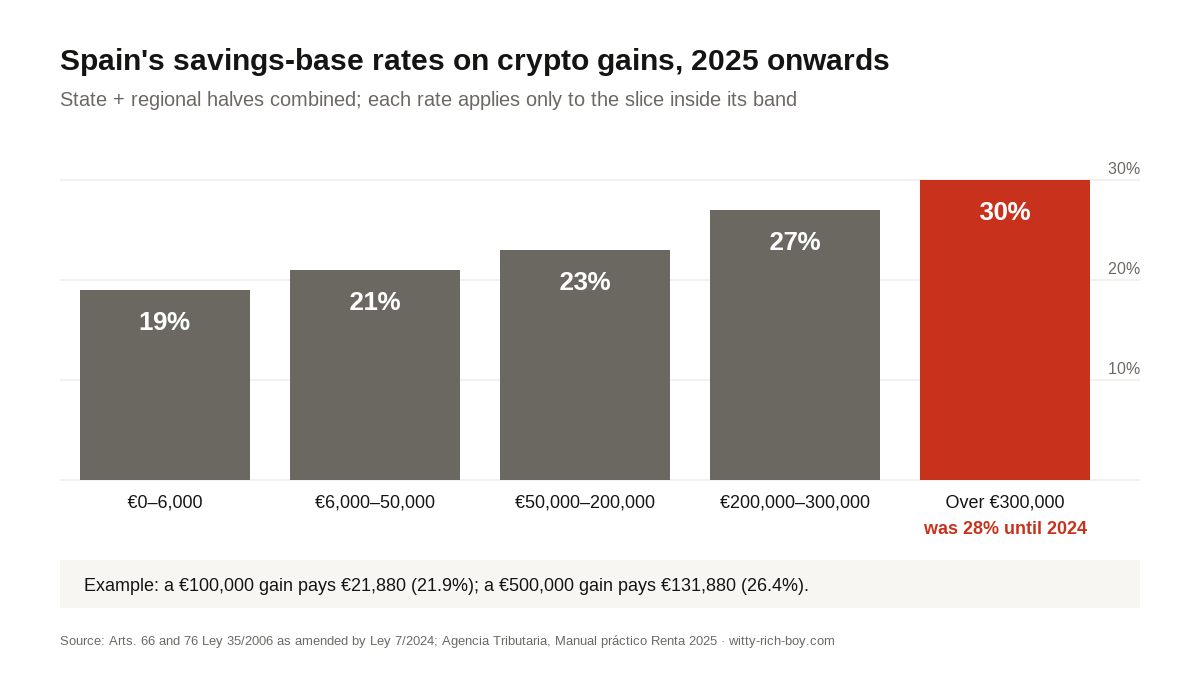
Five bands from 19% to 30%. The scale is split in two equal halves: a state scale under article 66 LIRPF and a regional scale under article 76 LIRPF. The AEAT’s state savings scale page sets 9.5%, 10.5%, 11.5%, 13.5% and 15%, and the regional scale carries the same rates and bands, so a resident pays twice those figures.
The change to note is at the top. Final provision seven of Ley 7/2024 raised the last band of both halves from 14% to 15% with effect from 1 January 2025, as the AEAT’s January 2025 notice confirms. Savings income above €300,000 is now taxed at 30%, up from 28%.
| Savings base band | State rate | Regional rate | Combined rate | Cumulative tax at top of band |
|---|---|---|---|---|
| €0 – €6,000 | 9.5% | 9.5% | 19% | €1,140 |
| €6,000 – €50,000 | 10.5% | 10.5% | 21% | €10,380 |
| €50,000 – €200,000 | 11.5% | 11.5% | 23% | €44,880 |
| €200,000 – €300,000 | 13.5% | 13.5% | 27% | €71,880 |
| Over €300,000 | 15% | 15% | 30% | — |
Worked numbers through the bands
The bands apply to the whole savings base, so interest and dividends push a crypto gain into higher bands. The figures assume crypto is the only savings income.
| Net crypto gain in 2026 | Tax | Effective rate | Under the pre-2025 scale |
|---|---|---|---|
| €10,000 | €1,980 | 19.8% | €1,980 |
| €50,000 | €10,380 | 20.8% | €10,380 |
| €100,000 | €21,880 | 21.9% | €21,880 |
| €250,000 | €58,380 | 23.4% | €58,380 |
| €500,000 | €131,880 | 26.4% | €127,880 |
Example: Lucía, resident in Valencia, sells bitcoin in 2026 for €140,000 that cost her €40,000, with €300 of fees in total. Her gain is €99,700. Tax: €1,140 on the first €6,000, €9,240 on the next €44,000 and €11,431 on the remaining €49,700 at 23%, a total of €21,811. Ley 7/2024 only bites above €300,000: on a €500,000 gain it adds €4,000, two points on the €200,000 slice above the threshold.
Are crypto-to-crypto swaps taxable in Spain?
Yes, every one. The AEAT treats exchanging one virtual currency for a different one as a barter (permuta) under article 37.1.h LIRPF. The gain or loss is the difference between the acquisition value of the coin you hand over and the higher of the market value of the coin given and the market value of the coin received. That figure then becomes the acquisition value of the new coin for later sales. Swapping into a stablecoin is a swap like any other.
Example: Marc swaps ETH that cost him €8,000 for a stablecoin worth €12,000. He has a €4,000 gain in the savings base for that year, owing €760 if it is his only savings income, even though he never touched euros. His stablecoin has a cost of €12,000.
That is the opposite of Portugal, where crypto-to-crypto swaps are deferred until you cash out, and of Italy, which does not tax swaps between crypto-assets with the same functions, and of France, which defers tax on swaps until you exit to euros; see whether crypto swaps are taxable elsewhere.
FIFO for partial sales
When you sell part of a holding of the same coin bought at different times and prices, the AEAT manual says the units sold are those acquired first — the first-in, first-out (FIFO) rule that Spanish law applies to homogeneous assets. The manual adds that FIFO applies even when you bought and sold on different exchanges, so you cannot pick a pricier lot on one platform to shrink the gain.
How do crypto losses work in Spain: the 25% rule and four years?
Losses first net against gains, then spill over to other savings income only up to 25%. Under article 49 LIRPF, as the AEAT’s savings-base offsetting page explains, gains and losses from transferring assets in the savings base are combined with each other without limit. If the result is negative, it can reduce the positive balance of investment income in the savings base (interest, dividends, staking) by up to 25% of that income. Anything left is carried forward and offset in the next four years, in the same order. Losses cannot be accumulated beyond those four years.
Example: in 2026 Pablo has a €9,000 net loss on crypto, no other gains and €4,000 of interest. He offsets €1,000 (25% of €4,000) and carries €8,000 forward. In 2027 he realises a €15,000 gain on shares; the €8,000 loss cuts it to €7,000. Had no gains arrived by 2030, the unused loss would have expired.
Our guide to crypto tax-loss harvesting compares how countries treat losses realised just before year-end.
How are staking rewards and airdrops taxed in Spain?
Differently from each other, and the answers come from binding rulings of the Directorate-General for Taxes (DGT) rather than the statute.
- Staking. In ruling V1766-22 (26 July 2022), the DGT ruled out staking as an economic activity and classified the rewards as income from movable capital under article 25.2 LIRPF, paid in kind and valued at their euro market price on the day received. That income goes into the savings base, and the coins received carry that value as their cost.
- Airdrops. In ruling V1948-21, the DGT treated tokens received free in an airdrop as a capital gain that does not arise from a transfer, valued at market value under article 37.1.l LIRPF. Such gains go in the general base, taxed at progressive rates alongside salary, and cannot be offset against losses from disposals.
A ruling binds the AEAT only for the person who asked and the facts described. Our airdrop tax guide compares other countries.
Who has to file Modelo 721 for crypto held abroad?
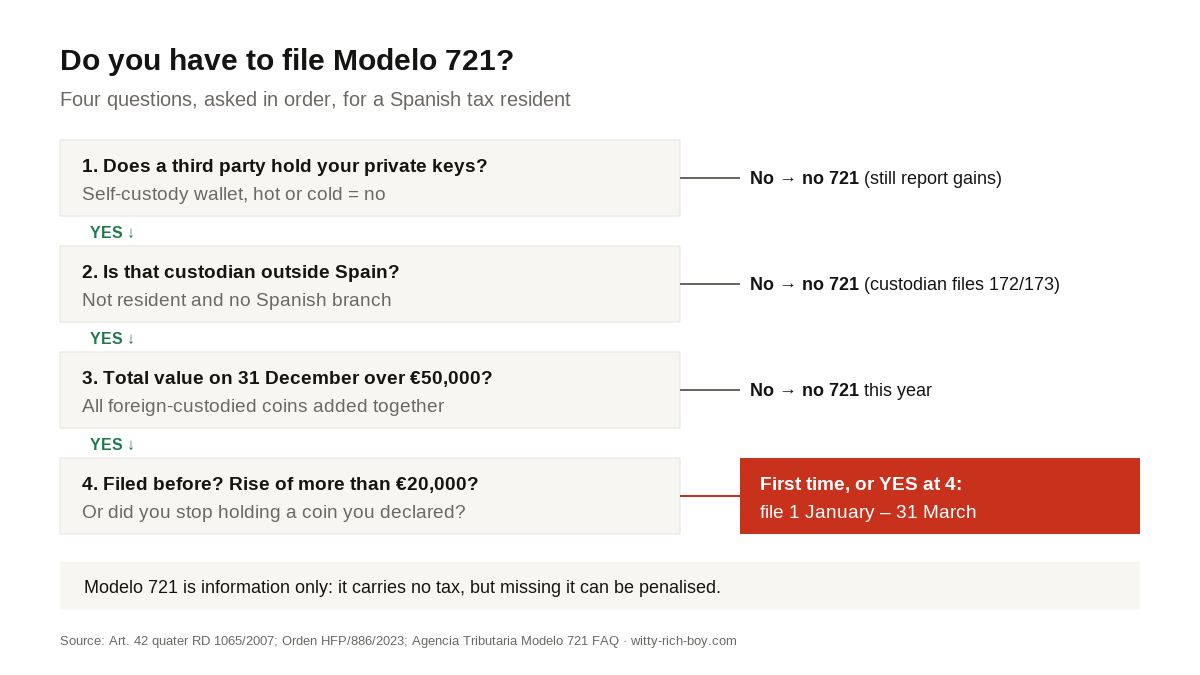
Modelo 721 is an annual information return on virtual currencies located outside Spain. It was approved by Orden HFP/886/2023 and applied first to 2023 balances. It carries no tax. The obligation, in article 42 quater of the general tax management regulation (RD 1065/2007), applies to Spanish residents who hold coins with a person or entity that safeguards private keys for others and is not resident in Spain and has no permanent establishment there.
Three conditions decide it:
- Custody. The AEAT’s Modelo 721 FAQ says coins in wallets where you control the private keys, hot or cold, are not held by a custodian. Self-custody falls outside 721.
- Threshold. According to the AEAT’s FAQ on exempt balances, nothing has to be reported when the euro value of all foreign-held coins on 31 December does not exceed €50,000 in total. Above it, you report all of them.
- Later years. After a first filing, you file again only if the 31 December total has risen by more than €20,000 since the last declaration, or if you stopped holding a declared coin during the year.
| Your situation on 31 December 2026 | File Modelo 721 by 31 March 2027? |
|---|---|
| All coins in a self-custody wallet | No |
| Coins with a Spanish-resident platform or Spanish branch | No — the platform reports on Modelo 172/173 |
| Foreign custodians, total €42,000 | No |
| Foreign custodians, total €65,000, never filed before | Yes, listing every coin |
| Filed for 2025 at €65,000; now €80,000 | No — rise of €15,000 |
| Filed for 2025 at €65,000; now €90,000 | Yes — rise of €25,000 |
| Filed for 2025, sold everything at the foreign platform in 2026 | Yes — to report you no longer hold the coins |
Modelo 720 vs Modelo 721: what’s the difference?
They are siblings. Both sit in additional provision eighteen of the General Tax Law (Ley 58/2003), share the 1 January to 31 March window and carry no tax. Modelo 720 covers foreign bank accounts, securities and real estate; Modelo 721 covers virtual currencies held abroad, under letter (d) of that provision. Modelo 721’s €50,000 test applies to the virtual-currency category alone. Holdings on Spanish platforms are reported instead by the platforms themselves on Modelo 172 (balances at 31 December) and Modelo 173 (operations), both under Orden HFP/887/2023 and filed in January.
Penalties have changed. After the EU Court of Justice ruled in case C-788/19 (27 January 2022) that its fixed fines were disproportionate, Ley 5/2022 rewrote the provision, and the AEAT’s Modelo 720 guidance now says late or missing filings are punished under the general rules in articles 198 and 199 LGT. Modelo 721 sits in the same provision.
Under the EU’s DAC8 directive, crypto-asset service providers report users to tax authorities from 2026; Spain’s implementing rules were still in the legislative process during 2026. Our DAC8 crypto reporting guide explains what is shared and when.
Do you pay wealth tax on crypto in Spain?
Possibly, if your net assets are large. Wealth tax (Impuesto sobre el Patrimonio) accrues on 31 December, and the AEAT’s wealth tax manual on virtual currencies says you declare the euro balance of each virtual currency you hold on that date — including coins in self-custody, which 721 ignores. The state exempt minimum is €700,000, which regions may change, and regional reliefs vary widely. Above €3,000,000 of net wealth, the temporary solidarity tax on large fortunes (Ley 38/2022) can apply, as a complement to wealth tax.
How to declare crypto in Spain, step by step
Crypto gains go on the annual income tax return, Modelo 100 (Renta). The AEAT’s guide to the Renta 2025 return has a dedicated sub-section in section F2 for gains and losses from transferring or swapping virtual currencies, entered per operation and per coin.
- Export every transaction for 2026 from each platform and wallet: date, coin, units, euro value and fees.
- Value swaps at the higher of the market values given and received, and record that value as the new coin’s cost.
- Match sales to purchases with FIFO, per coin, across all platforms together.
- Enter each disposal in section F2 of Modelo 100, in the virtual-currency sub-section, with transfer value, acquisition value and costs.
- Add staking rewards as investment income in the savings base and airdrops as gains in the general base.
- Apply losses: net them against gains, use up to 25% against other savings income, and record the rest for the next four years.
- Check Modelo 721: if foreign-held coins topped €50,000 on 31 December 2026, file between 1 January and 31 March 2027.
- Check wealth tax using the same 31 December values, and keep records of every lot.
When are the Spanish crypto tax deadlines for tax year 2026?
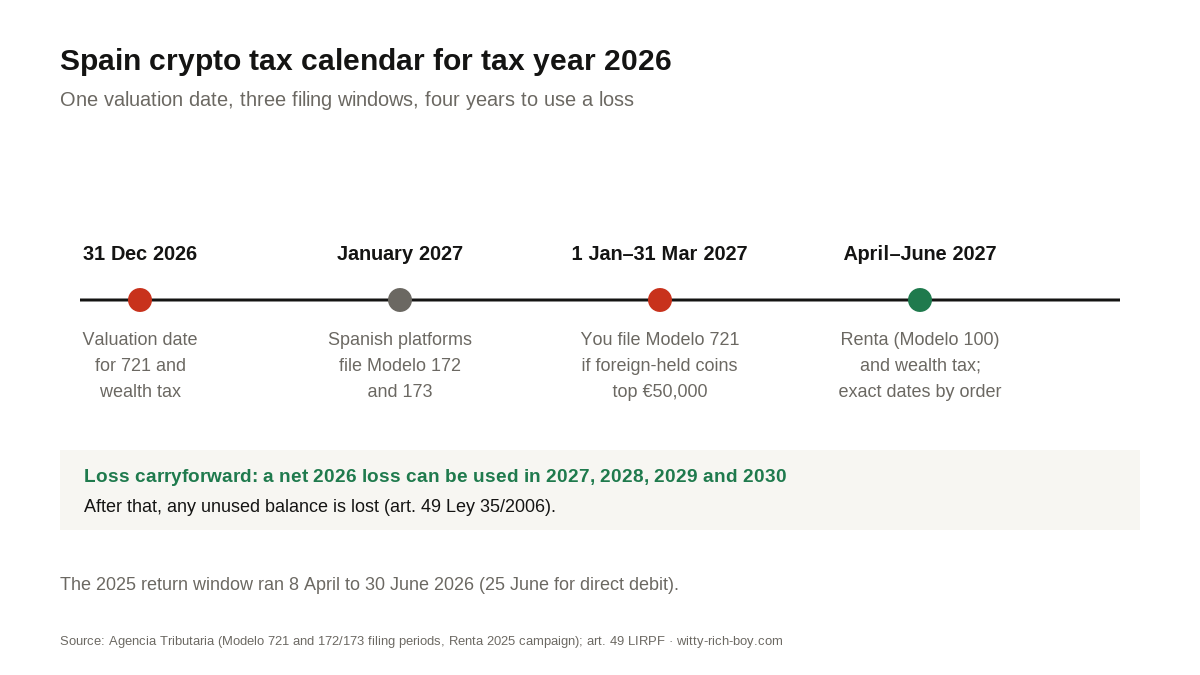
The 721 window is fixed; the Renta dates are set each year by ministerial order. The AEAT’s Modelo 721 filing-period page gives 1 January to 31 March of the year after the one reported.
| Date | What happens | Who acts |
|---|---|---|
| 31 December 2026 | Valuation date for Modelo 721 and wealth tax | — |
| January 2027 | Modelo 172 (balances) and 173 (operations) for 2026 | Spanish platforms |
| 1 January – 31 March 2027 | Modelo 721 for coins held abroad over €50,000 | You |
| Spring 2027 (2025 return ran 8 April – 30 June 2026) | Renta (Modelo 100) and wealth tax for 2026 | You |
| Tax years 2027–2030 | Window to use a net 2026 loss | You |
New arrivals should note that tax residence, not citizenship, decides all this; our guide to digital nomad tax residency explains how day-count and centre-of-interest tests decide where you are resident.
Questions readers ask
How much tax do you pay on crypto in Spain?
Gains from selling or swapping crypto are taxed in the savings base at 19% on the first €6,000, 21% up to €50,000, 23% up to €200,000, 27% up to €300,000 and 30% above that. The rates are progressive by slice, so a €10,000 gain costs €1,980 and a €100,000 gain €21,880, assuming no other savings income in the year.
Who has to file Modelo 721?
Spanish tax residents whose crypto is held by a custodian that safeguards private keys for others and is not resident in Spain, nor a Spanish branch, when the combined euro value of those coins on 31 December exceeds €50,000. Once you are over the limit you report all of them, between 1 January and 31 March of the following year.
Do I need to file Modelo 721 for a hardware or self-custody wallet?
No. The Agencia Tributaria's Modelo 721 guidance says coins in wallets where you control the private keys are not held by a custodian, whether the wallet is hot or cold, so they fall outside the declaration. They still count for income tax when you sell or swap them, and for wealth tax if your net assets are high enough.
Is a crypto-to-crypto swap taxable in Spain?
Yes. The Agencia Tributaria treats swapping one virtual currency for a different one as a barter (permuta) under article 37.1.h of the IRPF law. The gain is the higher of the market value of the coin given or the coin received, minus what you paid. That value becomes the cost of the new coin for later sales.
Can I deduct crypto losses in Spain?
Yes. Losses on crypto disposals first offset gains from other disposals in the savings base without limit. A remaining net loss can reduce interest, dividends and other savings-base investment income by up to 25% of that income in the same year. Anything left over is carried forward and can be used within the next four years.
What is the difference between Modelo 720 and Modelo 721?
Both are information returns under additional provision eighteen of the General Tax Law, filed between 1 January and 31 March. Modelo 720 covers foreign bank accounts, securities and real estate, while Modelo 721, approved by Orden HFP/886/2023, covers virtual currencies held with custodians outside Spain. Neither carries tax; Modelo 721 is triggered when your foreign-held crypto exceeds €50,000 on 31 December.
Are staking rewards taxed in Spain?
In binding ruling V1766-22 the Directorate-General for Taxes treated staking rewards as income from movable capital under article 25.2 of the IRPF law, paid in kind and valued at market price when received. That income falls in the savings base. A ruling binds the authority only for the person who asked, so facts that differ can lead elsewhere.
Do I pay wealth tax on crypto in Spain?
Possibly. Wealth tax accrues on 31 December, and the Agencia Tributaria's wealth tax manual says you declare the euro balance of each virtual currency you hold on that date. The state exempt minimum is €700,000, which regions can change. Net wealth above €3,000,000 can also bring in the temporary solidarity tax on large fortunes.
Was this guide useful?
Thanks — your answer helps us decide what to cover next.
Sources
- Gravamen estatal de la base liquidable del ahorro — Manual práctico Renta 2025 (Agencia Tributaria)
- Novedades publicadas en el INFORMA, enero 2025 — Ley 7/2024 savings-scale change (Agencia Tributaria)
- Ley 7/2024, de 20 de diciembre (BOE-A-2024-26694), final provision seven amending Ley 35/2006
- Compra y venta de monedas virtuales: tributación en el IRPF del inversor — Manual práctico Renta 2025 (Agencia Tributaria)
- Integración y compensación de rentas en la base imponible del ahorro — Manual práctico Renta 2025 (Agencia Tributaria)
- Preguntas frecuentes sobre el modelo 721 — ¿Quiénes están obligados a presentar el modelo 721? (Agencia Tributaria)
- Preguntas frecuentes sobre el modelo 721 — ¿Respecto de qué monedas virtuales no resultará obligatorio informar? (Agencia Tributaria)
- Modelo 721 — Plazos de presentación (Agencia Tributaria)
- Orden HFP/886/2023, de 26 de julio, approving Modelo 721 (BOE-A-2023-17429)
- Monedas virtuales — Manual práctico Patrimonio 2025 (Agencia Tributaria)
General information, not tax or legal advice. Rules change — check the official source or a licensed adviser before acting.