Netherlands · Crypto
Netherlands crypto tax Box 3 (2026): the 6% deemed return
Netherlands crypto tax Box 3, 2026: coins are taxed at 36% on a deemed 6% return on their 1 January value above €59,357. Worked example and actual-return rule.

The short answer
- Crypto held privately falls in Box 3 as an other asset: for 2026 it is deemed to earn 6.00%, taxed at 36%, whatever the coins actually did.
- Only the value on the 1 January peildatum counts, at the rate of the platform you use; selling or swapping during the year is not itself a taxable event.
- The first €59,357 of net Box 3 assets per person (€118,714 for fiscal partners) is tax-free; debts are deducted only above €3,800 per person.
- Under the Wet tegenbewijsregeling box 3, in force since 19 July 2025, you are taxed on your actual return if it is lower; a loss is set to €0 and no allowance applies.
- The Wet werkelijk rendement box 3 passed the lower house on 12 February 2026; the Senate held its vote on 30 June 2026, so the planned 1 January 2028 start is not yet law.
- Under DAC8, Dutch crypto providers record client data from 1 January 2026 and file the first report by 31 January 2027.
In force: Tax year 2026 (peildatum 1 January 2026; 2026 rates for bank balances and debts final in early 2027) · Wet tegenbewijsregeling box 3 in force since 19 July 2025 · DAC8 data collection from 1 January 2026, first Dutch filing by 31 January 2027 · Wet werkelijk rendement box 3 planned for 1 January 2028, Senate vote pending
In the Netherlands, privately held crypto is taxed in Box 3, not on gains. For 2026 the Belastingdienst assumes your coins earned a deemed 6.00% return on their 1 January value and taxes that at 36%, above a €59,357 tax-free allowance. If your actual return was lower, you can report it and be taxed on that instead.
The Dutch approach to crypto puzzles most newcomers. There is no capital gains tax for private investors, no holding period and no per-trade calculation. Instead the state pretends your coins earned a fixed return and taxes the pretence, whether bitcoin doubled or halved. Since a series of Supreme Court rulings, that pretence has a safety valve: a taxpayer whose real return fell short can prove it and pay less. And a new system taxing actual returns every year is in Parliament, though not yet law. This guide sets out the 2026 rules with the Belastingdienst’s own deep links, then works through the numbers.
How is crypto taxed in the Netherlands under Box 3?
Crypto held as a private investment is an asset in Box 3, the part of Dutch income tax that covers “income from savings and investments”. The Belastingdienst’s crypto page states that crypto belongs to your Box 3 assets and is declared at its value on 1 January. It falls in the category other assets (overige bezittingen), alongside shares and funds, not with bank balances.
Box 3 is the Dutch tax on a deemed return: the Belastingdienst calculates a notional yield on what you own at the start of the year, rather than measuring what you earned. The deemed return (forfaitair or fictief rendement) is that notional yield.
The exception is crypto earned through work or a business. The Belastingdienst says that where crypto activity amounts to a werkzaamheid (work outside employment) or an enterprise, the crypto is taxed in Box 1 at income tax rates, and crypto received as payment for work is income too.
| Situation | Where it is taxed | What is taxed |
|---|---|---|
| Holding coins as a private investor | Box 3 | Deemed return on the 1 January value |
| Selling coins for euros | Box 3 | Nothing at the moment of sale |
| Swapping one coin for another | Box 3 | Nothing at the moment of the swap |
| Crypto received as payment for work | Box 1 | Income from other work or business profit |
| Crypto activity run as a business | Box 1 | Business profit |
| Coins you can no longer access | Box 3 | Value may be nil if nobody would buy them |
The point about swaps matters for anyone used to other regimes. In the UK or Germany a crypto-to-crypto swap is a disposal that can trigger tax; in the Dutch deemed-return system it changes nothing until the next 1 January.
What are the Box 3 deemed return rates for 2026?
For 2026 crypto is deemed to earn 6.00%, bank balances 1.28%, and debts reduce the return by 2.70%. The Belastingdienst’s 2026 Box 3 calculation page states that the 6.00% rate for investments and other assets is fixed, while the bank and debt rates are provisional and will be set in early 2027 for the final assessment.
| Item | 2026 | Status |
|---|---|---|
| Deemed return, bank and savings balances | 1.28% | Provisional; final in early 2027 |
| Deemed return, investments and other assets (including crypto) | 6.00% | Fixed |
| Deemed return, debts (deducted) | 2.70% | Provisional; final in early 2027 |
| Debt threshold | €3,800 per person | Debts count only above this amount |
| Tax-free allowance (heffingsvrij vermogen) | €59,357; €118,714 for fiscal partners | Per the Belastingdienst |
| Tax rate on Box 3 income | 36% | Same as 2025 |
| Valuation date (peildatum) | 1 January 2026 | Start of the tax year |
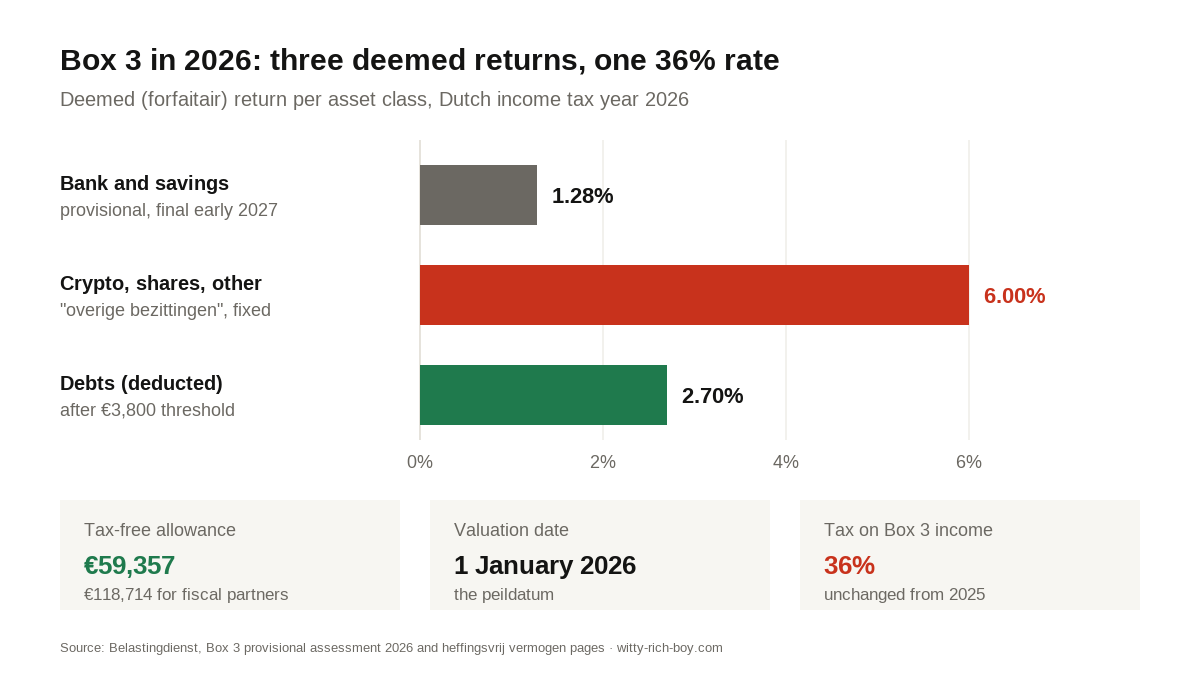
The tax-free allowance for 2025 was €57,684 per person, and the rate on other assets was 5.88%. The Belastingplan 2026 as first proposed would have raised the other-assets rate to 7.78% and cut the allowance to €51,396; the figures the Belastingdienst now applies for 2026 are 6.00% and €59,357. Check the date on any guide you read, as older ones still quote the proposal.
How is crypto valued on the 1 January peildatum?
At its market value on 1 January, using the price of the platform you use. The Belastingdienst’s crypto page says you declare the value “in the economic sense” on the peildatum, and that because coins trade at different prices, the rate of your exchange platform applies. For the 2026 tax year, that is 1 January 2026.
Peildatum is the Dutch term for the reference date: one moment that fixes your Box 3 position for the whole year. Three consequences follow.
- Intra-year moves are invisible to the deemed return. Coins bought on 2 January 2026 do not enter the 2026 deemed calculation; coins sold on 31 December 2025 are not in it either.
- Year-end shuffles can be ignored. Because savings carry a far lower deemed rate than crypto, selling coins for cash just before 1 January and buying back just after looks attractive. The Belastingdienst’s rules on peildatumarbitrage disregard such moves where no more than three months separate the sale and the repurchase, unless there were business reasons.
- Lost coins may count for nothing. A Belastingdienst knowledge-group position, KG:202:2026:5, says inaccessible crypto can remain a Box 3 asset but may be valued at nil when no party would buy it.
How much Box 3 tax would you pay on crypto? A 2026 worked example
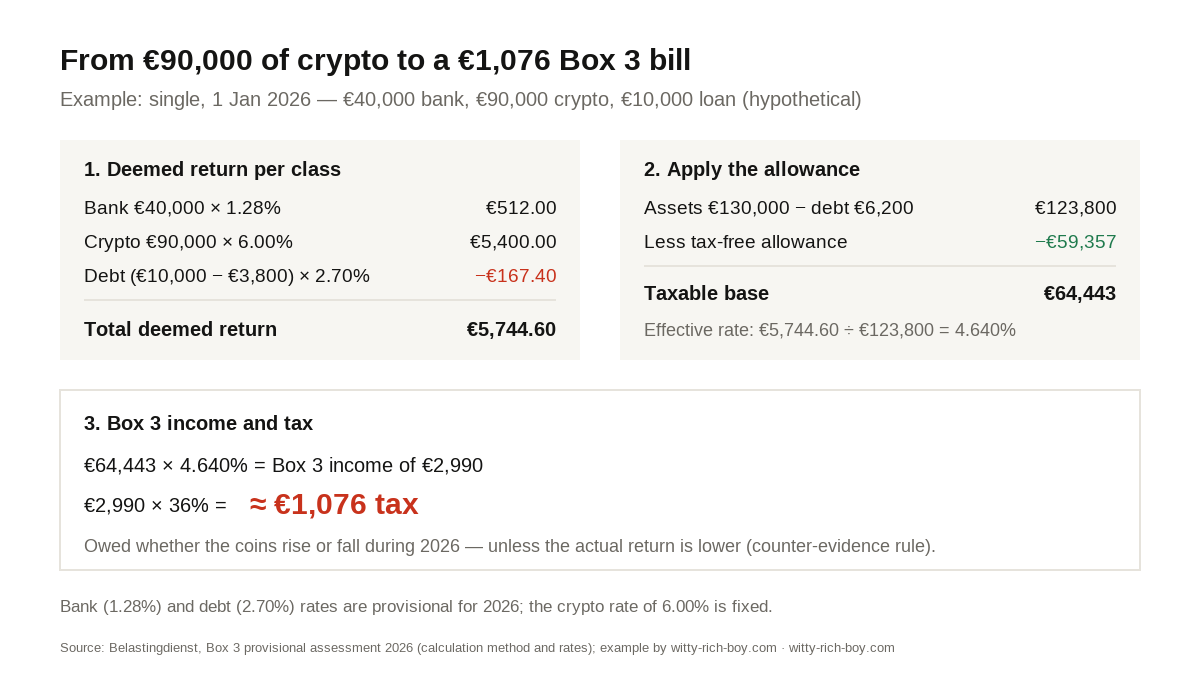
Roughly €1,076 on €90,000 of crypto, in the example below. The Belastingdienst’s 2026 page sets out a fixed sequence: deemed return per category, then the rendementsgrondslag (assets minus debts), then the taxable base after the allowance, then an effective percentage applied to that base.
Example: Sanne is single and lives in Amsterdam. On 1 January 2026 she holds €90,000 of crypto at her platform’s prices, €40,000 in a savings account and a €10,000 personal loan.
- Deemed return per category. Bank: €40,000 × 1.28% = €512.00. Crypto: €90,000 × 6.00% = €5,400.00. Debt: (€10,000 − €3,800) × 2.70% = €167.40, which is subtracted. Total deemed return: €5,744.60.
- Return base. Assets of €130,000 minus €6,200 of counted debt: €123,800.
- Taxable base. €123,800 − €59,357 allowance = €64,443.
- Effective percentage. €5,744.60 ÷ €123,800 = 4.640%.
- Box 3 income. €64,443 × 4.640% = €2,990.
- Tax. €2,990 × 36% = about €1,076.
The crypto drives the bill. Had the same €90,000 been in savings, the deemed return on it would have been €1,152 rather than €5,400. Because the bank and debt rates are still provisional, Sanne’s final figure may move slightly when they are fixed in early 2027.
Can you pay tax on your actual crypto return instead?
Yes, when your actual return is lower than the deemed one. After Supreme Court rulings that a deemed return higher than the actual one may not be taxed, Parliament passed the Wet tegenbewijsregeling box 3 (counter-evidence act). According to the Rijksoverheid timeline of the Box 3 legal remedy, the Senate adopted it on 8 July 2025 and it entered into force on 19 July 2025.
The actual return (werkelijk rendement) is everything your Box 3 assets produced in the calendar year: interest, dividends, rent, and realised and unrealised changes in value, positive or negative. The Belastingdienst’s page What is my actual return? explains the comparison. Three rules shape the maths:
- No allowance. The actual return is calculated on your total Box 3 assets; per the Belastingdienst’s calculation examples, the Supreme Court ruled there is no exemption here. It is compared with your Box 3 income, which already reflects the allowance.
- Costs are not deductible, interest is. Advisory and maintenance costs do not reduce the actual return; interest paid on Box 3 debts does.
- Losses stop at zero. A negative actual return is set to €0.
For crypto the Belastingdienst gives a formula: value on 31 December, minus value on 1 January, minus purchases, plus sales. Its example: €80,000 on 1 January, €90,000 on 31 December, €5,000 bought and €17,000 sold, gives an actual return of €22,000.
Back to Sanne. Suppose her savings earned €600 of interest and she paid €500 interest on her loan. Her deemed Box 3 income is €2,990.
| Crypto value on 31 Dec 2026 | Actual return | Deemed Box 3 income | Taxed on | Box 3 tax |
|---|---|---|---|---|
| €70,000 (fell €20,000) | −€19,900, set to €0 | €2,990 | Actual | €0 |
| €90,000 (flat) | €100 | €2,990 | Actual | €36 |
| €120,000 (rose €30,000) | €30,100 | €2,990 | Deemed | about €1,076 |
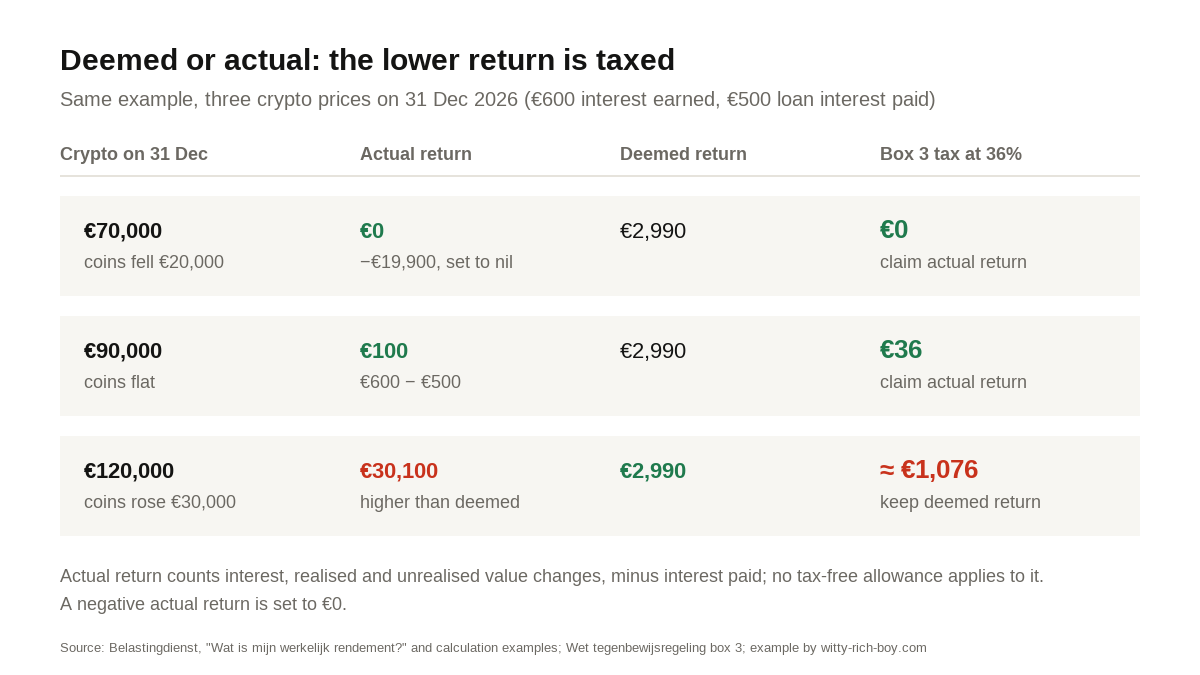
The asymmetry is the information most guides miss. In a strong year, the deemed system is a bargain: Sanne pays about €1,076 on a €30,100 real gain. In a crash year, she pays nothing, but the €19,900 loss is simply set to zero; carrying losses forward features only in the proposed 2028 system.
How to calculate and declare crypto in Box 3, step by step
- Record every holding at 1 January. Take each platform’s balance and price at the start of 1 January, plus self-custody wallets valued at your platform’s rate.
- Add the other Box 3 items. Bank balances, shares and funds, other assets and debts, as at the same date.
- Compute the deemed result. Apply 1.28%, 6.00% and 2.70%, deduct the €59,357 allowance from the base, and follow the six steps in the example above.
- Keep year-end data. Note each coin’s value on 31 December and your total purchases and sales during the year; the counter-evidence calculation needs all four figures.
- Compare. If interest and value changes, minus interest paid, come to less than your deemed Box 3 income, the actual return is more favourable.
- Declare it in the income tax return. From the 2025 tax year, the actual return is entered in the return itself, and the Belastingdienst uses whichever amount is more favourable. For 2024 and earlier years, a separate form, Opgaaf werkelijk rendement, was used.
- File on time. The 2025 return was due by 1 May 2026, with an extension to 1 September 2026 available if requested before then; the 2026 return follows the same spring timetable in 2027.
Fiscal partners divide the Box 3 base between them in the return, and the actual return is divided the same way, per the Belastingdienst’s examples.
When will the Netherlands tax actual returns? The Wet werkelijk rendement timeline
Not before 1 January 2028, and not yet with certainty. The Wet werkelijk rendement box 3 (bill 36.748) would replace the deemed system with a tax on actual returns each year. According to the Senate’s bill dossier, the House of Representatives passed it on 12 February 2026. On 30 June 2026, after the plenary debate, the Senate decided to hold its vote until the cabinet’s announced amending bill (novelle) has been dealt with.
| Date | Step |
|---|---|
| 19 July 2025 | Wet tegenbewijsregeling box 3 enters into force |
| 12 February 2026 | House of Representatives adopts Wet werkelijk rendement box 3 |
| 30 June 2026 | Senate debates the bill and holds the vote pending a novelle |
| 31 January 2027 | First Dutch DAC8 crypto report due, covering 2026 |
| 1 January 2028 | Planned start of the actual-return system, if enacted |
As drafted, the bill taxes most assets, crypto included, on annual capital growth (vermogensaanwas), meaning unrealised price rises would be taxed each year. The Senate’s factsheet on the new system describes a tax-free return of €1,800 replacing the asset allowance, a 36% rate and carry-forward of losses above €500. For a crypto holder, that would end the bargain in good years and the zero floor in bad ones.
What does DAC8 reporting mean for Dutch crypto holders?
Your platform will tell the Belastingdienst what you hold and trade. Under the EU’s DAC8 crypto reporting directive, the Belastingdienst’s page Meer zicht op cryptotransacties says that about 100 crypto service providers in the Netherlands must record client and transaction data from 1 January 2026 and file the first report, covering 2026, by 31 January 2027. The Belastingdienst also receives data on Dutch residents from providers elsewhere in the EU, and from non-EU states under the OECD’s CARF.
The Belastingdienst says DAC8 changes nothing in how individuals file. In practice, the 1 January balance you declare and the trading totals behind any actual-return claim can now be checked against third-party data.
How does Box 3 compare with crypto tax in Germany, Switzerland and the UK?
The Netherlands taxes holding, like Switzerland, but at a much higher effective rate. In Germany, crypto gains are tax-free after one year; Switzerland exempts private gains but levies a cantonal wealth tax on the 31 December value; the UK taxes gains above a £3,000 allowance.
| Country | What is taxed | Valuation or trigger | Swaps taxable? |
|---|---|---|---|
| Netherlands | Deemed 6.00% return, at 36% | Value on 1 January | No (deemed system) |
| Germany | Gains on coins held up to one year | Each sale or swap | Yes, within one year |
| Switzerland | Wealth, at cantonal rates | Value on 31 December | No, for private investors |
| United Kingdom | Gains above the annual allowance | Each disposal | Yes |
For Sanne, the Dutch bill is about €1,076 a year on €90,000 of coins plus her savings. For large holdings, the cost of each extra euro of crypto approaches 6.00% × 36% = 2.16% of its value a year, regardless of performance, unless the counter-evidence rule applies. If you are moving to or from the Netherlands, our guide to digital nomad tax residency explains how residence is decided, which determines whether Box 3 applies at all.
Questions readers ask
Do you pay tax on crypto in the Netherlands?
Yes, but not on sales. Crypto held as a private investment sits in Box 3, where the Belastingdienst taxes a deemed return on your assets rather than gains you realise. For 2026 crypto is deemed to earn 6.00% of its 1 January value, and that deemed return is taxed at 36% once your net Box 3 assets exceed the €59,357 tax-free allowance. Crypto earned through work or a business is taxed in Box 1 instead.
Is there capital gains tax on crypto in the Netherlands?
There is no separate capital gains tax for private investors. Selling or swapping coins is not a taxable event in itself, because Box 3 looks only at what you own on 1 January. Gains do matter indirectly: a higher holding raises next year's 1 January value, and if you claim your actual return under the counter-evidence rule, realised and unrealised value changes are counted in that calculation.
What are the Box 3 rates for 2026?
For 2026 the Belastingdienst uses a deemed return of 1.28% on bank balances, 6.00% on investments and other assets, including crypto, and 2.70% on debts. The 6.00% rate is fixed; the bank and debt rates are provisional and will be set in early 2027. The tax-free allowance is €59,357 per person and the tax rate on the resulting Box 3 income is 36%.
Which value do I use for crypto on my Dutch tax return?
The value in the economic sense on 1 January of the tax year, the peildatum. Because coins trade at different prices on different venues, the Belastingdienst says to use the rate of the exchange platform you use. For the 2026 tax year that means your holdings at the start of 1 January 2026. Coins you can no longer access may be valued at nil if nobody would buy them.
Can I pay tax on my actual crypto return instead of the deemed return?
Yes, if it is lower. Under the Wet tegenbewijsregeling box 3, in force since 19 July 2025, you can report your actual return in your income tax return and the Belastingdienst taxes whichever is more favourable. The actual return counts interest, dividends and realised and unrealised value changes, minus interest paid on debts. It gets no tax-free allowance, and a negative result is set to €0.
How do I calculate the actual return on crypto?
The Belastingdienst's method is the value on 31 December, minus the value on 1 January, minus purchases during the year, plus sales during the year. Its own example: coins worth €80,000 on 1 January and €90,000 on 31 December, with €5,000 of purchases and €17,000 of sales, give an actual return of €22,000. You report those four figures in the return.
When does the new Box 3 actual-return system start?
It is planned for 1 January 2028, but it is not law yet. The Wet werkelijk rendement box 3 (bill 36.748) passed the House of Representatives on 12 February 2026. On 30 June 2026 the Senate decided to hold its vote until the cabinet's announced amending bill has been dealt with. Until a new law takes effect, the deemed-return system with the counter-evidence rule applies.
Will Dutch crypto platforms report my holdings to the Belastingdienst?
Yes. Under the EU's DAC8 rules, about 100 crypto service providers in the Netherlands must record client and transaction data from 1 January 2026 and file the first report, covering 2026, by 31 January 2027. The Belastingdienst also receives data on Dutch residents from providers in other EU countries. The Belastingdienst says DAC8 does not change how individuals file or pay tax.
Was this guide useful?
Thanks — your answer helps us decide what to cover next.
Sources
- How is my Box 3 income calculated on my provisional assessment 2026? (Belastingdienst)
- Heffingsvrij vermogen (Belastingdienst)
- Moet ik aangifte doen en belasting betalen over mijn crypto's? (Belastingdienst)
- What is my actual return? (Belastingdienst)
- Rekenvoorbeelden berekening werkelijk rendement (Belastingdienst)
- Fiscale informatie 2025, chapter 32: Peildatumarbitrage (Belastingdienst)
- Tijdlijn rechtsherstel box 3 (Rijksoverheid)
- Wet werkelijk rendement box 3 (36.748), bill dossier (Eerste Kamer)
- Senaat houdt stemming box 3-wet aan, 30 June 2026 (Eerste Kamer)
- Meer zicht op cryptotransacties (Belastingdienst)
General information, not tax or legal advice. Rules change — check the official source or a licensed adviser before acting.