Switzerland · Crypto
Switzerland crypto tax (2026): tax-free gains, 31 Dec wealth tax
Switzerland crypto tax 2026: private gains are tax-free, but coins count towards cantonal wealth tax at their 31 December value; staking and airdrops are income.

The short answer
- For private investors, gains on selling or swapping crypto are tax-free capital gains on private assets under Art. 16 para. 3 DBG; losses are not deductible.
- Every coin you hold counts towards cantonal wealth tax at its market value on 31 December; the ESTV price list put 1 BTC at CHF 69,571.99 for 2025, down from CHF 85,926.49 for 2024.
- Staking rewards and airdrops are taxable income at their Swiss-franc value when received; mining is taxable income and can be self-employment.
- ESTV Circular No. 36 rules out professional trading if all five tests are met, including a holding period of at least 6 months, volume no more than 5× opening holdings and gains under 50% of net income.
- Wealth tax is set by each canton: Thurgau charges a simple tax of 1.1‰ after a CHF 100,000 deduction, while Zurich taxes nothing below CHF 80,000 of taxable wealth for single filers.
In force: Tax year 2026 (valuation date 31 December 2026; Zurich filing deadline 31 March 2027) · CARF crypto reporting in Switzerland from 1 January 2027 at the earliest
In Switzerland, private investors pay no tax on crypto capital gains: selling or swapping coins at a profit is exempt under Art. 16 para. 3 DBG. Instead, every coin counts towards cantonal wealth tax at its value on 31 December, and staking rewards, airdrops and mining are taxed as income. Frequent, leveraged traders risk being taxed as professionals.
Switzerland lets a long-term crypto investor realise a large gain without paying income tax on it. The trade-off is a tax most countries no longer levy: an annual charge on what you own. So the questions that matter are what your coins were worth on 31 December, which canton you live in, and whether the tax office could treat your trading as a business. Below are the 2026 rules, each tied to the federal statute, the Swiss Federal Tax Administration (ESTV) or a cantonal tax office, with numbers worked through.
Is crypto taxed in Switzerland?
Yes, but mostly not where investors expect. The ESTV states that cryptocurrencies are subject to direct federal tax, withholding tax and stamp duty at federal level, and its working paper on cryptocurrencies explains how general tax principles apply to them. There is no crypto-specific tax law. For a private individual, the practical result is three separate touch points.
| Event | Taxed as | Legal basis |
|---|---|---|
| Holding coins at 31 December | Cantonal and municipal wealth tax on market value | Cantonal tax law; ESTV working paper |
| Selling crypto for francs at a gain (private investor) | Tax-free private capital gain | Art. 16 para. 3 DBG |
| Swapping one coin for another (private investor) | Tax-free private capital gain | Art. 16 para. 3 DBG |
| Loss on a sale (private investor) | Not deductible | Art. 16 para. 3 DBG |
| Staking rewards (delegated) | Income from movable assets, value on receipt | Art. 20 para. 1 DBG |
| Airdrops | Income at market value on allocation | ESTV working paper |
| Mining | Taxable income; self-employment if business criteria met | ESTV working paper; Art. 18 DBG |
| Gains of a professional trader | Self-employment income, losses deductible | Art. 18 DBG; ESTV Circular No. 36 |
A payment token is the ESTV’s term for a coin such as bitcoin or ether intended as a means of payment, as distinct from asset and utility tokens. This guide concerns payment tokens held as private assets.
Do you pay capital gains tax on crypto in Switzerland?
No, not as a private investor. Art. 16 para. 3 of the Federal Act on Direct Federal Taxation (DBG, LIFD in French) exempts capital gains made on the disposal of private assets, and the ESTV’s tax information confirms that gains on private movable assets such as securities are tax-free at federal level and in every canton. The ESTV’s 2023 crypto update applies the same principle to payment tokens. The canton of Zurich puts it simply in Zürcher Steuerbuch No. 16.5: unless there is professional trading, price gains or losses have no effect on income.
There is no holding period to wait out, unlike in Germany, where crypto becomes tax-free only after one year, and no allowance to track, unlike the UK’s £3,000 capital gains allowance. A bitcoin bought in March and sold in November is treated like one held for a decade.
Swaps are disposals, but the gain is still exempt
Exchanging bitcoin for ether disposes of the first coin, a taxable event in countries that tax gains (see how swaps are treated elsewhere). In Switzerland the gain falls under the same private exemption; what matters is the new coin’s value at 31 December.
Losses cannot be deducted
The exemption cuts both ways: the ESTV states that losses on private movable assets are not deductible. A private investor who loses CHF 30,000 on a token collapse cannot set it against salary; the loss shows up only as a lower wealth figure at year-end.
When does the tax office treat you as a professional crypto trader?
When your activity looks like a business rather than private wealth management. Gains on movable assets are taxed as self-employment income under Art. 18 DBG if the person buys and sells in a way that amounts to an economic activity. To draw the line, the ESTV uses Circular No. 36 on professional securities trading of 27 July 2012, which its 2023 crypto update says continues to apply in full to crypto.
The circular sets out a safe harbour of five criteria. If all five are met cumulatively, professional trading is ruled out and your gains stay tax-free.
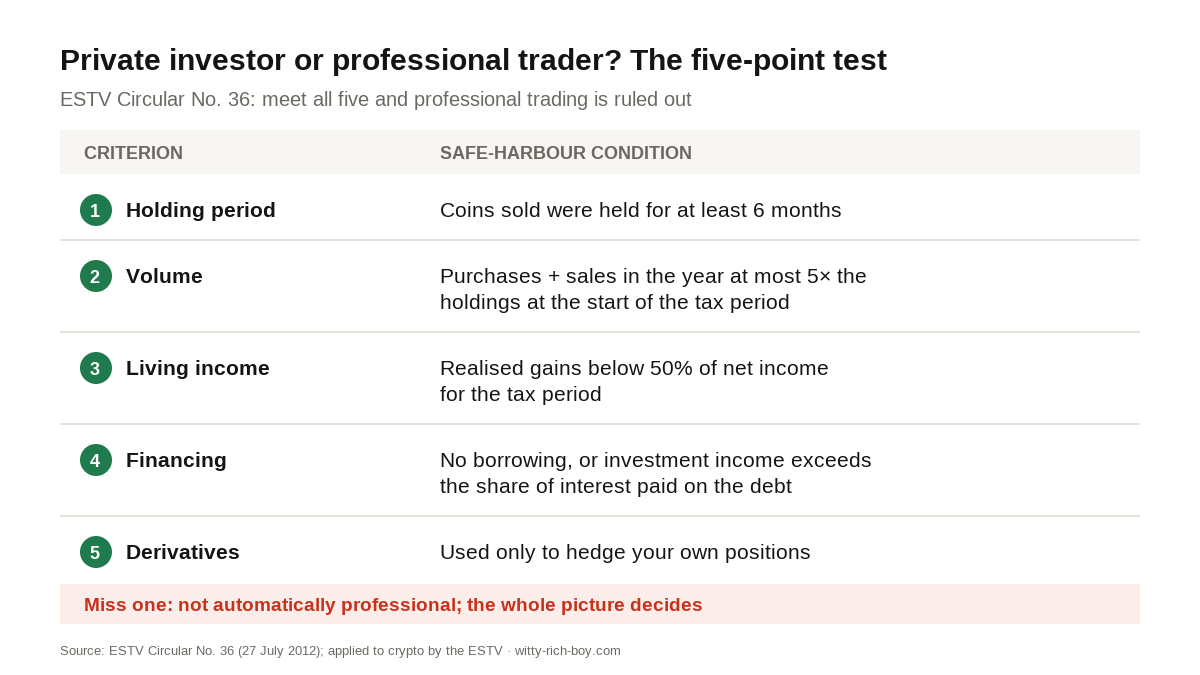
| Criterion (Circular No. 36) | Safe-harbour condition | Typical way crypto investors fail it |
|---|---|---|
| 1. Holding period | Assets sold were held at least 6 months | Frequent rotation between coins |
| 2. Transaction volume | Purchases plus sales in the year at most 5× the holdings at the start of the tax period | Active trading on a small starting balance |
| 3. Living income | Realised gains below 50% of net income in the period | Gains replace a salary |
| 4. Financing | No debt financing, or taxable investment income exceeds the related interest | Borrowing to buy coins, margin loans |
| 5. Derivatives | Used only to hedge your own positions | Speculative options or futures |
Failing a test does not make you a professional automatically: the tax office then weighs all the circumstances, in line with Federal Supreme Court practice. The circular calls borrowed money the strongest indicator of professional trading, and treats derivatives used beyond hedging, at large volumes relative to total assets, as speculation pointing the same way.
Example: Marco starts 2026 with CHF 40,000 of coins and a CHF 110,000 salary. He buys and sells CHF 260,000 worth during the year and realises a CHF 18,000 gain. Gains are 16% of income and he uses no debt, but his volume is 6.5× his opening holdings, so he is outside the safe harbour. That does not settle the matter, but invites a closer look.
What changes if you are classed as professional
Gains become taxable self-employment income and losses become deductible, with losses from the seven previous business years usable if not already offset, per the ESTV guide for the self-employed. Self-employment income is also reported to the social-security (AHV) authorities, as the Zurich guidance for the self-employed notes. Direct federal tax alone is capped at an average rate of 11.5% under Art. 128 of the Federal Constitution, reached for 2025 from CHF 793,400 of taxable income for single taxpayers, per the ESTV; cantonal and municipal tax comes on top.
How does the Swiss wealth tax on crypto work?
Every coin you own on the last day of the tax period is part of your taxable net wealth. The ESTV working paper says payment tokens are subject to cantonal wealth tax and must be declared at market value at the end of the tax period; if no current valuation rate can be determined, you declare the original purchase price converted into Swiss francs. There is no federal wealth tax: it was abolished at federal level in 1959, so rates, deductions and thresholds are set by each canton.
The ESTV publishes year-end tax values for the most widely held coins in its price list, the Kursliste, hosted on ICTax. For coins it does not list, the ESTV says to use the year-end price of the trading platform you use. Zurich’s 2026 tax return guide adds that foreign-currency values are converted at the exchange rate of 31 December.
| Coin | ESTV tax value per unit, 2024 | ESTV tax value per unit, 2025 | Change |
|---|---|---|---|
| Bitcoin (BTC) | CHF 85,926.49 | CHF 69,571.99 | −19.0% |
| Ether (ETH) | CHF 3,083.56 | CHF 2,364.08 | −23.3% |
Values from the ESTV token price lists for 2025 and 2024, rounded to the centime.
A coin that trebles in June and crashes in December is taxed on its December value: only the year-end price counts.
How much wealth tax would you pay on crypto? A worked example
It depends on your canton and municipality, so this example uses a canton whose rules fit on one page. Thurgau, according to the ESTV cantonal sheet, deducts CHF 100,000 from net wealth for single taxpayers (CHF 200,000 for married couples taxed jointly, plus CHF 100,000 per child) and levies a proportional simple tax of 1.1‰ on the rest (§§ 53–54 StG TG). The simple tax is then multiplied by the cantonal and municipal tax multipliers (Steuerfüsse) set each year.
Example: Lena, single, no children, lives in Thurgau. On 31 December she holds 0.8 BTC, 6 ETH and CHF 120,000 in a bank account, with no debts.
- Value the coins at the ESTV year-end tax values. For 2025: 0.8 × CHF 69,571.99 = CHF 55,657.59, plus 6 × CHF 2,364.08 = CHF 14,184.49, so CHF 69,842.08 of crypto.
- Add other assets and subtract debts. Net wealth: CHF 69,842.08 + CHF 120,000 = CHF 189,842.08.
- Apply the cantonal deduction. CHF 189,842.08 − CHF 100,000 = CHF 89,842.08 taxable.
- Apply the rate. CHF 89,842.08 × 1.1‰ = CHF 98.83 of simple tax; the crypto alone accounts for CHF 76.83 of it.
- Apply the multipliers. The final bill is the simple tax times the combined cantonal and municipal multiplier for Lena’s municipality, published by the canton each year.
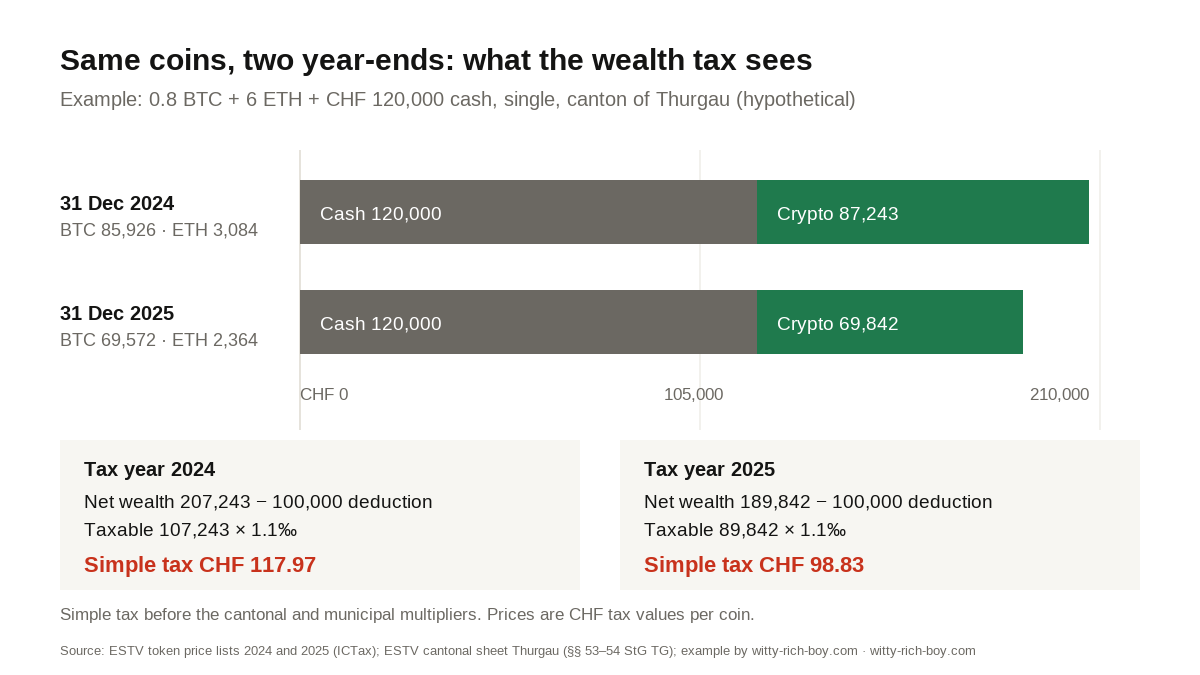
At 2024 tax values the same coins were worth CHF 87,242.53, giving a simple tax of CHF 117.97. The table shows how the 2025 bill scales with the multiplier; the multipliers are illustrative, not Thurgau’s actual rates.
| Combined multiplier (illustrative) | Wealth tax, 2025 example | Of which on crypto |
|---|---|---|
| 200% | CHF 197.66 | CHF 153.65 |
| 250% | CHF 247.07 | CHF 192.07 |
| 300% | CHF 296.49 | CHF 230.48 |
Computed from the figures above; your canton’s tax calculator gives the exact bill.
How do wealth tax rules differ by canton?
Substantially. The ESTV’s overview of wealth tax on individuals explains that cantons set their own rates and tax-free amounts. Most use progressive rates expressed in per mille; only Lucerne, Uri, Schwyz, Obwalden, Nidwalden, Appenzell Innerrhoden, St Gallen and Thurgau use a proportional rate. Most cantons have no overall burden cap for individuals.
| Canton | Rate structure | Threshold or deduction | Other feature |
|---|---|---|---|
| Zurich | Progressive, simple state tax 0–3‰ | No wealth tax below CHF 80,000 taxable wealth (single) | No deduction: the threshold is a starting point, not an allowance |
| Thurgau | Proportional, 1.1‰ simple tax | CHF 100,000 single; CHF 200,000 married; +CHF 100,000 per child | Multiplied by cantonal and municipal rates |
| Lucerne | Proportional | Set by cantonal law | Total wealth tax capped at 3.0‰ |
Sources: ESTV wealth tax overview (legislation as at 1 January 2024); ESTV cantonal sheet Thurgau; Kanton Zurich Wegleitung 2026 and Steuerwissen pages.
Zurich shows why a threshold is not an allowance: it grants no deduction on wealth, but levies no tax while taxable wealth stays below CHF 80,000 for a single filer.
How are staking, mining and airdrops taxed in Switzerland?
As income, at the moment you receive them, and then as wealth for as long as you hold the coins.
- Staking. For a private investor who delegates tokens to a validator or pool, the ESTV working paper treats rewards as income from movable assets under Art. 20 para. 1 DBG, valued at the time of receipt and converted into francs. The tokens themselves remain wealth. The ESTV says such rewards are generally not subject to withholding tax. If you run a validator as a business, the rewards may instead be self-employment income.
- Mining. The ESTV says mining rewards are taxable income; where the general criteria for self-employment are met, they are self-employment income, with the business consequences that follow.
- Airdrops. Tokens received free of charge are subject to income tax at their market value when allocated, generally as income from movable assets. Depending on the facts, the ESTV notes they may instead fall under general income, employment income or self-employment.
A CHF 1,200 staking reward is taxed once as income in the year you receive it; its year-end value is then part of your wealth every year you keep it.
How to declare crypto on your Swiss tax return, step by step
Crypto goes in the securities and assets list (Wertschriften- und Guthabenverzeichnis), which every canton includes in its return. Zurich’s Steuerbuch No. 16.5 suggests listing coins under other assets with the name of the cryptocurrency and proving the balance with a wallet printout as at the end of the tax period.
- Download year-end statements from every exchange account and wallet, showing balances on 31 December.
- Find each coin’s tax value. Use the ESTV Kursliste value where one is published; otherwise the platform’s year-end price; if no current price exists, the original purchase price in francs.
- Convert foreign-currency values at the 31 December exchange rate if your source quotes another currency.
- List each coin in the assets list with quantity and tax value, under other assets or the position your canton’s form specifies.
- Total staking rewards, airdrops and other crypto income for the year at their franc value on receipt, and declare them as income from movable assets.
- Check the five Circular No. 36 criteria. Outside the safe harbour, consider asking your cantonal tax office for a ruling before filing.
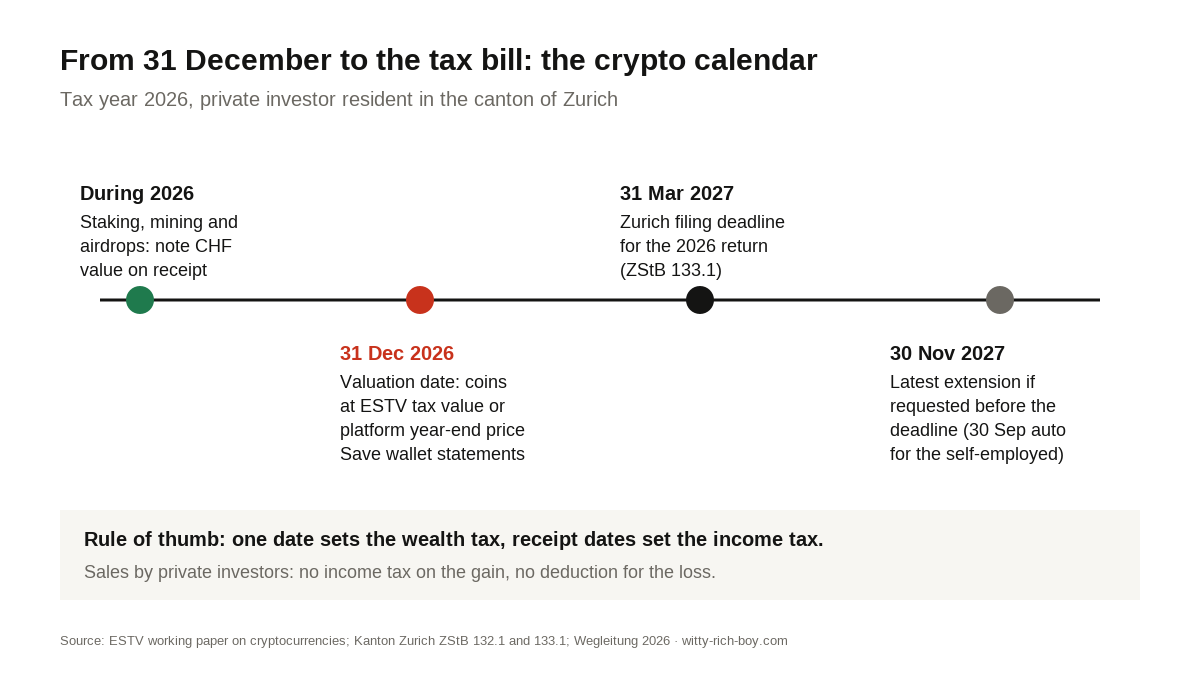
- File on time. In Zurich, the 2026 return is due by 31 March 2027; extensions requested before the deadline can run to 30 November 2027 at the latest, and self-employed people get an automatic extension to 30 September. Other cantons set their own dates.
Will Switzerland exchange crypto data with other tax authorities?
From 2027 at the earliest. Parliament approved the OECD Crypto-Asset Reporting Framework (CARF) on 26 September 2025, but the Federal Council decided its crypto provisions would not apply in 2026, after deliberation on the list of partner states was suspended. According to the SIF’s CARF FAQ, updated in May 2026, Switzerland will implement CARF at the earliest from 1 January 2027, and Swiss crypto service providers have no due-diligence duties under it in 2026.
The EU applies the same standard through DAC8 crypto reporting, so cross-border holdings will become visible to the tax authority at home. If you move into or out of Switzerland, our guide to digital nomad tax residency explains how residence is tested.
How does Switzerland compare with Germany, the UK and Japan?
Switzerland taxes holding instead of selling. Germany exempts gains after one year, the UK taxes gains above a small allowance, and Japan taxes crypto gains as miscellaneous income at progressive rates. Of the four, only Switzerland charges an annual tax on the value of your coins, due whether prices rise or fall; the Netherlands reaches a similar result by taxing a deemed return on their 1 January value in Box 3. Singapore, by contrast, has neither a capital gains tax nor a wealth tax; there the line that matters is whether IRAS sees you as a trader, as our Singapore crypto tax guide explains.
Questions readers ask
Do you pay tax on crypto in Switzerland?
Usually yes, but not on gains. Private investors pay no income tax when they sell or swap crypto at a profit, because private capital gains are exempt under Art. 16 para. 3 DBG. They do pay cantonal wealth tax on the value of their coins at 31 December, and income tax on staking rewards, airdrops and mining. Professional traders are taxed on gains as self-employment income.
Is crypto tax-free in Switzerland?
Capital gains are tax-free for private investors, but crypto is not tax-free overall. The coins are part of your taxable wealth and must be declared every year at their market value at the end of the tax period. Rewards you receive, such as staking income and airdrops, are taxable income at their Swiss-franc value on receipt. Losses on private holdings cannot be deducted.
How is crypto valued for Swiss wealth tax?
At its market value at the end of the tax period, normally 31 December. The ESTV publishes tax values for the most common coins in its price list; for 2025 it listed 1 BTC at CHF 69,571.99 and 1 ETH at CHF 2,364.08. For coins not on the list, use the year-end price of the platform you use. If no current price exists, the ESTV says to declare the original purchase price in francs.
When are you a professional crypto trader in Switzerland?
The ESTV applies Circular No. 36. Professional trading is ruled out if you meet all five tests: coins held at least six months, annual volume no more than five times your opening holdings, gains below 50% of net income, no borrowing (or investment income above the interest), and derivatives only for hedging. Missing one test does not make you professional automatically; the tax office then looks at all the circumstances.
How are staking rewards taxed in Switzerland?
For a private investor who delegates coins, staking rewards are income from movable assets under Art. 20 para. 1 DBG, taxed at their value in Swiss francs when received, according to the ESTV working paper. The ESTV says such rewards are generally not subject to withholding tax. Someone running a validator as a business may instead have self-employment income. The rewarded coins also count towards wealth at 31 December.
Can I deduct crypto losses in Switzerland?
Not as a private investor. Because gains on private movable assets are tax-exempt, losses on them are not deductible either. Only someone classed as a professional trader can deduct losses, as part of self-employment income, with losses from the seven previous business years carried forward to the extent they were not used earlier, according to the ESTV guidance for self-employed people.
Where do I declare crypto on my Swiss tax return?
In the securities and assets list (Wertschriften- und Guthabenverzeichnis). The canton of Zurich suggests listing coins under other assets with the name of the cryptocurrency, valued at the end of the tax period, and attaching a wallet or exchange statement as proof. Staking rewards and airdrops go in as income from movable assets. Other cantons use their own forms, so follow your canton's guide.
Does Switzerland share crypto data with other countries?
Not yet under the crypto-specific standard. Parliament approved the OECD Crypto-Asset Reporting Framework in September 2025, but the Federal Council decided its provisions would not apply in 2026. According to the State Secretariat for International Finance, Switzerland will implement CARF from 1 January 2027 at the earliest, with Swiss crypto service providers then collecting and reporting user data.
Was this guide useful?
Thanks — your answer helps us decide what to cover next.
Sources
- Cryptocurrencies — taxation at federal level (ESTV / Swiss Federal Tax Administration)
- Arbeitspapier Kryptowährungen und Initial Coin/Token Offerings als Gegenstand der Vermögens-, Einkommens- und Gewinnsteuer (ESTV working paper, PDF)
- Kreisschreiben Nr. 36 — Gewerbsmässiger Wertschriftenhandel, 27 July 2012 (ESTV Circular No. 36, PDF)
- Kursliste 2025 — virtual currencies / token tax values (ESTV ICTax, PDF)
- Loi fédérale sur l'impôt fédéral direct (LIFD / DBG), consolidated text (Fedlex, PDF)
- Kryptowährungen — B Aktualitäten, ESTV tax information October 2023 (PDF)
- Zürcher Steuerbuch Nr. 16.5 — Steuerliche Behandlung von Kryptowährungen (Kanton Zürich)
- Wegleitung zur Steuererklärung 2026 (Kanton Zürich Steueramt, PDF)
- Vermögenssteuer natürlicher Personen, as at 1 January 2024 (ESTV tax information, PDF)
- Automatic exchange of information on crypto-assets (CARF) — FAQ (State Secretariat for International Finance SIF, PDF)
General information, not tax or legal advice. Rules change — check the official source or a licensed adviser before acting.