UAE · Crypto
UAE crypto tax (2026): 0% for individuals, 9% for businesses
UAE crypto tax 2026: individuals pay 0% on crypto gains, businesses pay 9% Corporate Tax above AED 375,000, and crypto transfers and swaps are VAT-exempt.

The short answer
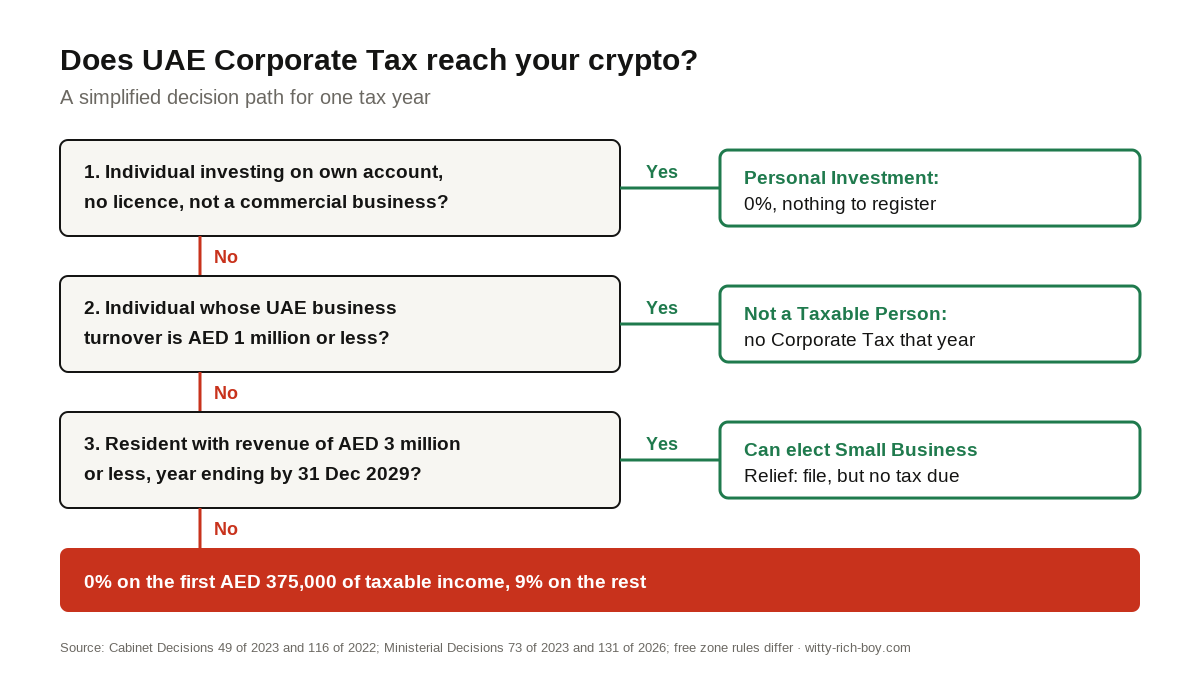
- The UAE has no personal income tax, and income from a natural person's Personal Investment is outside Corporate Tax under Cabinet Decision No. 49 of 2023, so an individual's crypto gains are taxed at 0%.
- Businesses pay 9% Corporate Tax on taxable income above AED 375,000 (Cabinet Decision No. 116 of 2022); an individual is caught only once UAE business turnover exceeds AED 1 million in a calendar year.
- Small Business Relief for resident businesses with revenue of up to AED 3 million now runs to tax periods ending on or before 31 December 2029 (Ministerial Decision No. 131 of 2026).
- Since 15 November 2024, the transfer and conversion of virtual assets are exempt financial services for VAT under Cabinet Decision No. 100 of 2024; the standard VAT rate is otherwise 5%.
- UAE tax residency needs 183 days in 12 months, or 90 days with a residence permit plus a UAE home or job (Cabinet Decision No. 85 of 2022), and none of it stops US citizens being taxed by the IRS.
- The UAE has signed the CARF agreement: reporting starts with calendar year 2027, with the first crypto data exchanged with partner countries in 2028.
In force: Rules as at 28 October 2026 · Corporate Tax for tax periods starting on or after 1 June 2023 · VAT exemption for virtual asset transfers and conversions under Cabinet Decision No. 100 of 2024, in force 15 November 2024 · Small Business Relief to tax periods ending by 31 December 2029 · CARF reporting from calendar year 2027
The UAE does not tax individuals on crypto gains: there is no personal income tax, and personal investment income is outside Corporate Tax. Businesses pay 9% Corporate Tax on taxable income above AED 375,000, and an individual is caught only above AED 1 million of business turnover. Transfers and conversions of crypto are exempt from VAT.
The Emirates’ reputation as a tax-free base for crypto holders is largely deserved, but it now rests on definitions rather than on the absence of tax law. Since 2023 the country has had a federal Corporate Tax and a statutory residency test and, since late 2024, explicit VAT rules for virtual assets. Below are the rules as at October 2026, each linked to the Federal Tax Authority (FTA) or the Ministry of Finance, with worked numbers in dirhams, a decision table and every relevant date in one place.
Is crypto taxed in the UAE?
Not for an individual investing their own money. The government’s u.ae taxation portal states that the UAE does not levy income tax on individuals. The only direct tax with a general reach is Corporate Tax under Federal Decree-Law No. 47 of 2022, which applies to tax periods starting on or after 1 June 2023, and that law deliberately leaves an individual’s private investments alone.
Virtual assets are defined in the VAT rules as a digital representation of value that can be digitally traded or converted and used for investment, excluding digital representations of fiat currencies and financial securities. Bitcoin, ether and most other tokens fit that description.
| Who and what | UAE tax treatment | Legal basis |
|---|---|---|
| Individual buying, holding, selling or swapping crypto on own account | No tax: no personal income tax; Personal Investment outside Corporate Tax | Cabinet Decision No. 49 of 2023 |
| Individual running a crypto business, UAE turnover up to AED 1 million | Not a Taxable Person for that year | Cabinet Decision No. 49 of 2023 |
| Individual running a crypto business, turnover above AED 1 million | 0% up to AED 375,000 of taxable income, 9% above | Decree-Law 47 of 2022; Cabinet Decision No. 116 of 2022 |
| Mainland company trading, mining or providing crypto services | 0% up to AED 375,000, 9% above | Decree-Law 47 of 2022 |
| Transfer or conversion of virtual assets | Exempt from VAT | VAT Executive Regulation, Art. 42, as amended by Cabinet Decision No. 100 of 2024 |
| Services charged by explicit fee or commission | Generally standard-rated VAT at 5% | FTA financial-services rules |
Do individuals pay tax on crypto gains in the UAE?
No, provided the activity is a personal investment. Cabinet Decision No. 49 of 2023 states that wages, Personal Investment income and Real Estate Investment income of a natural person are not subject to Corporate Tax, whatever their size, and do not count towards the AED 1 million turnover threshold.
Personal Investment is investment activity a natural person conducts for their personal account that is neither conducted through, nor requires, a licence from a UAE licensing authority, and is not considered a commercial business under Federal Decree-Law No. 50 of 2022, the Commercial Transactions Law. The FTA’s guide to taxation of natural persons illustrates it with someone investing personal savings in listed securities, who needs no licence and so earns Personal Investment income.
The edge case is the Commercial Transactions Law itself, which lists “virtual asset works” among the activities treated as commercial business when carried out as an occupation. Someone who deals in crypto as a living, takes clients, or operates under a licence is therefore not protected by the Personal Investment exclusion. Buying, holding and occasionally selling on your own account is the core case the exclusion was written for. We found no FTA guidance specific to staking or mining by individuals; the same test applies, so a mining operation run as a business sits on the business side.
When does a crypto business pay 9% Corporate Tax?
When it is a juridical person, or an individual whose business turnover crosses AED 1 million. Cabinet Decision No. 116 of 2022 sets the rates: the portion of taxable income not exceeding AED 375,000 is taxed at 0%, and the portion above it at 9%. The same decision warns that splitting a business to stay under the threshold can be treated as an arrangement to obtain a tax advantage.
For individuals, Cabinet Decision No. 49 of 2023 adds a turnover gate. A natural person is a Taxable Person only where total turnover from business conducted in the UAE exceeds AED 1 million in a Gregorian calendar year. Turnover is gross, before costs; the 0% band then applies to taxable income, after deductions. According to the FTA’s natural persons guide, an individual who crosses the threshold must register by 31 March of the following year, and the tax period is the calendar year. Returns, for companies and individuals alike, are due within nine months of the end of the tax period; the FTA confirmed 30 September 2026 as the deadline for periods ending on 31 December 2025.
Small Business Relief lets a resident taxable person, individual or company, with revenue of AED 3 million or less in the tax period and all earlier ones elect to be treated as having no taxable income. Ministerial Decision No. 131 of 2026, issued on 29 July 2026, extended the relief from tax periods ending by 31 December 2026 to those ending on or before 31 December 2029. Older FTA guides still show the 2026 cut-off.
How much UAE tax would you pay? Worked examples
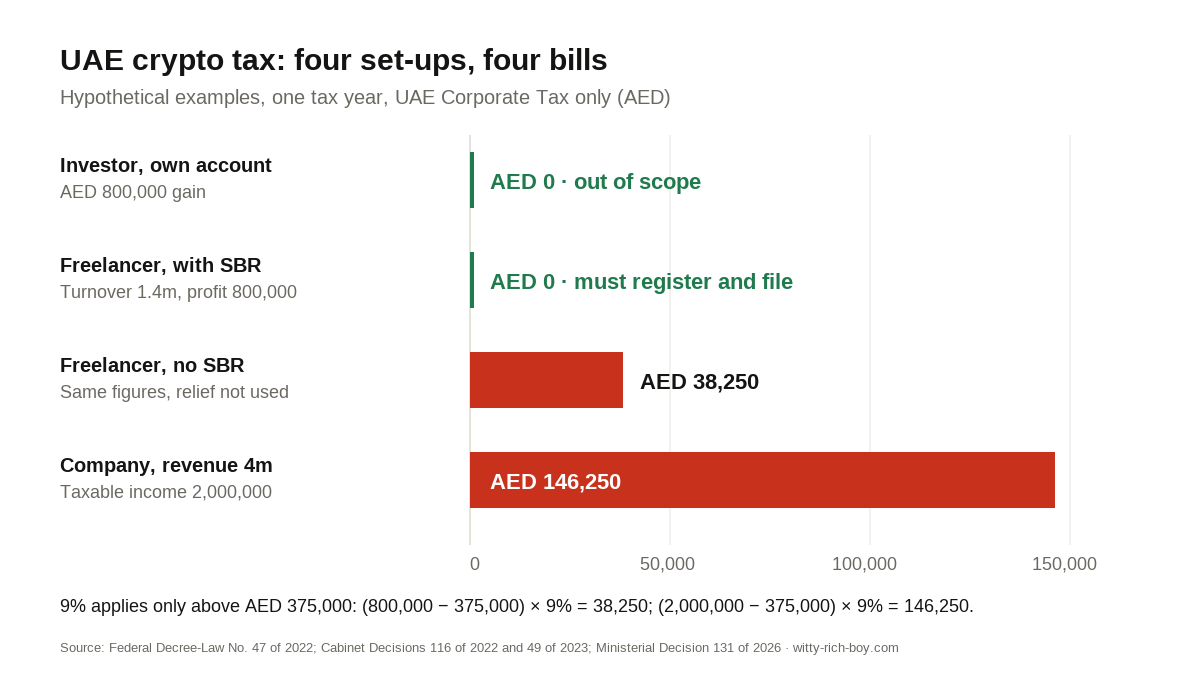
The answer ranges from nothing to six figures depending on structure, not on the size of the gain. These are hypothetical examples for one calendar tax year, covering UAE Corporate Tax only.
Example 1: Omar, investor. Omar, a UAE resident, sells bitcoin he bought on his own account and makes an AED 800,000 gain. He has no licence and does not deal for clients. The gain is Personal Investment income. UAE tax: AED 0, and nothing to register.
Example 2: Layla, licensed freelancer. Layla holds a freelance licence and earns fees, partly paid in tokens, for crypto consulting. Her turnover is AED 1.4 million and her taxable income after expenses AED 800,000.
- Turnover test. AED 1.4 million exceeds AED 1 million, so she is a Taxable Person and must register by 31 March of the next year.
- Small Business Relief. Her revenue is under AED 3 million, so she can elect the relief on her return: tax AED 0.
- Without the relief (or for a period ending after 31 December 2029): (800,000 − 375,000) × 9% = AED 38,250, an effective rate of 4.8% on her profit.
- Below the line. Had her turnover been AED 900,000, she would not have been a Taxable Person at all.
Example 3: a mainland company. A UAE company providing crypto services earns revenue of AED 4 million, too much for Small Business Relief, and taxable income of AED 2 million. Tax: (2,000,000 − 375,000) × 9% = AED 146,250, an effective 7.3%.
Decision table: which profile are you?
| Profile | Key facts | UAE Corporate Tax | Registration |
|---|---|---|---|
| Example: long-term holder | Buys and holds on own account, sells a few times a year | None (Personal Investment) | None |
| Example: active self-directed investor | Frequent trades, own money, no clients, no licence | Likely none, but closer to the “occupation” line | None, keep records |
| Example: licensed freelancer, turnover AED 900,000 | Fees for crypto services | None: below AED 1 million | None that year |
| Example: licensed freelancer, turnover AED 1.4 million | Revenue under AED 3 million | 0% with Small Business Relief | Register and file |
| Example: company, revenue AED 4 million | Mainland, no relief available | 9% above AED 375,000 | Register and file |
| Example: free zone company | Qualifying and non-qualifying income | Free zone regime; no 0% band on non-qualifying income | Register and file |
Is there VAT on crypto in the UAE?
Not on the crypto itself. Cabinet Decision No. 100 of 2024, issued on 6 September 2024 and in force from 15 November 2024, amended Article 42 of the VAT Executive Regulation to list the transfer of ownership of virtual assets, including virtual currencies, and the conversion of virtual assets as financial services. The VAT Decree-Law exempts financial services specified in the Executive Regulation, so buying, selling and swapping tokens is an exempt supply.
The standard rate, introduced on 1 January 2018, is 5%. The FTA’s Financial Services VAT Guide explains the general principle: services paid for through an implicit margin or spread are exempt, while those charged by an explicit fee, commission, discount or rebate are taxable.
How do you prove UAE tax residency?
By meeting one of three tests in Cabinet Decision No. 85 of 2022, in force from 1 March 2023, and then obtaining a certificate. You are a UAE tax resident if:
- your usual or primary place of residence and centre of financial and personal interests are in the UAE; or
- you are physically present for 183 days or more in a consecutive 12-month period; or
- you are present for 90 days or more in that period, are a UAE or GCC national or hold a valid UAE residence permit, and have either a permanent place of residence or a job or business in the UAE.
Ministerial Decision No. 27 of 2023 counts any part of a day as a full day and accepts a rented home if it is continuously available to you. Our guide to digital nomad tax residency compares these tests with those of Portugal, Spain and the UK.
The proof is a Tax Residency Certificate from the FTA. Its service page says applicants must meet the Cabinet Decision 85 criteria for the 12-month period and, on the 90-day route, supply an official entry and exit report plus evidence of a UAE job, business or permanent residence. The certificate is valid for one year and carries a fee.
What tax still applies after moving to the UAE?
Your old country’s, in two common cases. UAE residence does not end claims from elsewhere.
Citizenship-based taxation. The IRS states on its page for US citizens and resident aliens abroad that worldwide income is subject to US income tax regardless of where you live. An American in Dubai still reports every crypto disposal, and foreign accounts may trigger the FBAR filing requirement and Form 8938.
Temporary non-residence. The UK charges certain gains made abroad in the year you return if you were non-resident for five years or less and had been UK resident in at least four of the seven tax years before leaving, according to HMRC’s HS278 helpsheet. A sale made in Dubai followed by a return to London within that window can still be taxed as in our UK crypto tax guide.
Will the UAE share crypto data with other countries?
Yes, from 2028. The Ministry of Finance announced that the UAE has signed the Multilateral Competent Authority Agreement under the OECD Crypto-Asset Reporting Framework (CARF). Its CARF overview says the UAE committed in November 2024 to begin exchanges by 2028 covering calendar year 2027, and ran a public consultation from 15 September to 8 November 2025. The UAE is aligning CRS 2.0, effective 1 January 2027, with the same timetable.
CARF creates no UAE tax; platforms will collect your tax residence and report your transactions to the countries concerned, as the EU does under DAC8 crypto reporting.
How to check your UAE crypto tax position, step by step
- Confirm residence. Count days in any 12-month window and check the three tests in Cabinet Decision No. 85 of 2022; apply for a Tax Residency Certificate if another country may claim you.
- Classify the activity. Own account, no licence, no clients: Personal Investment. Licensed, client-facing or run as an occupation: business.
- Measure business turnover for the calendar year. At AED 1 million or below, an individual is not a Taxable Person.
- Register on time. An individual over the threshold registers with the FTA by 31 March of the following year.
- Test Small Business Relief. Revenue of AED 3 million or less in the year and every earlier year: elect it on the return, for periods ending by 31 December 2029.
- Compute and file. Otherwise 9% on taxable income above AED 375,000, with the return and payment due nine months after the year-end.
- Keep records of every purchase, sale and fee in dirhams; the FTA requires taxable persons to keep them for at least seven years.
| Date | What happened or falls due |
|---|---|
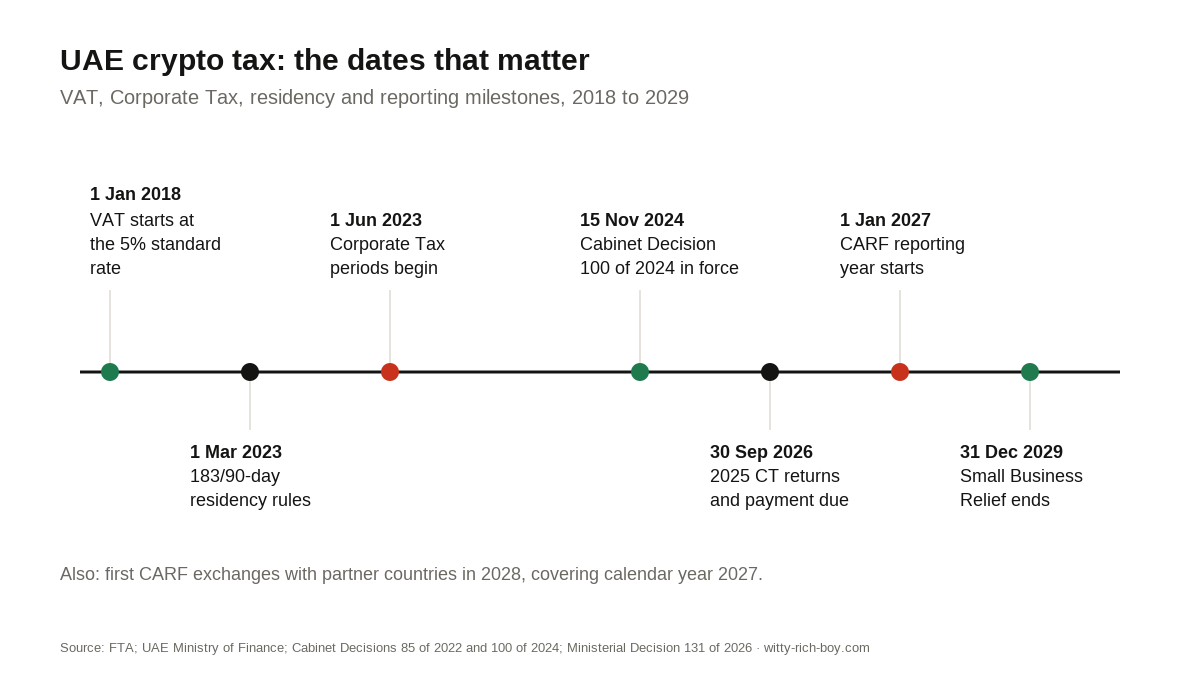
| 1 January 2018 | VAT starts at the 5% standard rate |
| 1 March 2023 | Cabinet Decision No. 85 of 2022 residency tests in force |
| 1 June 2023 | Corporate Tax applies to tax periods starting on or after this date |
| 15 November 2024 | Cabinet Decision No. 100 of 2024 in force: virtual assets in VAT rules |
| 30 September 2026 | Corporate Tax returns and payment due for periods ending 31 December 2025 |
| 1 January 2027 | First CARF reporting year begins |
| 31 March 2027 | Registration deadline for individuals whose 2026 business turnover exceeded AED 1 million |
| 2028 | First CARF exchanges with partner jurisdictions |
| 31 December 2029 | Last tax-period end date eligible for Small Business Relief |
How does UAE crypto tax compare with other countries?
The UAE is at the lightest end, with Singapore, and unlike Switzerland it has no wealth tax. The table draws on our country guides.
| Country | Tax on an individual investor’s crypto gain | Annual tax on holdings | Our guide |
|---|---|---|---|
| UAE | None; 9% Corporate Tax only for businesses | None | This page |
| Singapore | None (capital); trading profits at 0–24% | None | Singapore crypto tax |
| Switzerland | None for private investors | Cantonal wealth tax | Switzerland crypto tax |
| United Kingdom | 18% or 24% above a £3,000 allowance | None | UK crypto tax |
| Germany | Tax-free after one year; otherwise income tax | None | See our country guides |
| United States (citizens abroad) | Taxed by the IRS wherever you live | None | FBAR rules |
The UAE’s advantage is real but narrow: it zeroes the tax on your own investments, not the obligations you carry from your passport or your last address.
Questions readers ask
Is crypto tax-free in the UAE?
For individuals investing their own money, yes. The UAE levies no income tax on individuals, and Cabinet Decision No. 49 of 2023 keeps a natural person's Personal Investment income outside Corporate Tax. The picture changes for businesses: a company, or an individual running a crypto business with UAE turnover above AED 1 million, pays 9% Corporate Tax on taxable income above AED 375,000.
Do you pay tax on crypto in Dubai?
Dubai applies federal UAE tax law, so the same rules hold there as in Abu Dhabi or Sharjah. A resident who buys and sells crypto on their own account, without a licence and not as a commercial business, pays no tax on the gains. A Dubai company that trades, mines or provides crypto services is within the 9% Corporate Tax, and free zone companies follow their own regime.
When does an individual pay Corporate Tax on crypto in the UAE?
Only when the crypto activity is a business rather than a personal investment, and total UAE business turnover exceeds AED 1 million in a calendar year. Personal Investment means activity on your own account that neither requires a licence nor counts as a commercial business under the Commercial Transactions Law. Above the threshold you must register by 31 March of the following year.
Is there VAT on buying crypto in the UAE?
Not on the asset itself. Cabinet Decision No. 100 of 2024, in force from 15 November 2024, lists the transfer of ownership of virtual assets and their conversion as exempt financial services in the VAT Executive Regulation. Under the FTA's financial-services rules, explicit fees and commissions are generally taxed at the 5% standard rate.
How many days do I need to be a UAE tax resident?
Under Cabinet Decision No. 85 of 2022 you are resident if your usual residence and centre of financial and personal interests are in the UAE; or you spend 183 days or more there in a 12-month period; or 90 days or more if you are a UAE or GCC national or residence-permit holder with a permanent place of residence or a job or business in the UAE. Any part of a day counts.
Do US citizens living in Dubai pay tax on crypto?
Yes, to the United States. The IRS taxes citizens on worldwide income regardless of where they live, and its guidance treats digital asset transactions as taxable like other property transactions. Moving to the UAE removes UAE tax, which was zero for an individual investor anyway, but not the US return. Foreign accounts may also trigger FBAR and Form 8938 reporting.
Will the UAE report my crypto to my home country?
From 2028, for countries that exchange with it. The UAE has signed the Multilateral Competent Authority Agreement under the OECD Crypto-Asset Reporting Framework. Reporting starts with calendar year 2027, and the first exchanges of information are expected in 2028. If you remain tax resident elsewhere, your home tax authority may receive details of your UAE crypto accounts.
Can I use Small Business Relief for a crypto business in the UAE?
Possibly. A resident taxable person, individual or company, with revenue of AED 3 million or less in the tax period and every earlier one can elect Small Business Relief, which treats it as having no taxable income. Ministerial Decision No. 131 of 2026 extended it to tax periods ending on or before 31 December 2029. You still register and file a return to claim it.
Was this guide useful?
Thanks — your answer helps us decide what to cover next.
Sources
- Federal Decree-Law No. 47 of 2022 on the Taxation of Corporations and Businesses (FTA, unofficial English translation, PDF)
- Cabinet Decision No. 116 of 2022 on the taxable income threshold for the 0% rate (Ministry of Finance, PDF)
- Cabinet Decision No. 49 of 2023 on business activities conducted by natural persons (Ministry of Finance, PDF)
- Taxation of Natural Persons under the Corporate Tax Law — Corporate Tax Guide (FTA, PDF)
- Ministerial Decision No. 131 of 2026 amending Ministerial Decision No. 73 of 2023 on Small Business Relief (Ministry of Finance, PDF)
- Executive Regulation of Federal Decree-Law No. 8 of 2017 on VAT, Cabinet Decision No. 52 of 2017 and its amendments (FTA, PDF)
- Cabinet Decision No. 85 of 2022 on the Determination of Tax Residency (FTA, unofficial translation, PDF)
- Issuance of Tax Residency Certificate (Federal Tax Authority service page)
- The Crypto-Asset Reporting Framework: General Overview (UAE Ministry of Finance, PDF)
- U.S. citizens and resident aliens abroad (IRS)
General information, not tax or legal advice. Rules change — check the official source or a licensed adviser before acting.