Singapore · Crypto
Singapore crypto tax (2026): 0% on gains, unless you trade
Singapore crypto tax 2026: no capital gains tax, so investors keep gains tax-free; trading profits are income at up to 24%, and token swaps are exempt from GST.
The short answer
- Singapore has no capital gains tax: IRAS treats profits from buying and selling digital tokens as personal investments that are generally not taxable.
- Gains become taxable income if IRAS's eight badges of trade show you are trading; residents then pay progressive rates of 0% to 24%.
- In our example, a SGD 40,000 gain costs an investor nothing, but adds SGD 4,600 of tax for a resident trader already on SGD 80,000 of chargeable income.
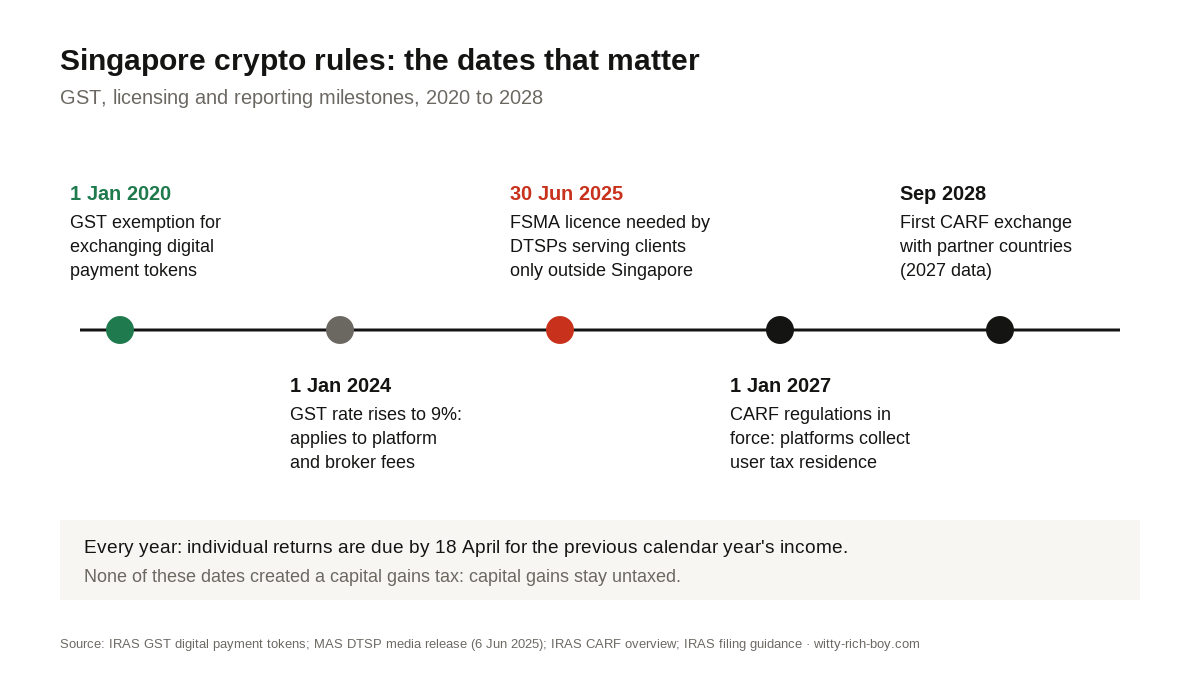
- Since 1 January 2020, exchanging digital payment tokens for money or other tokens is exempt from GST; fees charged by exchanges, wallets and brokers are not.
- Since 30 June 2025, Singapore-based DTSPs serving clients only abroad need an FSMA licence, which MAS says it will generally not grant.
- Singapore's CARF rules apply from 1 January 2027, with the first crypto data exchanged with partner countries from September 2028.
In force: Rules as at 27 October 2026 · income earned in 2026 is assessed in YA 2027, returns due by 18 April · GST exemption for digital payment tokens since 1 January 2020 · DTSP licensing under the FSMA since 30 June 2025 · CARF in force from 1 January 2027
Singapore has no capital gains tax, so an individual who buys and holds crypto as an investment pays nothing on the gain when selling. Profits become taxable income only when IRAS's badges of trade show you are trading; residents then pay 0% to 24%. Exchanging digital payment tokens has been exempt from GST since 1 January 2020.
Singapore’s reputation as a crypto-friendly tax home is deserved, but it rests on one distinction: capital gain or income. Cross the line into trading and the same profit is taxed at progressive rates. Below are the rules as at October 2026, each linked to IRAS, the Monetary Authority of Singapore (MAS) or the statute, with a worked example in Singapore dollars and a decision table the official pages do not give you.
Is crypto taxed in Singapore?
Only when it produces income. Section 10 of the Income Tax Act 1947 charges tax on income accruing in or derived from Singapore, or received in Singapore from outside it, starting with gains or profits from any trade, business, profession or vocation. Capital gains are not on the list, which is why Singapore is said to have no capital gains tax.
IRAS applies that to crypto in its e-Tax Guide “Income Tax Treatment of Digital Tokens”. The guide sorts tokens by what they do, not what they are called. A payment token is a token, such as bitcoin, intended as a means of payment; for income tax IRAS views it as intangible property. Utility tokens give access to a product or service, and security tokens are treated as debt or equity.
| Event for an individual | Usual tax treatment | IRAS basis |
|---|---|---|
| Buying tokens | Not a taxable event | Digital tokens e-Tax Guide |
| Selling or swapping tokens held as an investment | Capital gain, not taxable | IRAS gains page; e-Tax Guide |
| Selling tokens as a trader | Trading income, taxed at income tax rates | Badges of trade; ITA s10(1)(a) |
| Loss on an investment holding | Not deductible | Follows capital treatment |
| Free airdrop, nothing given in return | Not income | e-Tax Guide |
| Airdrop in return for a service | Can be taxable income | e-Tax Guide |
| Hard-fork tokens | Not taxable on receipt | e-Tax Guide |
| Mining as a hobby | Gains on sale are capital; costs not deductible | e-Tax Guide |
| Tokens received by a business for goods or services | Taxed on the value of the goods or services | e-Tax Guide |
Is there capital gains tax on crypto in Singapore?
No. IRAS’s page on gains from sale of property, shares and financial instruments states that profits or losses from buying and selling shares or other financial instruments, including digital tokens, are generally viewed as personal investments and are not taxable. There is no holding period to wait out, no annual allowance and no wealth tax on what you hold.
That applies to swaps too. Exchanging one coin for another is a disposal, taxable in many countries (see how swaps are treated elsewhere), but in Singapore an investor’s gain on a swap is capital like any other.
The flip side: an investor’s losses do nothing for tax, so year-end loss harvesting, routine in the UK or Canada, has no purpose in Singapore unless you are a trader.
When do crypto gains become taxable income in Singapore?
When your buying and selling amounts to trading. The digital tokens guide says buying a payment token is not a taxable event, but your intention at the point of purchase, tested through the badges of trade, decides whether a later disposal is a trading activity and whether the gain or loss is revenue in nature.
The badges of trade are the factors IRAS uses to tell trading from investing. IRAS’s guide to the taxability of income lists eight: the nature of the subject matter, length of ownership, frequency of transactions, supplementary work, circumstances of realisation, motive, mode of financing, and other factors such as records and accounting treatment. No single badge is decisive, and a shorter holding period makes trading more likely.
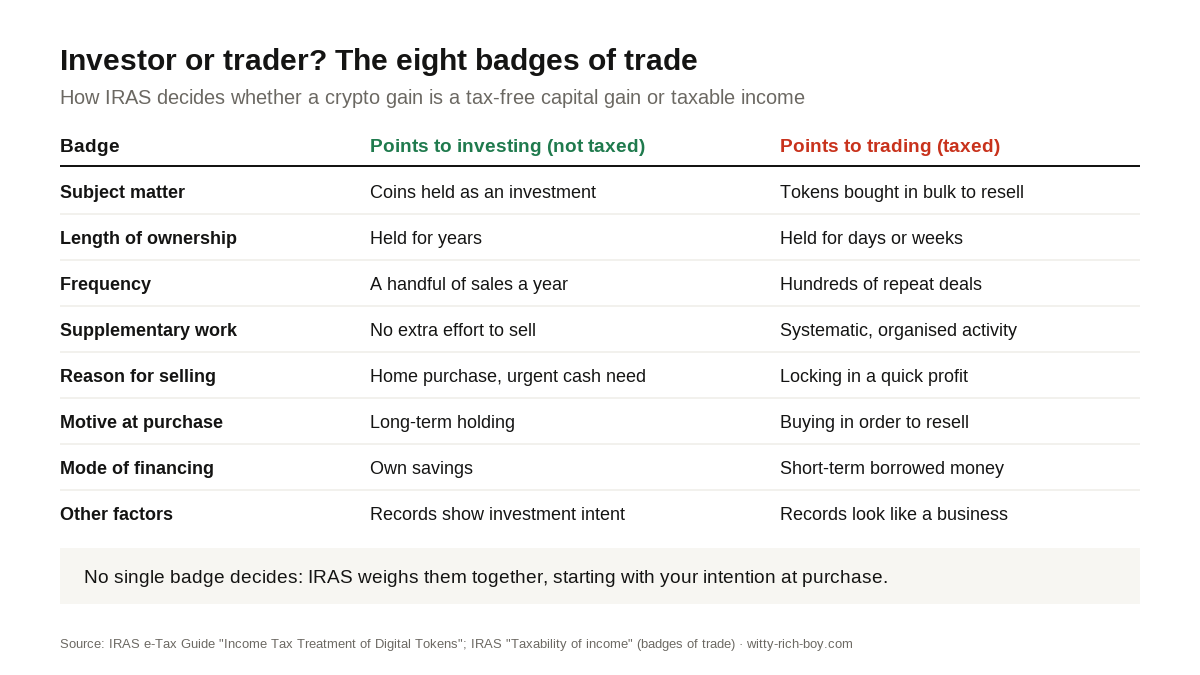
A badges-of-trade decision table with examples
These hypothetical scenarios show how the badges tend to point; they are not rulings.
| Example | Key facts | Badges that weigh most | Likely treatment |
|---|---|---|---|
| Example: long-term holder | Buys SGD 20,000 of bitcoin over 2021–22, sells once in 2026 for SGD 60,000 to fund a flat | Long ownership, one sale, reason for selling | Capital: SGD 40,000 gain not taxable |
| Example: occasional rebalancer | Holds SGD 100,000 across five coins, rebalances four times a year, own savings | Low frequency, investment motive | Capital: gains not taxable |
| Example: active day trader | 1,500 round trips a year, positions held hours or days, profits used to live on | Frequency, length of ownership, motive | Trading: SGD 40,000 net profit taxable |
| Example: borrowed-money buyer | Takes a SGD 50,000 short-term loan to buy tokens and sells within weeks | Mode of financing, length of ownership | Leans towards trading |
| Example: token-launch flipper | Buys tokens in bulk at each new launch to resell on listing | Subject matter, motive, frequency | Leans towards trading |
How much tax do crypto traders pay in Singapore?
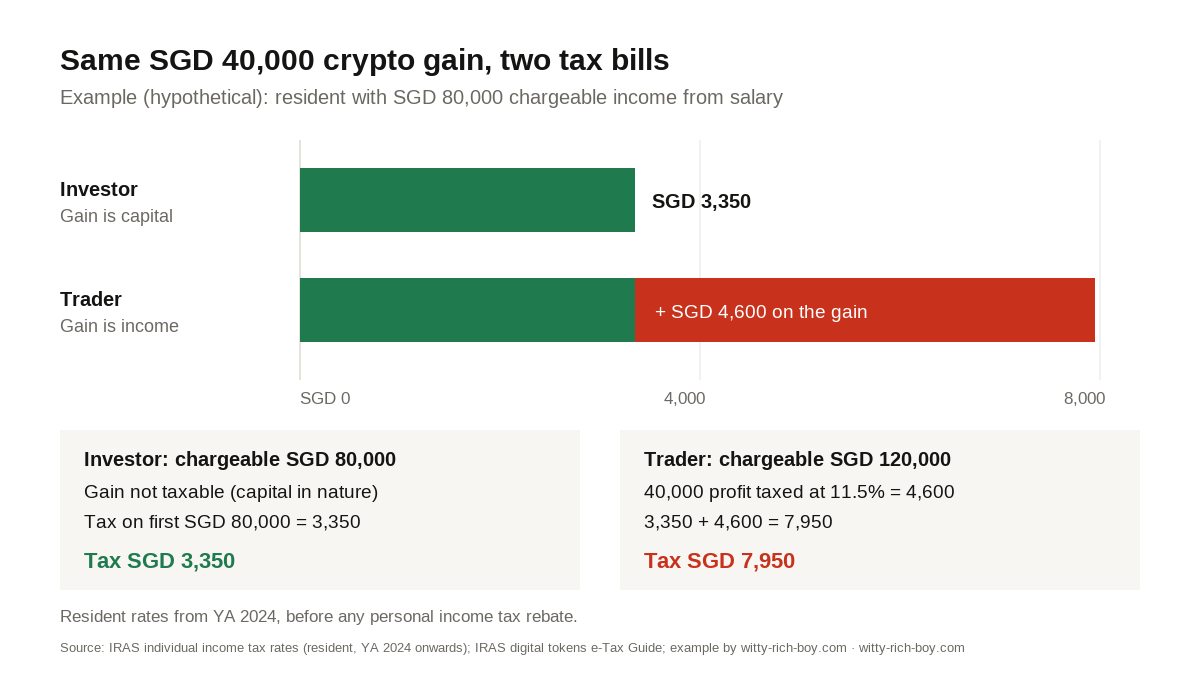
A resident trader adds net trading profit to other income and pays the normal progressive rates. IRAS’s individual income tax rates for tax residents run from 0% to 24% on chargeable income, after expenses, donations and personal reliefs. From YA 2024 the first SGD 20,000 is taxed at 0%, tax on the first SGD 80,000 is SGD 3,350, the next SGD 40,000 is taxed at 11.5%, and income above SGD 1 million is taxed at 24%.
Example: Wei Ling is a Singapore tax resident whose chargeable income after reliefs is SGD 80,000. In 2026 she makes a SGD 40,000 net gain on crypto.
- Investor case. The gain is capital and not taxable. Her tax stays at SGD 3,350, the tax on the first SGD 80,000.
- Trader case. The SGD 40,000 profit is trading income, raising chargeable income to SGD 120,000.
- Tax the extra slice. The SGD 40,000 falls entirely in the 11.5% band: 40,000 × 11.5% = SGD 4,600.
- Total. SGD 3,350 + SGD 4,600 = SGD 7,950, before any personal income tax rebate announced for the year.
A trader is taxed on net profit, so trading losses and expenses incurred in producing the income count against it. Income for a calendar year is assessed in the following year of assessment: profits made in 2026 fall into YA 2027.
How are staking, mining and airdrops taxed in Singapore?
IRAS has given clear rules on airdrops, hard forks and mining, but not on staking.
- Airdrops. The digital tokens guide says a token received free, with nothing given in return, is not income of the recipient and is not taxable. If the airdrop was in return for, or in expectation of, a service, it could be taxable income, for example tokens given for promotional work.
- Hard forks. New tokens from a fork are a windfall received without doing anything in return, so they are not taxable on receipt. A later sale is taxable only if the holder is trading.
- Mining. An individual who mines is treated prima facie as doing so as a hobby: gains on selling mined payment tokens are capital and not taxable, and mining expenses are not deductible. Someone who shows a habitual and systematic effort to profit may be carrying on a vocation, with taxable profits. Companies that mine are taxed when they sell mined tokens.
- Staking. The e-Tax Guide contains no specific section on staking. Its principles suggest rewards received for a service or as part of a business can be income, but IRAS has not published a staking rule for individuals. Singapore’s crypto-asset reporting rules will make platforms report staking income from 2027, so keep a record of each reward and its value in Singapore dollars.
Is there GST on crypto in Singapore?
Not on exchanging the tokens themselves. According to IRAS’s page on GST and digital payment tokens, from 1 January 2020 the following are exempt from GST: exchanging digital payment tokens for fiat currency or for other digital payment tokens, and providing loans of digital payment tokens. Using a digital payment token to pay for anything else is disregarded as a supply, so paying for goods in bitcoin does not create a second GST charge on the token. Before 2020, supplies of virtual currencies were taxable services.
| Supply | GST treatment |
|---|---|
| Swapping digital payment tokens for money or other such tokens | Exempt from 1 January 2020 |
| Lending digital payment tokens | Exempt from 1 January 2020 |
| Paying for goods or services with digital payment tokens | Token side disregarded; the goods or services follow normal rules |
| Fees charged by an exchange, wallet or broker | Taxable services (9% standard rate since 1 January 2024) |
| Tokens pegged to or backed by a fiat currency, such as stablecoins | Not digital payment tokens; exempt as derivatives under para 1(j), Fourth Schedule, GST Act |
| Non-fungible tokens, such as digital art | Not digital payment tokens; taxable as services |
What are Singapore’s DTSP rules under the FSMA?
They are licensing rules for businesses, not tax rules for investors. Since 30 June 2025, a digital token service provider (DTSP) — an individual, partnership or company operating from a place of business in Singapore, or a Singapore-incorporated company, that provides digital token services only to customers outside Singapore — needs a licence under section 137 of the Financial Services and Markets Act 2022 (FSMA).
MAS said in its media release of 6 June 2025 that it would set a high bar for these licences and would generally not issue one, citing money-laundering risks and the difficulty of supervising activity carried on abroad. MAS’s Guidelines on Licensing for DTSPs say providers without a licence had to suspend or cease the business by 30 June 2025, with no transitional period. MAS said very few providers were affected.
For an individual investor, the DTSP regime changes nothing about tax.
What do foreigners and new residents need to know?
The capital-versus-income test applies to everyone; residence decides the rates. IRAS’s tax residency rules treat a foreigner as resident if they stay or work in Singapore for at least 183 days in a calendar year, for three consecutive years, or across two calendar years with 183 days in total. Residents get progressive rates and personal reliefs.
A non-resident is taxed only on Singapore-sourced income: employment income at the higher of a flat 15% or the resident rates, and most other income generally at 24%, with no personal reliefs. A capital gain on crypto is not taxable for a non-resident either.
Foreign income is the other point for newcomers. IRAS says foreign-sourced income received by resident individuals is generally exempt, unless received through a partnership in Singapore. Moving here does not end your old country’s claim automatically, so read our guide to digital nomad tax residency before timing a move around a sale.
Will Singapore share crypto data with other tax authorities?
Yes, from 2028. IRAS’s CARF overview says the regulations implementing the OECD Crypto-Asset Reporting Framework were enacted on 11 August 2026 and enter into force on 1 January 2027, with exchanges with partner jurisdictions intended from September 2028, covering 2027 data. Platforms must obtain a self-certification of tax residence from existing individual users by 31 December 2027.
If you are still resident elsewhere, that country will see your Singapore account; the EU runs the same standard through DAC8 crypto reporting.
How to report crypto on your Singapore tax return, step by step
Only taxable crypto income goes on the return; capital gains are not declared.
- Classify your activity. Run your year through the badges-of-trade table above. A clear investor has nothing to report on disposals.
- Keep records anyway. Save exchange statements, wallet addresses and the date and SGD value of each purchase and sale, so you can show investment intent if IRAS asks.
- Value income items in SGD. Note the value on receipt of taxable airdrops, staking rewards you treat as income and tokens received for work or business.
- Work out net trading profit if you are a trader: proceeds less cost and expenses incurred in producing the income.
- Check whether you must file. IRAS’s filing rules require a return if your income in the previous year exceeded SGD 22,000, your self-employed net profit exceeded SGD 6,000, or you are a non-resident with Singapore-sourced income.
- File by 18 April through myTax Portal for the previous calendar year’s income; you can ask for an extension of up to 14 days.
- If unsure, ask first. IRAS offers advance rulings, and a tax adviser can help for large or unusual activity.
How does Singapore crypto tax compare with other countries?
Singapore is at the light end, alongside Switzerland, but without the Swiss wealth tax; the UAE goes further, with no personal income tax at all and Corporate Tax only for businesses. The table summarises rules from our country guides.
| Country | Tax on an investor’s crypto gain | Annual tax on holdings | Our guide |
|---|---|---|---|
| Singapore | None (capital); trading profits at 0–24% | None | This page |
| Switzerland | None for private investors | Cantonal wealth tax on 31 December value | Switzerland crypto tax |
| United Kingdom | 18% or 24% above a £3,000 allowance | None | UK crypto tax |
| Germany | Tax-free after one year; otherwise income tax | None | Germany crypto tax |
| Japan | Miscellaneous income, up to 55.945% combined | None | Japan crypto tax |
In Singapore what matters is not how long you hold but how you behave: a holder keeps the whole gain, while activity that looks like a business is taxed like a salary.
Questions readers ask
Do you pay tax on crypto in Singapore?
Usually not on gains. Singapore has no capital gains tax, and IRAS treats profits from buying and selling digital tokens as personal investments that are generally not taxable. Tax applies when your activity amounts to trading under the badges of trade, when tokens are received as payment for goods or services, or when an airdrop is given in return for a service. Such income is taxed at normal income tax rates.
Is crypto tax-free in Singapore?
For a typical long-term investor, the gain on selling crypto is tax-free because it is capital in nature and Singapore taxes income, not capital gains. Crypto is not tax-free in every case, though: trading profits, business receipts paid in tokens and some airdrops are income. Losses follow the same line, so an investor's losses are not deductible, while a trader's losses can be set against trading income.
How does IRAS decide if I am a crypto trader?
IRAS applies the badges of trade: the nature of the asset, how long you held it, how often you transact, any supplementary work, the circumstances of the sale, your motive at purchase, how you financed it and other evidence such as records. No single factor is decisive. Short holding periods, frequent repeat transactions and borrowed money all point towards trading income rather than capital gains.
Is crypto staking income taxable in Singapore?
IRAS's e-Tax Guide on digital tokens has no specific section on staking, so there is no published rule saying staking rewards are always taxable or always exempt. The guide's principles point towards tax where tokens are received in return for a service or as part of a business. Staking income is also a reportable transaction for platforms under Singapore's crypto-asset reporting rules from 2027, so keep records.
Are airdrops and mining taxable in Singapore?
An airdrop received free, with nothing done in return, is not income, according to IRAS; one received in return for, or in expectation of, a service can be taxable. Hard-fork tokens are not taxed on receipt. An individual who mines is treated prima facie as a hobbyist, so gains on selling mined tokens are capital and expenses are not deductible, unless the mining is habitual and systematic.
Is there GST on buying crypto in Singapore?
Not on the tokens themselves. Since 1 January 2020, exchanging digital payment tokens for fiat currency or other digital payment tokens, and lending them, are exempt from GST, and paying with them is disregarded as a supply. Fees charged by exchanges, wallets and brokers remain taxable, at 9% since 1 January 2024. Stablecoins pegged to a currency and NFTs are not digital payment tokens for GST.
Do foreigners pay crypto tax in Singapore?
The same capital-versus-income test applies to everyone. A foreigner present or working in Singapore for at least 183 days in a calendar year is generally a tax resident, taxed on income at 0% to 24%. A non-resident is taxed only on Singapore-sourced income, with most income other than employment taxed at 24%. Capital gains on crypto are not taxable for either group.
Do I have to declare crypto on my Singapore tax return?
Only if it produces taxable income. Capital gains from investing are not taxable and need not be declared. Trading profits and other taxable crypto income must be reported in your return, which is due by 18 April for the previous calendar year's income. IRAS requires you to file if your income exceeded SGD 22,000, or your self-employed net profit exceeded SGD 6,000.
Was this guide useful?
Thanks — your answer helps us decide what to cover next.
Sources
- Income Tax Treatment of Digital Tokens — IRAS e-Tax Guide (PDF)
- Gains from sale of property, shares and financial instruments (IRAS)
- Section 2 — Taxability of income: badges of trade (IRAS, PDF)
- Income Tax Act 1947, section 10 — charge of income tax (Singapore Statutes Online)
- Individual Income Tax rates (IRAS)
- Working out my tax residency (IRAS)
- GST: Digital payment tokens (IRAS)
- MAS clarifies regulatory regime for digital token service providers (MAS media release, 6 June 2025)
- Guidelines on Licensing for Digital Token Service Providers (MAS)
- CARF overview and latest developments (IRAS)
General information, not tax or legal advice. Rules change — check the official source or a licensed adviser before acting.