United States · Tax
401(k) Contribution Limit (2026): $24,500 and $11,250 Catch-Up
The 401(k) contribution limit for 2026 is $24,500, plus an $8,000 catch-up at 50 or $11,250 at ages 60–63, inside a $72,000 total cap. Roth catch-up rule explained.

The short answer
- The 2026 401(k) contribution limit for employee deferrals is $24,500, up from $23,500, shared across 401(k), 403(b) and TSP accounts (IR-2025-111).
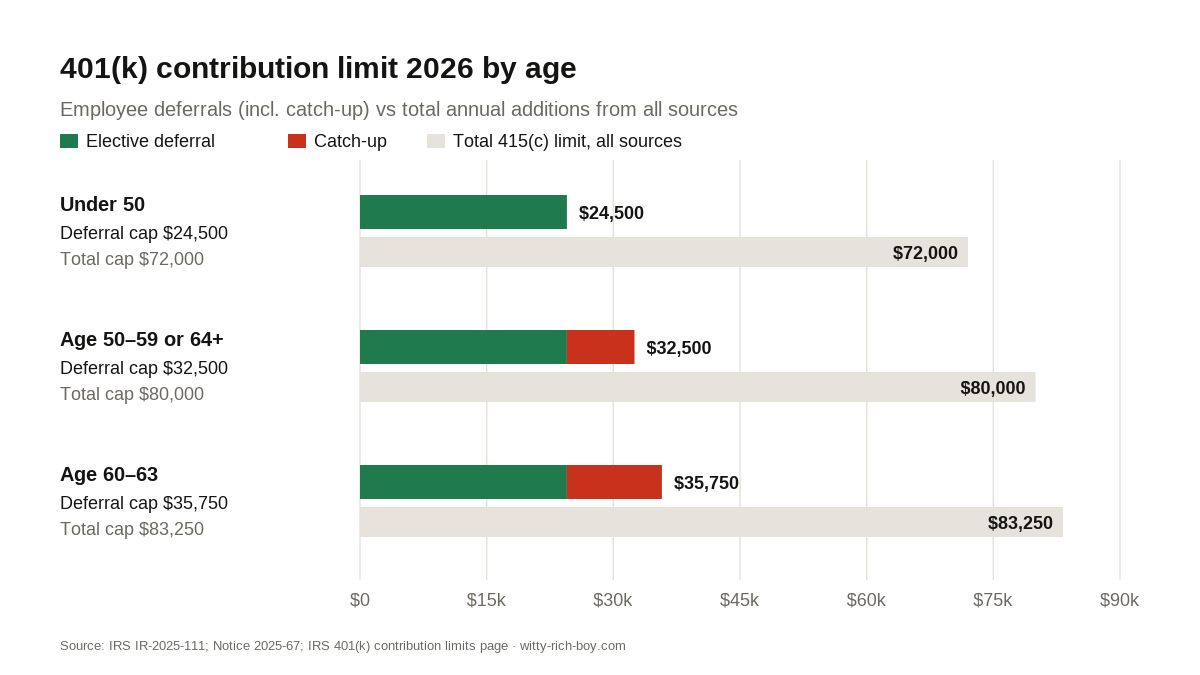
- Savers aged 50 or over can add an $8,000 catch-up (2025: $7,500); those turning 60, 61, 62 or 63 in 2026 can add $11,250 instead — $35,750 in total.
- The total annual additions limit under § 415(c) — your deferrals plus employer money — is $72,000, or $80,000 with the standard catch-up and $83,250 at 60–63.
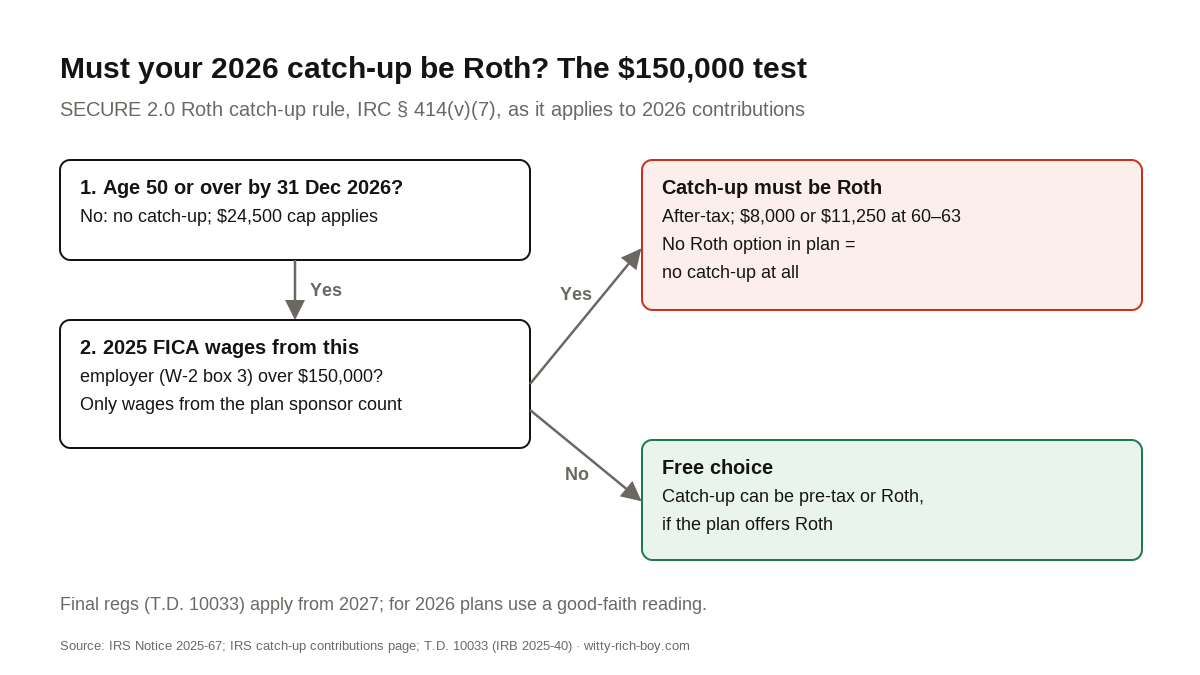
- If your 2025 FICA wages from your employer exceeded $150,000, your 2026 catch-up must be Roth; final regulations (T.D. 10033) apply from 2027.
- A governmental 457(b) plan has its own separate $24,500 limit; SIMPLE plans are capped at $17,000 with a $4,000 catch-up.
- An excess deferral must be paid out, with earnings, by 15 April of the following year, or it is taxed twice.
In force: 1 January 2026 (2026 limits under IRS Notice 2025-67) · 1 January 2027 (final Roth catch-up regulations, T.D. 10033, generally apply) · 15 April 2027 (deadline to remove 2026 excess deferrals)
The 401(k) contribution limit for 2026 is $24,500 of employee deferrals, up from $23,500. Savers aged 50 or over can add an $8,000 catch-up, and those turning 60 to 63 can add $11,250 instead. Employer and employee money together is capped at $72,000, or $80,000 and $83,250 including catch-ups.
The 401(k) is where most American retirement saving actually happens, and its rules come in layers. There is a cap on what you put in from salary, a separate cap on what goes in from all sources, a catch-up that now depends on your exact age, and — new for 2026 — a rule that forces higher earners’ catch-ups into Roth. Below: every 2026 figure against 2025, the employer-match arithmetic with worked numbers, the $150,000 Roth catch-up test, how 403(b), 457(b), TSP and SIMPLE plans share (or do not share) the limit, and how to repair an over-contribution before the 15 April deadline.
What is the 401(k) contribution limit for 2026?
The 2026 limit on elective deferrals — the salary you choose to put into a 401(k), whether pre-tax or Roth — is $24,500, up $1,000 from $23,500 in 2025, according to IRS news release IR-2025-111 and Notice 2025-67. The cap is set by 26 U.S.C. § 402(g) and indexed to inflation each autumn.
An elective deferral is any contribution you elect to have taken from your pay before it reaches you. Pre-tax and designated Roth deferrals count against the same $24,500; choosing Roth changes the tax treatment, not the size of the allowance. Deferrals are also limited to 100% of your compensation from the employer.
| Limit | 2025 | 2026 | Legal source |
|---|---|---|---|
| Elective deferrals (401(k), 403(b), TSP) | $23,500 | $24,500 | § 402(g)(1) |
| Catch-up, age 50+ | $7,500 | $8,000 | § 414(v)(2)(B)(i) |
| Higher catch-up, turning 60–63 | $11,250 | $11,250 | § 414(v)(2)(E) |
| Total annual additions (defined contribution) | $70,000 | $72,000 | § 415(c)(1)(A) |
| Compensation counted for contributions | $350,000 | $360,000 | § 401(a)(17) |
| Highly compensated employee threshold | $160,000 | $160,000 | § 414(q)(1)(B) |
| Key employee threshold | $230,000 | $235,000 | § 416(i) |
| SIMPLE IRA / SIMPLE 401(k) deferrals | $16,500 | $17,000 | § 408(p)(2)(E) |
| SIMPLE catch-up, age 50+ | $3,500 | $4,000 | § 414(v)(2)(B)(ii) |
| IRA contribution (for comparison) | $7,000 | $7,500 | § 219(b)(5) |
Sources: IRS Notice 2025-67; IRS COLA table for dollar limitations.
How do 401(k) catch-up contributions work in 2026?
A catch-up contribution is an extra elective deferral allowed for employees who are 50 or older by the end of the calendar year. For 2026 the standard catch-up is $8,000, so a 52-year-old can defer up to $32,500. You need not be 50 on the day you contribute; reaching 50 by 31 December 2026 is enough, according to the IRS catch-up contributions page.
The SECURE 2.0 Act added a second tier, often called the super catch-up. Employees who turn 60, 61, 62 or 63 during the calendar year can contribute a higher catch-up — $11,250 for 2026, unchanged from 2025 — instead of the standard amount, under § 414(v)(2)(E). That lifts their deferral ceiling to $35,750. The window is narrow: in the year you turn 64 you fall back to $8,000.
| Age at 31 December 2026 | Deferral limit | Catch-up | Total you can defer | Total annual additions |
|---|---|---|---|---|
| Under 50 | $24,500 | — | $24,500 | $72,000 |
| 50–59 | $24,500 | $8,000 | $32,500 | $80,000 |
| 60, 61, 62 or 63 | $24,500 | $11,250 | $35,750 | $83,250 |
| 64 or over | $24,500 | $8,000 | $32,500 | $80,000 |
Catch-ups are permitted, not required: your plan must offer them, and most large plans do. The super catch-up is likewise optional for the employer.
What is the total 401(k) limit including employer contributions?
The total limit is $72,000 for 2026, up from $70,000, under § 415(c)(1)(A). This annual additions limit counts everything credited to your account in one employer’s plan: your pre-tax and Roth deferrals, employer matching and profit-sharing contributions, any after-tax contributions and forfeitures allocated to you. It is the lesser of $72,000 and 100% of your compensation.
Catch-up contributions do not count against it. That is why the IRS page on 401(k) contribution limits quotes $72,000, “$80,000 including catch-up contributions”, and up to $83,250 for those aged 60 to 63.
Worked example: how much room is left?
Example: Jordan, 41, earns $150,000, defers the full $24,500 and receives a 4% employer match of $6,000. Total additions so far are $30,500, leaving $41,500 of § 415(c) room. That space can only be filled if the plan allows after-tax (non-Roth) contributions — the raw material of what is informally called a “mega backdoor Roth”. Many plans do not offer them, and the $41,500 then simply goes unused.
The $360,000 compensation cap
A second ceiling applies to the pay on which contributions are calculated. Under § 401(a)(17), a plan can take into account no more than $360,000 of compensation in 2026 (2025: $350,000). Example: on a $400,000 salary, a 4% match is worked out on $360,000 and comes to $14,400 rather than $16,000.
How does 401(k) employer match maths work?
An employer match is a contribution the employer makes in proportion to what you defer, up to a stated share of your pay. The formula belongs to your plan, not the tax code, but the maths is always the same: multiply your pay by the matched percentage, then by the match rate. Matching dollars do not use up any of your $24,500.
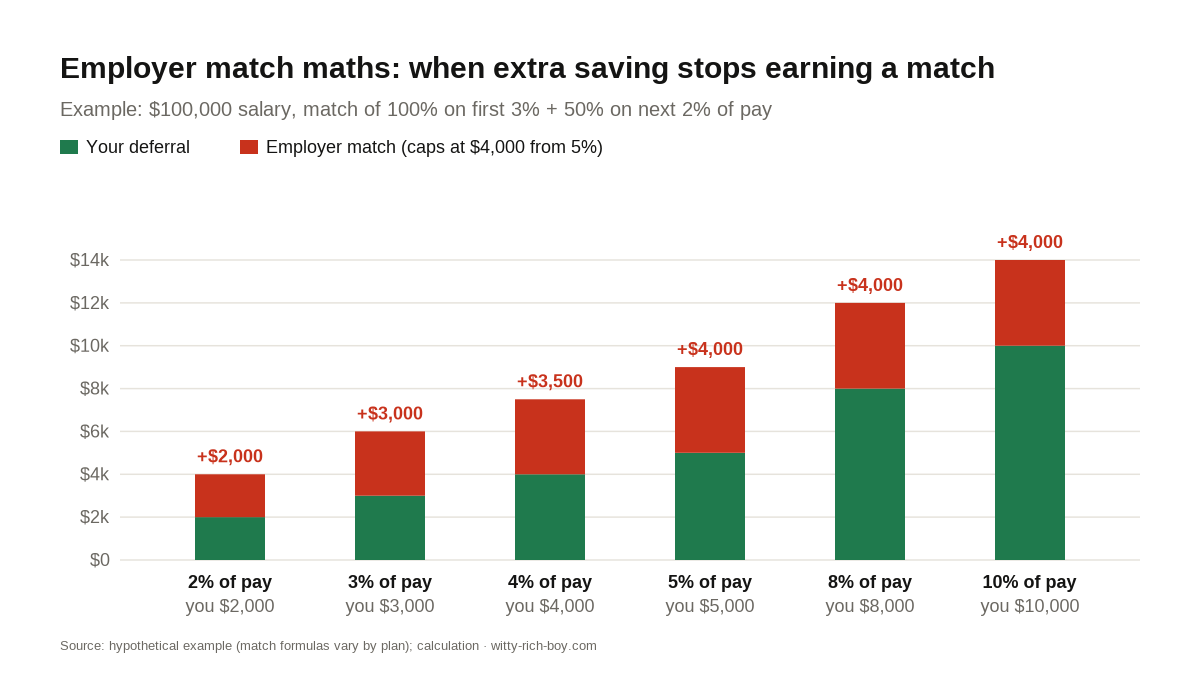
Take a common design, used here as a hypothetical: 100% on the first 3% of pay you defer, plus 50% on the next 2%.
| Example: $100,000 salary | You defer | Employer match | Total going in |
|---|---|---|---|
| 2% of pay | $2,000 | $2,000 | $4,000 |
| 3% of pay | $3,000 | $3,000 | $6,000 |
| 4% of pay | $4,000 | $3,500 | $7,500 |
| 5% of pay | $5,000 | $4,000 | $9,000 |
| 10% of pay | $10,000 | $4,000 | $14,000 |
| Full $24,500 (24.5%) | $24,500 | $4,000 | $28,500 |
The match stops growing at 5% of pay. Every dollar beyond that is still tax-advantaged, but it earns no employer money.
How to set your 2026 401(k) contribution, step by step
- Find your match formula in the plan’s summary plan description, and note whether it is calculated per pay period or annually.
- Defer at least the percentage that captures the full match — 5% of pay in the example above.
- Check your age bracket for 2026: $24,500 under 50, $32,500 from 50, $35,750 if you turn 60 to 63 during the year.
- Test the Roth catch-up rule if you are 50 or over: look at box 3 of your 2025 Form W-2 from this employer and compare it with $150,000.
- Spread contributions over the year if the match is calculated per pay period. Reaching $24,500 by September can leave the last months’ match unpaid unless the plan makes a year-end “true-up”.
- Add up deferrals at every employer if you changed jobs in 2026. The $24,500 is a personal limit, and neither payroll knows what the other has taken.
- Re-check in January, when the 2027 limits apply and new elections take effect.
Must 401(k) catch-up contributions be Roth in 2026?
Yes, for higher earners. Under § 414(v)(7), added by section 603 of the SECURE 2.0 Act, an employee whose prior-year FICA wages from the employer sponsoring the plan exceeded $145,000, indexed for inflation, must make any catch-up contributions as designated Roth contributions. Notice 2025-67 sets that Roth catch-up wage threshold at $150,000 for 2025 wages, which decide the treatment of 2026 catch-ups.
The test uses FICA wages: the Social Security wages shown in box 3 of Form W-2. Only wages from the employer sponsoring the plan count, so a high salary from a former employer does not trigger the rule at a new one. The regular $24,500 deferral is unaffected and can still go in pre-tax.
Example: Dana, 56, had $165,000 of box 3 wages from her employer in 2025. In 2026 she can defer $24,500 pre-tax, but her $8,000 catch-up must be Roth. A colleague of the same age with $140,000 of 2025 wages can choose either.
Two consequences matter. If a plan does not offer a Roth option, employees above the threshold cannot make catch-up contributions at all. And if any participant is caught by the rule, the plan must let every catch-up-eligible participant make Roth catch-ups.
When do the final regulations apply?
Treasury and the IRS published final regulations, T.D. 10033, in Internal Revenue Bulletin 2025-40 on 29 September 2025. The Roth catch-up provisions generally apply to contributions in taxable years beginning after 31 December 2026 — 2027 for calendar-year plans — with later dates for some governmental and collectively bargained plans. For 2026, plans must comply using a reasonable, good-faith interpretation of the statute, after the administrative transition period in Notice 2023-62 ended with 2025. The regulations’ own examples use a $155,000 threshold for 2026 wages, which will govern 2027 catch-ups.
Do 403(b), 457(b), TSP and SIMPLE plans share the 401(k) limit?
Mostly yes — with one important exception. The $24,500 deferral limit is personal: according to the IRS page on deferring to more than one plan, your deferrals to all 401(k), 403(b), SIMPLE and SARSEP plans are added together. IR-2025-111 applies the same $24,500 to the federal Thrift Savings Plan, so TSP deferrals share the pot too.
The exception is the 457(b) plan. A governmental or tax-exempt employer’s 457(b) plan has its own, separate limit — $24,500 for 2026 — that is not combined with 401(k) or 403(b) deferrals.
| Plan | 2026 deferral limit | Shares the $24,500 with a 401(k)? | Catch-up at 50+ | Catch-up turning 60–63 |
|---|---|---|---|---|
| 401(k) | $24,500 | — | $8,000 | $11,250 |
| 403(b) | $24,500 | Yes | $8,000 | $11,250 |
| Thrift Savings Plan | $24,500 | Yes | $8,000 | $11,250 |
| Governmental 457(b) | $24,500 | No — separate limit | $8,000 | $11,250 |
| SIMPLE IRA / SIMPLE 401(k) | $17,000 | Yes | $4,000 | $5,250 |
Example: a public-school employee aged 45 offered both a 403(b) and a 457(b) could defer $24,500 into each — $49,000 in 2026 — if her salary allows it.
SIMPLE plans, aimed at employers with up to 100 employees, have lower limits: $17,000 of deferrals in 2026 (2025: $16,500), a $4,000 catch-up and $5,250 for those turning 60 to 63. According to the IRS SIMPLE IRA plan page, a higher employee limit of $18,100 can apply for 2026 at employers with 25 or fewer employees.
What happens if you contribute too much to a 401(k)?
An excess deferral is any amount above the § 402(g) limit across all your plans. It must be distributed, with its earnings, by 15 April of the year after the deferral — 15 April 2027 for 2026 — according to the IRS page on the consequences of excess deferrals. A tax-return extension does not move that date.
A timely correction is taxed once: the excess is included in income for the year it was deferred, and the earnings are taxed in the year they are paid out. There is no 10% early-distribution tax. Miss the date and the pre-tax excess is taxed twice — in the year contributed and again when it is eventually withdrawn, because it never acquires basis.
Worked example: changing jobs mid-year
Example: Sam, 38, defers $14,000 at his first employer from January to June 2026, then $12,500 at a new employer from July. Each payroll stays well under $24,500, but together he has deferred $26,500 — an excess of $2,000.
- Tell one of the plans in writing, well before 15 April 2027, that $2,000 of deferrals exceeds the limit and ask for a corrective distribution.
- Expect a Form 1099-R showing the excess plus earnings.
- Report the $2,000 as wages on the 2026 return, and the earnings in the year they are paid.
The employer match on the excess may be forfeited, depending on plan terms. Excess deferrals are a personal limit problem, so plans will not catch them on your behalf when two employers are involved.
Who is a highly compensated employee in 2026?
A highly compensated employee (HCE) is, under § 414(q), someone who owned more than 5% of the employer in the current or prior year, or who was paid more than the threshold in the prior year. The threshold stays at $160,000 for 2026 under Notice 2025-67. An employer may elect to count only those in the top-paid 20% of its workforce.
The label matters because traditional 401(k) plans must pass non-discrimination tests showing that HCEs do not defer a disproportionately larger share of pay than everyone else. When a plan fails, HCEs can receive refunds of deferrals even though they stayed below $24,500. Safe-harbour plan designs, which commit to a minimum employer contribution, avoid that test. The separate key employee threshold, used in top-heavy testing, rises to $235,000.
401(k) vs IRA: how do the 2026 limits compare?
The 401(k) limit is more than three times the IRA limit, and the two do not overlap. You can defer $24,500 to a 401(k) and still contribute $7,500 to an IRA in 2026 ($8,600 from age 50), according to IR-2025-111. What a workplace plan changes is the IRA’s tax treatment: with a 401(k) in the picture, the deduction for a traditional IRA phases out at $81,000–$91,000 of modified AGI for single filers.
| 2026 feature | 401(k) | Roth IRA | Traditional IRA |
|---|---|---|---|
| Basic limit | $24,500 | $7,500, shared with traditional | $7,500, shared with Roth |
| Catch-up at 50+ | $8,000 ($11,250 at 60–63) | $1,100 | $1,100 |
| Income limit to contribute | None | Phases out from $153,000 single | None |
| Employer money | Yes, within $72,000 | No | No |
Pre-tax 401(k) deferrals also lower the adjusted gross income that drives the Roth test, which is why they can bring someone back under the Roth IRA income limits for 2026. Our Roth IRA contribution calculator shows how much of the $7,500 IRA limit that leaves for a Roth. If your 401(k) sits alongside a high-deductible health plan, the separate HSA contribution limit for 2026 — $4,400 self-only or $8,750 family — adds another pre-tax allowance that does not touch either cap. Other countries ration retirement saving differently: Australia’s super contribution caps work on a similar pre-tax logic, Canada’s TFSA contribution limit carries unused room forward indefinitely, and the UK’s ISA allowance has a single £20,000 annual cap with no employer element.
Questions readers ask
What is the maximum 401(k) contribution for 2026?
An employee can defer up to $24,500 of salary into a 401(k) in 2026. Workers aged 50 or over can add an $8,000 catch-up, for $32,500, and those turning 60 to 63 during 2026 can add $11,250 instead, for $35,750. Including employer contributions, the total for one plan is capped at $72,000, or $80,000 and $83,250 with the respective catch-ups.
Does the employer match count towards the $24,500 limit?
No. The $24,500 limit under § 402(g) covers only your own elective deferrals, pre-tax and Roth combined. Employer matching and profit-sharing contributions count towards the separate $72,000 annual additions limit under § 415(c), which also includes your deferrals and any after-tax contributions. Catch-up contributions sit outside the $72,000, which is why the IRS quotes $80,000 and $83,250 for older savers.
What is the super catch-up for ages 60 to 63?
The SECURE 2.0 Act created a higher catch-up for employees who turn 60, 61, 62 or 63 during the calendar year. For 2026 it is $11,250 in 401(k), 403(b), governmental 457(b) and TSP plans, against $8,000 for other savers aged 50 or over, and $5,250 in SIMPLE plans. In the year you turn 64 you drop back to the standard catch-up.
Do I have to make Roth catch-up contributions in 2026?
Only if your FICA wages from the employer sponsoring the plan, shown in box 3 of your 2025 Form W-2, exceeded $150,000. Then any 2026 catch-up must be designated Roth. Your regular $24,500 can still be pre-tax. If your plan offers no Roth option, you cannot make catch-up contributions at all. Final regulations apply from 2027; 2026 runs on a good-faith interpretation.
Can I contribute to a 401(k) and a 457(b) in the same year?
Yes, and the limits do not combine. A governmental 457(b) plan has its own $24,500 limit for 2026, separate from the $24,500 that 401(k), 403(b), SIMPLE and TSP deferrals share. Someone eligible for both a 403(b) and a 457(b) could therefore defer up to $49,000 in 2026 before catch-ups, provided they have enough compensation.
Is the 401(k) limit per plan or per person?
The $24,500 elective deferral limit is per person, not per plan. If you work for two employers in 2026, or change jobs mid-year, your deferrals to every 401(k), 403(b), SIMPLE and TSP account are added together. Each employer only sees its own payroll, so tracking the combined total is your responsibility. The $72,000 total additions limit, by contrast, generally applies separately to each unrelated employer's plan.
What happens if I go over the 401(k) limit?
Ask the plan to return the excess deferral and its earnings by 15 April of the following year — 15 April 2027 for 2026. A timely refund is taxed once, in the year deferred, with earnings taxed when paid. Miss the date and the excess is taxed in the year contributed and again when finally withdrawn. Filing extensions do not move the deadline.
What is the highly compensated employee threshold for 2026?
The threshold in § 414(q) stays at $160,000 for 2026. An employee generally counts as highly compensated if they own more than 5% of the business or earned more than $160,000 from it in the prior year. Plans must test that highly compensated employees do not defer disproportionately more than others, so some may receive refunds even below $24,500.
Was this guide useful?
Thanks — your answer helps us decide what to cover next.
Sources
- 401(k) limit increases to $24,500 for 2026, IRA limit increases to $7,500 — IR-2025-111 (IRS)
- Notice 2025-67: 2026 amounts relating to retirement plans and IRAs (IRS)
- COLA increases for dollar limitations on benefits and contributions (IRS)
- Retirement topics — 401(k) and profit-sharing plan contribution limits (IRS)
- Retirement topics — Catch-up contributions (IRS)
- Internal Revenue Bulletin 2025-40: T.D. 10033, Catch-up contributions final regulations (IRS)
- 26 CFR § 1.414(v)-2 — Catch-up contributions required to be designated Roth contributions (Cornell LII)
- How much salary can you defer if you're eligible for more than one retirement plan? (IRS)
- Consequences to a participant who makes excess deferrals to a 401(k) plan (IRS)
- SIMPLE IRA plan (IRS)
General information, not tax or legal advice. Rules change — check the official source or a licensed adviser before acting.