United States · Tax
Roth IRA income limits 2026: $153,000 and $242,000 phase-outs
Roth IRA income limits 2026: the $7,500 limit phases out at $153,000–$168,000 MAGI for singles and $242,000–$252,000 for couples. The formula and backdoor steps.

The short answer
- The 2026 IRA contribution limit is $7,500, up from $7,000, plus a $1,100 catch-up from age 50 — $8,600 in total (IRS Notice 2025-67).
- Single and head-of-household filers can contribute in full below $153,000 of modified AGI; the limit phases out to zero at $168,000 (2025: $150,000–$165,000).
- Married couples filing jointly phase out between $242,000 and $252,000 (2025: $236,000–$246,000); married filing separately stays at $0–$10,000.
- Inside the range, the reduced limit is the full limit minus a share equal to (MAGI − lower threshold) ÷ $15,000 or $10,000, rounded up to $10, with a $200 floor.
- Conversions have had no income limit since 2010, which is what makes the backdoor Roth — a nondeductible contribution reported on Form 8606, then converted — possible.
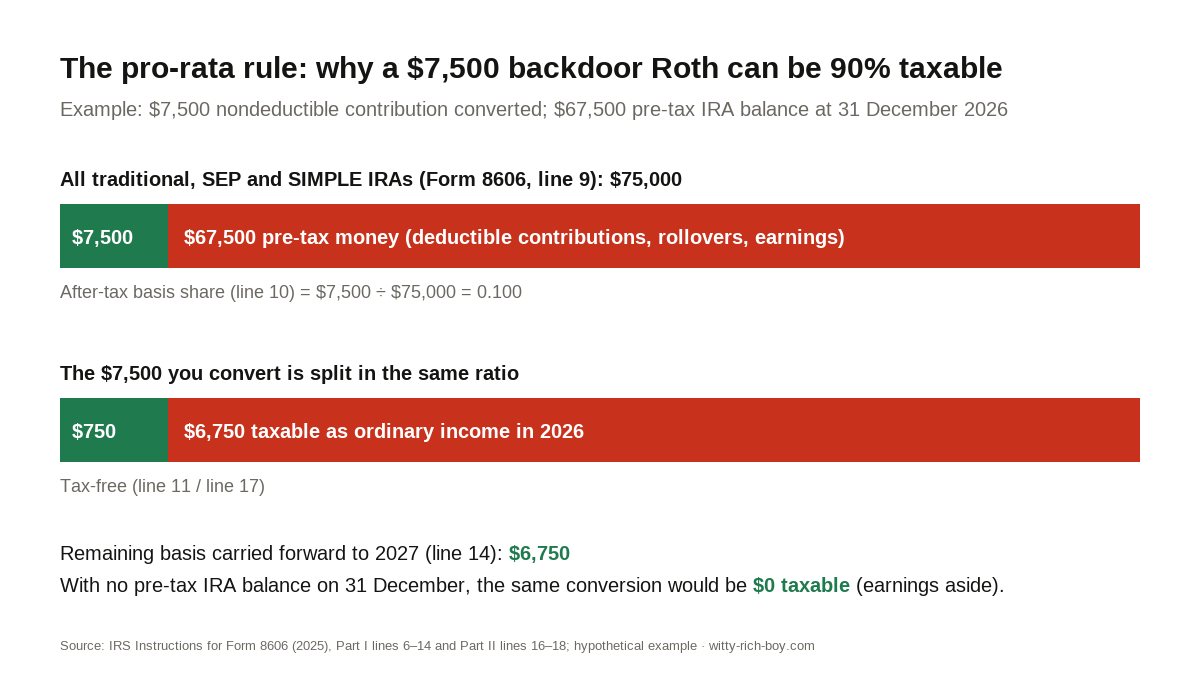
- The pro-rata rule counts every traditional, SEP and SIMPLE IRA balance on 31 December: with $67,500 of pre-tax money, 90% of a $7,500 conversion is taxable.
In force: 1 January 2026 (2026 limits under IRS Notice 2025-67) · 15 April 2027 (last day for 2026 contributions)
For 2026, you can contribute the full $7,500 to a Roth IRA ($8,600 from age 50) if your modified AGI is below $153,000 as a single filer or $242,000 filing jointly. The limit shrinks across a phase-out range and reaches zero at $168,000 and $252,000. Married people filing separately phase out between $0 and $10,000.
A Roth IRA is the most generous wrapper in the American tax code: contributions go in after tax, but qualified withdrawals — growth included — come out tax-free. Congress pays for that generosity by fencing off high earners. Each autumn the IRS moves the fences with inflation, and for 2026 they moved by $3,000 for single filers and $6,000 for couples. Below: the new ranges against 2025, the exact formula the IRS uses inside the range with worked numbers, and the two-step “backdoor” for those above it — including the pro-rata trap that catches most people who try it.
What are the Roth IRA income limits for 2026?
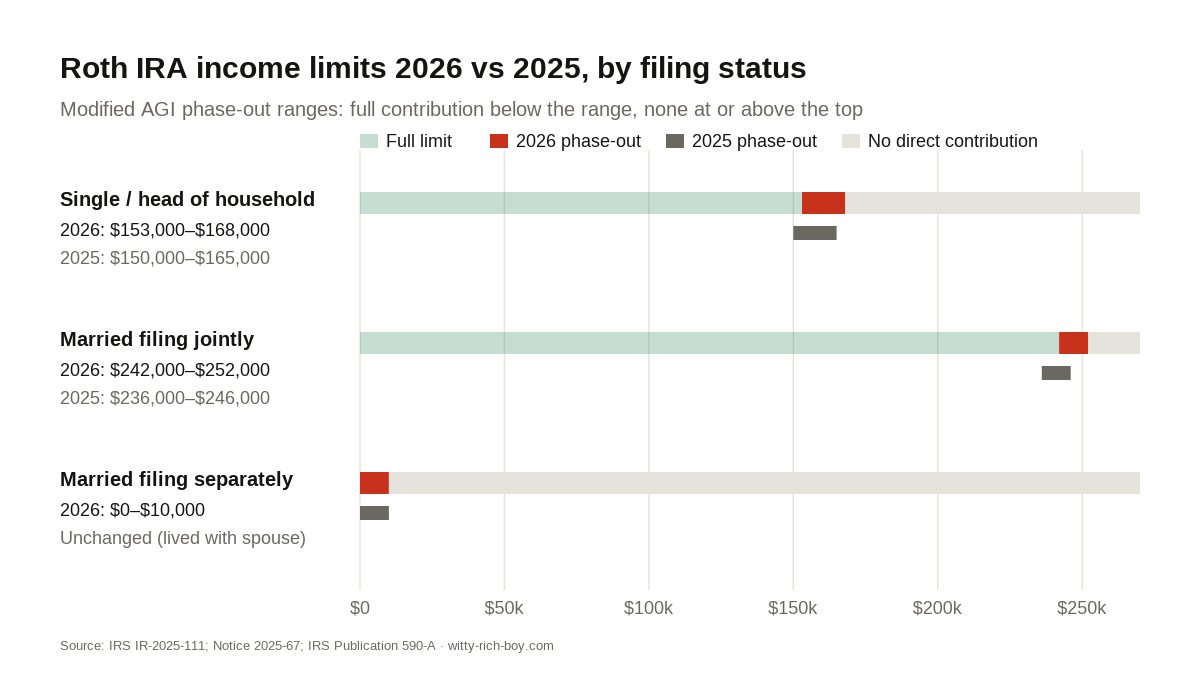
The 2026 Roth IRA income limits are $153,000–$168,000 of modified AGI for single and head-of-household filers and $242,000–$252,000 for married couples filing jointly, according to IRS news release IR-2025-111 and Notice 2025-67. Below the lower figure you can contribute in full; at or above the upper figure you cannot contribute directly at all.
The mechanism sits in 26 U.S.C. § 408A(c)(3). A phase-out range is the band of income across which your allowed contribution falls from the full limit to zero. The statute fixes its width — $15,000 for single filers, $10,000 for joint filers and married filing separately — and indexes the starting points to inflation.
| Filing status | 2025 phase-out (MAGI) | 2026 phase-out (MAGI) | Change |
|---|---|---|---|
| Single, head of household, married filing separately (did not live with spouse) | $150,000–$165,000 | $153,000–$168,000 | +$3,000 |
| Married filing jointly, qualifying surviving spouse | $236,000–$246,000 | $242,000–$252,000 | +$6,000 |
| Married filing separately (lived with spouse at any time in the year) | $0–$10,000 | $0–$10,000 | Not indexed |
A married person filing separately who did not live with their spouse at any time during the year is treated as single for this test, per IRS Publication 590-A. And the separate-return range is not adjusted for inflation: anyone who lived with their spouse and files separately loses the Roth contribution entirely at $10,000 of modified AGI.
How much can you contribute to a Roth IRA in 2026?
The 2026 IRA contribution limit is $7,500, up from $7,000 in 2025, plus a catch-up of $1,100 for anyone aged 50 or over by the end of the year — $8,600 in total. The catch-up rose from $1,000 because the SECURE 2.0 Act of 2022 added an annual cost-of-living adjustment to it, according to IR-2025-111.
Three limits stack on top of one another:
- The dollar limit — $7,500 or $8,600 — is a single combined limit across all your traditional and Roth IRAs, according to the IRS “Retirement topics — IRA contribution limits” page. Contributing $3,000 to a traditional IRA leaves $4,500 of Roth room.
- Taxable compensation caps it. Someone earning $5,000 can contribute only $5,000. Wages, salaries and self-employment income count; interest, dividends and capital gains do not. A spouse with little or no income can contribute on the strength of a joint return.
- The income phase-out then reduces the Roth share if modified AGI falls inside the range.
There is no age ceiling: Publication 590-A confirms you can contribute to a Roth IRA at any age, provided you have compensation.
How is the reduced Roth IRA contribution calculated?
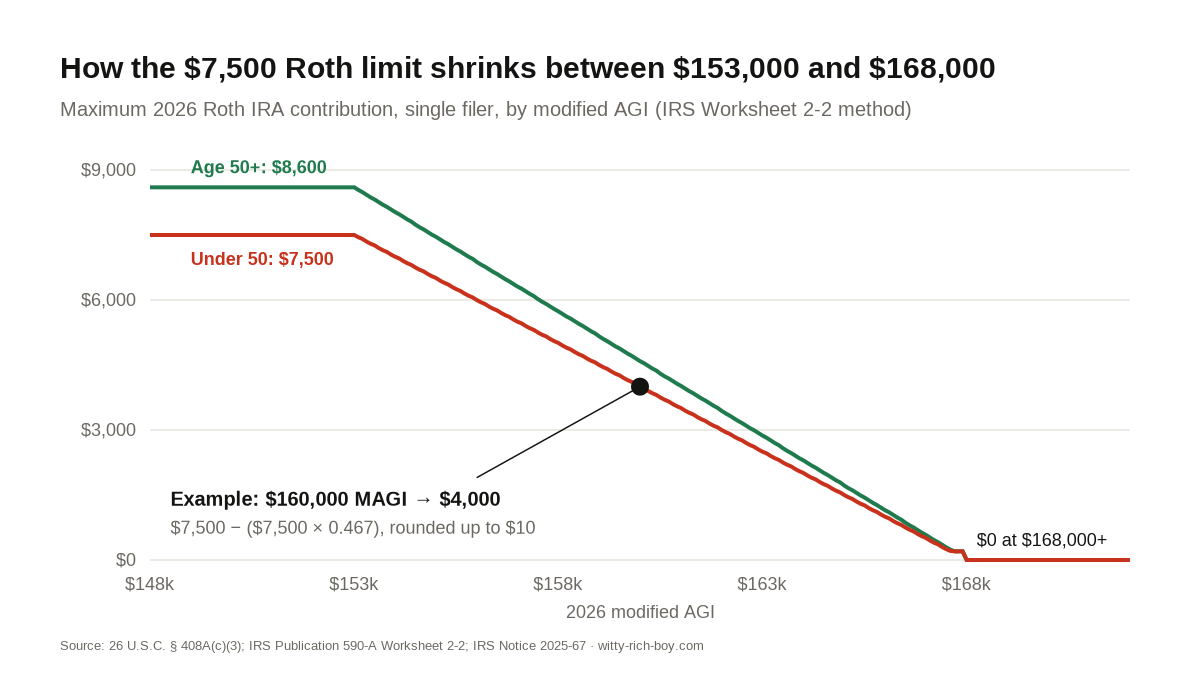
Inside the phase-out range, your reduced contribution limit equals your full limit minus a proportion of it. That proportion is how far your modified AGI sits into the range, divided by the width of the range. Section 408A(c)(3)(A) puts it in words; Publication 590-A Worksheet 2-2 turns it into arithmetic:
Reduced limit = Full limit − Full limit × (MAGI − lower threshold) ÷ range width
The worksheet adds two rules from Treasury Regulation § 1.408A-3. First, the ratio is taken to at least three decimal places, and the result is rounded up to the next multiple of $10. Second, if the answer is above zero but below $200, you may contribute $200. The limit only reaches zero at the top of the range.
Worked example: a single filer at $160,000
Example: Maya is 40, files as single and has 2026 modified AGI of $160,000. She has made no traditional IRA contributions this year.
| Worksheet step | Calculation | Result |
|---|---|---|
| Amount above the lower threshold | $160,000 − $153,000 | $7,000 |
| Ratio (at least 3 decimals) | $7,000 ÷ $15,000 | 0.467 |
| Full limit | Under 50, ample compensation | $7,500 |
| Reduction | $7,500 × 0.467 | $3,502.50 |
| Before rounding | $7,500 − $3,502.50 | $3,997.50 |
| Reduced Roth limit | Rounded up to $10 | $4,000 |
At 52, with the same income, Maya’s full limit is $8,600: the reduction is $4,016.20 and her Roth limit becomes $4,590.
Quick reference: 2026 reduced limits at common incomes
| Filing status | 2026 MAGI | Limit under 50 | Limit at 50+ |
|---|---|---|---|
| Single | $155,000 | $6,510 | $7,460 |
| Single | $160,000 | $4,000 | $4,590 |
| Single | $165,000 | $1,500 | $1,720 |
| Single | $167,900 | $200 (floor) | $200 (floor) |
| Married filing jointly | $244,000 | $6,000 | $6,880 |
| Married filing jointly | $247,000 | $3,750 | $4,300 |
| Married filing jointly | $249,500 | $1,880 | $2,150 |
| Either | At or above top of range | $0 | $0 |
Each spouse on a joint return applies the formula to their own limit, so a couple at $247,000 could put $3,750 each into Roth IRAs — $7,500 between them. To run the same worksheet on your own figures, use our Roth IRA contribution calculator.
What counts as modified AGI for a Roth IRA?
Modified adjusted gross income (MAGI) for Roth purposes is your adjusted gross income from Form 1040 with a few items stripped out or added back. Publication 590-A Worksheet 2-1 sets it out. You subtract any income from converting a traditional IRA to a Roth IRA, or from rolling a workplace plan into one — so a large conversion does not by itself push you out of the contribution range. You then add back items that reduced your AGI, including the foreign earned income exclusion, the student loan interest deduction and excluded employer-provided adoption benefits.
Because the test starts from AGI, pre-tax contributions to a workplace 401(k) — which never reach your AGI — lower your Roth MAGI dollar for dollar. With the 401(k) contribution limit for 2026 at $24,500, that can be enough to pull a single filer from the top of the phase-out range back below $153,000. Contributions within the HSA contribution limit for 2026 work the same way, because they too are excluded from wages or deducted above the line.
What happens if you go over the Roth IRA income limit?
If you contribute more than your limit — often because a bonus arrives in December — the excess is subject to a 6% excise tax for every year it remains in the account, under 26 U.S.C. § 4973, reported on Form 5329. The tax is capped at 6% of the account’s value at year-end, but it recurs annually until the excess is fixed.
There are three ways out, all set out in Publication 590-A:
- Withdraw it in time. Take the excess and its earnings out by the due date of your return, including extensions. The contribution is then treated as never made; the earnings are taxable in the year of the contribution.
- Recharacterize it. Move the contribution, with its earnings, into a traditional IRA by the same deadline. It is then treated as a traditional contribution from the start — often the first step of a backdoor Roth.
- Absorb it. Treat the excess as part of a later year’s contribution, if you are eligible that year. The 6% still applies for each year it stayed in place.
Note the asymmetry: since 2018, conversions to a Roth IRA can no longer be recharacterized, per Publication 590-A. Annual contributions still can.
How does a backdoor Roth IRA work?
A backdoor Roth IRA is the informal name for making a nondeductible contribution to a traditional IRA and then converting it to a Roth IRA. It works because the income limits apply only to direct contributions. Since 2010 there has been no income or filing-status condition on conversions, according to IRS Publication 590-B. The term appears nowhere in the code; the steps do.
Earners above the 2026 ranges who also have a workplace retirement plan usually cannot deduct a traditional IRA contribution either: IR-2025-111 puts the 2026 deduction phase-out for covered single filers at $81,000–$91,000 and for covered joint filers at $129,000–$149,000. The contribution is therefore made after tax, creating basis — money that has already been taxed and should not be taxed again on conversion.
How to do a backdoor Roth IRA for 2026, step by step
- Check your IRA balances first. Add up every traditional, SEP and SIMPLE IRA you own. If any hold pre-tax money, read the pro-rata section below before going further.
- Make a nondeductible traditional IRA contribution of up to $7,500 ($8,600 at 50+) for 2026, no later than 15 April 2027. You must have at least that much taxable compensation.
- Convert it to a Roth IRA.
- Collect Form 1099-R from your IRA provider, which reports the conversion as a distribution, and your year-end valuation statement — due by 31 January — showing each IRA’s value on 31 December.
- File Form 8606 with your return. Part I records the nondeductible contribution (line 1) and works out the taxable share of the conversion; Part II (lines 16–18) reports the conversion itself.
- Carry any leftover basis forward. Line 14 shows basis still sitting in your traditional IRAs; it feeds into next year’s Form 8606, line 2.
Form 8606 is not optional. The IRS instructions impose a $50 penalty for failing to file it when you make a nondeductible contribution and a $100 penalty for overstating nondeductible contributions, unless you can show reasonable cause.
How does the pro-rata rule tax a backdoor Roth?
The pro-rata rule means you cannot choose to convert only your after-tax dollars. For tax purposes, all your traditional, SEP and SIMPLE IRAs are treated as one pot, and every conversion or distribution carries a slice of basis in proportion to the whole. Form 8606 does the sum on lines 6 to 11.
Line 6 is the crucial number: the total value of all your traditional, SEP and SIMPLE IRAs on 31 December of the conversion year, plus outstanding rollovers. The test date is the end of the year, not the day you convert. Roth IRAs and workplace plans such as 401(k)s are not included.
Worked example: $67,500 of pre-tax money
Example: David contributes $7,500 nondeductible for 2026 and converts it in the same month. He also holds an old rollover IRA worth $67,500 of pre-tax money on 31 December 2026, and has no basis from earlier years.
| Form 8606 line | What it holds | Amount |
|---|---|---|
| Line 3 (basis) | 2026 nondeductible contribution | $7,500 |
| Line 6 | Traditional, SEP and SIMPLE IRA value on 31 Dec 2026 | $67,500 |
| Line 8 | Net amount converted in 2026 | $7,500 |
| Line 9 | Line 6 + line 7 + line 8 | $75,000 |
| Line 10 | Line 5 ÷ line 9 (not above 1.000) | 0.100 |
| Line 11 / 17 | Tax-free part of conversion: $7,500 × 0.100 | $750 |
| Line 18 | Taxable conversion income | $6,750 |
| Line 14 | Basis carried forward to 2027 | $6,750 |
Ninety per cent of the conversion is taxable. The basis is not lost — $6,750 carries forward and will shelter future conversions or withdrawals — but the tax is due now. Had David held no pre-tax IRA money on 31 December, line 10 would be 1.000 and the conversion would be tax-free apart from any earnings.
Are there other Roth IRA rules to know in 2026?
Yes — two timing rules matter as much as the income limits.
The conversion five-year rule. Each conversion starts its own five-year clock, beginning on 1 January of the year of conversion. Withdraw the taxable part of a conversion within that window while under 59½ and a 10% additional tax may apply to it, according to Publication 590-B.
Gains inside the account are not taxed as they happen. Selling or swapping one investment for another inside an IRA does not create a taxable event, unlike the same trade in an ordinary brokerage account — compare how crypto-to-crypto swaps are taxed outside a tax-advantaged account. Other countries take a different route: the UK achieves something similar through its tax-free wrapper with an annual cap, explained in our guide to the ISA allowance, while UK crypto tax and German crypto tax show what happens to gains held outside any wrapper. Canada’s TFSA is the closest cousin of the Roth IRA — after-tax money in, tax-free withdrawals out — but has no income test; see our guide to the TFSA contribution limit for 2026.
Roth IRA vs traditional IRA: which income limits apply?
The Roth IRA and traditional IRA share the same $7,500 contribution limit but use income in opposite ways. Anyone with compensation can contribute to a traditional IRA; income decides only whether the contribution is deductible. For a Roth IRA, income decides whether you can contribute at all.
| Feature (2026) | Roth IRA | Traditional IRA |
|---|---|---|
| Contribution limit | $7,500 ($8,600 at 50+), shared | $7,500 ($8,600 at 50+), shared |
| Income cap on contributing | Yes — phase-out from $153,000 / $242,000 | None |
| Income test on deduction | No deduction | Phases out at $81,000–$91,000 single, $129,000–$149,000 joint, if covered by a workplace plan |
| Tax on qualified withdrawals | None | Taxed as ordinary income |
| Conversion to Roth | — | Allowed at any income |
The practical consequence: above the Roth range, a traditional contribution is usually still possible but nondeductible — exactly the raw material for the backdoor.
Questions readers ask
What is the income limit for a Roth IRA in 2026?
For 2026, single and head-of-household filers can make a full Roth IRA contribution with modified AGI below $153,000, a reduced one between $153,000 and $168,000, and none at $168,000 or more. Married couples filing jointly phase out between $242,000 and $252,000. Married people filing separately who lived with their spouse phase out between $0 and $10,000.
How much can I put in a Roth IRA in 2026?
The 2026 limit is $7,500, or $8,600 if you are 50 or older by the end of the year, thanks to a $1,100 catch-up. It is a combined limit across all your traditional and Roth IRAs, and it can never exceed your taxable compensation for the year. If your income falls in the phase-out range, your Roth share is reduced further.
Can I contribute to a Roth IRA if I earn $200,000?
It depends on filing status. A single filer with $200,000 of modified AGI in 2026 is above the $168,000 ceiling and cannot contribute directly. A married couple filing jointly with $200,000 is below $242,000 and can each contribute the full $7,500, provided the couple has enough taxable compensation. Over the limit, many people use the backdoor route instead.
Is the backdoor Roth IRA legal?
The term is informal, but each step rests on statute. Anyone with taxable compensation can make a nondeductible traditional IRA contribution, and since 2010 there has been no income or filing-status condition on converting a traditional IRA to a Roth IRA. The IRS expects both steps to be reported on Form 8606, where the pro-rata rule decides how much of the conversion is taxable.
What happens if I contribute too much to a Roth IRA?
The excess is taxed at 6% for every year it stays in the account under § 4973, reported on Form 5329. You avoid the tax by withdrawing the excess and its earnings by your return's due date, including extensions; the earnings are taxable. Alternatively, you can recharacterize the contribution as a traditional IRA contribution before that deadline.
What counts as modified AGI for Roth IRA purposes?
Start with the adjusted gross income on Form 1040, subtract any income from converting a traditional IRA or rolling a plan into a Roth IRA, then add back items such as the foreign earned income exclusion, the student loan interest deduction and excluded adoption benefits. IRS Publication 590-A Worksheet 2-1 sets out every line.
When is the deadline for 2026 Roth IRA contributions?
You can contribute for 2026 at any time from 1 January 2026 until the due date of your 2026 return, not including extensions — 15 April 2027 for most people. Tell your IRA provider which year the contribution is for if you make it between January and April 2027. Conversions, by contrast, count in the calendar year they happen.
Do Roth IRA income limits apply to conversions?
No. The income limits restrict only direct annual contributions. Since 2010 anyone can convert a traditional, SEP or SIMPLE IRA to a Roth IRA regardless of income or filing status. The converted pre-tax amount is added to your income for the year, but it is excluded from modified AGI when testing your Roth contribution eligibility.
Was this guide useful?
Thanks — your answer helps us decide what to cover next.
Sources
- 401(k) limit increases to $24,500 for 2026, IRA limit increases to $7,500 — IR-2025-111 (IRS)
- Notice 2025-67: 2026 amounts relating to retirement plans and IRAs (IRS)
- Retirement topics — IRA contribution limits (IRS)
- Publication 590-A (2025), Contributions to Individual Retirement Arrangements (IRS)
- Publication 590-B (2025), Distributions from Individual Retirement Arrangements (IRS)
- Instructions for Form 8606 (2025), Nondeductible IRAs (IRS)
- 26 U.S. Code § 408A — Roth IRAs (Cornell LII)
- 26 CFR § 1.408A-3 — Contributions to Roth IRAs (Cornell LII)
- 26 U.S. Code § 4973 — Tax on excess contributions (Cornell LII)
General information, not tax or legal advice. Rules change — check the official source or a licensed adviser before acting.