HSA Contribution Limit (2026): $4,400 Self-Only, $8,750 Family
The HSA contribution limit for 2026 is $4,400 self-only or $8,750 family, plus $1,000 from age 55. HDHP rules, new bronze-plan eligibility and the 2027 limits.

The short answer
- The 2026 HSA contribution limit is $4,400 for self-only HDHP coverage and $8,750 for family coverage, up from $4,300 and $8,550 (Rev. Proc. 2025-19).
- Account holders aged 55 or over by year-end can add a $1,000 catch-up, which is fixed in § 223(b)(3) and not indexed for inflation.
- A 2026 HDHP needs a deductible of at least $1,700 (self-only) or $3,400 (family) and out-of-pocket costs capped at $8,500 or $17,000.
- From 2026, bronze and catastrophic marketplace plans count as HSA-compatible, and direct primary care fees of up to $150 a month ($300 for a family) no longer block contributions (Notice 2026-5).
- Contributing through a cafeteria plan saves income tax and 7.65% FICA: about $1,305 on $4,400 at a 22% bracket.
- The 2027 limits are already set at $4,500 and $9,000 (Rev. Proc. 2026-24); 2026 contributions are allowed until 15 April 2027.
In force: 1 January 2026 (2026 limits under Rev. Proc. 2025-19; bronze, catastrophic and direct primary care rules under Notice 2026-5) · 15 April 2027 (last day for 2026 contributions) · 1 January 2027 (2027 limits under Rev. Proc. 2026-24)
The HSA contribution limit for 2026 is $4,400 with self-only high-deductible health plan coverage and $8,750 with family coverage, up from $4,300 and $8,550. Savers aged 55 or over can add a $1,000 catch-up. A qualifying plan needs a deductible of at least $1,700, or $3,400 for families.
The health savings account is a rare thing in the American tax code: deductible going in, untaxed while it grows and untaxed coming out — provided the money is spent on medical care. That generosity is why the IRS polices eligibility so closely. Below: the 2025–2027 limits, the plans that newly qualify under the One Big Beautiful Bill Act, the tax saving at 22% and 24%, the last-month rule, an HSA vs FSA table and how to unwind an over-contribution.
What is the HSA contribution limit for 2026?
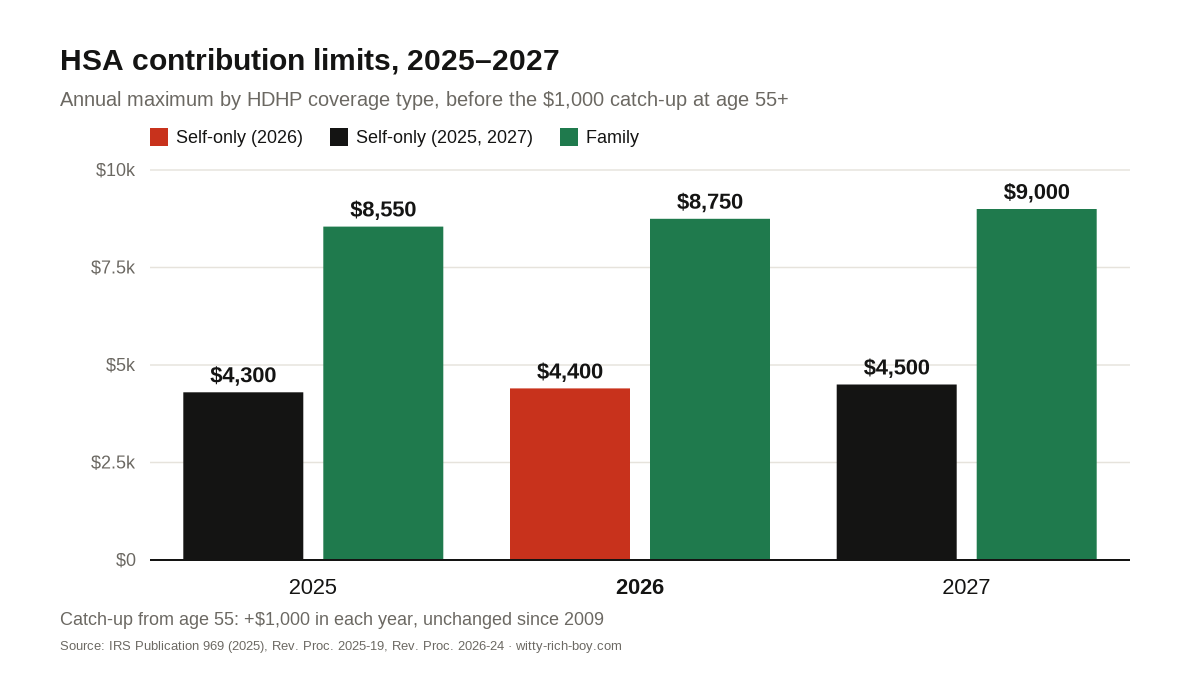
The 2026 limit is $4,400 for an individual with self-only coverage under a high-deductible health plan and $8,750 for family coverage, according to Rev. Proc. 2025-19, which sets the annual deduction limits under 26 U.S.C. § 223(b)(2). A health savings account (HSA) is a tax-exempt trust or custodial account you own, used to pay qualified medical expenses for yourself, your spouse and your dependants. Self-only coverage insures only you; family coverage is any HDHP covering you and at least one other person.
The limit covers every source combined: your deposits, payroll deductions and employer money. The catch-up contribution of $1,000 for anyone aged 55 or over by the end of the year is written into § 223(b)(3), is not indexed for inflation and has stayed at $1,000 since 2009.
| Limit | 2025 | 2026 | 2027 |
|---|---|---|---|
| HSA contribution, self-only | $4,300 | $4,400 | $4,500 |
| HSA contribution, family | $8,550 | $8,750 | $9,000 |
| Catch-up, age 55+ | $1,000 | $1,000 | $1,000 |
| HDHP minimum deductible, self-only | $1,650 | $1,700 | $1,750 |
| HDHP minimum deductible, family | $3,300 | $3,400 | $3,500 |
| HDHP out-of-pocket maximum, self-only | $8,300 | $8,500 | $8,700 |
| HDHP out-of-pocket maximum, family | $16,600 | $17,000 | $17,400 |
Sources: IRS Publication 969 (2025); Rev. Proc. 2025-19 (2026); Rev. Proc. 2026-24 (2027).
HSA limits for married couples
If either spouse has family HDHP coverage, Publication 969 treats both as having family coverage. The couple then share one $8,750 limit, split equally unless they agree a different division. Catch-ups are personal: each spouse aged 55 or over can add $1,000, but only into an HSA in their own name. Two spouses over 55 can therefore put in $10,750 between them, but only by using two accounts.
What counts as an HSA-eligible health plan in 2026?
You can contribute for any month in which, on the first day of the month, you are covered by a high-deductible health plan, have no other disqualifying health coverage, are not enrolled in Medicare and cannot be claimed as someone else’s dependant. That is the eligibility test in Publication 969.
A high-deductible health plan (HDHP) is, for 2026, a plan with an annual deductible of at least $1,700 for self-only coverage or $3,400 for family coverage, and out-of-pocket costs — deductibles, co-payments and other amounts, excluding premiums — capped at $8,500 or $17,000.
Disqualifying coverage is any other health plan that pays benefits before the HDHP deductible is met. The most common trap is a spouse’s general-purpose health FSA, which counts as coverage for you as well. A limited-purpose FSA or HRA that pays only for dental and vision care does not disqualify you.
Medicare ends contributions entirely. Publication 969 says your limit is zero from the first month you are enrolled, and retroactive Medicare coverage turns contributions made during that period into excess contributions. Anyone applying for Medicare after 65 should therefore stop deposits before the date their coverage is backdated to.
What changed for HSAs in 2026 under the One Big Beautiful Bill Act?
Three changes in Public Law 119-21, the reconciliation act known as the One Big Beautiful Bill Act, widen who can contribute from 2026. The IRS explained them in Notice 2026-5, announced in its 9 December 2025 news release.
| Change | What it does | Effective |
|---|---|---|
| Bronze and catastrophic plans | Treated as HDHPs if available as individual coverage through an Exchange, even if the deductible or out-of-pocket limit would not otherwise qualify | Months beginning after 31 December 2025 |
| Direct primary care | Enrolment in a qualifying arrangement no longer blocks contributions; HSA money can pay the fees | Months beginning after 31 December 2025 |
| Telehealth safe harbour | Pre-deductible telehealth and other remote care permanently allowed | Plan years beginning after 31 December 2024 |
Bronze and catastrophic plans. Many bronze-tier marketplace plans used to fail the HDHP test on their out-of-pocket limits; they now qualify automatically. According to Notice 2026-5, an off-Exchange plan counts too if the same plan is offered on an Exchange.
Direct primary care. A direct primary care service arrangement (DPCSA) gives access to a primary care practice for a fixed periodic fee. It qualifies only if that fee is the sole compensation for the care and does not exceed $150 a month for one person, or $300 for an arrangement covering more. Fees may be billed for up to a year at a time, so $1,800 a year for an individual fits. Rev. Proc. 2026-24 keeps both caps unchanged for 2027.
Telehealth. The pandemic-era rule letting an HDHP cover telehealth before the deductible is now permanent, retroactive to plan years beginning after 31 December 2024. It does not extend to in-person services, equipment or drugs provided alongside a remote visit.
How much tax does an HSA save?
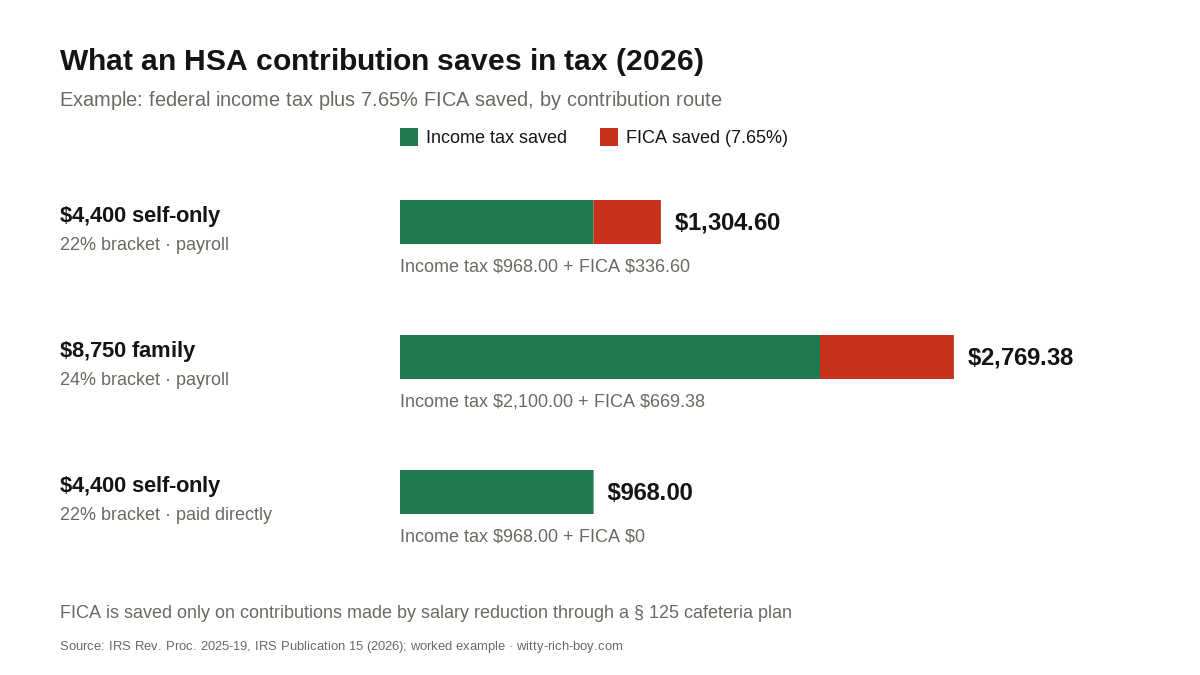
An HSA saves federal income tax at your marginal rate on every dollar contributed, and — when contributions go through an employer’s cafeteria plan under § 125 — the 7.65% employee share of Social Security and Medicare tax as well. Publication 15 says HSA contributions made by salary reduction through a cafeteria plan are not wages for employment tax purposes.
This is the triple tax advantage: contributions reduce taxable income, growth inside the account is not taxed, and withdrawals for qualified medical expenses are tax-free.
| Example: 2026 contribution | Bracket | Income tax saved | FICA saved (7.65%) | Total saved |
|---|---|---|---|---|
| $4,400 self-only, via payroll | 22% | $968.00 | $336.60 | $1,304.60 |
| $4,400 self-only, via payroll | 24% | $1,056.00 | $336.60 | $1,392.60 |
| $8,750 family, via payroll | 22% | $1,925.00 | $669.38 | $2,594.38 |
| $8,750 family, via payroll | 24% | $2,100.00 | $669.38 | $2,769.38 |
| $4,400 self-only, paid in directly | 22% | $968.00 | $0 | $968.00 |
Example: Priya, single and in the 22% bracket, elects $4,400 of HSA payroll deductions for 2026. Her wages fall by $4,400 for income tax and FICA alike, saving $1,304.60 — almost 30% of the contribution before any growth. Paying the same amount in directly would earn the Form 8889 deduction but no FICA saving: $968.
Above the Social Security wage base only the 1.45% Medicare share is saved. The examples ignore state income tax.
What the growth is worth
Example: holding contributions flat at $4,400 a year for 20 years at an assumed 5% annual return produces about $145,000, of which $88,000 is contributions. Spent on medical bills, none of it is taxed. Non-medical withdrawals before 65 are taxed as income plus a 20% additional tax under § 223(f)(4); from 65 the 20% falls away, which makes an unused HSA behave much like a traditional IRA.
How are HSA contributions pro-rated if you join mid-year?
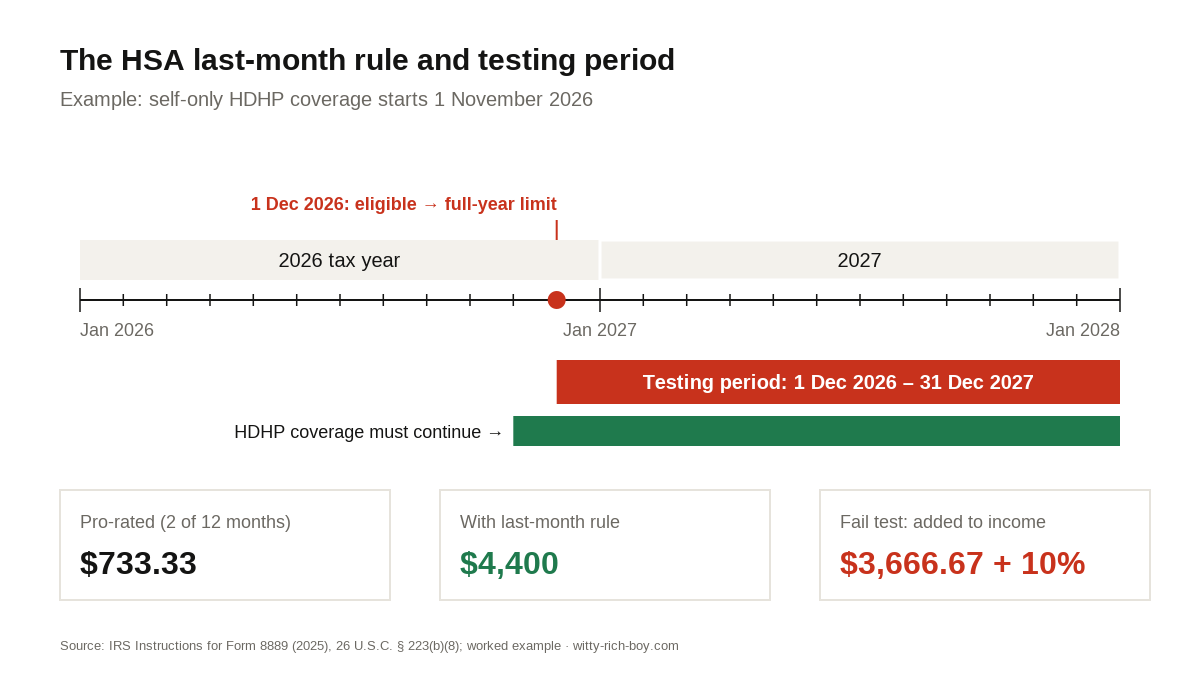
Normally your limit is pro-rated by month: one-twelfth of the annual figure for each month in which you were eligible on the first day. The last-month rule in § 223(b)(8) overrides that: if you are eligible on 1 December, you are treated as eligible for the whole year and can contribute the full amount.
The price is the testing period. According to the Instructions for Form 8889, it begins with the last month of the tax year and ends on the last day of the 12th month after it — for 2026, from 1 December 2026 to 31 December 2027. Leave HDHP coverage in that window for any reason other than death or disability, and the contributions that only the last-month rule allowed are added to your income and hit by a 10% additional tax, reported in Part III of Form 8889.
Example: Luis starts self-only HDHP coverage on 1 November 2026. Pro-rated, he could contribute two-twelfths of $4,400, or $733.33. Using the last-month rule he contributes $4,400. If he then moves to a non-HDHP plan in June 2027, $3,666.67 is added to his 2027 income and a 10% additional tax of $366.67 applies.
| Eligible from | Pro-rated 2026 limit (self-only) | With last-month rule | Testing period |
|---|---|---|---|
| 1 January 2026 | $4,400 | Not needed | None |
| 1 April 2026 | $3,300 | $4,400 | 1 Dec 2026 – 31 Dec 2027 |
| 1 November 2026 | $733.33 | $4,400 | 1 Dec 2026 – 31 Dec 2027 |
| 1 December 2026 | $366.67 | $4,400 | 1 Dec 2026 – 31 Dec 2027 |
If a job change or a switch to Medicare in 2027 is likely, the pro-rated amount is the safer figure.
HSA vs FSA: which is better in 2026?
An HSA is the better account for anyone who qualifies, because the money is yours, rolls over without limit and can be invested. A health flexible spending arrangement (FSA) is an employer plan funded from salary that anyone can join regardless of deductible, but it is built to be spent within the year. Rev. Proc. 2025-32 sets the 2026 health FSA salary-reduction limit at $3,400 and the maximum carryover at $680.
| 2026 feature | HSA | Health FSA |
|---|---|---|
| Who can open one | HDHP-covered, no other coverage, not on Medicare | Any employee whose employer offers one |
| Annual limit | $4,400 / $8,750 | $3,400 per employee |
| Catch-up | $1,000 from age 55 | None |
| Unused money | Rolls over indefinitely | Forfeited, except a carryover of up to $680 if the plan allows |
| Owned by | You — moves with you between jobs | Employer plan |
| Investment | Allowed, depending on the trustee | Not possible |
| Payroll FICA saving | Yes, via cafeteria plan | Yes |
| Non-medical use | Taxed, plus 20% before 65 | Not allowed |
You generally cannot have both: a general-purpose health FSA is disqualifying coverage. A limited-purpose FSA covering only dental and vision can sit alongside an HSA.
What happens if you contribute too much to an HSA?
An excess contribution — anything above your limit, including employer money — is not deductible and attracts a 6% excise tax under § 4973 for each year it remains in the account, according to Publication 969. The tax is calculated on Form 5329.
You avoid the 6% by withdrawing the excess and its earnings by the due date of your return, including extensions — 15 October 2027 for a 2026 return on extension. The earnings are reported as “other income” for the year you withdraw them.
Example: Ana, 41, with self-only coverage, receives $1,000 from her employer and pays in $3,600 herself. The $200 excess costs $12 a year if left alone; asking the trustee to remove it before her filing deadline costs only tax on its earnings.
How do you report HSA contributions on Form 8889?
You file Form 8889 with your Form 1040 for any year in which you or your employer contributed to an HSA, or you took money out. Part I works out your limit and deduction, Part II reports distributions and Part III adds income from failing the testing period.
Employer and payroll contributions appear in box 12 of Form W-2 with code W and are not deducted again; the trustee reports contributions on Form 5498-SA and withdrawals on Form 1099-SA. Personal contributions made directly to the trustee give rise to the deduction on line 13, which flows to Schedule 1 as an adjustment to income — available whether or not you itemise.
Because HSA contributions lower adjusted gross income, they also help with income-tested benefits. They reduce the modified AGI that decides eligibility under the Roth IRA income limits for 2026, and our Roth IRA contribution calculator shows the effect.
How to max out your HSA in 2026
- Confirm your plan is an HDHP — a deductible of at least $1,700 (self-only) or $3,400 (family), or a bronze or catastrophic plan available on an Exchange.
- Check for disqualifying coverage, including a spouse’s general-purpose FSA and any Medicare enrolment.
- Set your target: $4,400 or $8,750, plus $1,000 if you turn 55 by 31 December 2026, pro-rated if you join mid-year.
- Subtract employer contributions, which count towards the same limit.
- Contribute through payroll where possible to save 7.65% FICA as well as income tax.
- Top up directly by 15 April 2027 if payroll falls short, telling the trustee the deposit is for 2026.
- Invest the balance you do not need for near-term bills, and keep receipts for medical costs you pay out of pocket.
- File Form 8889 with your 2026 return and withdraw any excess before the deadline.
The HSA sits alongside, not inside, retirement limits. The 401(k) contribution limit for 2026 of $24,500 and the $7,500 IRA limit are separate, so a saver can fill all three. Canada’s TFSA contribution limit shows a tax-free wrapper with no health condition at all.
What are the HSA contribution limits for 2027?
The 2027 limits are $4,500 for self-only coverage and $9,000 for family coverage, set by Rev. Proc. 2026-24, which the IRS released in May 2026. The catch-up stays at $1,000. For 2027 an HDHP must have a deductible of at least $1,750 or $3,500, with out-of-pocket maximums of $8,700 and $17,400. The direct primary care caps remain $150 and $300 a month, and the excepted benefit HRA limit rises from $2,200 to $2,250.
Payroll elections made this autumn for 2027 should use the new figures; any 2026 top-up still runs on $4,400 and $8,750 until 15 April 2027.
Questions readers ask
What is the HSA contribution limit for 2026?
For 2026 you can contribute up to $4,400 to a health savings account if your high-deductible health plan covers only you, or $8,750 if it covers you and at least one other person. Anyone aged 55 or over by 31 December 2026 can add a $1,000 catch-up. Employer contributions, including payroll deductions, count towards the same limit.
What is the HSA limit for 2027?
The IRS published the 2027 figures in Rev. Proc. 2026-24 in May 2026. The limit rises to $4,500 for self-only coverage and $9,000 for family coverage, and the $1,000 catch-up from age 55 is unchanged. The HDHP minimum deductible rises to $1,750 and $3,500, and the out-of-pocket maximum to $8,700 and $17,400.
Are bronze plans HSA-eligible in 2026?
Yes. Under the One Big Beautiful Bill Act, and as explained in IRS Notice 2026-5, a bronze or catastrophic plan available as individual coverage through a health insurance Exchange is treated as a high-deductible health plan for months from January 2026, even if its deductible or out-of-pocket limit would not otherwise qualify. A plan bought off-Exchange also counts if the same plan is offered on an Exchange.
Can I contribute to an HSA for 2026 until April 2027?
Yes. Contributions for 2026 can be made at any time from 1 January 2026 until the due date of your 2026 return, without extensions — 15 April 2027 for most people. Tell your HSA trustee which year a January to April 2027 deposit is for. Payroll contributions, however, count in the year they are taken from your pay.
How do HSA limits work for married couples?
If either spouse has family HDHP coverage, both are treated as having family coverage, and the $8,750 family limit is shared between them, split equally unless they agree otherwise. Each spouse aged 55 or over can add $1,000, but only into an HSA in their own name, so a couple who are both over 55 need two accounts to put in $10,750.
What happens if I contribute too much to my HSA?
Excess contributions are not deductible and are hit by a 6% excise tax for every year they stay in the account, calculated on Form 5329. You avoid the tax by withdrawing the excess and its earnings by the due date of your return, including extensions. The earnings are reported as other income in the year you take them out.
Can I contribute to an HSA after I go on Medicare?
No. Publication 969 says your contribution limit is zero from the first month you are enrolled in Medicare, including any month covered retroactively. You can still spend the money already in the account tax-free on qualified medical expenses, and from age 65 non-medical withdrawals avoid the 20% additional tax, although they are taxed as ordinary income.
Is an HSA better than an FSA?
For someone eligible for both, an HSA is usually more flexible. Its 2026 limit is higher — $4,400 or $8,750 against $3,400 — the money rolls over every year, the account belongs to you when you change jobs, and balances can be invested. A health FSA is available without a high-deductible plan, but unused money is largely forfeited at year-end.
Was this guide useful?
Thanks — your answer helps us decide what to cover next.
Sources
- Rev. Proc. 2025-19: 2026 inflation-adjusted amounts for HSAs and HDHPs (IRS)
- Rev. Proc. 2026-24: 2027 inflation-adjusted amounts for HSAs, DPCSAs and excepted benefit HRAs (IRS)
- Notice 2026-5: Expansion of HSA availability and eligibility under the One, Big, Beautiful Bill (IRS)
- Treasury, IRS provide guidance on new tax benefits for health savings account participants under the One, Big, Beautiful Bill (IRS)
- Publication 969 (2025), Health Savings Accounts and Other Tax-Favored Health Plans (IRS)
- Instructions for Form 8889 (2025), Health Savings Accounts (IRS)
- Rev. Proc. 2025-32: 2026 inflation adjustments including the health FSA limit (IRS)
- Publication 15 (2026), (Circular E), Employer's Tax Guide (IRS)
General information, not tax or legal advice. Rules change — check the official source or a licensed adviser before acting.