Canada · Tax
TFSA Contribution Limit 2026: $7,000 a Year, $109,000 Total
TFSA contribution limit 2026: $7,000, taking total room since 2009 to $109,000. Year-by-year table, the 1%-a-month over-contribution tax and TFSA vs RRSP.
The short answer
- The TFSA dollar limit for 2026 is $7,000, the same as in 2024 and 2025; it was added to everyone's contribution room on 1 January 2026.
- Someone eligible every year since 2009 who has never contributed has $109,000 of cumulative TFSA room in 2026 — the sum of eighteen annual limits from $5,000 to $10,000.
- An excess TFSA amount is taxed at 1% of the highest excess in each month under Income Tax Act s. 207.02: a $5,000 excess left for six months costs $300.
- Withdrawals come back as room only on 1 January of the next year; re-depositing them in the same year without spare room creates an excess.
- The 2026 RRSP dollar limit is $33,810 (18% of 2025 earned income, capped); an RRSP beats a TFSA only if your tax rate on withdrawal is lower than your rate when contributing.
In force: 1 January 2026 ($7,000 TFSA dollar limit added to contribution room) · 30 June of the following year (TFSA return due if you owe tax on an excess)
The TFSA contribution limit for 2026 is $7,000, the same as in 2024 and 2025. Anyone who has been 18 or older and resident in Canada since 2009 and has never contributed has $109,000 of room in 2026. Unused room carries forward, withdrawals return on 1 January the next year, and excess contributions are taxed at 1% a month.
A Tax-Free Savings Account (TFSA) is a registered account in which interest, dividends and capital gains are not taxed, either while they accumulate or when withdrawn. Contributions come from after-tax money and are not deductible. The annual limit has sat at $7,000 for three years, but what most Canadians need is their cumulative room — and what catches them out is the timing of re-contributions. Below: the year-by-year table since 2009, room by the year you turned 18, the 1%-a-month penalty in dollars, and the TFSA vs RRSP arithmetic.
What is the TFSA contribution limit for 2026?
The TFSA dollar limit for 2026 is $7,000, confirmed by the Canada Revenue Agency on its contribution-room pages and in its table of registered-plan limits. It was added to the contribution room of every eligible person on 1 January 2026.
The TFSA dollar limit is the amount of new room the government grants each year. It is the same for every holder, regardless of income — unlike the RRSP deduction limit, which is 18% of earned income, there is no link to earnings. Since 2016 it has been indexed to inflation and rounded to the nearest $500, which is why it moves in steps: $6,000 from 2019 to 2022, $6,500 in 2023, then $7,000 from 2024.
Three conditions decide whether you receive it, per the CRA’s Before you contribute to a TFSA:
- Age 18 or older. Room starts accruing in the calendar year you turn 18. In provinces and territories where the age of majority is 19, you may not be able to open an account until then, but the room from the year you turned 18 carries forward.
- Resident in Canada for at least part of the year. No room accrues for any calendar year in which you are non-resident for the entire year.
- A valid Social Insurance Number to open the account.
The 2027 limit, not yet listed on the CRA’s TFSA pages, will again follow inflation indexing.
How much TFSA room have you accumulated since 2009?
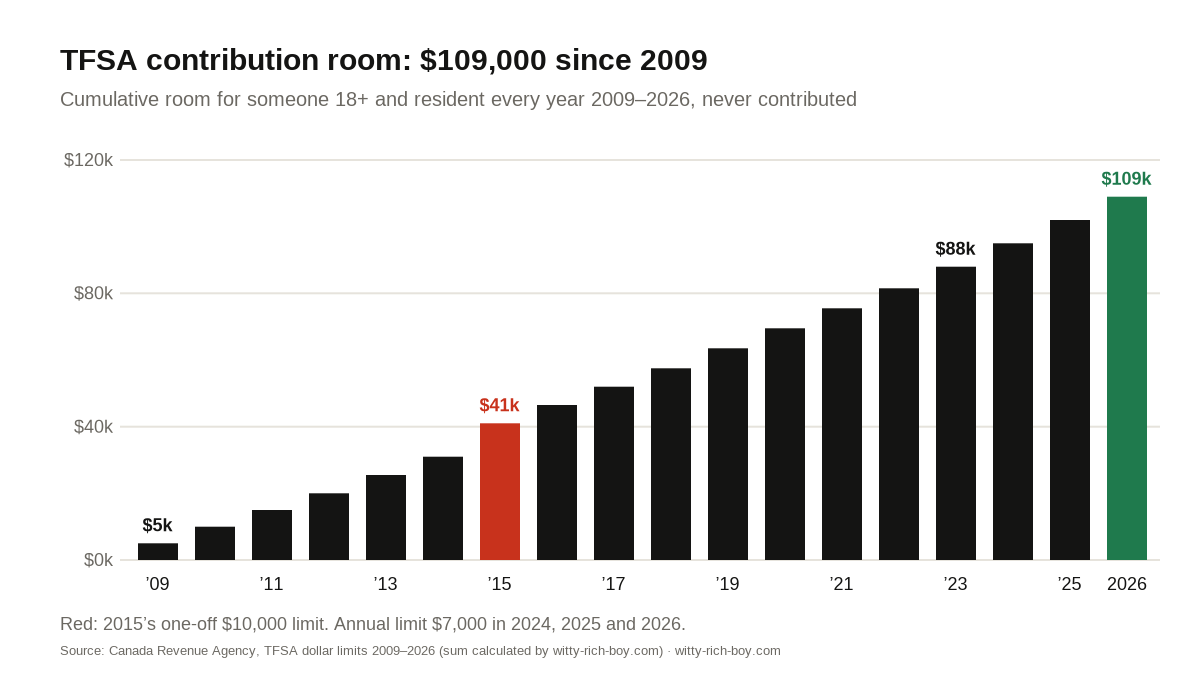
If you were eligible in every year since the TFSA began in 2009 and have never contributed, your total contribution room in 2026 is $109,000. The CRA publishes the annual limits; the running total below is our sum of those limits, checked line by line.
| Year | Annual TFSA limit | Cumulative room |
|---|---|---|
| 2009 | $5,000 | $5,000 |
| 2010 | $5,000 | $10,000 |
| 2011 | $5,000 | $15,000 |
| 2012 | $5,000 | $20,000 |
| 2013 | $5,500 | $25,500 |
| 2014 | $5,500 | $31,000 |
| 2015 | $10,000 | $41,000 |
| 2016 | $5,500 | $46,500 |
| 2017 | $5,500 | $52,000 |
| 2018 | $5,500 | $57,500 |
| 2019 | $6,000 | $63,500 |
| 2020 | $6,000 | $69,500 |
| 2021 | $6,000 | $75,500 |
| 2022 | $6,000 | $81,500 |
| 2023 | $6,500 | $88,000 |
| 2024 | $7,000 | $95,000 |
| 2025 | $7,000 | $102,000 |
| 2026 | $7,000 | $109,000 |
The outlier is 2015: Budget 2015 raised the limit to $10,000 without indexation, and from 2016 it returned to $5,500 with indexation reinstated. The 2015 room was not taken back.
Room by the year you turned 18
Most people did not become eligible in 2009. If you have been resident throughout and never contributed, your 2026 room is the sum of the limits from the year you turned 18:
| Turned 18 in | Born in | Total room in 2026 |
|---|---|---|
| 2009 or earlier | 1991 or earlier | $109,000 |
| 2010 | 1992 | $104,000 |
| 2012 | 1994 | $94,000 |
| 2015 | 1997 | $78,000 |
| 2018 | 2000 | $57,000 |
| 2020 | 2002 | $45,500 |
| 2023 | 2005 | $27,500 |
| 2026 | 2008 | $7,000 |
New residents follow a different start date: room begins in the year you become resident, not the year you turned 18. Someone aged 30 who moved to Canada in 2022 has accumulated the limits for 2022 to 2026 — $33,500 — not the full $109,000.
How is your TFSA contribution room calculated?
Your available room for a year is the current dollar limit, plus any unused room carried forward, plus the withdrawals you made in the previous year, minus the contributions you make during the year. The CRA sets this out on Calculate your TFSA contribution room. Four rules follow from it:
- Unused room never expires. If you contributed nothing for a decade, every dollar of room is still there.
- Withdrawals are added back next year, not immediately. Taking money out does not reduce the contributions you have already made in the year.
- Investment growth and losses do not change room. A loss is never added back: a $7,000 contribution that falls to $5,000 restores only $5,000 if withdrawn.
- Direct transfers between TFSAs are neutral. A qualifying transfer arranged between institutions does not count as a withdrawal or a contribution. Withdrawing cash yourself and depositing it at another institution does count — as both.
How to check your TFSA room before contributing in 2026
The room in your CRA account is a snapshot: institutions report a year’s TFSA transactions by the end of February of the next year, so 2026 activity is missing. The CRA says to rely on your own records. A five-minute check:
- Find your room at 1 January 2026. Use the tables above, subtract every contribution made before 2026 and add back every withdrawal made before 2026, or use Form RC343.
- List your 2026 contributions across all TFSAs. The limit is per person, not per account. Two accounts at two institutions share one room.
- Ignore your 2026 withdrawals. They come back on 1 January 2027, not before.
- Subtract. Room at 1 January minus 2026 contributions equals what you can still put in this year.
- Move money between institutions by direct transfer. Ask the receiving institution to arrange it; do not withdraw and redeposit.
What happens if you over-contribute to a TFSA?
An over-contribution creates an excess TFSA amount, which is taxed at 1% of the highest excess in each month it remains in the account. The charge comes from section 207.02 of the Income Tax Act: “if, at any time in a calendar month, an individual has an excess TFSA amount, the individual shall, in respect of that month, pay a tax … equal to 1% of the highest such amount in that month.” The excess itself is defined in s. 207.01(1).
Three features make the tax stricter than it first sounds:
- A single day counts as a month. The tax applies to the highest excess at any time in the month, so an excess that exists for one day in July is taxed for all of July.
- Partial withdrawals do not reduce that month’s charge. The CRA’s own example shows a $6,000 excess created in August, $4,000 of it withdrawn in mid-September and the rest in October: tax is $60 for August, $60 for September and $20 for October.
- It continues until fixed — until the excess is withdrawn or absorbed by new room on a later 1 January.
Deliberate over-contributions are treated differently: the CRA warns that excess amounts resulting from a deliberate over-contribution may be taxed at the 100% advantage rate. And the Minister may waive or cancel the 1% tax under s. 207.06(1) where the excess arose from a reasonable error and is withdrawn without delay.
Worked example: a $5,000 excess
Example: Maya had used all her TFSA room before 2026. On 1 January 2026 she gains $7,000 of room and contributes $7,000 in January. In April she withdraws $5,000 for a car repair. On 10 July she puts the $5,000 back, assuming the room has returned. It has not: she now has a $5,000 excess.
| Scenario A: withdraws on 28 Sept 2026 | Scenario B: leaves it in | |
|---|---|---|
| Months with an excess | July, August, September | July to December |
| Monthly tax (1% × $5,000) | $50 | $50 |
| Total tax | $150 | $300 |
| How the excess ends | Withdrawal | Absorbed on 1 Jan 2027, when the April withdrawal returns as room |
| TFSA return (RC243) due | 30 June 2027 | 30 June 2027 |
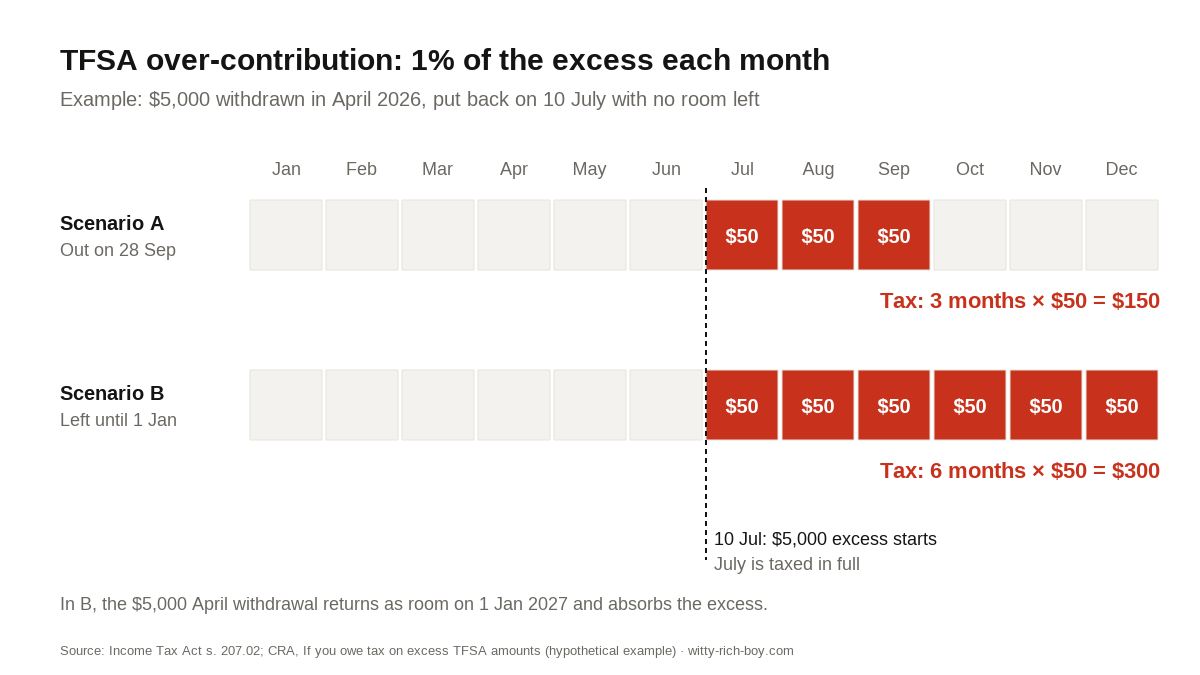
Two details matter. The part of a withdrawal that eliminates an excess is a qualifying portion and is not added back as room the following year, so Maya’s September withdrawal creates no fresh 2027 room. And she must still file: the CRA’s guidance on excess amounts says to withdraw the excess, complete Form RC243 Tax-Free Savings Account Return and Schedule A (RC243-SCH-A), and pay by 30 June of the year after the excess arose, even though the money is already out.
When can you put back money withdrawn from a TFSA?
You can re-contribute a TFSA withdrawal without penalty from 1 January of the following calendar year, or earlier only if you still have unused room in the current year. The CRA’s page Withdrawing from a TFSA puts it bluntly: unless you have unused room, do not re-contribute in the same year.
Example: Daniel has $20,000 of room on 1 January 2026.
| Date | Action | Room left in 2026 |
|---|---|---|
| February 2026 | Contributes $15,000 | $5,000 |
| May 2026 | Withdraws $12,000 | $5,000 (unchanged) |
| August 2026 | Can safely put back | $5,000 of the $12,000 |
| 1 January 2027 | $12,000 returns, plus the 2027 limit | $5,000 + $12,000 + 2027 limit |
Had Daniel redeposited all $12,000 in August, he would have created a $7,000 excess and owed $70 for every month it stayed in.
Do TFSA withdrawals count as income?
No. The CRA’s What is a TFSA page says income earned in a TFSA and withdrawals from it do not affect eligibility for federal income-tested benefits and credits, including Old Age Security, the Guaranteed Income Supplement, the Canada child benefit, the Canada workers benefit and the GST/HST credit. RRSP withdrawals, by contrast, are taxable income.
Non-residents may keep a TFSA, but no new room accrues for a full year of non-residency, and any contribution made while non-resident attracts a separate 1%-a-month tax until it is withdrawn or you return — on top of the excess tax if it also exceeds your room.
TFSA vs RRSP: which should you fill first?
The deciding factor is your marginal tax rate when you contribute compared with your rate when you withdraw. A Registered Retirement Savings Plan (RRSP) works in reverse to a TFSA: contributions are deductible up to your RRSP deduction limit for 2026, growth is sheltered, and withdrawals are taxed as income. The CRA’s Tax rates on withdrawals page sets withholding at 10% on amounts up to $5,000, 20% on withdrawals over $5,000 up to $15,000 and 30% on withdrawals over $15,000 (lower in Quebec), but the final tax depends on your marginal rate that year.
| Feature | TFSA (2026) | RRSP (2026) |
|---|---|---|
| New room for 2026 | $7,000 for every eligible adult | 18% of 2025 earned income, up to $33,810, minus pension adjustment |
| Contribution deductible? | No | Yes |
| Withdrawals taxed? | No | Yes, as income |
| Withdrawals restore room? | Yes, on 1 January of next year | No |
| Affects income-tested benefits? | No | Yes |
| Age limit | From 18, no upper limit | Must stop contributing by 31 December of the year you turn 71 |
| Over-contribution tax | 1% of highest monthly excess | Separate RRSP rules |
The arithmetic is symmetrical. Take $1,000 of pre-tax pay at a 30% marginal rate, invested until it doubles. Through a TFSA, you invest $700 after tax and withdraw $1,400 tax-free. Through an RRSP, you invest the full $1,000 (the deduction refunds the tax), it grows to $2,000, and you pay tax on the way out.
| Your marginal rate at withdrawal | RRSP after tax | TFSA after tax | Larger |
|---|---|---|---|
| 20% | $1,600 | $1,400 | RRSP |
| 30% (same as today) | $1,400 | $1,400 | Equal |
| 40% | $1,200 | $1,400 | TFSA |
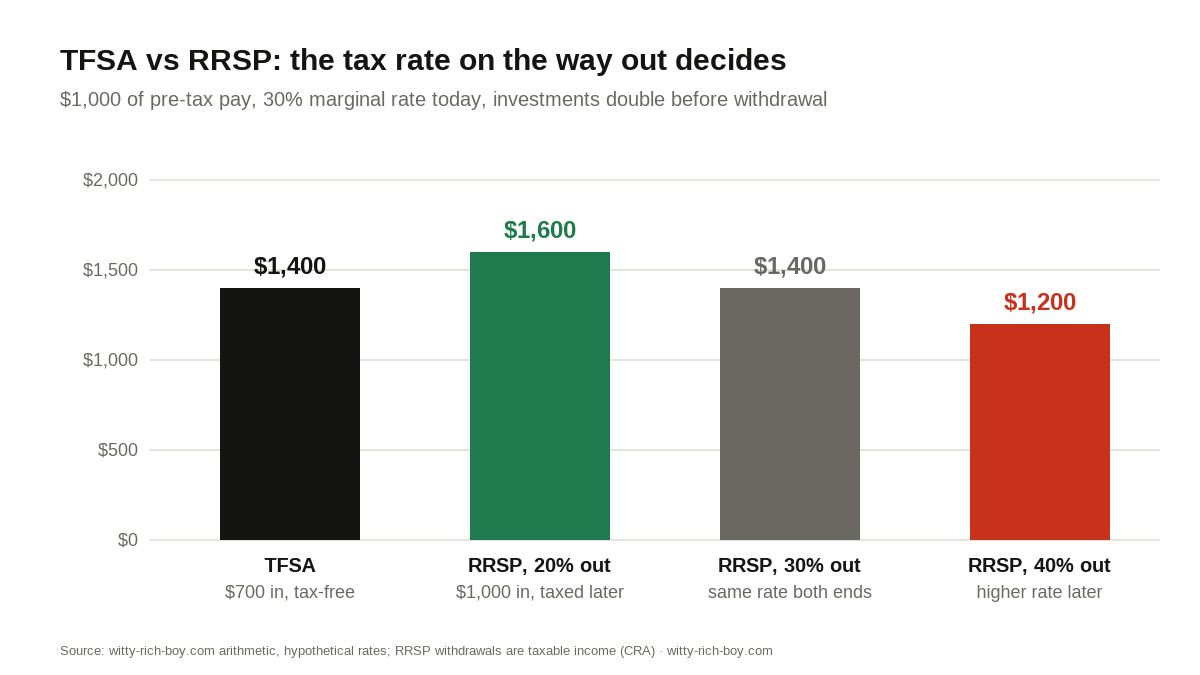
In practice, taxable RRSP withdrawals can also reduce income-tested benefits in retirement, while TFSA withdrawals return as room — which matters for money you may need early. These are mechanics, not recommendations.
How do TFSAs compare with tax-free accounts abroad?
The TFSA is unusually flexible. The UK’s ISA allowance of £20,000 a year is larger but cannot be carried forward — unused allowance is lost on 5 April — whereas TFSA room accumulates indefinitely. The US Roth IRA is closer in design (after-tax money in, tax-free out) but restricts who can contribute: see our guide to Roth IRA income limits for 2026. The TFSA has no income test at all. Australia takes the opposite approach to retirement saving: its super contribution caps for 2026-27 allow $32,500 a year before tax and $130,000 after tax, but the money is generally locked away until retirement.
Assets held outside any tax-free account are taxed under ordinary rules; for crypto that includes disposals many investors do not expect — see whether crypto-to-crypto swaps are taxable. In Canada, half of a capital gain on crypto is taxable and the 30-day superficial loss rule can deny losses, as our Canada crypto tax guide explains.
Key TFSA dates for 2026 and 2027
| Date | What happens |
|---|---|
| 1 January 2026 | 2026 dollar limit of $7,000 added; 2025 withdrawals return as room |
| 30 June 2026 | Deadline for the RC243 return and tax on any 2025 excess |
| 31 December 2026 | Last day for 2026 TFSA contributions to count against 2026 room |
| 1 January 2027 | 2026 withdrawals (minus any qualifying portion) and the 2027 limit added |
| 1 March 2027 | Last day of the RRSP contribution period for the 2026 tax year (first 60 days of 2027) |
| 30 June 2027 | RC243 return and tax due for any 2026 excess |
Three numbers sum up 2026: $7,000 of new room, $109,000 at most in total, and 1% a month on any excess.
Questions readers ask
What is the TFSA contribution limit for 2026?
The TFSA dollar limit for 2026 is $7,000, the same as for 2024 and 2025. The Canada Revenue Agency adds it to every eligible person's contribution room on 1 January. Your actual room for 2026 is that $7,000 plus any unused room from earlier years plus the withdrawals you made in 2025.
What is the total TFSA contribution room in 2026?
If you were at least 18 and resident in Canada in every year since 2009 and have never contributed, your total room in 2026 is $109,000. That figure is the sum of the annual limits from 2009 to 2026. If you turned 18 later, add only the limits from that year onwards — someone who turned 18 in 2015 has $78,000.
What happens if I over-contribute to my TFSA?
You pay a tax of 1% of the highest excess amount in each month the excess stays in the account, under section 207.02 of the Income Tax Act. A $5,000 excess costs $50 a month. You must withdraw the excess, file Form RC243 with Schedule A and pay the tax by 30 June of the following year. Deliberate over-contributions can be taxed far more heavily.
When can I re-contribute money I withdrew from my TFSA?
A withdrawal is added back to your contribution room on 1 January of the following calendar year. You can re-contribute earlier only if you still have unused room that year. Example: take out $4,000 in March 2026 with no room left, and you must wait until 1 January 2027 to put it back without creating an excess.
Does the CRA show my exact TFSA room?
Not always. Financial institutions report a year's TFSA transactions to the CRA by the end of February of the following year, so the room shown in your CRA account does not include contributions or withdrawals made in the current year. The CRA tells you to rely on your own records and offers Form RC343 as a worksheet.
Do TFSA withdrawals affect OAS or other benefits?
No. According to the CRA, income earned in a TFSA and amounts withdrawn from it are not included in income, so they do not affect eligibility for federal income-tested benefits and credits such as Old Age Security, the Guaranteed Income Supplement, the Canada child benefit and the GST/HST credit. RRSP withdrawals, by contrast, are taxable income.
Is it better to put money in a TFSA or an RRSP?
It depends mainly on tax rates. An RRSP contribution is deductible and withdrawals are taxed; a TFSA contribution is not deductible and withdrawals are tax-free. If your marginal rate at withdrawal will be lower than today, the RRSP leaves more after tax; if it will be higher, the TFSA does; if it is the same, they are equal.
Do I lose TFSA room if my investments fall in value?
Yes, in effect. The CRA says an investment loss inside a TFSA is not a withdrawal and is never added back as contribution room. If you contribute $7,000 and it falls to $5,000, withdrawing everything restores only $5,000 of room the next year. Gains work the other way: withdrawing a grown balance restores the larger amount.
Was this guide useful?
Thanks — your answer helps us decide what to cover next.
Sources
- Calculate your TFSA contribution room (Canada Revenue Agency)
- Before you contribute to a TFSA — eligibility and annual limits (Canada Revenue Agency)
- MP, DB, RRSP, DPSP, ALDA, TFSA limits, YMPE and the YAMPE (Canada Revenue Agency)
- Withdrawing from a TFSA (Canada Revenue Agency)
- If you owe tax on excess TFSA amounts (Canada Revenue Agency)
- Examples — tax payable on an excess TFSA amount (Canada Revenue Agency)
- Income Tax Act, section 207.02 — tax payable on excess TFSA amount (Justice Laws)
- What is a TFSA (Canada Revenue Agency)
- How non-residency affects your TFSA (Canada Revenue Agency)
- RRSP tax rates on withdrawals (Canada Revenue Agency)
General information, not tax or legal advice. Rules change — check the official source or a licensed adviser before acting.