Canada · Tax
RRSP Deduction Limit 2026: 18% of Income, Up to $33,810
RRSP deduction limit 2026: 18% of 2025 earned income up to $33,810, minus pension adjustment, plus unused room. Carry-forward, $2,000 buffer and HBP rules.
The short answer
- The RRSP dollar limit for 2026 is $33,810 (CRA limits table); your new room is the lesser of that and 18% of 2025 earned income, so the cap bites from $187,834 of income.
- Your deduction limit also adds every dollar of unused room since 1991 and subtracts your pension adjustment (T4 box 52) under Income Tax Act s. 146(1).
- Contributions more than $2,000 above your deduction limit are taxed at 1% a month, reported on Form T1-OVP.
- Contributions made by 1 March 2027, the 60th day of 2027, can be deducted for 2026; the 2027 dollar limit is already set at $35,390.
- The Home Buyers' Plan lets you withdraw up to $60,000 tax-free; for a first withdrawal in 2026 the CRA puts the first repayment year at 2031, with up to 15 years to repay.
In force: 2026 tax year ($33,810 RRSP dollar limit) · 1 March 2027 (last day of the first 60 days of 2027 for 2026 contributions) · 2027 tax year ($35,390 RRSP dollar limit)
The RRSP deduction limit for 2026 is 18% of your 2025 earned income, capped at the CRA's $33,810 dollar limit, minus any pension adjustment, plus all unused room carried forward. Contributions made up to 1 March 2027 count for 2026. Exceed your limit by more than $2,000 and you pay 1% a month.
A Registered Retirement Savings Plan (RRSP) is a tax-deferred retirement account: contributions are deducted from taxable income, investment growth is sheltered, and withdrawals are taxed as income. How much you can deduct is not a single national number but a personal figure, rebuilt every year from your earnings, your workplace pension and every year of room you have left unused. Below: the 2026 and 2027 dollar limits, the formula with worked numbers, a pension-adjustment example, a five-year carry-forward table, the $2,000 over-contribution buffer, the Home Buyers’ Plan repayment timeline and a decision table for RRSP, TFSA and FHSA money.
What is the RRSP deduction limit for 2026?
The RRSP dollar limit for 2026 is $33,810, up from $32,490 in 2025, according to the CRA’s table of MP, DB, RRSP, DPSP, ALDA, TFSA limits. The same table already fixes the 2027 figure at $35,390.
The dollar limit caps new room only. Your RRSP deduction limit — what you can actually deduct for 2026 — is personal: new room plus unused room from earlier years, minus pension-plan reductions.
Why $33,810? Under the definition of “RRSP dollar limit” in s. 146(1) of the Income Tax Act, the limit for a year equals the money purchase limit for registered pension plans for the preceding year. The 2025 money purchase limit was $33,810, so that becomes the 2026 RRSP dollar limit; the 2026 money purchase limit of $35,390 becomes the 2027 RRSP limit. This one-year lag is why the following year’s RRSP figure is always known in advance.
| Tax year | RRSP dollar limit | Earned income needed to reach it | Earned income year |
|---|---|---|---|
| 2023 | $30,780 | $171,000 | 2022 |
| 2024 | $31,560 | $175,334 | 2023 |
| 2025 | $32,490 | $180,500 | 2024 |
| 2026 | $33,810 | $187,834 | 2025 |
| 2027 | $35,390 | $196,612 | 2026 |
The income column is our arithmetic: the dollar limit divided by 18%, rounded up to the next dollar.
How is your RRSP deduction limit calculated?
Your 2026 deduction limit is your unused room at the end of 2025, plus the lesser of 18% of your 2025 earned income and $33,810, minus your 2025 pension adjustment and certain other pension amounts. The CRA sets out the components on How contributions affect your RRSP deduction limit; the statutory formula is the definition of “RRSP deduction limit” in s. 146(1).
In plain terms:
- + Unused RRSP deduction room at the end of the previous year.
- + The lesser of 18% of the previous year’s earned income and the year’s RRSP dollar limit.
- − Pension adjustment (PA) for the previous year, from workplace pension plans and DPSPs.
- − Net past service pension adjustment (PSPA), if a defined benefit plan upgraded past benefits.
- + Pension adjustment reversal (PAR), which restores room if you left a pension plan with less than the PAs reported.
Earned income for RRSP purposes is not your total income. It is built from employment income and net self-employment income plus certain other amounts, less items such as business or rental losses and certain employment expenses. Investment income — interest, dividends, capital gains — does not count, and nor do RRSP withdrawals. That is why a retiree living on investment returns accrues no new room.
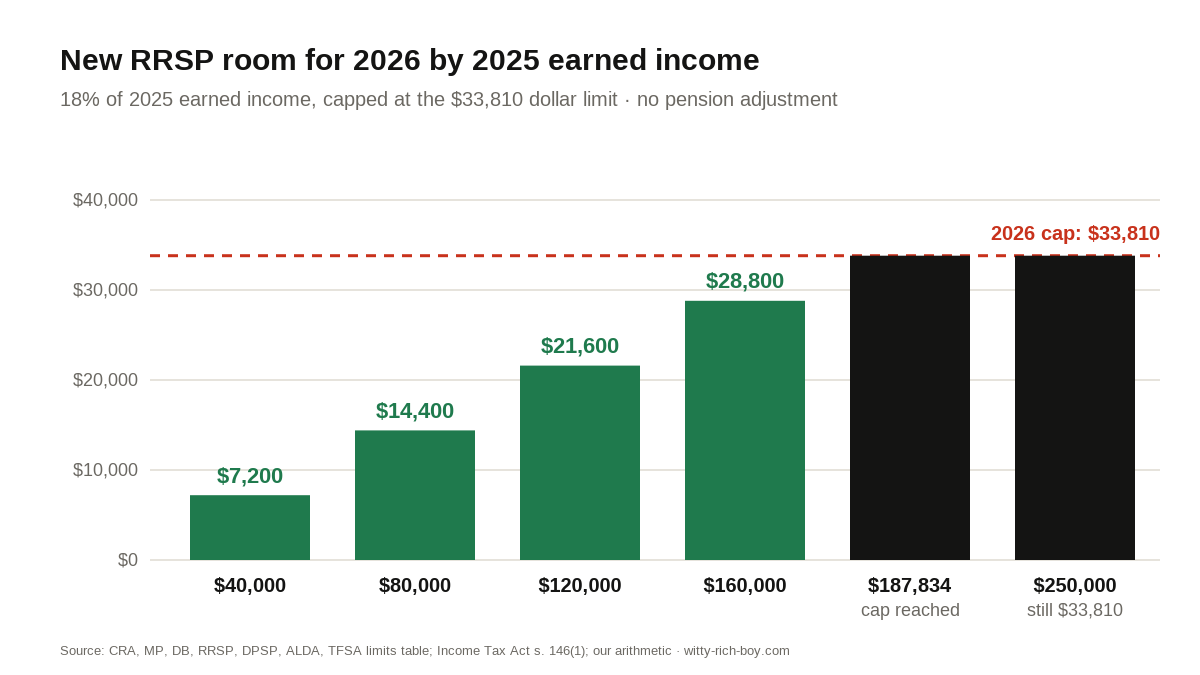
How much new RRSP room do you get at different incomes?
Below roughly $187,800 of 2025 earned income, your new room for 2026 is simply 18% of it; above that, it is $33,810 regardless of how much more you earn. The table assumes no workplace pension.
| 2025 earned income | 18% | New 2026 room |
|---|---|---|
| $40,000 | $7,200 | $7,200 |
| $60,000 | $10,800 | $10,800 |
| $80,000 | $14,400 | $14,400 |
| $120,000 | $21,600 | $21,600 |
| $160,000 | $28,800 | $28,800 |
| $187,834 | $33,810 | $33,810 (cap) |
| $250,000 | $45,000 | $33,810 (cap) |
Those are the amounts added for 2026 only. Most people’s deduction limit is larger, because of room carried forward.
How does a pension adjustment reduce your RRSP room?
A pension adjustment is the value of the retirement benefits you earned in a year under your employer’s registered pension plans (RPPs) and deferred profit-sharing plans (DPSPs). It appears in box 52 of your T4 (or box 034 of a T4A) and reduces your RRSP room for the following year.
For a defined contribution (money purchase) plan, the CRA’s Pension Adjustment Guide (T4084) says the pension credit includes all employer and member contributions for the year. Defined benefit plans use a formula based on the pension earned in the year instead.
Example: Marc earned $90,000 in 2025 and belongs to a defined contribution plan. He contributes 5% of salary and his employer matches 5%.
| Step | Amount |
|---|---|
| 18% of 2025 earned income ($90,000) | $16,200 |
| Below the $33,810 cap? | Yes |
| Less pension adjustment (5% + 5% of $90,000), T4 box 52 | −$9,000 |
| New RRSP room for 2026 | $7,200 |
Marc’s total tax-assisted saving for 2025–26 is still $16,200 — $9,000 through the pension and $7,200 through the RRSP. If he leaves the plan before vesting, a pension adjustment reversal can restore some of that room.
How does unused RRSP room carry forward?
Unused RRSP deduction room never expires. The CRA states that you can carry forward indefinitely any part of your deduction room accumulated after 1990 that you do not use, and it becomes part of the next year’s deduction limit. Room and contributions are separate: you can also contribute now and deduct later, for example in a higher-income year.
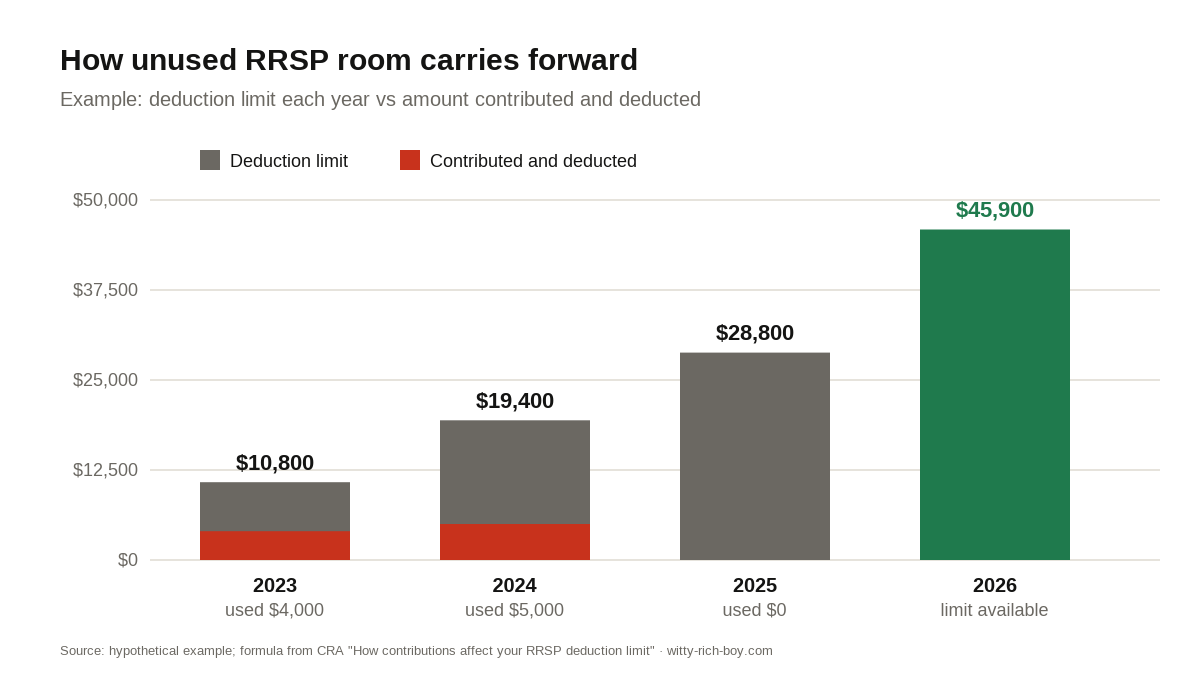
Example: Priya had no unused room at the end of 2022 and no pension plan. Her earned income was $60,000 in 2022, $70,000 in 2023, $80,000 in 2024 and $95,000 in 2025.
| Tax year | Carried in | New room (18% of prior-year income) | Deduction limit | Contributed and deducted | Carried out |
|---|---|---|---|---|---|
| 2023 | $0 | $10,800 | $10,800 | $4,000 | $6,800 |
| 2024 | $6,800 | $12,600 | $19,400 | $5,000 | $14,400 |
| 2025 | $14,400 | $14,400 | $28,800 | $0 | $28,800 |
| 2026 | $28,800 | $17,100 | $45,900 | — | — |
Priya’s 2026 deduction limit, $45,900, is well above the $33,810 headline figure. That is not an error: the dollar limit caps only the new room added each year, not the total.
How to find and check your RRSP deduction limit for 2026
The CRA prints your RRSP deduction limit statement on your latest notice of assessment, and shows it in My Account; see Where can you find your RRSP deduction limit. If your limit changes after the notice is issued, the CRA sends Form T1028 instead. A five-step check:
- Open your 2025 notice of assessment (issued after you filed for 2025). The “RRSP deduction limit for 2026” line is your starting figure.
- Check for unused contributions. The statement also lists contributions you made but have not yet deducted; they use up part of the limit even though they were never claimed.
- Add up contributions since 2 March 2026. Contributions in the first 60 days of 2026 (to 2 March 2026, as 1 March fell on a Sunday) may already be counted against your 2025 limit. Everything after that date counts against 2026.
- Include spousal RRSP contributions. Money you put into a spouse’s or common-law partner’s RRSP uses your limit, not theirs, per the CRA’s spousal RRSP page.
- Leave a margin. The $2,000 buffer is there for mistakes; aiming for it on purpose leaves no protection if a figure on your statement is later revised.
What happens if you over-contribute to an RRSP?
You pay a tax of 1% a month on unused contributions that exceed your RRSP deduction limit by more than $2,000. The charge is imposed by s. 204.1(2.1) of the Income Tax Act on the “cumulative excess amount”; the $2,000 buffer is built into that calculation, and the CRA confirms both on its deduction-limit page. The buffer is available only to people aged 18 or over.
Example: Daniel’s 2026 deduction limit is $10,000. In February 2026 he contributes $15,000.
| Amount | |
|---|---|
| Unused contributions above his deduction limit | $5,000 |
| Less the $2,000 buffer | −$2,000 |
| Taxable excess | $3,000 |
| Tax per month (1%) | $30 |
| If left in from February to December 2026 (11 months) | $330 |
Daniel would file Form T1-OVP and pay within 90 days after the end of the year. To stop the charge he can withdraw the excess — the withdrawal is taxable income, though an offsetting deduction may be available under s. 146(8.2) if conditions are met — or wait for new room to absorb it. The Minister can waive the tax if the excess arose from a reasonable error and steps are taken to remove it.
How do Home Buyers’ Plan and Lifelong Learning Plan withdrawals work?
Both let you take money out of an RRSP without paying tax, provided you repay it on schedule. The CRA says withdrawals under either plan are not included in income.
Home Buyers’ Plan (HBP)
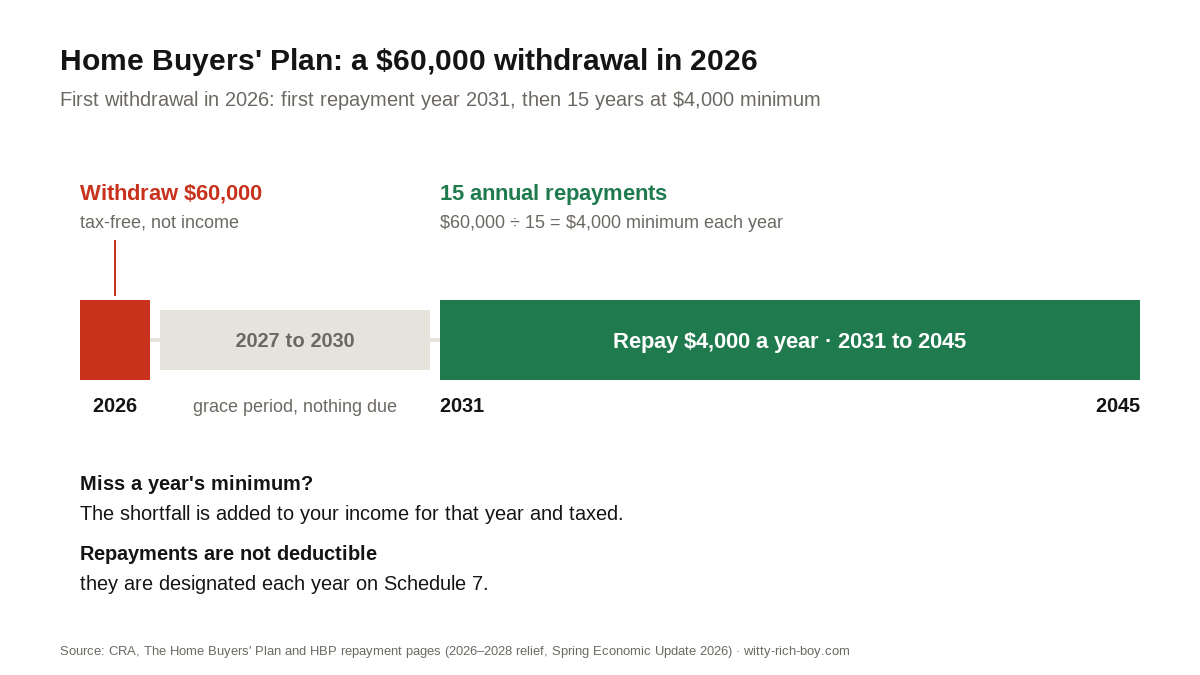
Under The Home Buyers’ Plan, a first-time home buyer can withdraw up to $60,000 to buy or build a qualifying home. You generally count as a first-time buyer if neither you nor your current spouse or common-law partner lived in a home that either of you owned in the current year or the four preceding calendar years. Your partner can withdraw for the same home.
Repayment runs for up to 15 years: the minimum each year is 1/15 of the amount withdrawn. When it starts depends on the year of your first withdrawal, per the CRA’s HBP repayment page:
| First HBP withdrawal | First repayment year |
|---|---|
| Before 2022 | Second year after the withdrawal |
| 2022 to 2025 | Fifth year after (e.g. 2022 → 2027) |
| 2026 to 2028 (relief extended, Spring Economic Update 2026) | Fifth year after (e.g. 2026 → 2031) |
Any year’s minimum you fail to repay is added to your income for that year. Repayments are designated on Schedule 7 and are not deductible. Watch the 89-day rule too: RRSP contributions made within 89 days before an HBP withdrawal may not be deductible.
The HBP and a First Home Savings Account (FHSA) can be used for the same qualifying home, the CRA confirms, provided you meet the conditions at each withdrawal.
Lifelong Learning Plan (LLP)
The Lifelong Learning Plan lets you withdraw up to $10,000 a year and $20,000 in total per participation period to finance full-time training or education for you or your spouse or common-law partner. You repay 1/10 a year over 10 years, starting in the second to fifth year after the first withdrawal, depending on how long the student stays in qualifying study.
Ordinary withdrawals
Any other RRSP withdrawal is taxable income. Under the CRA’s tax rates on withdrawals, the institution withholds 10% on amounts up to $5,000, 20% on amounts over $5,000 up to $15,000 and 30% over $15,000 (5%, 10% and 15% federal in Quebec, plus provincial tax). The withholding is a prepayment; the final tax depends on your marginal rate. And unlike a TFSA, the room used for the original contribution is gone for good.
RRSP vs TFSA vs FHSA: which should you fill first in 2026?
The deciding variable is your marginal tax rate now compared with the rate you expect when the money comes out. An RRSP deduction is worth your marginal rate times the contribution: a $10,000 deduction saves $2,000 at an illustrative 20% combined rate, $3,000 at 30%, $4,000 at 40% and $5,000 at 50%. That saving is repaid, in effect, at whatever rate applies on withdrawal. Rates below are illustrative, not actual federal-provincial brackets.
| Situation (illustrative rates) | RRSP | TFSA | FHSA | What the mechanics favour |
|---|---|---|---|---|
| 20% now, 20%+ in retirement | Saves 20%, taxed 20%+ later | Tax-free out, room returns | Deductible and tax-free if buying a first home | TFSA, or FHSA if buying |
| 30% now, ~20% in retirement | Saves 30%, taxed ~20% later | Neutral on rates | Best of both if buying | RRSP; FHSA first if buying |
| 45%+ now, any lower rate later | Largest gain from deduction | Useful overflow | Up to $8,000 a year | RRSP to limit, FHSA if eligible |
| Expect income-tested benefits in retirement | Withdrawals are income | Withdrawals not income | — | TFSA |
| First home within a few years | HBP up to $60,000, repayable | Flexible | $8,000 a year, $40,000 lifetime | FHSA, then HBP |
The FHSA alone gives both a deduction on the way in and a tax-free qualifying withdrawal, but it is capped at $8,000 a year and $40,000 for life. And an RRSP contribution need not be deducted in the year it is made. The TFSA side is covered in our guide to the TFSA contribution limit for 2026, which works through the same arithmetic.
Other countries cap tax-advantaged retirement saving very differently. A US employee can defer $24,500 into a 401(k) in 2026, a flat figure with no link to income; Australia’s super contribution caps also carry forward unused concessional room, but only for five years and only below a balance threshold. The UK’s ISA allowance does not carry forward at all. Investments held outside any registered account in Canada are taxed in the ordinary way; for digital assets, see our Canada crypto tax guide.
Key RRSP dates for 2026 and 2027
| Date | What happens |
|---|---|
| 2 March 2026 | Last day for contributions deductible for 2025 (1 March was a Sunday) |
| 31 December 2026 | Last day to contribute to your own RRSP if you turn 71 in 2026 |
| 1 March 2027 | Last day of the first 60 days of 2027: final contributions deductible for 2026 |
| 31 March 2027 | T1-OVP due, with tax, for a 2026 excess (90 days after year-end) |
| 2027 tax year | RRSP dollar limit rises to $35,390 (18% of 2026 earned income, capped) |
The 60-day window comes from the CRA’s guidance on line 20800: contributions made in 2026 or in the first 60 days of 2027 can be deducted for 2026. Day 60 of 2027 is Monday 1 March.
Questions readers ask
What is the RRSP deduction limit for 2026?
For 2026, new RRSP room is 18% of your 2025 earned income, up to a maximum of $33,810, minus your 2025 pension adjustment. Your full deduction limit adds any unused room carried forward from earlier years. The CRA prints the exact figure on your 2025 notice of assessment and in My Account.
How much do I need to earn to max out my RRSP in 2026?
You reach the $33,810 cap with $187,834 of earned income in 2025, because 18% of that figure is just over $33,810. Below it, your new room is simply 18% of earned income: $14,400 on $80,000, for example. A pension adjustment from a workplace plan reduces the result dollar for dollar.
What is the RRSP contribution deadline for the 2026 tax year?
Contributions made in the first 60 days of 2027 can be deducted on your 2026 return. In 2027 that window ends on Monday 1 March 2027. Contributions made in that window can instead be deducted in a later year, and any contributions also made during 2026 itself count towards the same deduction limit.
Does unused RRSP room carry forward?
Yes. Under the CRA's rules any RRSP deduction room accumulated after 1990 that you do not use can be carried forward indefinitely and becomes part of the next year's deduction limit. Separately, contributions you make but do not deduct can be claimed in a later year, for instance one in which your marginal tax rate is higher.
What is the penalty for over-contributing to an RRSP?
You pay 1% a month on unused contributions that exceed your RRSP deduction limit by more than $2,000, under Part X.1 of the Income Tax Act (s. 204.1). A $5,000 over-contribution therefore leaves a $3,000 taxable excess and costs $30 a month. You report it on Form T1-OVP and pay within 90 days after the end of the year.
How much can I take out under the Home Buyers' Plan?
Up to $60,000 in total, tax-free, for a qualifying first home. Your spouse or common-law partner can also participate for the same home. The CRA says first withdrawals made from 2026 to 2028 get a five-year grace period, so a 2026 withdrawal is first repaid in 2031, over up to 15 years.
Does a pension plan reduce my RRSP room?
Yes. The pension adjustment, shown in box 52 of your T4, is the value of benefits you earned in the year under your employer's registered pension plans and DPSPs. It is subtracted from the next year's new RRSP room. In a defined contribution plan, it is broadly the total of your and your employer's contributions.
Can I contribute to a spousal RRSP after age 71?
Yes, if your spouse or common-law partner is 71 or younger on 31 December of the year you contribute and you still have deduction room. Your own RRSP must stop accepting contributions on 31 December of the year you turn 71. Contributions to a spousal RRSP use your deduction limit, not your spouse's.
Was this guide useful?
Thanks — your answer helps us decide what to cover next.
Sources
- MP, DB, RRSP, DPSP, ALDA, TFSA limits, YMPE and the YAMPE (Canada Revenue Agency)
- How contributions affect your RRSP deduction limit (Canada Revenue Agency)
- Where can you find your RRSP deduction limit (Canada Revenue Agency)
- Line 20800 — RRSP deduction (Canada Revenue Agency)
- The Home Buyers' Plan (Canada Revenue Agency)
- How to repay the amounts withdrawn from your RRSPs under the HBP (Canada Revenue Agency)
- Lifelong Learning Plan withdrawals (Canada Revenue Agency)
- Tax rates on withdrawals (Canada Revenue Agency)
- Contributing to your spouse's or common-law partner's RRSPs (Canada Revenue Agency)
- Income Tax Act, section 146 — Registered retirement savings plans (Justice Laws)
General information, not tax or legal advice. Rules change — check the official source or a licensed adviser before acting.