France · Crypto
France crypto tax (2026): 31.4% flat tax and form 2086
France crypto tax 2026: gains pay the 31.4% flat tax (12.8% income tax plus 18.6% social levies), sales under €305 a year are exempt and swaps are deferred.

The short answer
- Crypto gains of private investors pay the 31.4% flat tax (PFU): 12.8% income tax plus 18.6% social levies, after the LFSS 2026 raised the CSG from 9.2% to 10.6% for 2025 income; it was 30% before.
- Taxpayers whose taxable disposals total €305 or less in the year is exempt. The test is on sale proceeds, not gains, and above it every euro of gain is taxed.
- Crypto-to-crypto swaps with no cash leg are deferred under art. 150 VH bis CGI; tax arises only on exit to euros, goods or services.
- Gains use a portfolio formula: sale price − (total acquisition cost × sale price ÷ global portfolio value). Selling €5,000 from a €25,000 portfolio that cost €10,000 gives a €3,000 gain and €942 of tax.
- Since 2023 you can opt for the progressive scale instead (box 3CN); the option covers all the household's crypto gains and the 18.6% social levies stay due.
- Accounts with platforms abroad go on form 3916-bis: the fine is €750 per undeclared account, €1,500 where its value exceeded €50,000 in the year.
In force: Gains realised in 2025 (declared in spring 2026) and in 2026 (declared in spring 2027) · art. 150 VH bis and 200 C CGI · social levies of 18.6% from 2025 income under art. 12 LFSS 2026 (Law 2025-1403 of 30 December 2025) · art. 150 VH bis in its version in force from 1 July 2026 (ordonnance 2024-936) · NFT carve-out to art. 150 VH ter for disposals from 1 January 2026 (Law 2026-534, art. 91)
French residents pay a 31.4% flat tax (PFU) on crypto gains: 12.8% income tax plus 18.6% social levies, up from 30% before the 2026 CSG increase. Sales totalling €305 or less a year are exempt, crypto-to-crypto swaps are deferred, and gains are calculated with a portfolio formula on form 2086.
France gave crypto its own article of the tax code in 2019. Article 150 VH bis of the Code général des impôts (CGI) sets a flat rate, a tiny exemption threshold, a generous deferral on swaps and an unusual whole-portfolio method of computing gains. Two things moved recently: the social levies rose by 1.4 points, taking the headline rate from 30% to 31.4%, and the article itself was reworded on 1 July 2026 as French law adapted to the EU’s Markets in Crypto-Assets Regulation (MiCA). Below are the rules for gains realised in 2025 and 2026, each tied to the CGI or to the tax authority’s guidance, with worked numbers, a declaration walk-through and a comparison with Italy, Spain, Germany and Portugal.
How is crypto taxed in France?
As a capital gain on movable property, taxed separately from salary at a flat rate. Article 150 VH bis CGI covers gains made by individuals tax-domiciled in France when they dispose of crypto-assets for consideration, directly or through an intermediary. A taxable disposal is a sale for euros or another legal-tender currency, or an exchange for goods or services. The official guidance, impots.gouv.fr’s page on declaring gains on digital assets, says gains made while managing private wealth pay the flat tax “quel que soit le nombre de transactions” — whatever the number of trades.
The wording changed in 2026. In the version of article 150 VH bis in force from 1 July 2026, under ordonnance 2024-936 on markets in crypto-assets, the article speaks of crypto-actifs rather than actifs numériques. Separately, article 91 of Law 2026-534 of 25 June 2026 moved gains on unique, non-fungible crypto-assets (NFTs) into a new article 150 VH ter for disposals from 1 January 2026. This guide covers fungible coins and tokens.
| Event | Tax treatment | Legal basis |
|---|---|---|
| Sale of crypto for euros | Taxable disposal, flat tax 31.4% | Art. 150 VH bis, art. 200 C CGI |
| Paying for goods or services in crypto | Taxable disposal | Art. 150 VH bis CGI |
| Swap for another crypto-asset, no cash leg | Deferred, not taxed in the year | Art. 150 VH bis II A CGI |
| Swap into a stablecoin | Deferred (a stablecoin is a crypto-asset) | Art. 150 VH bis II A CGI |
| Total taxable proceeds of €305 or less in the year | Exempt | Art. 150 VH bis CGI |
| Trading in conditions analogous to a professional | Non-commercial profits (BNC), progressive scale | Art. 92 CGI |
| Gain on a unique NFT, disposed of from 2026 | Separate regime | Art. 150 VH ter CGI |
There is no holding-period relief: a coin held ten years pays the same rate as one held ten days.
What is the crypto flat tax rate in 2026: 30% or 31.4%?
31.4%: 12.8% income tax plus 18.6% social levies. For crypto, the flat rate had been 30% since the regime began in 2019, made up of 12.8% income tax under article 200 C CGI and 17.2% of social levies. Article 12 of the 2026 social security financing law (LFSS 2026, Law 2025-1403 of 30 December 2025) raised the CSG on capital income from 9.2% to 10.6%. The income tax part did not move.
According to service-public.gouv.fr (F2329), the 18.6% now breaks down as CSG 10.6%, CRDS 0.5% and solidarity levy 7.5%. A short list of income, including property income and some life insurance products, stays at 17.2%; crypto gains are not on it. The tax authority’s “principales nouveautés” brochure for 2025 income applies the increase from 2025 income, and the crypto guidance on impots.gouv.fr gives 31.4% (12.8% + 18.6%). In practice, gains realised in 2025 and declared in spring 2026 were the first to pay 31.4%.
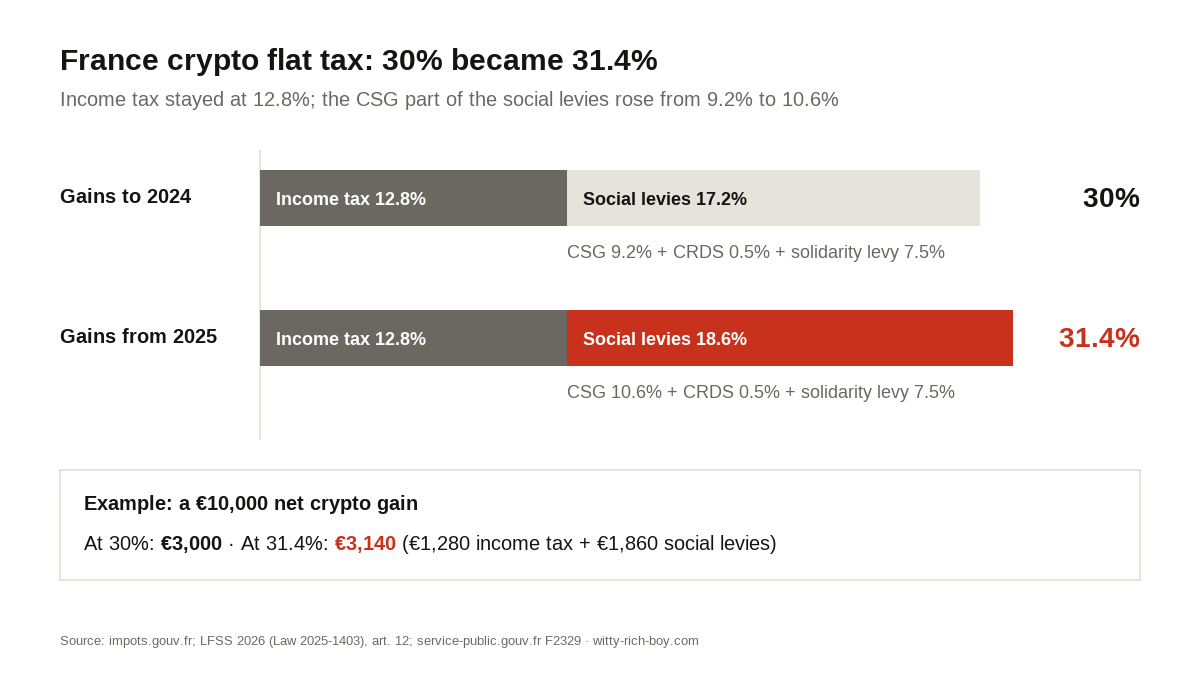
| Net crypto gain | Tax at 30% (gains to 2024) | Tax at 31.4% (from 2025) | Of which income tax 12.8% | Of which social levies 18.6% |
|---|---|---|---|---|
| €1,000 | €300 | €314 | €128 | €186 |
| €3,000 | €900 | €942 | €384 | €558 |
| €10,000 | €3,000 | €3,140 | €1,280 | €1,860 |
| €50,000 | €15,000 | €15,700 | €6,400 | €9,300 |
Is there a tax-free threshold for crypto in France?
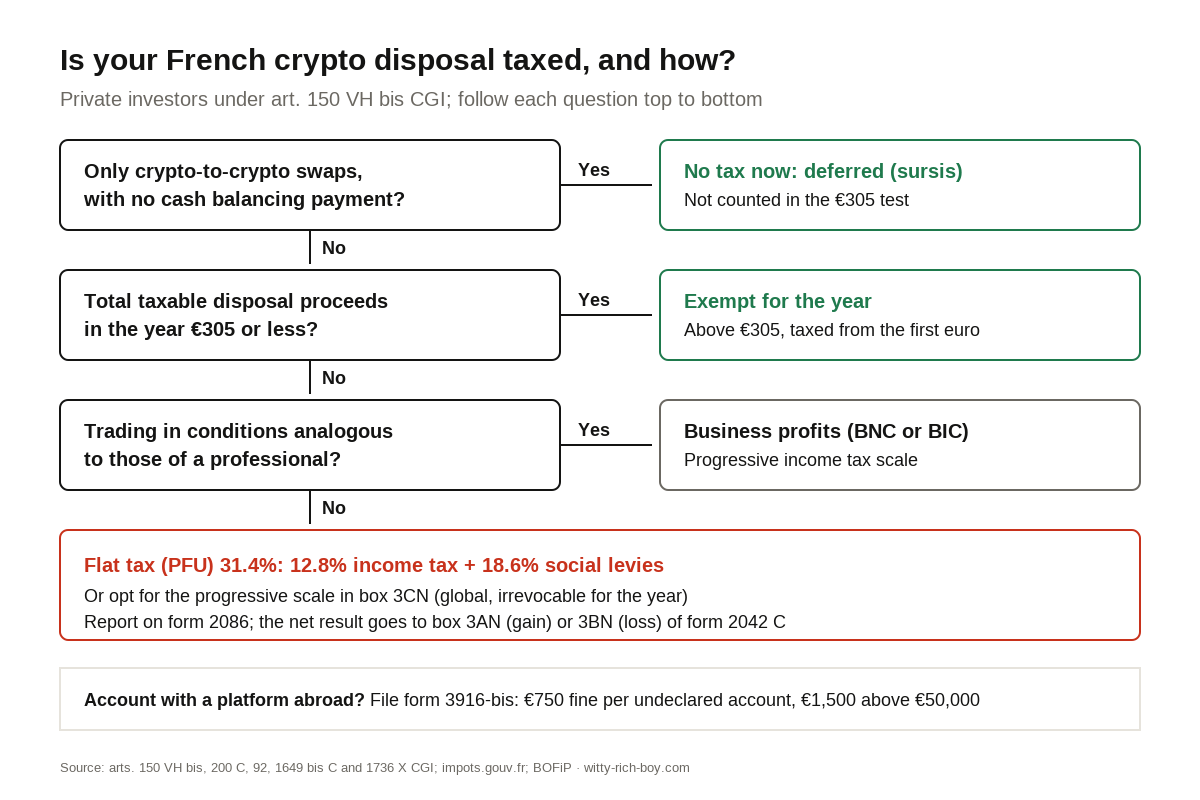
Yes, but it is small and works on proceeds, not gains. Article 150 VH bis exempts taxpayers whose total sale prices from taxable crypto disposals in the year do not exceed €305. Swaps under deferral do not count towards the total. Above €305, the whole gain is taxed from the first euro: it is a threshold, not an allowance.
Example: Hugo sells crypto for €300 in total during 2026. He owes nothing. Had he sold for €310, from a portfolio worth €3,100 just before the sale that had cost him €1,000 in all, his gain would be €310 − (€1,000 × 310 ÷ 3,100) = €210, and the tax €65.94.
Are crypto-to-crypto swaps taxable in France?
No, not when they happen. Article 150 VH bis II A states that the regime does not apply, for the year of the exchange, to opérations d’échange sans soulte entre crypto-actifs. A soulte is a cash balancing payment; an exchange with no cash leg is fully deferred (sursis d’imposition). That includes swaps into stablecoins, because a stablecoin is itself a crypto-asset. The gain built up across the swaps is taxed only when you exit to euros, goods or services.
Example: Léa buys bitcoin for €4,000, swaps it for ether when it is worth €9,000, then swaps the ether for a stablecoin worth €10,000. Neither swap is taxed. When she sells the stablecoin for €10,000 — her whole portfolio — the formula gives a gain of €6,000 and tax of €1,884.
Most large tax systems do the opposite; our comparison of whether crypto swaps are taxable shows the UK, US, Germany and Japan taxing each swap, and Spain treating every swap as a taxable barter.
How do you calculate the gain with the 2086 portfolio formula?
With one formula applied to the whole portfolio, not coin by coin. Article 150 VH bis III defines the gain on each taxable disposal as:
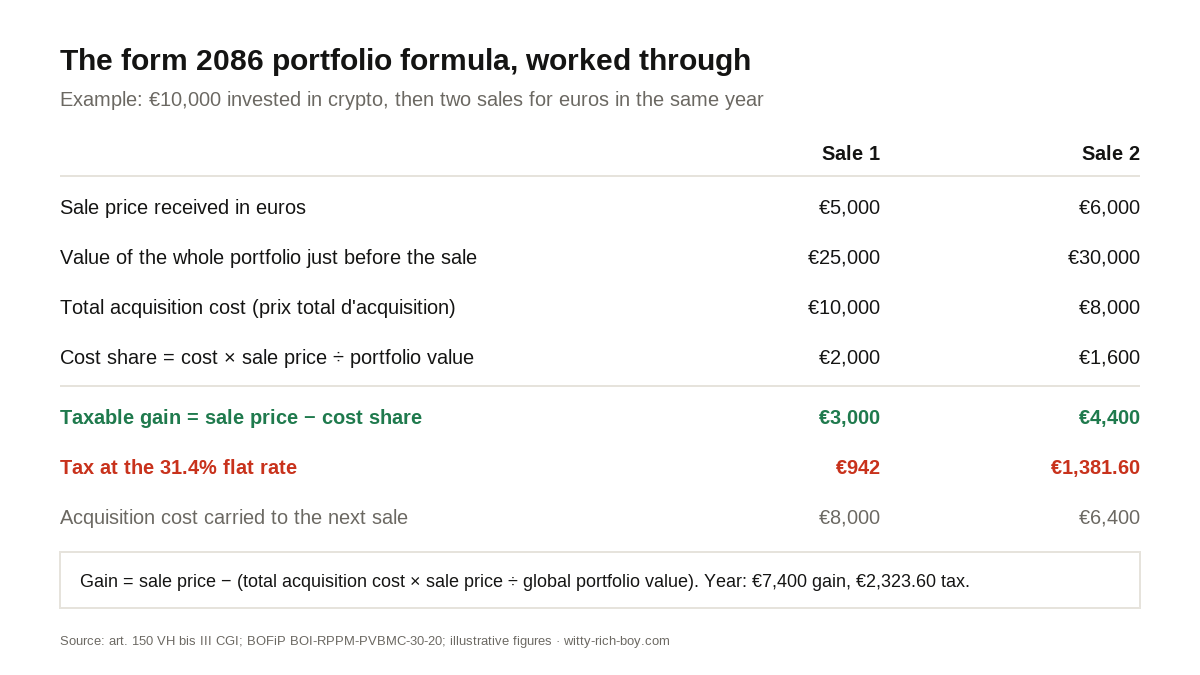
Gain = sale price − (total acquisition cost × sale price ÷ global portfolio value)
The BOFiP commentary BOI-RPPM-PVBMC-30-20 defines each term:
- Sale price (prix de cession): the amount received in legal-tender currency, or the value of the goods or services obtained.
- Total acquisition cost (prix total d’acquisition): everything paid in money or goods to acquire crypto, including cash balancing payments made, reduced by balancing payments received in earlier swaps and by the cost share already used in earlier taxable disposals.
- Global portfolio value (valeur globale du portefeuille): the value, at the moment of the taxable disposal, of all crypto-assets held just before it — including coins on foreign platforms and in offline wallets.
The BOFiP’s own example: €1,000 invested, a portfolio worth €1,200, a sale for €450. The gain is €450 − (€1,000 × 450 ÷ 1,200) = €75, and €375 of cost is used up.
Example: Claire has invested €10,000 in crypto over the years. In March her whole portfolio is worth €25,000 and she sells €5,000 for euros. The cost share is €10,000 × 5,000 ÷ 25,000 = €2,000, so her gain is €3,000 and the tax €942 (€384 income tax, €558 social levies). Her acquisition cost falls to €8,000. In September the portfolio is worth €30,000 and she sells €6,000: cost share €1,600, gain €4,400, tax €1,381.60, and €6,400 of cost carries forward. Her year: €7,400 of gains and €2,323.60 of tax.
What happens to losses?
A disposal can produce a loss when the portfolio is worth less than its remaining cost. According to impots.gouv.fr, a net loss can be set only against crypto gains realised in the same year; it does not reduce other capital gains and cannot be carried forward. That makes France an outlier: Italy allows four years of carry-forward. Our guide to crypto tax-loss harvesting explains how other countries treat realised losses.
Should you opt for the progressive scale instead of the flat tax?
Only if your household’s marginal income tax rate is below 12.8%. For disposals from 1 January 2023, article 79 of the 2022 finance law lets you choose the progressive income tax scale (barème) for crypto gains, as the BOFiP update ACTU-2024-00078 records. Under article 200 C CGI the option is express and irrevocable, made when filing, and global: it covers all the household’s crypto gains for the year. You tick box 3CN of form 2042 C. impots.gouv.fr adds that it is independent of the separate option for dividends and interest, and that the social levies stay due.
| Claire’s €3,000 gain | Income tax | Social levies 18.6% | Total |
|---|---|---|---|
| Flat tax (PFU) | €384 (12.8%) | €558 | €942 |
| Progressive scale, 11% marginal rate (illustrative) | €330 | €558 | €888 |
| Progressive scale, 0% marginal rate (illustrative) | €0 | €558 | €558 |
The scale figures are simplified: a large gain can push part of the income into a higher bracket, so run the official simulator before ticking the box.
When does crypto trading count as professional income?
Rarely. The 2022 finance law (art. 70) added a provision to article 92 CGI taxing as non-commercial profits (BNC) the purchase, sale and exchange of crypto-assets carried out in conditions analogous to those of a professional, even when it is not the taxpayer’s job. The BOFiP commentary BOI-BNC-CHAMP-10-10-20-40 says this applies only in exceptional cases, judged on a set of indicators such as mastery of specialised techniques and the number and sophistication of operations. Such profits pay the progressive scale, not the flat tax. Where buying and selling crypto is the taxpayer’s actual trade, business profit (BIC) rules apply instead.
The same BOFiP chapter says crypto received in return for taking part in creating or running a blockchain — mining — can fall under article 92 as BNC income. We found no primary source setting out a specific rule for staking rewards, so we do not state one.
How do you declare crypto on form 2086?
Online, in the annex to your income tax return. Form 2086 lists each taxable disposal of the year, and the net result flows to box 3AN (gain) or 3BN (loss) of form 2042 C.
- List every taxable disposal of the year: sales for euros and payments for goods or services. Leave out crypto-to-crypto swaps without a cash leg.
- Check the €305 test: add up the sale prices. At €305 or less, no tax is due.
- Record the portfolio value at the moment of each disposal, across every platform and wallet you own.
- Track the total acquisition cost, reducing it after each disposal by the cost share used.
- Apply the formula on form 2086, line by line, for each disposal; the 2026 form and notice (16043*07, for 2025 gains) lays out the columns.
- Carry the net result to box 3AN or 3BN; online, the 2086 annex fills it automatically. On paper, attach form 2086 to the return.
- Choose the scale if it suits you by ticking box 3CN; otherwise the 31.4% flat tax applies.
- File form 3916-bis for each crypto account opened, held, used or closed abroad during the year.
What are the form 3916-bis penalties?
Article 1649 bis C CGI requires residents to declare every account of crypto-assets opened, held, used or closed with a company, institution or organisation established abroad, on form 3916-bis by the income tax return deadline, as impots.gouv.fr explains. Under article 1736 X CGI the fine is €750 per undeclared account, or €125 per omission or inaccuracy, capped at €10,000 per return. It rises to €1,500 and €250 where the account’s value exceeded €50,000 at any time in the year. Newer wording of article 1736 counts per wallet and per unique NFT, so check the version that applies to your year.
What changes with DAC8, and when are the deadlines?
From 2026, platforms report you automatically. France transposed the EU’s DAC8 directive and the OECD’s CARF in articles 1649 AC bis to 1649 AC sexies CGI, created by Law 2025-127 of 14 February 2025. Decree 2025-1276 of 19 December 2025 makes crypto-asset service providers collect users’ tax residence and report transactions carried out from 1 January 2026, with the first returns due in 2027 (the tax authority’s CARF/DAC8 page holds the technical specifications). Our DAC8 crypto reporting guide covers what is reported and when.
| Step | Date | Source |
|---|---|---|
| Online return for 2025 income opened | 9 April 2026 | impots.gouv.fr |
| Paper return deadline (2025 income) | 19 May 2026 | impots.gouv.fr |
| Online deadline, départements 01–19 and non-residents | 21 May 2026 | impots.gouv.fr |
| Online deadline, départements 20–54 | 28 May 2026 | impots.gouv.fr |
| Online deadline, départements 55–976 | 4 June 2026 | impots.gouv.fr |
| DAC8 reporting covers transactions from | 1 January 2026 | Decree 2025-1276 |
| Gains realised in 2026 declared | Spring 2027, dates not yet published | — |
The 2026 dates come from impots.gouv.fr’s filing deadline page; form 3916-bis follows the same deadline as the return.
How does France compare with Italy, Spain, Germany and Portugal?
France sits in the middle on rate, but is the strictest on losses and, with Portugal, among the most lenient on swaps.
| France | Italy | Spain | Germany | Portugal | |
|---|---|---|---|---|---|
| Rate on gains (2026) | 31.4% flat | 33% flat | 19–30% savings scale | Personal rate if held ≤ 1 year | 28% if held < 365 days |
| Long-term relief | None | None | None | Tax-free after one year | Excluded after 365 days |
| Small-gain rule | Exempt if proceeds ≤ €305 | None since 2025 | None | Exempt if short-term gains < €1,000 | None |
| Crypto-to-crypto swaps | Deferred | Not taxed between like assets | Taxable | Taxable | Deferred |
| Loss carry-forward | None | Up to 4 years | 4 years (25% offset rule) | 1 year back, unlimited forward, short-term losses only | 5 years, only if income is aggregated |
For a French resident the practical lesson is that swaps cost nothing until you exit, but every exit year stands alone. Gains and losses must meet in the same calendar year, and the portfolio formula ties each sale to the value of everything you hold, so a precise record of portfolio values on each sale date is the one document that cannot be rebuilt later.
Questions readers ask
How much tax do you pay on crypto in France?
Private investors pay the flat tax (PFU) of 31.4% on net crypto gains: 12.8% income tax plus 18.6% social levies. The rate applies whatever the number of transactions and however long you held the coins. A €10,000 net gain therefore costs €3,140. You can opt for the progressive income tax scale instead, but the social levies remain due either way.
Why is the French crypto flat tax 31.4% and not 30%?
Article 12 of the 2026 social security financing law (Law 2025-1403 of 30 December 2025) raised the CSG on most capital income from 9.2% to 10.6%. Total social levies went from 17.2% to 18.6%, and with 12.8% income tax the flat rate became 31.4%. The tax authority applies the new rate to crypto gains from 2025 income, declared in spring 2026.
Is there a tax-free allowance for crypto in France?
There is a threshold, not an allowance. Under article 150 VH bis CGI, you are exempt when the total sale prices of its taxable crypto disposals in the year do not exceed €305. The test is on proceeds, not gains, and swaps under deferral are left out. Once total proceeds pass €305, the gain is taxed from the first euro.
Are crypto-to-crypto swaps taxable in France?
No, not when they happen. Article 150 VH bis CGI excludes exchanges between crypto-assets with no cash balancing payment (soulte) from the year's taxable disposals. Swapping bitcoin for ether or for a stablecoin is deferred; the accumulated gain is taxed when you sell for euros or use crypto to pay for goods or services.
How do you calculate crypto gains on form 2086?
Each taxable disposal uses the portfolio formula of article 150 VH bis: sale price minus total acquisition cost multiplied by the sale price divided by the global value of the whole crypto portfolio just before the sale. The cost share used is then deducted from the total acquisition cost carried to the next sale. Form 2086 asks for each figure, disposal by disposal.
Can crypto losses be carried forward in France?
No. According to impots.gouv.fr, a net loss on crypto disposals can only be set against crypto gains of the same type realised in the same year. It cannot reduce gains on shares or other assets, salary income or future years' crypto gains. Timing disposals within one calendar year therefore matters more in France than in countries that allow carry-forward.
Do I need to declare a foreign crypto exchange account in France?
Yes. Article 1649 bis C CGI requires residents to declare every crypto account opened, held, used or closed with a platform established abroad, on form 3916-bis filed with the income tax return. Under article 1736 X CGI the fine is €750 per undeclared account, or €1,500 where the account's value exceeded €50,000 at any time in the year.
When is crypto trading taxed as professional income in France?
Only in exceptional cases. Since the 2022 finance law, article 92 CGI taxes as non-commercial profits (BNC) operations carried out in conditions analogous to those of a professional, judged on indicators such as specialised techniques and the number and sophistication of operations. Those profits are taxed at the progressive scale rather than the flat tax. Where trading is the taxpayer's actual business, business profit (BIC) rules apply.
Was this guide useful?
Thanks — your answer helps us decide what to cover next.
Sources
- Comment déclarer les plus ou moins values sur cessions d'actifs numériques ? (impots.gouv.fr)
- Formulaire n° 2086 — Déclaration des plus ou moins-values de cessions d'actifs numériques (impots.gouv.fr)
- Form 2086 (16043*07) — plus ou moins-values réalisées en 2025, with notice (impots.gouv.fr, PDF)
- Article 150 VH bis, Code général des impôts (Légifrance)
- BOI-RPPM-PVBMC-30-20 — Cession d'actifs numériques à titre occasionnel, base d'imposition (BOFiP)
- ACTU-2024-00078 — Option pour le barème progressif sur les plus-values d'actifs numériques (BOFiP)
- BOI-BNC-CHAMP-10-10-20-40 — Activités dont la classification fiscale des revenus a donné lieu à des solutions (BOFiP)
- Modalités de déclaration des comptes d'actifs numériques détenus à l'étranger (impots.gouv.fr)
- Social security contributions (CSG, CRDS...) on wealth and investment income — F2329 (service-public.gouv.fr)
- Transfert d'informations en application des dispositifs CARF/DAC8 (impots.gouv.fr)
General information, not tax or legal advice. Rules change — check the official source or a licensed adviser before acting.